|
In This Issue
Health Policy in Action: Unlocking the Potential of Generic Drug Repurposing
Upcoming Events: Meeting the Moment: Reforming Accountable Care to Achieve the Promise of Better Health and Health Care
People: Mark McClellan
| | |
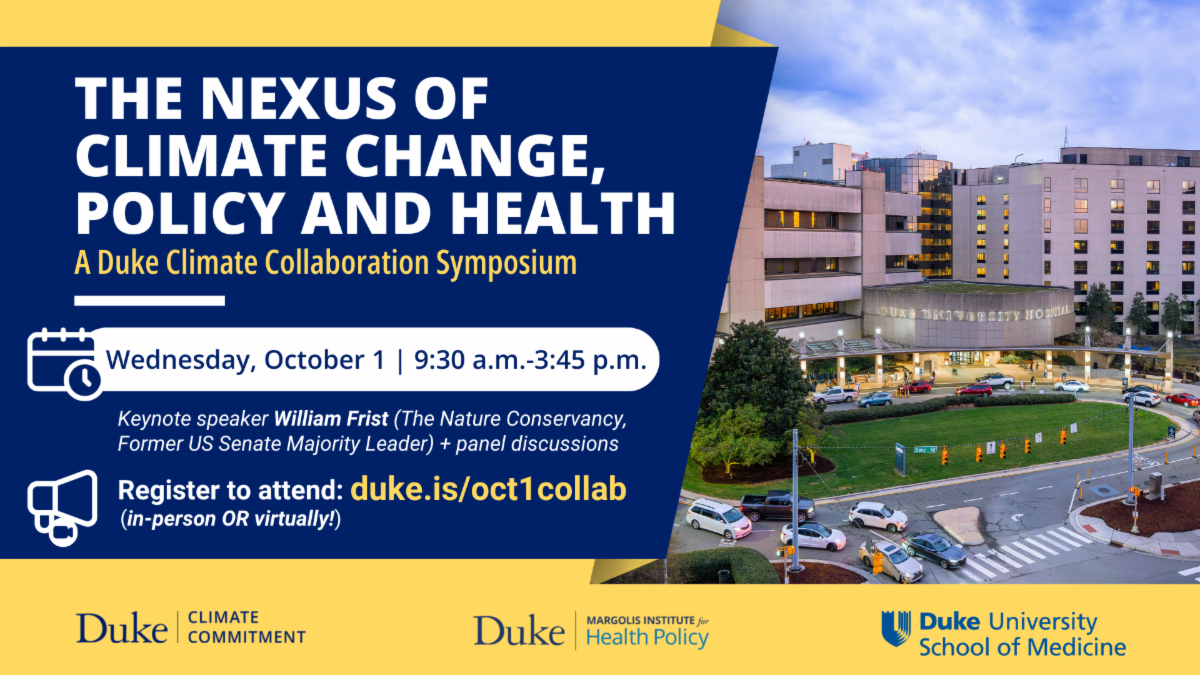
The Nexus of Climate Change, Policy, and Health: A Duke Climate Collaboration Symposium
Climate change has many implications for health and health care. It exacerbates many existing health vulnerabilities and presents new ones, and health systems need to evolve to keep pace. Meanwhile, as one of the largest and fastest-growing sectors of the economy, health care has been a major contributor to greenhouse gas emissions. During this event, speakers explored how policy reform can yield diverse “co-benefits”: health system sustainability, healthier patients and communities, greater operational efficiency, and a more resilient health care ecosystem.
Duke-Margolis and the Duke University School of Medicine co-hosted this event as the fourth installment in the Duke Climate Collaboration Symposia. Several Duke-Margolis researchers and Core Faculty members spoke at this event, including Mark McClellan, Stephen Colvill, Mike Pignone, and Rebecca Whitaker.
Learn more here.
| | |
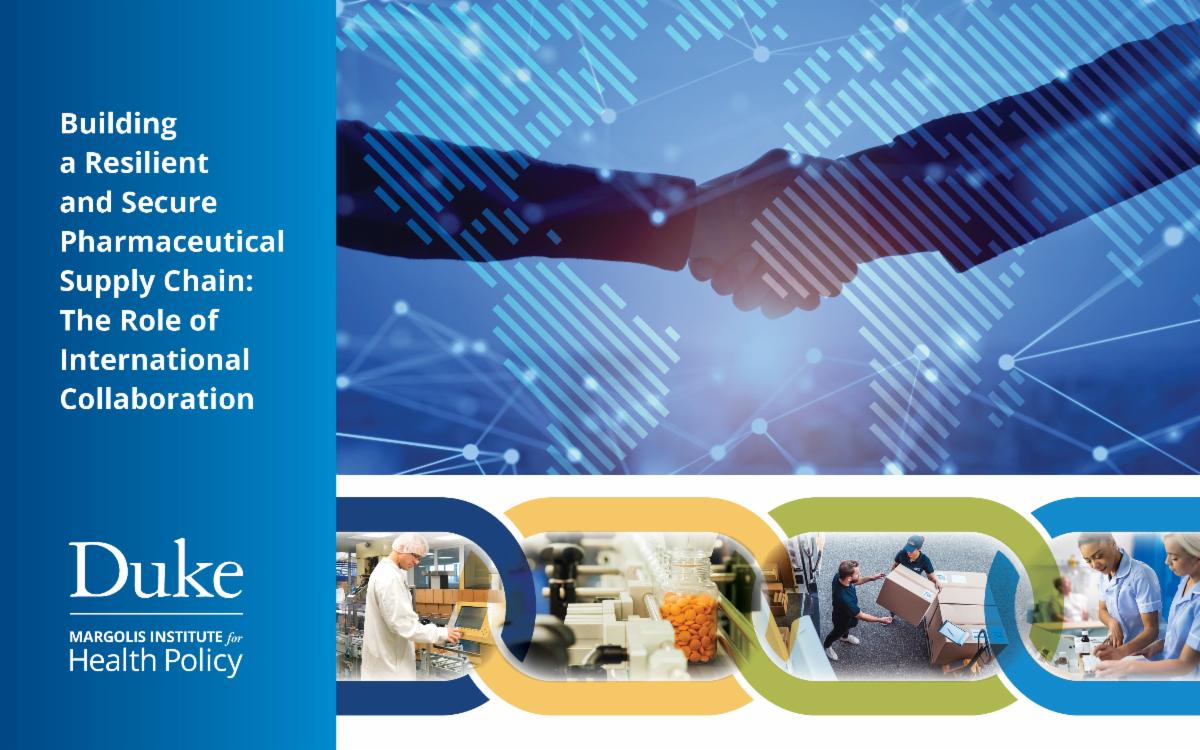
Building a Resilient and Secure Pharmaceutical Supply Chain
Following up on a white paper published last year, Duke-Margolis researchers Thomas Roades, Stephen Colvill, Madi Cordle, and Chan Harjivan co-authored a new white paper to further discuss opportunities to improve drug supply chain resilience. The medicines that Americans rely on every day are often products of complex global supply chains, which offer great efficiency but also come with challenges, such as geopolitical risks and divergent international regulations. This paper provides recommendations for policymakers to pursue international collaborations to build resilience as a complement to onshoring efforts. Such partnerships can help ensure an efficient and secure supply chain that gets patients the medicines they need. Read more here.
| |
Unlocking the Potential of Generic Drug Repurposing
Generic drug repurposing has the potential to meet unmet patient needs using preexisting treatments, versus going through the lengthy process to create novel drugs. Still, some barriers exist to pursuing regulatory approval for new uses of generic drugs. Policy Analyst Mia Williams, Policy Research Associate Beth Boyer, and Visiting Fellow Tanisha Carino have co-authored a white paper that outlines key policy recommendations to address these challenges. Read more here.
| | |
Now More than Ever: Addressing the Global Imperative of Mental Health Equity
October 7, 2025 | 8:30 am – 5:00 pm ET
Location: Penn Pavilion, Duke University Campus, or Virtual via Zoom
The Duke Center of Global Mental Health is hosting their 2025 conference to explore ways to address mental health disparities locally and globally. Registration is free and all are welcome to attend. Learn more and register here.
| |
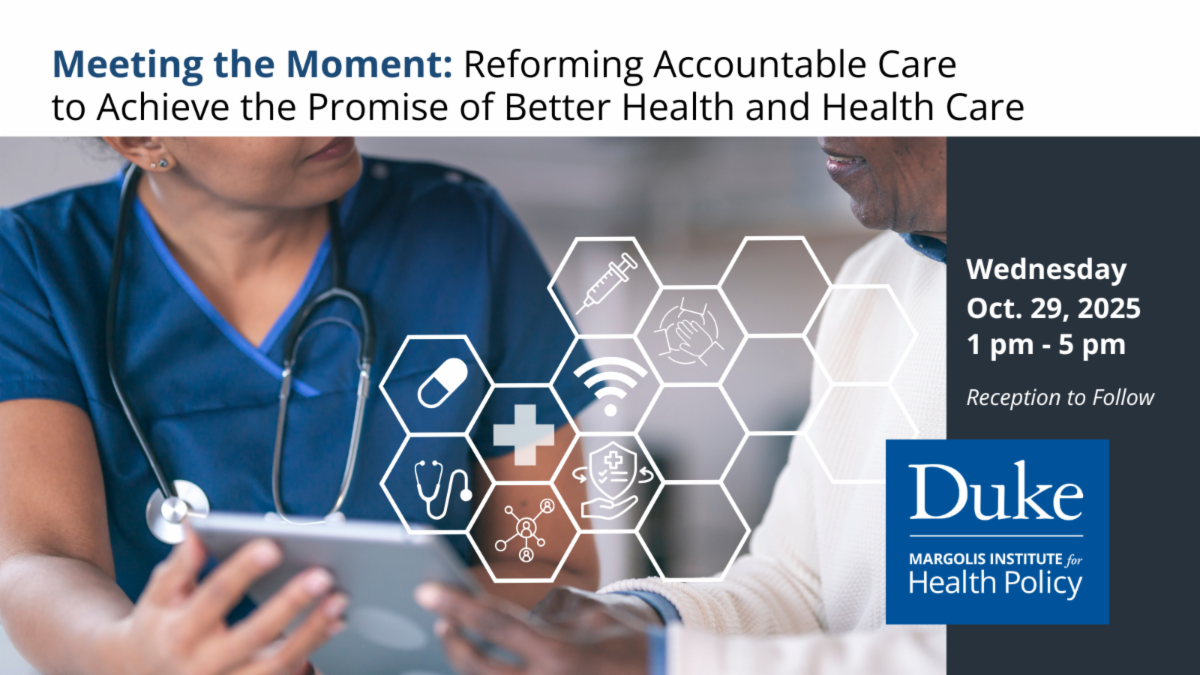
Meeting the Moment: Reforming Accountable Care to Achieve the Promise of Better Health and Health Care
October 29, 2025 | 1:00 – 5:00 pm ET
Location: Convene, Washington, DC or Virtual via Zoom
Accountable care—centered on personalized, coordinated, and whole-person care—is no longer just a vision for the future of the American Health system: it is here, now. Join us next month for an event that will launch the new West Health Accelerator at Duke-Margolis. The event is open to the public and will feature panels with top health policy experts and leaders. More details, including an agenda and speaker list, are coming soon. Join us as we outline the vision and priorities for accountable care reform and chart a path toward delivering better health and better care for all.
Learn more and register here.
| | |
On the RISE: Controls in Rare Disease Clinical Trials for Small and Diminishing Populations
This hybrid public workshop was co-convened by Duke-Margolis and the U.S. Food and Drug Administration (FDA) Rare Disease Innovation Hub under a cooperative agreement with the FDA. Speakers explored considerations when choosing a control in rare disease clinical trials, discussed existing and innovative control options internal and external to the trial, and identified how these controls can be used to generate evidence that supports regulatory decision-making.
Bloomberg Law reported on this event in an article focusing on the FDA’s new approval pathway for rare disease treatments, which is designed to bypass certain clinical trial requirements and make rare disease drug approvals easier.
Endpoints News also wrote an article on this topic, featuring the Duke-Margolis event.
Watch the recording here.
| |
Lessons Learned from the Chemistry, Manufacturing, and Controls (CMC) Development and Readiness Pilot (CDRP) Program
Duke-Margolis hosted a virtual workshop in collaboration with the FDA that delved into the challenges and strategies for expedited chemistry, manufacturing, and controls (CMC) development. The meeting featured perspectives from both industry leaders and FDA regulators, who discussed best practices and lessons learned from the CMC Development and Readiness Pilot program.
Watch the recording here.
| |
Assessing Novel Efficacy Endpoints in Ophthalmologic Rare Disease Drug and Biologics Development
Under a cooperative agreement with the FDA, Duke-Margolis convened a public workshop focused on novel efficacy endpoints used in interventional clinical trials for drugs and biological products intended for patients with severe vision loss. In particular, the workshop focused on full-field stimulus threshold testing and ellipsoid zone data. Researchers, clinicians, and others discussed evidence and data that may support the use of these tools in regulatory decision-making, and explored current limitations and potential strategies to advance the use and implementation of these tools.
Watch the recording here.
| | |
Regulatory Submissions with Real-World Evidence: Successes, Challenges, and Lessons Learned
The FDA, in collaboration with Duke-Margolis, hosted a hybrid public meeting on the use of real-world evidence (RWE) in regulatory submissions. Drawing on real case examples to illustrate the practical application of RWE in regulatory submissions, experts discussed rationales for particular approaches, shared lessons learned to inform future efforts, and highlighted key challenges.
Regulatory Focus reported on this event in an article that described some of the main reasons the FDA has rejected applicants from participating in their Advancing Real-World Evidence Program.
Watch the recording here.
| | |
The Friends of Cancer Research awarded Mark McClellan the Marlene A. Malek Public Service Award for his "exceptional leadership and enduring contributions to public health.” Mark and Founding Donor Bob Margolis both offered remarks in this video on the award. Congratulations, Mark!
The Centers for Medicare & Medicaid Services’ (CMS) Administrator, Mehmet Oz, and Mark McClellan discussed CMS' vision and strategies during the “Public Health Grand Rounds,” an event hosted by The Aspen Institute. Learn more here.
| | Scientific American quoted Core Faculty member Gavin Yamey in an article on the response to Health and Human Services Secretary Kennedy’s recent hearing at the Senate Committee on Finance to discuss vaccine safety. Read more here. | | Research Director Rachele Hendricks-Sturrup discussed ethical, legal, and social implications of real-world data generation at an event hosted by the Johns Hopkins Berman Institute. She was also a panelist during an Endpoints News webinar on “Data you can trust: Setting the bar for ML/LLM-extracted real-world data.” | | |
Core Faculty member Gary Maslow was quoted in an article from North Carolina Health News, which discussed the North Carolina Psychiatry Access Line as a critical free service to support pediatric behavioral health. Maslow highlighted the importance of psychiatric care for children, which remains difficult to access between insurance coverage and the number of providers.
| | Do you want to be part of health policy in action? Do you want to work on the leading health policy issues confronting cities, states, the nation, and the globe? The Duke-Margolis team is a dynamic, high impact national leader in leveraging policy to ensure high quality, affordable care for all. Multiple positions are currently available with new ones added frequently. Click here to view all of our career opportunities. | | | | |