Health Worker Well-Being Day -- SUNY/UB School of Public Health -- Primary Care Crisis -- Call on Hochul to Adjust Budget -- Training Resources

Pictures not showing? Click "Download Images" or click here to view as webpage.

Health Worker Well-Being Day

nurses.jpg

Recently, Senators Tim Kaine (D-Virginia) and Roger Marshall (R-Kansas) introduced a bipartisan resolution designating March 18, 2024, as Health Workforce Well-Being Day of Awareness.


The date was chosen to coincide with the day that the senators’ bipartisan Dr. Lorna Breen Health Care Provider Act was signed into law by President Biden in 2022.


“Our health care providers protect our health and well-being every day, often at the expense of their own. My Dr. Lorna Breen Health Care Provider Protection Act is making strides to reduce and prevent suicide, burnout, and mental and behavioral health conditions among healthcare professionals. I was proud to introduce a bill to reauthorize the law—but there’s more we can do to raise awareness,” Sen. Kaine said. “Designating March 18 as Health Workforce Well-Being Day of Awareness would help reduce stigma, advance research, and ensure providers can get the care they need.”


For the article in its entirety, click here: Sen. Kaine proposes bipartisan Health Workforce Well-Being Day (wset.com)

SUNY/UB School of Public Health and Health Professions Receives Funding 

The University at Buffalo’s School of Public Health and Health Professions has been awarded $1.3 million from the U.S. government to help train the next generation of public health workers by providing scholarship opportunities to graduate students from disadvantaged or underrepresented groups.


UB is one of 29 universities receiving a total of $40.7 million from the Health Resources and Services Administration (HRSA), an agency of the U.S. Department of Health and Human Services, through its Public Health Scholarship Program. It’s part of a $266 million package in American Rescue Plan funding aimed at growing the nation’s community and public health workforce.


The program will fund graduate tuition for Master of Public Health (all concentrations) and advanced public health certificate program students from underrepresented backgrounds from Western New York. The emphasis will be on creating a path to graduate education for students from underrepresented groups.


“This funding is a big deal for our school and the university, and especially the Western New York region, which will benefit tremendously from an influx of much-needed public health practitioners in the coming years,” says Jean Wactawski-Wende, Ph.D., dean of UB’s School of Public Health and Health Professions. “This scholarship program incentivizes individuals to pursue careers in public health and removes an important financial barrier. We are proud to be selected for this funding and the opportunities it will provide.”


The full article can be found here: UB receives $1.3 million to train next generation of public health workforce (wnypapers.com)

Primary Care Crisis Rooted in Workforce

Community health center leaders from New York and across the nation met in Washington recently. They were strategizing about how to address the country’s primary-care crisis.


This means examining solutions to workforce shortages, inflationary costs and other issues. New York ranked sixth on a report’s top ten listing of states with high medically disenfranchised populations.


Paloma Hernandez, board chair for the National Association of Community Health Centers, noted that workforce issues need serious attention.


“After the pandemic, with the COVID funding ending, many of us faced a lot of challenges in just being able to recruit and retain staff,” said Hernandez. “So providers, the primary-care provider shortage is very real to us.


While Congress has approved short-term stopgap measures to fund the federal government, Hernandez said she hopes to see long-term funding sustain necessary programs.


Bipartisan legislation is pending in both chambers of Congress to increase health-center funding and key workforce programs. Now, it’s up to lawmakers to reach an agreement.


Losing health-care coverage post-pandemic has only made things worse. People automatically enrolled in Medicaid during the pandemic were dropped when the public health emergency ended.


Hernandez said this leaves health centers in a predicament.


Click here for the entire article: EXCLUSIVE: Primary care crisis across Upstate NY rooted in workforce, access issues | Fingerlakes1.com

Call on Hochul to Adjust Budget

According to 1199SEIU United Healthcare Workers East, the largest Healthcare Union in the Nation, over seven million New Yorkers rely on Medicaid for their health insurance, including half of the state’s children and people with disabilities. Yet New York’s Medicaid program reimburses doctors and providers 30% less than the actual cost of their care.


This shortfall has pushed hospitals and nursing homes across the state to the financial brink, especially those serving low-income communities with high Medicaid enrollment. Chronic Medicaid underfunding has caused Recent and announced hospital closures include Mt. Sinai Beth Israel, Eastern Niagara, OBH Kingsbrook, and SUNY Downstate.


As a result of this, more hospital and nursing home workers are calling on Governor Kathy Hochul to reverse a billion dollars in proposed budget cuts that would impact Medicaid.

They're also asking for more of an increase in Medicaid reimbursements to these critical facilities.


"It causes an issue for recruitment and retainment," said Tiara Tazell, administrative organizer for SEIU1199. "Folks won't stay because facilities have a hard time keeping folks here because they can go work somewhere else and get paid more. And that's a direct effect of Medicaid."

Training Resources

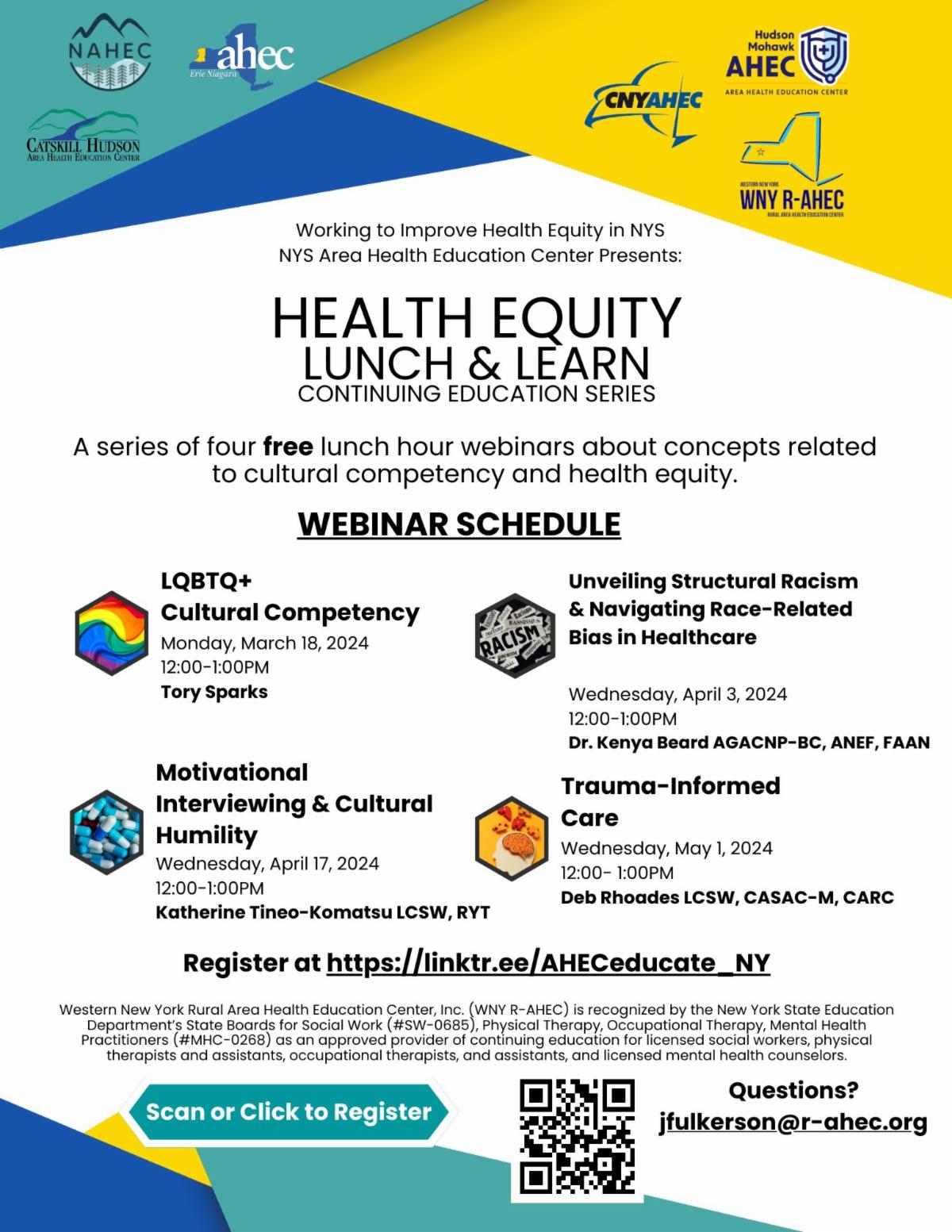
WNY R-AHEC to Host Webinar Series Focused on Health Equity


Western New York Rural Area Health Education Center is hosting a virtual webinar series focused on health equity. You can register at https://linktr.ee/AHECeducate_NY. for one session or multiple sessions. Continuing Education Credits are available for OT, PT, Social Work, and Mental Health. Credit pending for Speech Language Pathology.


Contact Jason Fulkerson, jfulkerson@r-ahec.org, if you have any questions.

Webinar Series on Rural Maternal Health Begins March 12


Registration is now open for a four-part webinar series presented by the Federal Office of Rural Health Policy (FORHP), in collaboration with the Rural Health Information Hub. Focused on the needs of rural facilities with and without birth units, the series will explain aspects of the new Birthing-Friendly Hospital Designation from the Centers for Medicare & Medicaid Services. 

Did someone forward this to you?


We want to keep in contact. Please consider signing up on our mailing list. Keep up to date with health workforce development information when you add your name to our growing list.

Sign up here

Do you have health workforce news for the Southern Tier?


Let us know about your program, event or best practice we can share with our regional list. We would love to highlight your good work.Your feedback is important. Drop us a line and let us know what you want to hear more about.


Hit the button below.

Email us!

This e-newsletter is for anyone in, and interested in, the health care workforce in Chautauqua County. We'll look at resources and educational opportunities with the goal of increasing health care, wellness and overall quality of life in the Southern Tier; please forward this email freely!

Issue 2402