Volume 6, Issue 1 | January 2026 | | | |
|
Your Monthly News
& Updates
| | Leading with Learning: Centering Students in a Changing Landscape | | |
Education stands at a crossroads. New technologies promise to transform how we teach and connect with students. Long-standing practices face renewed scrutiny as we better understand their impact on young learners. And through it all, one question remains constant: Are we truly putting students—their growth, their well-being, their humanity—at the center of every decision we make?
This month's newsletter explores that question from four distinct but interconnected angles. First, we are concerned about the immediate well-being of families and students. We care about their rights and due process and believe in a government that extends compassion to all. We're also excited to introduce our new Executive Director, Kahlil M. Kuykendall, who shares her vision for how our organization can champion student-centered education in the years ahead. We next examine how artificial intelligence, when thoughtfully applied, can actually scale the compassionate, SEL-centered approaches our students need most. And we investigate a troubling trend: the expansion of standardized testing into the earliest years of primary school, and what it means for our youngest learners who are still discovering what it means to be students at all.
Each article asks us to look critically at the landscape around us—not to resist all change, but to ensure that as education evolves, we never lose sight of the children at its heart. We hope these pieces spark reflection, conversation, and action in your own work.
| | |
A CEI Response to Immigration Raids and Child Detainments
Melody Mann, M.S. M.A.
| | |
Now, more than ever, heart centered learning is becoming a vital necessity across education. With the rise of ICE raids and detainments taking place, families and children as early as preschool are being wrongfully taken from classrooms and daycare centers alike. Across the United States, in this year alone we have witnessed aggressive immigration enforcement actions taking place from New York City, Minneapolis and other localities. These actions not only traumatize youth and their families, but build a dystopian reality of segregation, isolation, and terror across communities. In the turbulent times our nation is navigating, fostering compassion, empathy, and acceptance is vital to the preservation of humanity and safety of our communities.
A Call to Action: Leveraging Heart Centered Learning
The Center of Educational Improvement promotes the usage of Heart Centered Learning (HCL) across educational spaces to foster inclusivity and unity across students, staff, and families. Applied broadly, HCL can combat the unnecessary brutalities taking place politically and within law enforcement by strengthening families and staff at the classroom level. Traditionally, HCL leverages the 5 C’s, compassion, courage, confidence, consciousness (awareness), and community, to equip students with the knowledge, attitudes, and skills necessary to understand and manage emotions, feel and show empathy for others, resolve conflicts nonviolently, think creatively, and overcome obstacles to succeed in the classroom and in life (read more here).
Expanded for our contemporary moment, HCL is actively cultivating reflection, mindfulness, emotional regulation, and collective responsibility. These practices create classrooms that function not only as academic spaces, but as sanctuaries of safety and belonging. When children are confronted with the threat of family separation, deportation, or racialized surveillance, schools must become places where students are seen, protected, and affirmed. HCL provides educators with concrete tools to recognize trauma, honor cultural identities, and foster resilience in the face of instability. As ICE raids spread and surveillance is forcefully infiltrating historically safe spaces like classrooms, HCL can be a protective tool for educators and staff alike to nurture and alert students and families...
Read more.
| | |
A Message from the Executive Director
Khalil Kuykendall, CEI Executive Director
| | |
Dear CEI Community,
It is with deep gratitude and enthusiasm that I introduce myself as the new Executive Director of the Center for Educational Improvement (CEI). I am honored to step into this role and to join a community that has long been committed to advancing educational equity, innovation, and excellence.
CEI’s mission—to strengthen schools, empower educators, and improve outcomes for students—resonates deeply with both my professional journey and my personal values. Throughout my career, I have worked at the intersection of education, wellness, leadership, and community engagement, always guided by the belief that meaningful change happens when people are supported, seen, and equipped to thrive.
As we move forward together, my vision for CEI centers on three guiding commitments:
1. Strengthening Educational Impact
We will continue to build and refine high-quality programs, resources, and partnerships that support educators and students across diverse learning environments. Our work will remain grounded in evidence-based practices while remaining responsive to the evolving needs of schools and communities.
2. Investing in People
Educators, students, families, and partners are at the heart of CEI. We will prioritize professional learning, leadership development, and well-being—recognizing that sustainable improvement begins with supporting the individuals doing the work.
3. Expanding Collaboration and Reach
CEI’s future depends on strong relationships. I look forward to deepening existing partnerships and forging new ones that amplify our impact, extend our reach, and align with our shared commitment to educational improvement.
In the coming months, we will be engaging in strategic planning, listening sessions, and collaborative conversations to ensure that CEI’s direction reflects both its legacy and its future potential. Your voices, insights, and experiences are essential to this process, and I look forward to learning from each of you.
Thank you for the warm welcome and for your continued commitment to CEI’s mission. I am excited about what lies ahead and grateful for the opportunity to serve this community.
With appreciation and purpose,
Kahlil M. Kuykendall
Executive Director
Center for Educational Improvement
| | |
Using AI to Scale Compassionate, SEL-Centered Education
Meghan Wenzel, CEI Editor
| | |
For years, educators have been tasked with a highly challenging balance: meeting rigorous academic standards and high-stakes testing demands while nurturing students' social-emotional wellbeing and holistic development. With limited time, resources, and energy, something always seems to give.
But the stakes are high. Schools have become the "de facto mental health system for many children and adolescents," according to a 2020 study in JAMA Pediatrics (Golberstein, Wen, & Miller, 2020). Nearly one in five students now accesses school-based mental health services (National Center for Education Statistics, 2026). Yet teachers and counselors remain stretched thin, often unable to provide the individualized attention and emotional support every student deserves.
AI might be able to help. When thoughtfully and carefully implemented, AI offers tools that can help educators scale their impact. AI can be a thought partner to help educators sift through emerging research and best practices, brainstorm exercises, and generate tailored content. There are certain AI tools geared especially for teachers needs, and educators can then use their training and judgment to craft appropriate solutions. These time savings can then free up educators to do what technology cannot: nurture emotional intelligence, facilitate meaningful peer connections, guide students through conflict resolution, and create the safe, responsive classroom environments where social-emotional learning thrives...
Read more.
| | |
More Than Self-Care: How Compassionate Practices Transform Schools
Fatima Rishana Azmie, CEI Intern
| |
Why six-year-olds are now sitting for ability tests — and what that means for learning, equity, and well-being
“The danger is not that we measure learning — but that we mistake measurement for learning.” Adapted from Bonner’s discussion of assessment as a support for learning (Bonner, 2013/2023).
In contemporary education systems, children encounter standardized testing at increasingly young ages. In the UAE and many other global contexts, students as young as six sit for cognitive ability tests (e.g., CAT4), reading assessments (e.g., NGRT), annual norm-referenced tests in core subjects, alongside language proficiency and government-mandated assessments. What was once designed as system-level monitoring has become embedded in routine classroom life (Au, 2007; Au, 2016; Nichols & Berliner, 2007; Stiggins, 2005; Ford, 2020).
Standardized assessments are often justified as mechanisms for accountability, equity, and early intervention. Yet a growing body of research suggests that excessive and high-stakes testing environments can distort learning, teaching, motivation, and children’s developing identities — particularly in early childhood (Au, 2016; Ford, 2020; Kohn, 2000).
This article draws on doctoral research and peer-reviewed studies to examine how early high-stakes testing reshapes childhood learning, affects teacher practice, and raises developmental and ethical concerns...
Read more.
| | Upcoming Events and Announcements | | |
Preparing Students for Success
Wondering about how you can prepare students for the future of work?
Hear from experts on why decision-making skills are in demand and how you can set students up for success. Join Alliance for Decision Education’s webinar – Decision Skills Bridge Classrooms and Careers.
January 29, 2026, 6-7pm EST.
Register here.
| | |
S-CCATE 2025-2026 Validation Study
We are revising CEI’s School Compassionate Culture Analytical Tool for Educators (S-CCATE) to reflect current educational needs and concerns. First developed in 2018, and initially validated on a national sample of over 800 educators, the updated S-CCATE will be available within the next few weeks. Note: We have also developed a brief companion S-CCATE Student Survey that will also be shared.
Both will be available as part of our 2026 S-CCATE Validation study to begin within a few weeks - we will be sending direct links for your participation through our HeartMind Community.
| | |
Register for our Transformative Leadership Webinar Series
Tuesdays at 6 pm - 7:15 pm ET:
February 10, and March 10, 2026.
Join Drs. Renee Owen and Christine Mason as they discuss their new book, Becoming a Transformative Leader from the Inside Out to be released on November 27. Owen and Mason will present the basics of transformative leadership in education, beginning with an initial session on values and your own internal transformation. The second session will focus on relationships, communication, and developing others. The last session will center on effecting social change, including tips on measuring progress, and considerations for visioning and the future of education.
Learn about ways to meet the demands placed on school leaders during this VUCA (volatile, uncertain, complex, and ambiguous) era, complete with examples from schools and districts across America. Based on neuroscience, holistic thinking, and systems theory, Owen and Mason take ideas from Peter Senge and apply them in the context of issues facing schools today.
You will:
- Learn about the science of belonging,
- Consider the wisdom of an Indigenous Worldview,
- Learn tools for self-reflection,
- Explore mindfulness leadership exercises, and
-
Begin identifying your blind spots.
Each session will include concrete examples from implementation in k-12 schools with ideas for developing group learning, including rituals to help improve the cohesion and well-being of staff and students in your schools.
Participants attending all 3 sessions will get CEI’s Transformative Leadership Certificate. Relevant for aspiring, new, and seasoned leaders, these sessions are offered at no charge for educators providing evidence of purchasing our book. During these sessions, Drs. Owen and Mason will offer follow-up Q&A and coaching sessions for participants who are interested in a deeper dive and/or have specific questions about their own situations.
Check out the recording of the first session from January 13.
Register here.
| | |
Limited Offer – 50% off CEI Books
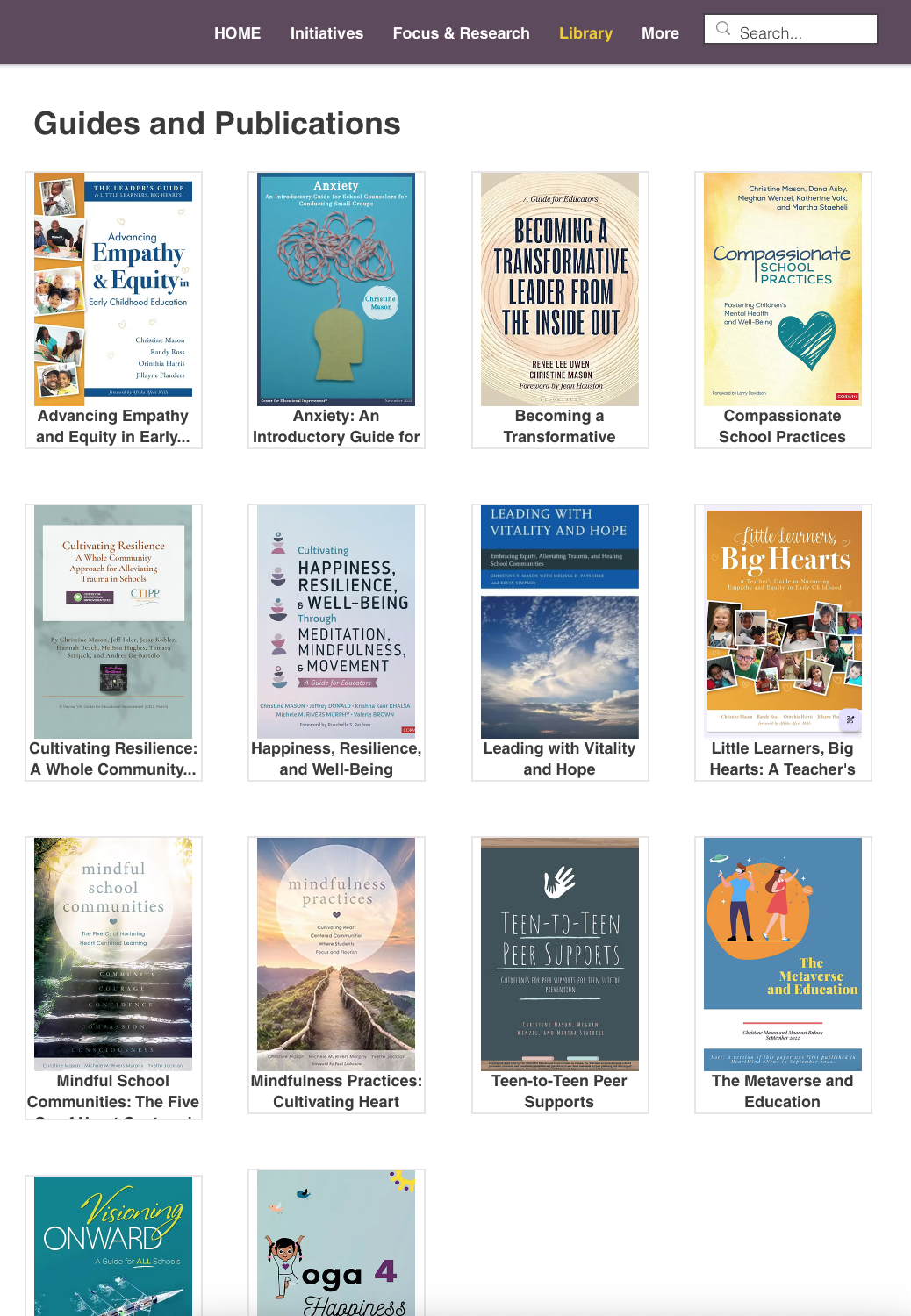
Published from 2018-2025, books on mindfulness, heart centered learning, visioning, leadership, and early childhood education. CEI has extra books in our private warehouse, and we want to close out our inventory.
To purchase, email Dr. Mason (chrismason@edimprovement.org), listing the titles of interest and number of copies of each, and your full name, physical address, and phone number. She will respond with a note about availability and final costs (to include handling and shipping).
| |
You are also invited to join the HeartMind Community to receive discounts on publications and workshops, networking opportunities, and special offers for virtual consultations and additional resources from the Center for Educational Improvement.
| | Editors: Lauren Kiesel and Meghan Wenzel | | | | |