|
“I went from adolescence to senility, trying to bypass maturity.”
― Tom Lehrer
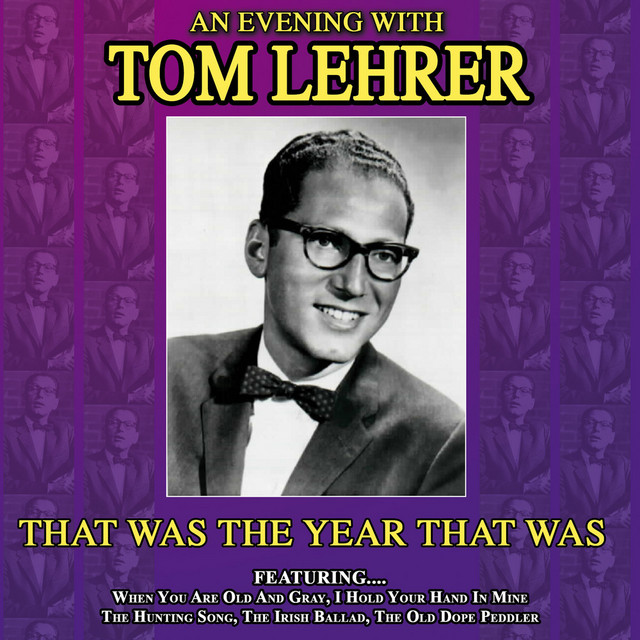
I’ve stolen the title for this month’s newsletter from the 1965 Live Comedy Album by Tom Lehrer. Tom himself somewhat stole the title from the NBC comedy show he appeared on from 1963-1965 called That Was the Week that Was. Harvard Professor Lehrer, who was enrolled at Harvard himself at the age of 14, entertained his classmates with funny little songs he wrote and performed. This side gig ended up becoming the more lucrative part of his life as his albums, especially the one mentioned above, sold hundreds of thousands of copies in the U.S., Canada and Great Britain. Lehrer went on to write and perform music for The Electric Company, an educational show on PBS that every Gen-Xer like me remembers fondly, all while continuing to teach at both Harvard and UC Santa Cruz. Lehrer is probably best known for his song, The Elements, in which he recites all the known elements of the time, to the tune of The Major General’s Song from the Pirates of Penzance. Lehrer is also attributed with inventing the Jello Shot as a way to get around the rules against drinking in his barracks when serving in the Army during the late 1950’s; this is probably not true but let’s not let the facts get in the way of a good story. I’m going to use this end of the year newsletter to discuss many of the momentous things that happened in 2025, but before I got into that I wanted to eulogize Mr. Lehrer who died at the age of 97, this past July.
Even just sticking to economic news there’s no way to summarize this past year in a short enough post that anyone would actually read it. Unprecedented Tariffs, not seen at this level in over 80 years, were announced, enacted, modified, changed, delayed, and targeted in fits and starts from the Steel and Aluminum tariffs that were enacted almost immediately after Trump’s swearing in, to the sweeping “Liberation Day” tariffs from April 2, to the recently announced deals with South Korea, Switzerland and The United Kingdom. These tariffs have undoubtably raised consumer prices, but at the same time there’s been a reduction in housing costs (mostly in rents) that has kept the overall CPI rate just a hair under 3% for most of the year. The OBBBA, that was signed into law on July 4th extended tax benefits that were set to expire and made other changes that we discussed in my October Newsletter. I will address some changes it made to charitable giving at the end of this newsletter that you may want to think about before the end of this calendar year. The Fed has continued to lower rates, albeit, slowly over the last few meetings and the day-to-day changes in consensus about what they’ll do at the next meeting is causing a see saw in the stock markets that hit all time highs the end of October before actually declining slightly for the month of November. Historically December is a positive month for the stock markets as people try and max out their retirement plan contributions while at the same time folks are hesitant to sell in taxable accounts and lock in capital gains so late in the year, but not every year follows this pattern. The longest ever Government shutdown seemed to anger everyone on every side of the political aisle as it caused travel chaos and led to a gap in the economic numbers as the BLS didn’t produce an October employment or CPI figure. This then feeds back on the Fed which might be hesitant to change rates without accurate economic data to guide them.
While all this was going on, the markets hit new highs, gold soared above $4,000 an ounce, silver doubled in value and the wonderful 5% guaranteed interest rates most people could get in CD’s or Money Markets in 2024, dropped down under 4%. With every piece of this economic news, the financial press was poised for a sell-off in the markets that never came. There was a brief correction right after the Liberation Day announcements that was entirely recovered by the end of that month. The doomsaying went on all year; the tariffs, the Fed, the AI bubble, all were going to cause the correction that yes, we are historically over due for, but it never happened. Not only have the markets performed well, but even with all the talk of the “Magnificent Seven” tech stocks providing most of the market’s gain the last half a decade, this year the performance was more widespread. Non-US Developed Market stocks were up 27.4% YTD through November, almost 10 points higher than the S&P 500. Emerging markets were up just a fraction more at 27.9% and U.S. Small Cap Stocks 13.5%, after several years of significant underperformance. U.S. Large Company stocks, measured by the S&P 500, are expensive on an historic basis and like most I expect some kind of pull back in that space at some point, to get those valuations back in line. But the same is not true of International and Smaller Company stocks whose valuations are more in line with historic averages. This is once again why having a diversified portfolio is so important. It may not give you the biggest upside, but it protects your downside, so even with a pull back in one area of the markets, you hopefully own something that’s still positively performing to lessen the impact.
The last thing I want to address before I go is end of year giving. I’m writing this on “Giving Tuesday.” The amount of emails I’ve gotten today from every non-profit organization I’ve ever heard of is making me feel less than generous at the moment, but it’s important to help these organizations, especially in a year like this when the Government Shut-Down and loss of SNAP benefits drained the resources and shelves of so many places that help those who are less fortunate. The problem is, with the expansion of the Standard Deduction in the 2017 Tax Bill, many people were no longer getting any additional tax savings for their charitable giving. This has led to an overall reduction in charitable donations, especially the small donations from individuals that still make up the majority of giving when added up. To rectify this, the newest tax reform has introduced a $1,000 per year ($2,000 for those filing jointly) above the line deduction for cash gifts to public charities (this means you don’t get this deduction if you donate clothes or food, only money.) At the same time, the bill reduced the charitable deduction benefits for those who itemize beyond the $1,000/ $2,000 already mentioned. You can only deduct the amount you give to charity in excess of 0.5% of your Adjusted Gross Income. So, for example, if your adjusted gross income was $150,000, the first $750 you give would not be deductible. For those in the top tax bracket, currently 37%, there is an additional provision that limits your deduction. While you pay taxes at 37%, your charitable contributions only save you 35% off your taxes. These two provisions are affectionately known as The Shave, and The Haircut. But none of these provisions go into effect until 2026. So, if you were thinking of donating to charity, or made a pledge to donate a certain amount over a number of years, you may want to accelerate those gifts into 2025. There are more complicated ways of doing that through Donor Advised Funds (DAF’s) and Private Foundations, but those explanations are too long to get into here. Still the absolute best way for those over the age of 70½ to give to charity, is by gifting directly through their IRA. The limit on these Qualified Charitable Distributions was raised from $100,000 to $108,000 in 2025 and will be indexed for inflation going forward. I’ve spoken about this tactic before, but it requires some planning so if you want to make a gift from your IRA in 2025, please notify us by December 15th at the absolute latest.
That should do it for 2025. In 2026 Commonwealth will be making the full transition to LPL, the target date for that move is November 14th. While we’ve been assured this will be a smooth, seamless transition we won’t have all the details until we begin working with our transition team in the early part of next year. We will certainly keep everyone posted with any information you need to know as we receive it. In the meantime, have a wonderful holiday season. Let me leave you with Tom Lehrer's A Christmas Carol below, please enjoy it in the spirit in which is is presented.
|