|
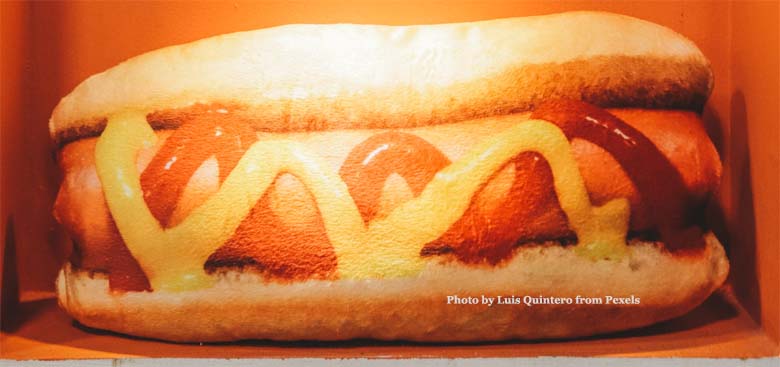
JULY is NATIONAL HOTDOG MONTH!
July 4th and hot dogs always seem to go together. July 4th in America has evolved into one of our most favorite and fun-filled family celebrations. When asked, "What does July 4th mean to you?" most would say, "Hot dogs and Fireworks!"
This could be either a bad or a good answer. Perhaps we are too many light years away from our fight for independence and, though we must express our sincere gratitude for our freedom, one could say the thought of eating our favorite food and the sight of fireworks while gathering with friends and family is not an unimportant reason to love the July 4th holiday! Or, one could even argue eating hot dogs on July 4th, at baseball games, and for that matter all throughout the summer, is as American as apple pie! Not only do hot dogs abound on the July 4th weekend, but July is also National Hot Dog Month!
Although some nutritionists suggest we shun them, for most of us they are probably the best picnic and family gathering food ever because everyone from grade schoolers to grandpa loves them. For that reason alone (though we probably should exercise moderation) we should try to keep the nutritionists at bay at least for the summer.
HOT DOGS & BASEBALL
Did you ever wonder how hot dogs and baseball are linked? According to the National Hot Dog & Sausage Council (NHDSC), vendors would sell 'hot dachshund sausages' during baseball games at the Polo Grounds in NYC in the late 19th and early 20th centuries.
Legend says in 1901, a cartoonist for a Hearst newspaper, Tad Dorgan, sketched a cartoon of a real dachshund dog, smeared with mustard, in a bun. Dorgan didn't seem to be able to spell the name of the dog and instead wrote 'get your hot dogs' for the cartoon caption. Apparently, Dorgan's cartoon has never been found to prove this, but it certainly makes for a good story!
Besides its early association with baseball parks, hot dogs are just about the most perfect food to enjoy while cheering on a favorite team. They are easy to prepare, relatively inexpensive, and easily portable. Hot dogs are eaten most often between Memorial Day and Labor Day, incidentally coinciding with the peak of baseball season.
HOT DOG HISTORY
A timeline of important facts in the history of the hot dog can be noted as follows:
-
1487 - The frankfurter supposedly was first developed in the city of Frankfurt in Germany. In fact, in 1987, the City of Frankfurt celebrated the 500th anniversary of the hot dog. It is also possible the original 'dachshund' or 'little dog' sausage was developed in Coburg, Germany in the late 1600s by a German butcher who then went to Frankfurt to promote his product. However, people from Vienna, Austria say the term 'wiener' proves their city (Wien) was the birthplace of the hot dog!
- 1800s - German immigrants brought sausages, as well as dachshund dogs to America.
- 1860s - Reports of a German immigrant selling hot dogs with milk rolls and sauerkraut in New York City's Bowery from a pushcart.
- 1871 - Charles Feltman, a German baker, set up the first Coney Island hot dog stand selling dachshund sausages in a milk roll.
- 1890s - Historians find mention of 'hot dog' in college campus magazines.
- 1893 - 'Little dog' sausages were introduced by St. Louis bar owner and German immigrant Chris Von de Ahe, who happened to own the St. Louis Browns baseball team.
More than likely, though, the North American hot dog came from a variation of the common European sausage, brought in by butchers of many different nationalities, which then spread throughout the country.
COOKING PERFECT HOT DOGS
When cooking hot dogs, temperature is the most important consideration for the best and tastiest hot dogs. They must be hot enough but not too hot. The optimum temperature is between 150 and 160 degrees. Hot dogs cooked at under 140 degrees will be spongy and dull tasting. Cooked over 165 degrees, they get bloated and quickly start to dry out.
A two-step process of poaching and then grilling can result in perfect hot dogs. First, heat up a saucepan to 155 degrees. Then, drop the heat to low. Put in the meat and wait 10 minutes. A perfectly heated hot dog will be the result. But since we all expect a grilled hot dog, quickly put them on a hot grill and in a few seconds, they will have a nice color. Remove them instantly and serve.
Of course, in reality, everyone has their favorite way of cooking and eating hot dogs. What is really fun about hot dogs as well, is how creative you can get with condiments. Some examples are: yellow, Dijon or spicy mustard, ketchup, mayo, chutney, BBQ sauce, Creole or chili sauce, sauerkraut, sweet pickle relish, dill pickle slices, jalapenos, sliced or diced peppers, grated cheddar, feta, blue, goat, cream cheese, nacho cheeses, and sour cream, etc.
Hot dogs are served in 95 percent of homes in the United States. Fifteen percent of hot dogs are purchased from street vendors and 9 percent are purchased at ballparks, according to statistics from the Heartland Buffalo Company.
It is estimated that Americans will consume more than 150 million hotdogs during the 3-day July 4th weekend!
Enjoy. And check out the descriptions of some regional hot dogs below:
REGIONAL HOT DOGS
To find out more about hot dogs and mouth-watering photos of regional favorites please continue reading here.
|