FOUNDATION AID
What's the backstory?

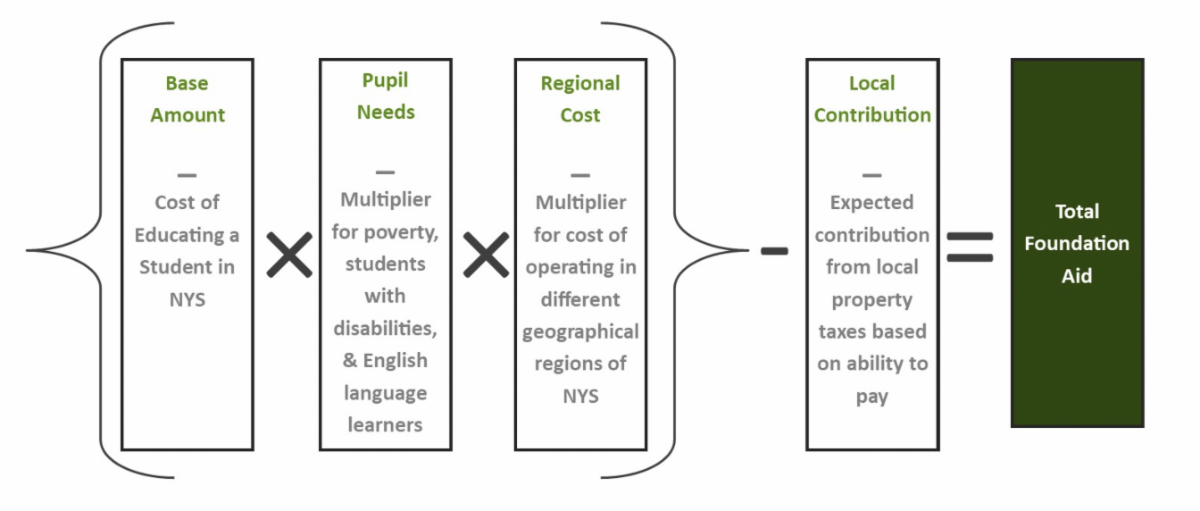
New York State provided aid to school districts long before the development of the Foundation Aid formula. The final ruling in 2007 in the court case Campaign for Fiscal Equity v State of New York, where the State of New York was found to be in violation of the state constitutional obligation to provide a “sound, basic education” was the final impetus to change approximately 30 aid categories into one streamlined calculation of the aid required to ensure the foundation for all students to be educated. The basic intention in building the Foundation Aid formula was to determine the cost of educating a child, then subtract the anticipated community contribution based on income and property wealth, leaving NYS to contribute the remainder in aid. 
In 2008, full funding of the Foundation Aid formula was interrupted by the economic downturn. The funding target of the Foundation Aid formula continues to be provided by NYS Education Department in state aid data runs, but actual dollars have never caught up. Current calculations show that the median WPSBA district receives 69% of full funding under the NYSED projections. Current Foundation Aid data for each Putnam and Westchester district is available on the WPSBA website.  
What's the latest on Foundation Aid?  

The inputs to the formula have not changed since the initial implementation in 2007, leading to unreliable outputs as to what a district truly needs to provide a sound basic education to their current student body. The formula currently uses: 
  • 2000 Census data - demographics in our region have changed significantly 
  • 2003 study on cost to educate students using the “Successful Schools Model” 
  • 2006 data on regional labor costs 

Decisions made years ago regarding data used in the formula continues to skew the results today: 
  • Westchester and Putnam counties are grouped in with the Hudson Valley region – a regional cost that includes seven counties stretching as far as Sullivan and Orange. Nassau and Suffolk counties on Long Island are grouped with New York City to calculate the cost of professional labor. 
  • Insufficient measures of pupil needs are included in the formula, such as measuring poverty through the disproportionate Free and Reduced-Price Lunch (FRPL) metric, which looks at poverty through a national lens without consideration for the high cost of living in NY. 

Subsequent agreements have continued to adjust the formulaic output to ensure political ends: 
  • The “shares” agreement specifies that NYC will receive 38.86% of the State budget’s annual aid increase, while Long Island receives a12.96% share. The remainder of the Foundation Aid increase is distributed to districts in the rest of NYS. 
  • The “hold harmless” provision ensures that each district’s Foundation Aid will not decline from one year to the next, regardless of changes in enrollment. 
  • “Set asides” are targeted monies from Foundation Aid allocated on a different basis from the aid formula, such as funds for programs like community schools. 

In 2019-20, State Senators Brian Benjamin (Chair, Committee on Revenue and Budget) and Shelley Mayer (Chair, Education Committee) convened a series of roundtables throughout the state to gather views on the current state of the Foundation Aid formula. Consistent feedback indicated that the formula and data used needed updating, and schools needed Foundation Aid to be fully funded to sufficiently educate each student. To get a deeper understanding of our perspective on this issue, you can read the WPSBA written testimony here
What's next?

Even in a year when it appears unlikely that NYS will have funds to substantially increase Foundation Aid, there continue to be Foundation Aid topics on our advocacy agenda: 

Regional Cost Index: Westchester and Putnam counties are inappropriately grouped with mid-Hudson counties that have substantially lower costs of living. WPSBA has long advocated for grouping our counties with the Long Island/NYC regional cost structure to more accurately reflect the cost of operating in suburbs of NYC. One proposal is to consider an “MTA region” that includes the Metro North commuter suburbs. 

Updated Data: Updating the Foundation Aid funding formula to include recent data would more accurately reflect the needs of WPSBA districts which have undergone many changes in demographics and regional costs. For example, the cost of educating students with disabilities and ENL students is expected to be significantly higher than the multiplier developed in 2003. 

Formula Review: WPSBA and many across NYS have long advocated for a full review of the formula. Data inputs should more accurately measure what is intended. For example, WPSBA has been a proponent of using a more accurate measure of student poverty than the federally determined FRPL metric. We have proposed the United Way ALICE (Asset-Limited, Income-Constrained, Employed) measurement of poverty levels as an alternative. Costs of education that were not included in the original measure should also be considered – specifically security and student mental health.  

Full Funding: Full funding of Foundation Aid has been too long delayed. 

Participate in the discussion of Foundation Aid advocacy at our upcoming Advocacy Committee meeting on November 2, and help prepare to have this issue be a key focus of WPSBA's Legislative Advocacy week in February.  

Add your positive energy to WPSBA's advocacy efforts.
Come to next week's advocacy meeting (Nov. 2nd, 6:30 pm - 8:00 pm) where the focus will be on finalizing this year's advocacy priorities.