|
|  |
Support NICOA with a gift to help us continue our mission! | |
|
Remarks from Billie Tohee,
NICOA Executive Director
| |
Greetings Everyone,
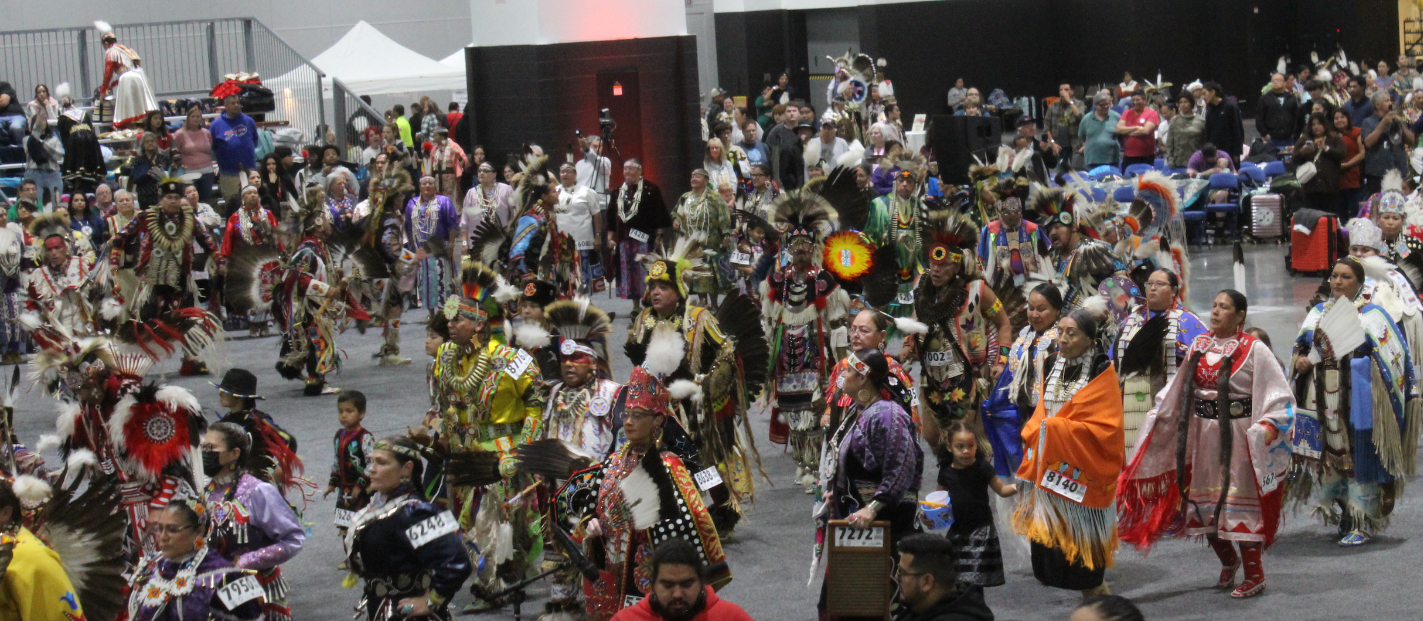
November is Native American Heritage Month which is focused on celebrating the rich cultures, traditions, and contributions of American Indian and Alaska Native people. It is to honor the legacy and stories of Tribal Nations and Indigenous communities across the United States.
November has been an exciting month for NICOA and Indian Country. Several events observed during November are:
November 5 US Presidential Election
November 11 Veterans Day and Armistice Day
November 13 Caregiver Appreciation Day
November 14 World Diabetes Day
November 28 Thanksgiving Day
November 29 Native American Heritage Day
NICOA’s mission is to advocate for the improved comprehensive health, social services, and economic well-being for American Indian and Alaska Native Elders. Several of these events have allowed us to continue to carry out our mission and goals.
Through our newsletters, I hope you will discover a wealth of knowledge and insights that will empower and uplift our Native Elder communities across Indian Country and urban settings. NICOA strives to create a space that celebrates the wisdom, strength, and resilience of our elders, while addressing the challenges they face, and to continue advocating for meaningful solutions.
We invite you to embark on this journey with us as we periodically delve into stories of remarkable individuals whose lives have been touched by NICOA. Together, we will uncover the transformative power of community support, the importance of long-term care, and educational resources to advocate for the rights, justice, and well-being of our Native Elders.
I hope NICOA and our newsletters serve as a source of knowledge, inspiration, and unity, as we work towards a future where every Native Elder can thrive and be honored for their invaluable contributions to society. NICOA is a place where Native Elders’ voices can and will be heard. Native Elders deserve the respect of their families and communities as well as allowing them to live with the dignity they deserve.
An elder is a man or woman older than the others in the family and community, who, while not elected or appointed, is widely recognized and highly respected for their wisdom and spiritual leadership. Elders often are known for being the kind of people who have paid attention and gained knowledge and wisdom from life experiences. During childhood, they watched and listened carefully to ceremonies and traditions, and as a youth, they paid attention to the ways the elders in their communities carried themselves. Through example and their way of life, Native Elders teach younger tribal members about the tribe’s culture and traditional ways of life, and it is through the oral traditions shared by elders that social values and beliefs are preserved. Elders are libraries of Indian knowledge, history, and tradition. The ways of our past are still of vital importance to the lifestyles of the present.
Especially during the holiday season, I encourage families, friends, neighbors, and communities of Native Elders to practice our Native American traditions of respecting and honoring elders. NICOA affirms that cultural values have been the source of strength for Indian people since time immemorial. Today, NICOA wants to spotlight traditional Indian values as being rediscovered and implemented in restorative justice, leadership, and community development programs.
Lastly, NICOA acknowledges, appreciates, and gives thanks to tribes, tribal leadership, organizations, and partnerships that include Native Elder causes, donors, sponsors, volunteers, and supporters for their contributions and commitment to our cause. I encourage all who care about and respect Native Elders to continue donating, volunteering their time and expertise, and spreading the word about NICOA’s mission.
HAPPY HOLIDAY SEASON.
Billie Tohee, Executive Director
| | | |
NICOA IMPORTANT ANNOUNCEMENTS | |
|
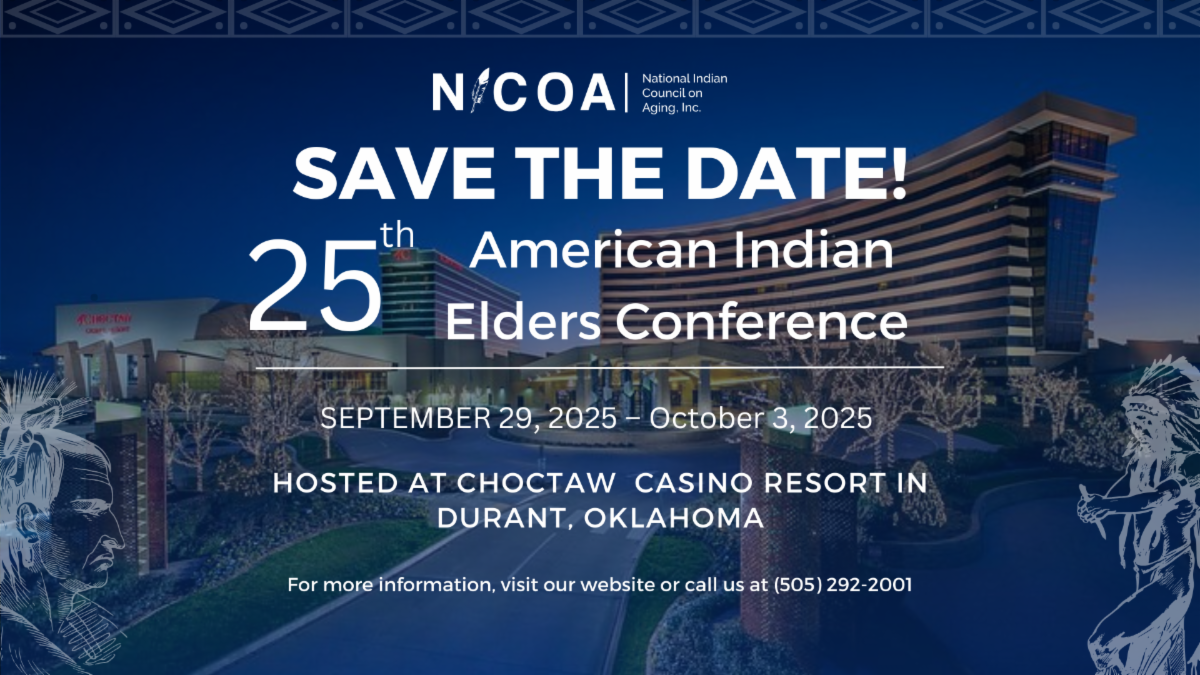
Remember to mark your calendars for the 25th Anniversary of the American Indian Elders Conference, a milestone event celebrating our journey since our first conference in 1976. Join us for this special gathering from September 29 to October 3, 2025, at the Choctaw Casino Resort in Durant, Oklahoma!
This biennial event, hosted by the National Indian Council on Aging (NICOA), brings together American Indian and Alaska Native elders to elect new board members, establish the aging policy agenda, and discuss solutions to improve aging services across Indian Country. Stay tuned for registration information and visit www.nicoa.org for the latest updates.
For any questions in the meantime, please call our office at (505) 292-2001.
| |
NICOA receives membership from the
Native Leadership Collective of Albuquerque
| |
|
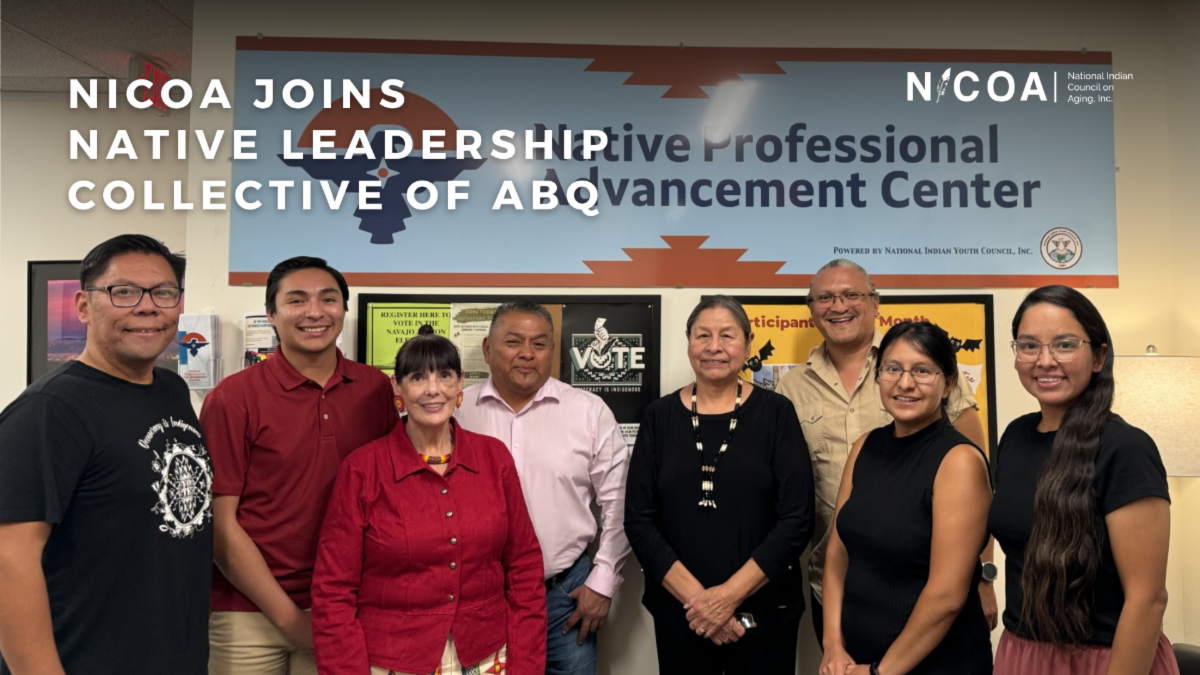
The National Indian Council on Aging is proud to announce new membership in the Native Leadership Collective of Albuquerque. NICOA is now the 34th member of the collective to join as of Oct. 23.
The National Leadership Collective of Albuquerque (NLC) comprises Executive Directors and Owners of 34 Native-led nonprofit organizations and Indian-owned businesses. NLC plays a crucial role in representing the collective constituencies to inform and hold accountable institutions and governments regarding the local urban Native American community.
NICOA is excited to work with the collective organizations and continue to advocate for native communities.
(NICOA staff are joined by current members of NLC pictured).
| |
La Montañita Food Co-Op Generously Gifts NICOA | |
|
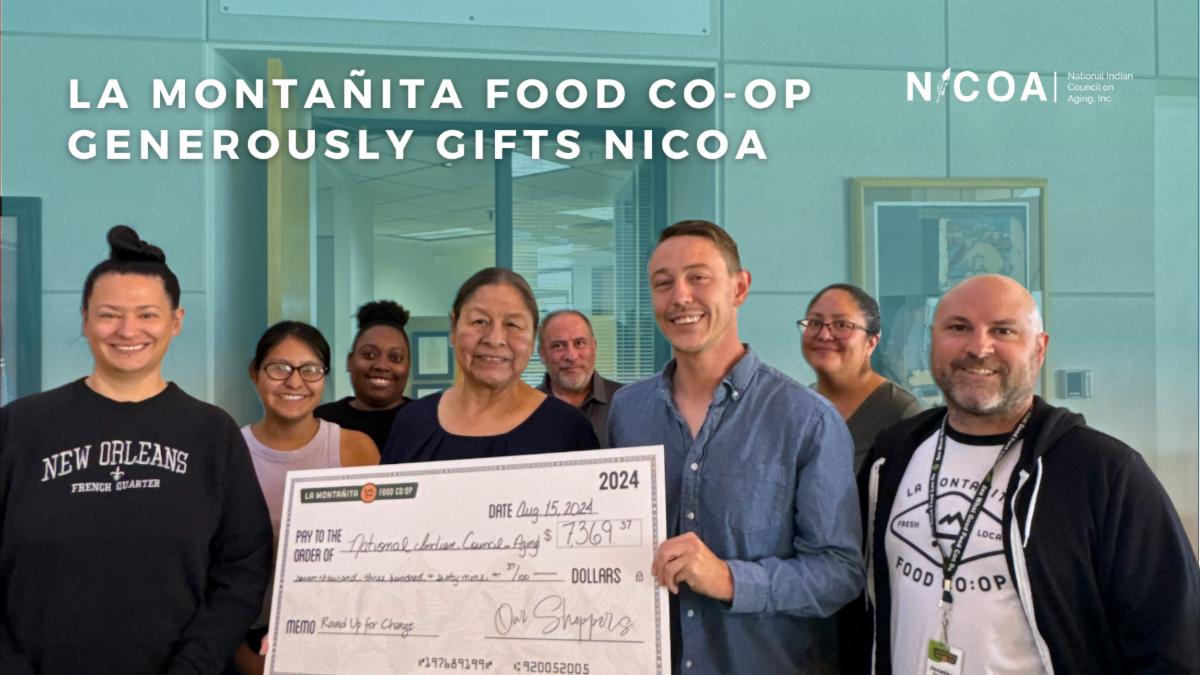
The National Indian Council on Aging was selected as a recipient of the La Montañita Food Co-op Round Up for Change program for the month of July. The program directly supports New Mexico nonprofits working in our community.
We'd like to thank La Montañita and the community for providing this gift that will directly help NICOAs mission to support and advocate for our Native elders.
| |
|
Become a NICOA Member:
2023-2024 Membership Available
| |
|
Do you want to improve aging services for American Indian and Alaska Native elders?
If so, become an advocate and learn more about supporting Native elders! NICOA is the premier organization on Native aging, and we invite you to become a member. Anyone can become a member, regardless of their age.
All elders are encouraged to join and have their voices heard. Be an important part of a national membership network and become a NICOA member by applying today. Memberships are for two calendar years.
| | | | | |
|
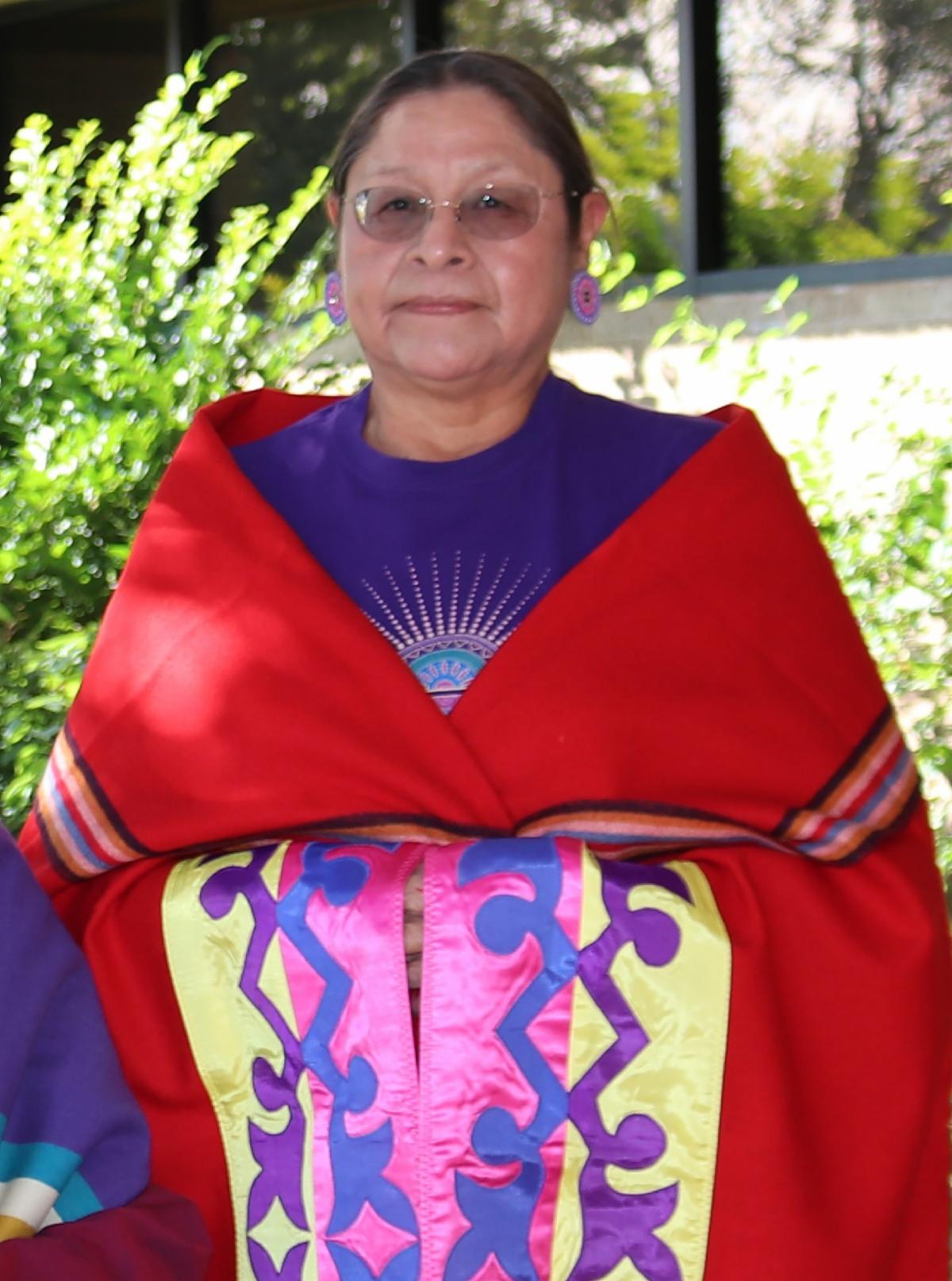
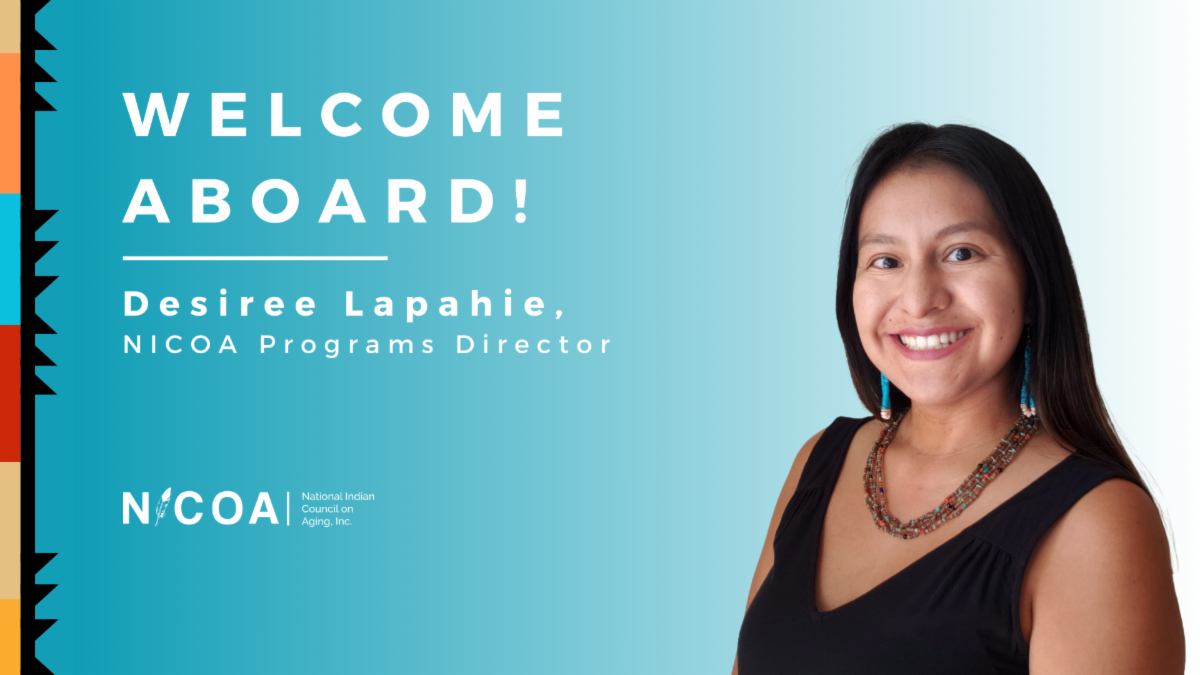
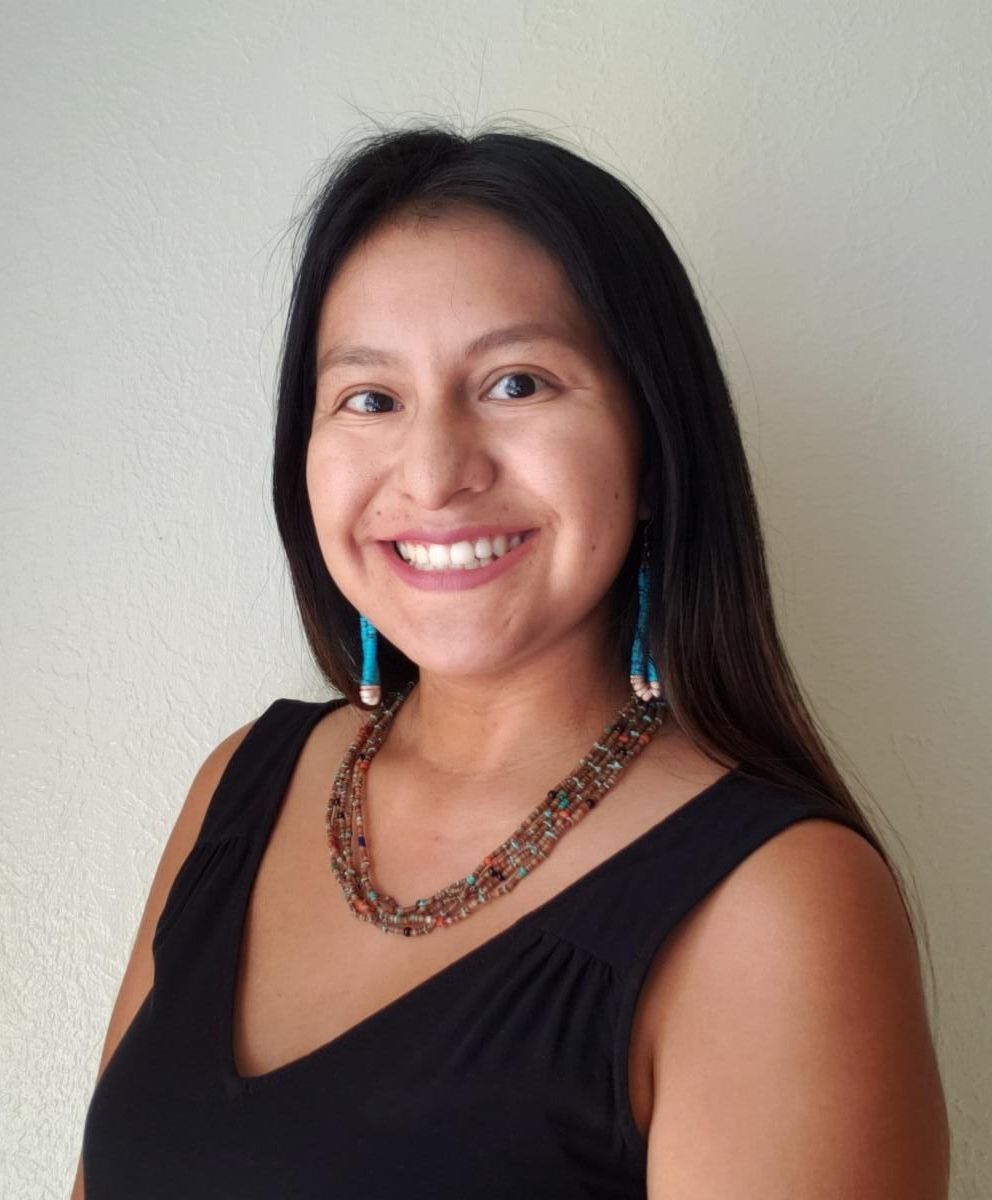
NICOA is thrilled to introduce Desiree Lapahie as the new NICOA Programs Director. Ms. Lapahie will oversee NICOA’s active grants, as well as curate and support relationships with current and future partners across Indian Country.
Ms. Lapahie is from the Navajo Nation and brings a wealth of experience advocating for elder issues, having been a caregiver to her Masani. She holds a bachelor’s degree in economics with a minor in business management from the University of New Mexico.
Ms. Lapahie previously served as a Data Analyst with NICOA advocating for AI/AN elder issues. Additionally, she played a pivotal role in updating the “Understanding Disabilities in American Indian & Alaska Native Communities Toolkit Guide (2023)” from the National Council on Disability. This guide is designed to help bridge the gaps between service providers and AI/AN communities, provide resources, and raise awareness for those living with disabilities.
Need to reach out to Ms. Lapahie, feel free to email her at dlapahie@nicoa.org.
| |
A Message from the Health Programs Director | |
Ya’at’eeh! Shi ei Desiree Lapahie yinishe. To’ahani nishli. Naakai Dine bashishchiin. Hashtl’ishnii dashichei. Tachini dashinali.
Hello! My name is Desiree Lapahie. I am Near the Water clan born for the Mexican People clan. My maternal grandfather is Mud clan. My paternal grandfather is Red Running into the Water clan. I am from the Navajo Nation on the New Mexico side. As I am settling into my position as the new Programs Director, I feel a deep sense of gratitude and excitement to be back with NICOA. Working with this organization allows me to contribute to the well-being of our elders and caregivers across Indian Country, and I look forward to collaborating with you to make a meaningful impact.
As we approach the holiday season, it’s a time of gathering, celebration, and togetherness for many families. But this season can also bring added responsibilities for caregivers who support elders. Holiday shopping, cooking, decorating, and hosting can become overwhelming, especially when paired with caregiving duties. To our caregivers: remember that your well-being is important too. Practicing self-care isn’t selfish; it’s a necessary way to maintain balance and energy. Here are some simple self-care reminders to support you through this season:
-
Let go of guilt and be kind to yourself. You are doing the best you can for everyone.
-
Join a caregiver support group. Whether in your community or online, sharing experiences with others can be deeply supportive.
-
Don’t be afraid to say “No.” to extra demands. Prioritizing your own needs is essential, especially during busy times.
-
Ask for help and take breaks when needed. Small moments of rest can make a big difference in recharging your spirit.
-
Reflect on the positives in your life or things you are grateful for.
For more resources on caregiver self-care, please click here.
At NICOA, we strive to create opportunities for youth and elders to connect and share cultural knowledge about their native language, and traditions. As part of our Connected Indigenous Elders campaign, we’re excited to share a coloring book filled with activities that encourage youth to spend meaningful time with their elders.
The coloring book is available for download, and we hope it brings joy to families this season.
A big thank you to our artists, Vanessa Bowen (@thevanessabowen), Leah Lewis, Damon Begay (@day_day_mon), and our youth artists, Kaydence M. Riley (@SantaFeIndianSchool), and Zaiera Moquino (@santafeprep)
Desiree Lapahie
Navajo Nation
Health Program Director
| | | |
Unique New Online Directory Offers Support for Dementia Caregivers | |
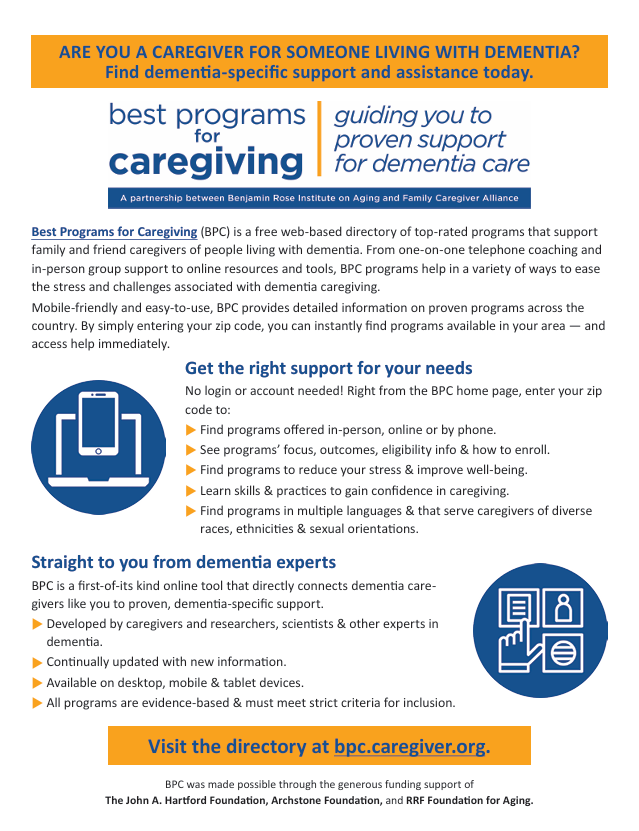
Best Programs for Caregiving (BPC) is a first-of-its-kind free online directory of top-rated programs that support the family members and friends caring for individuals living with dementia. Best Programs for Caregivers provides detailed information on nearly 50 dementia caregiving programs across the country that have help caregivers to identify the resources and services they need, improve their hands-on skills, reduce stress and enhance their physical and mental well-being.
Caregivers simply enter their zip code on the home page to find high-quality education and support programs offered online, via telephone or in person. No login or account is required. They’ll find a range of programs proven to help manage the challenges associated with dementia caregiving.
In addition to program features and focus areas, caregivers can view information on eligibility, enrollment, costs, and program length and format. They can also find programs offered in multiple languages or that serve caregivers of diverse races, ethnicities and sexual orientations.
Equally important, Best Programs for Caregiving also helps to address underserved populations across the country by expanding both awareness and availability of top-rated programming in remote and rural areas. The website includes information and enrollment details for 15 proven caregiver support programs that are available nationally in any location, through live or recorded online sessions or via telephone, to accommodate the needs of remote geographies.
Visit the site at bpc.caregiver.org.
| | | |
A Message from the Senior Community Service Employment Program (SCSEP) | |
NICOA Secures Four-Year SCSEP Funding
The National Indian Council on Aging (NICOA) is thrilled to announce that we have successfully secured four years of funding for the Senior Community Service Employment Program (SCSEP). This accomplishment includes both set-aside funding and general funding, ensuring the continuation and expansion of our vital services for American Indian and Alaska Native elders and all older adults in the communities we serve.
SCSEP is a critical program that provides job training and employment opportunities for low-income, unemployed older adults. For many, this program is a lifeline, offering not only a chance to earn an income but also to gain new skills, stay active, and contribute to their communities. Through SCSEP, job seekers are placed in part-time community service positions where they receive valuable on-the-job training.
The newly awarded four-year funding will allow NICOA to continue supporting our elders in achieving economic self-sufficiency and improving their quality of life. The set-aside funding specifically focuses on American Indian and Alaska Native older adults, recognizing the unique challenges and barriers they face in the job market.
With this substantial funding, NICOA plans to expand its reach and enhance the services provided through SCSEP. We will increase the number of job seekers, broaden the range of training opportunities, and strengthen our partnerships with local organizations and employers. This expansion will create more pathways for our elders to gain meaningful employment and engage more deeply with their communities.
This funding allows us to continue our mission of advocating for the rights and well-being of American Indian and Alaska Native elders. We are grateful for the trust placed in us by our funders and are determined to deliver impactful results over the next four years.
We invite all members of the NICOA community and our partners to join us in celebrating this significant achievement. Together, we will continue to empower our elders, honor their contributions, and build a stronger, more inclusive future for all.
Key Objectives of SCSEP:
-
Training and Employment: SCSEP provides part-time, community service training positions to eligible older adults, allowing them to gain work experience and skills that improve their chances of obtaining unsubsidized employment.
-
Economic Self-Sufficiency: By offering paid training opportunities, the program helps job seekers achieve financial independence and economic self-sufficiency.
-
Community Service: Job seekers are placed in various community service roles, such as in libraries, schools, hospitals, and senior centers. This not only benefits the job seekers but also enhances community resources and services.
-
Promoting Health and Well-being: Engaging in meaningful work and community activities helps improve the mental and physical health of older adults.
-
Combating Age Discrimination: SCSEP works to raise awareness and reduce barriers related to age discrimination in the workforce.
Eligibility Criteria:
- Age 55 or older
- Unemployed
- Meet income guidelines (typically at or below 125% of the federal poverty level)
- Reside in the area served by the SCSEP project
Program Structure:
Job seekers typically work an average of 20 hours per week and are paid the highest of the federal, state, or local minimum wage. They receive on-the-job training and may also access supportive services such as personal and career counseling, job search assistance, and skills training. The goal is to transition job seekers to unsubsidized employment in the private or public sector.
If you or anyone you know can benefit from SCSEP, please contact us at 505-292-2001 or www.nicoa.org. NICOA administers SCSEP in seven states, including, Arizona, Minnesota, New Mexico, North Dakota, Oklahoma, South Dakota, and Wisconsin.
| | | |
|
Contact Information:
New Mexico Regional Office (Serving portions of AZ & NM)
Phone: (505) 292-2001, Fax: (505) 292-1922
Oklahoma Regional Office (Serving portions of MN, OK, & WI)
Phone: (405) 254-3642, Fax: (405) 254-5044
North Dakota State Office Phone: (701) 314-5100, Fax: (701) 787-1880
South Dakota State Office Phone: 605-220-7200, Fax: 605-220-8869
Leslie Maly
Senior Community Service Employment Program Director
| | | |
|
The Senior Community Service Employment Program (SCSEP) is currently hiring! The Employment Training Coordinator (ETC) will assist Job Seekers by placing them in community service positions at non-profit organizations or public agencies, where they can enhance their skills and increase their chances of finding permanent employment.
If you are passionate about making a difference in your community apply today! Visit www.nicoa.org/about-us/job-opportunities/.
| | | |
Connecting with OUR Community | |
|
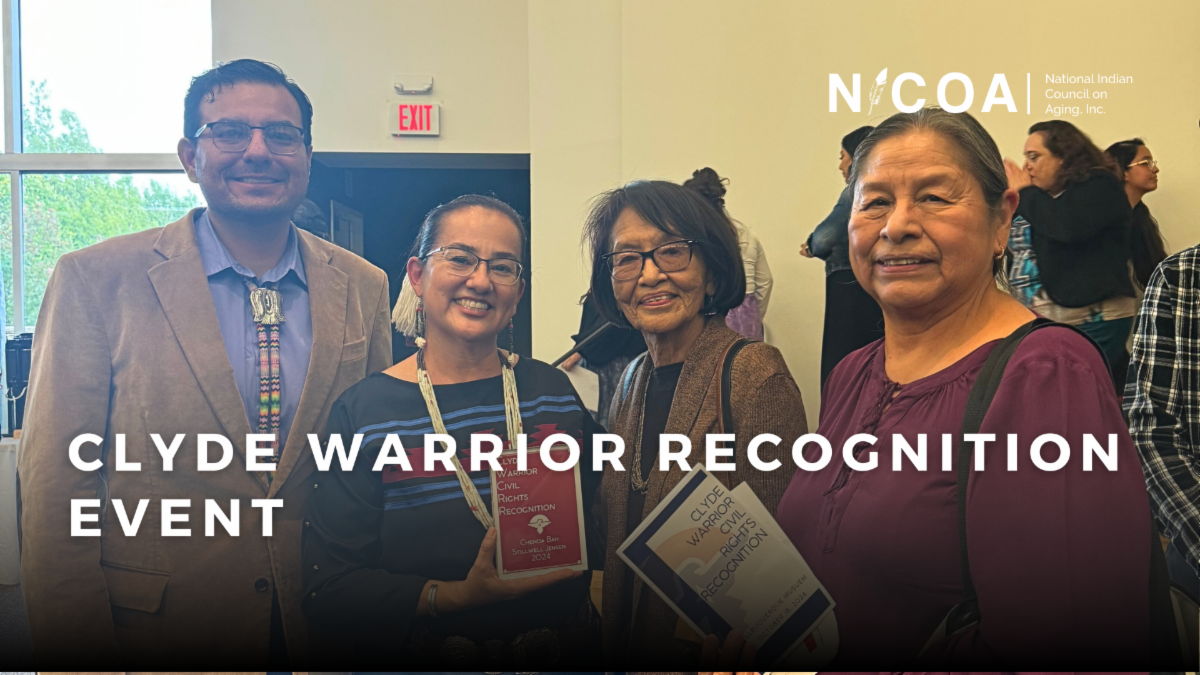
The National Indian Council on Aging staff attended the Clyde Warrior Recognition event in October hosted by the Native Professional Advancement Center (NPAC) originally called the National Indian Youth Council, Inc. (NYIC).
We were so honored to hear about the monumental impact Clyde Warrior (Ponca) had on the Native community and his dedication to standing up for American Indian rights. As well, as hearing about his resilience to speak out against injustice and leading the Red Power movement back in the late 1960s.
NICOA staff also heard stories of many leaders today who were also recognized for their impact on the native community. (Pictured, Chenoa Bah Stilwell-Jensen being recognized by NPAC).
| |
|
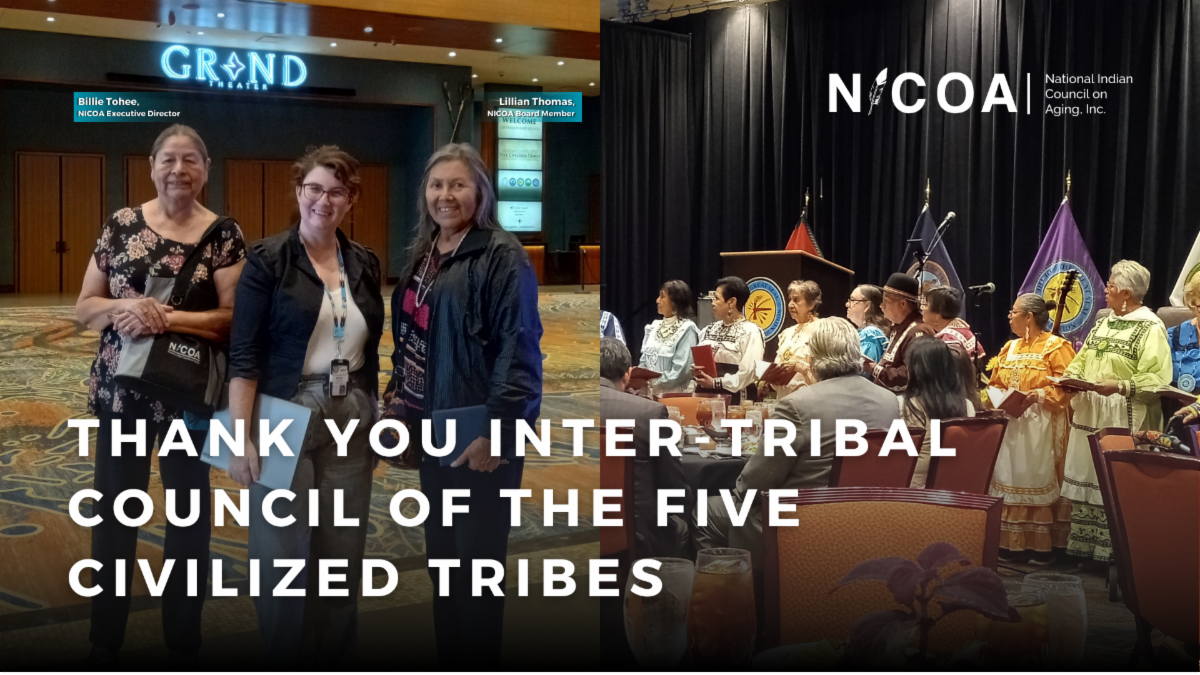
In October, NICOA Executive Director, Billie Tohee was invited to attend the Inter-Tribal Council of the Five Civilized Tribes Executive Council meeting in Durant, Oklahoma.
In addition, Board Member, Lillian Thomas from the Muscogee (Creek) Nation, representing our Eastern Oklahoma region, also attended.
We would like to thank the Inter-Tribal Council of the Five Civilized Tribes, for allowing NICOA leadership to attend and speak at the Executive Council meeting.
| |
|
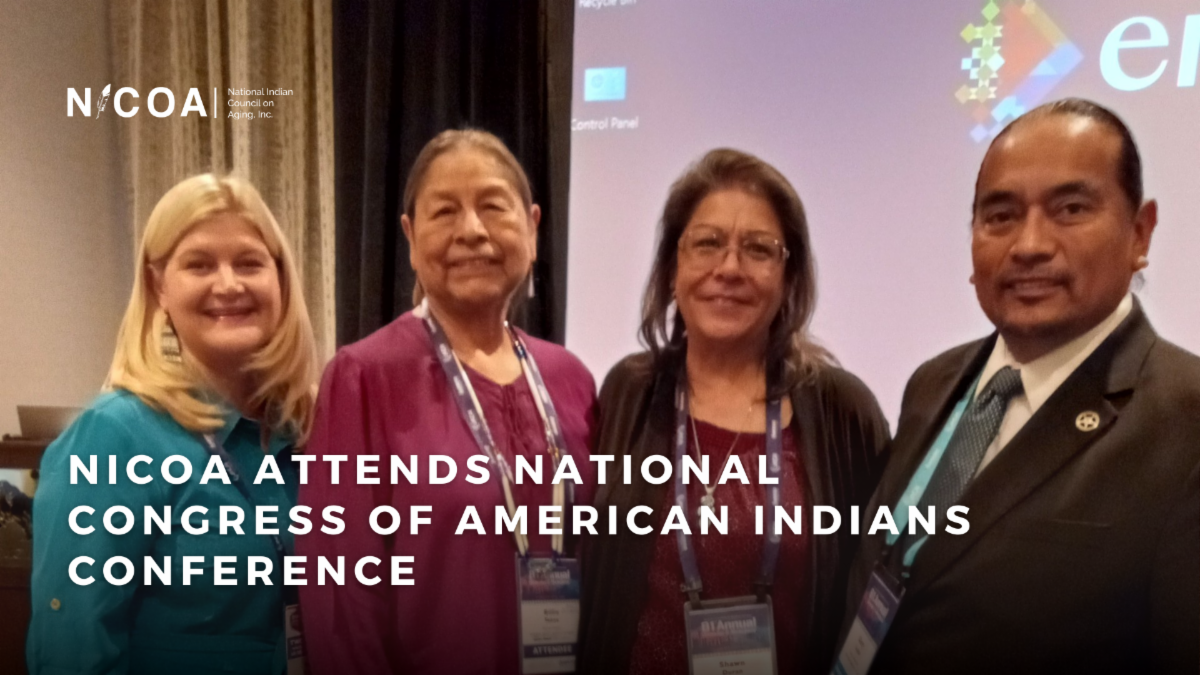
Earlier this month NICOA leadership attended the National Congress of American Indians in Las Vegas, Nevada. We would like to recognize the importance of NCAI creating a space to address issues in the native community and how to collectively resolve them.
NICOA leadership in attendance is as follows:
- Board Chairperson, James DeLaCruz (Quinault Indian Nation, Northwest Region)
- Board Vice Chairperson, Donna Ennis (Fond du Lac Band of Lake Superior Chippewa, Midwest Region)
- Executive Director, Billie Tohee (Otoe-Missouria Tribe)
Additionally, James DeLaCruz and Donna Ennis also serve as co-chairs of the NCAI Elders Committee.
Thank you National Congress of American Indians for putting on this conference! Looking forward to next year.
| |
Join Giving Tuesday and Support NICOA! | |
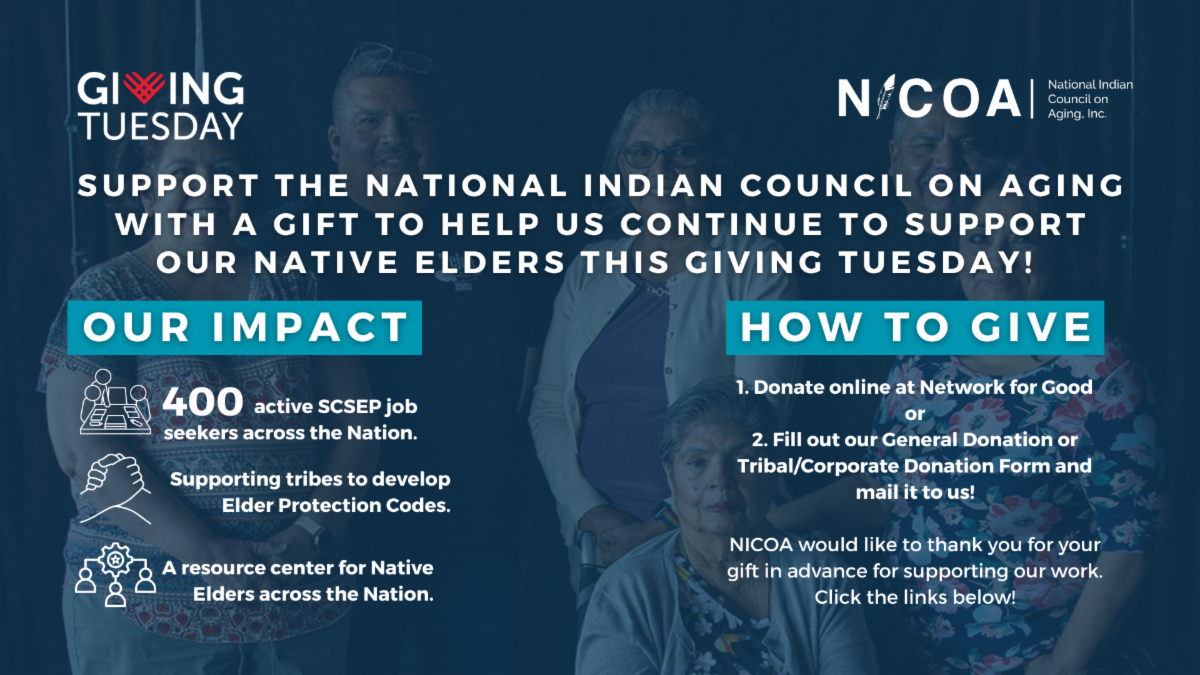
Mark your calendars because December 3, 2024, is Giving Tuesday! The National Indian Council on Aging invites you to join and celebrate Giving Tuesday.
GivingTuesday was founded in 2012 with a simple goal: to inspire people to do good. Over the past nine years, this idea has blossomed into a worldwide movement that motivates millions to give, collaborate, and celebrate generosity.
A simple gift can transform lives and create a lasting impact on our Native communities. Support NICOA today by clicking one of the links below!
| |
|
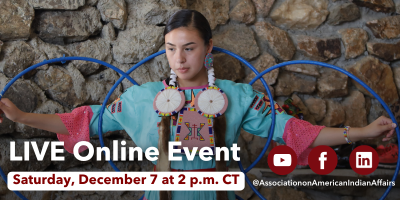
Upcoming Event: Tribal Museums Day,
December 7-13, 2024
Tribal Museums Day brings attention to our diverse Nations and cultures, stimulates tourism and grows Tribal economies. Tribal Museums Day also supported the vision and mission of each Tribal Museum by re-educating the public that our Nations are the primary experts of Indigenous histories, knowledge, cultures, lifeways and values.
Check out a Tribal Museum or Cultural Center near you and you may enjoy:
- FREE Admission
- Special Exhibits
- Gift Shop Discounts (consider holiday gift giving!)
- Art Markets
- Live Cultural Demonstrations
| |
Recent Tribal Newsletters | | | |
|
The President of the United States Issues Historic Apology for U.S. Indian Boarding School Atrocities
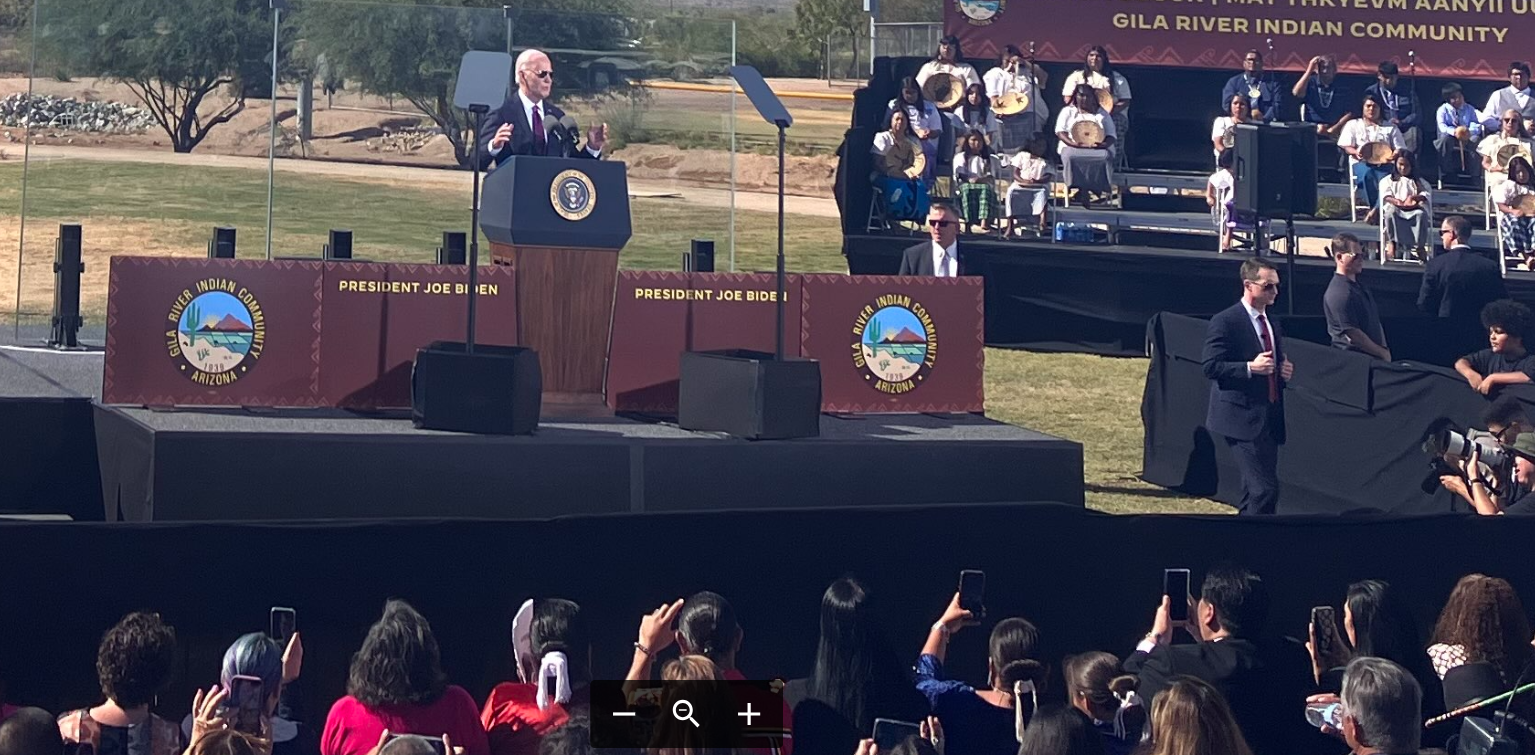
GILA RIVER INDIAN RESERVATION -- A moment of silence, and then an apology.
President Joe Biden marked history at the Gila River Indian Community where he apologized before community members and tribal leaders from nations across the country in an effort to move forward from the horrendous era of the U.S. Indian boarding school policies.
“Native communities flourished on this land, they practiced democratic government before we ever heard of it, developed advanced agriculture, contributed to science, art and culture,” Biden said to a round of cheers.
This marked the first visit by a U.S. president to a tribal nation since Barack Obama went to Standing Rock in 2014.
| | | |
UNM researching is advancing HIV Prevention and Health Equity for Native Americans | |
A University of New Mexico researcher and assistant professor is breaking barriers in the health community for fellow Native Americans.
Hailing from the Diné Nation, Crystal Lee has been researching health disparities in the Native American community, specializing in infectious diseases and associated preventative medicine practices.
“Our primary use of health care is through the Indian Health Service ... and the second is called Tribal 638,” said Lee.
The Indian Health Service is federally funded and works similar to Veteran Affairs services. Tribal 638 is funded through the Indian Health Service but is not federally monitored. Instead, tribes self-govern the health care services.
Lee conducted a study to analyze which health services Native Americans preferred when needing HIV prevention and biomedical care and the distinction in services and effectiveness between tribal-operated clinics and Indian Health Service clinics.
Lee has created a proposal for the National Institutes of Health focusing on HIV awareness and prevention using the results from her study.
“In general, we suffer from high rates of disparities, both infectious and chronic,” Lee said. “There are such a limited amount of Native American researchers in the U.S., especially that focus on infectious diseases. We need more Native American researchers out there who can conduct research in a culturally responsive capacity that benefits the community.”
| | | |
Medicaid to cover traditional Tribal community healthcare | |
For the first time, the Centers for Medicare and Medicaid Services is allowing Medicaid coverage of traditional healthcare practices provided by Indian Health Services facilities, Tribal facilities and urban Indian organizations.
CMS has approved section 1115 demonstration amendments that allow for traditional practices to be covered under Medicaid and the Children's Health Insurance Program (CHIP). The action applies to American Indian and Alaska Native communities.
Health insurance has not always recognized traditional healthcare practices for coverage.
CMS said the action is expected to improve access to culturally appropriate healthcare and improve the quality of care and health outcomes for tribal communities in Arizona, California, New Mexico and Oregon. It will support facilities in serving their patients.
| | | |
Biden-Harris Administration Announces $71 Million to Electrify Homes Across Indian Country with Clean Energy through President’s Investing in America Agenda | |
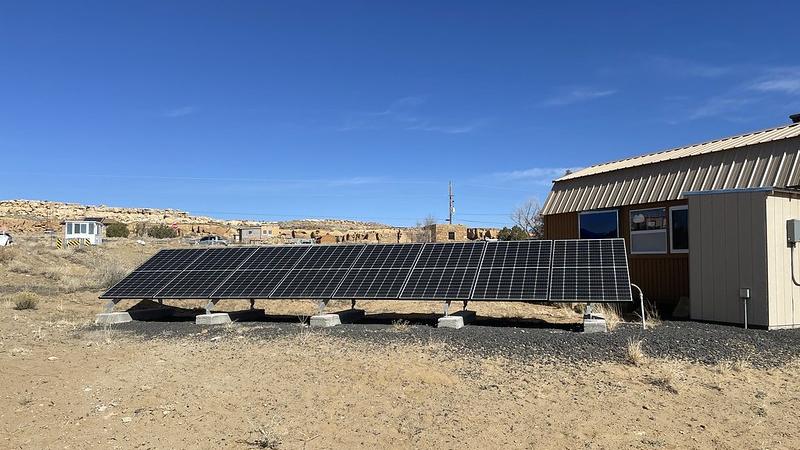
The Department of the Interior today announced a $71 million investment from President Biden’s Investing in America agenda to electrify homes in 13 Tribal communities across Indian Country, helping to close the Tribal access-to-electricity gap. This investment from the Inflation Reduction Act – the largest ever investment in climate – is a critical step toward the goal of electrifying all homes in the United States with clean energy sources and advances the Biden-Harris administration’s work to reach a carbon pollution-free electricity sector by 2035.
This second and final round of funding from the Bureau of Indian Affairs’ Tribal Electrification Program, is part of an overall $150 million commitment to provide financial and technical assistance to connect homes in Tribal communities to transmission and distribution that is powered by clean energy; provide electricity to unelectrified homes through zero-emissions energy systems; transition electrified homes to zero-emissions energy systems; and support associated home repairs and retrofitting necessary to install the zero-emissions energy systems. In addition, the program supports clean energy workforce development opportunities in Indian Country.
| | | |
‘A new era’: Indian Country sees big investments in economic development | |
The Department of the Treasury is celebrating a major milestone in tribal economic development, surpassing the $500 million mark in investments for small businesses and entrepreneurs in Indian Country.
Through the State Small Business Credit Initiative (SSBCI), tribes have been developing their own small business, financing and other economic initiatives. As of October 2024, $523 million has been invested in Indian Country.
According to Treasury’s announcement, 235 tribal nations have been approved for the SSBCI program, accounting for 40 percent of the total number of federally recognized tribes. Participants include the Cherokee Nation, where an $86 million investment will be utilized to provide loans to small businesses in Oklahoma.
“I think it’s a new era for supporting small businesses across the Cherokee Nation Reservation,” Principal Chief Chuck Hoskin Jr. said on a conference call with reporters last Thursday.
| | | |
|
President Biden Proclaims November as Native American Heritage Month
WASHINGTON — President Joe Biden on Thursday proclaimed November 2024 as Native American Heritage Month.
In the presidential proclamation below, the president said: "Indigenous peoples’ history in the United States is defined by strength, survival, and a deep commitment to and pride in their heritage, right to self-governance, and ways of life."
President Biden referenced his visit last week to the Gila River Indian Reservation where he issued an apology on behalf of the United States government's role in the physical, emotional, and sexual abuse of thousands of Native American students at Indian boarding schools.
| | | |
Forest managers finalize land exchange with Yavapai-Apache Nation | |
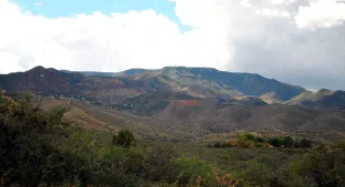
CAMP VERDE, Ariz. — U.S. forest managers have finalized a land exchange with the Yavapai-Apache Nation that has been decades in the making and will significantly expand the size of the tribe's reservation in Arizona's Verde Valley, tribal leaders announced Tuesday, Oct. 29.
As part of the arrangement, six parcels of private land acquired over the years by the tribe will be traded to the U.S. Forest Service in exchange for the tribe gaining ownership of 5 square miles of national forest land that is part of the tribe's ancestral homelands.
The tribe will host a signing ceremony next week to celebrate the exchange, which was first proposed in 1996.
"This is a critical step in our history and vital to the nation's cultural and economic recovery and future prosperity," Yavapai-Apache Chairwoman Tanya Lewis said in a post on the tribe's website.
Prescott National Forest Supervisor Sarah Clawson said in a statement that there had been many delays and changes to the proposal over the years, but the tribe and the Forest Service never lost sight of developing an agreement that would benefit both public and tribal lands.
| | | |
|
Feds Invest $82 Million in Clean Water for Tribes
For many Native communities in the Western United States, poor water quality and water shortages are a part of daily life. Citizens of the Navajo Nation regularly travel up to two hours one way to fill barrels of water at access points across the reservation; in recent years, tribes across the region have issued emergency declarations or advisories for water shortages caused by record-breaking droughts or contaminated water.
That could change, thanks to an $82M investment in clean drinking water announced by the Department of Interior last week that will fund clean water infrastructure in 23 Tribal communities.
The announcement was made last week at the San Carlos Apache Tribe reservation in eastern Arizona by Bureau of Reclamation Deputy Commissioner David Palumbo and Deputy Assistant Secretary for Water and Science Gary Gold.
| | | | | | |
|
We are committed to providing services for Native elders, but the power to provide starts with you.
Your support brings attention, education, and improved services to elders and people with disabilities across Indian Country. Every elder deserves access to the services and resources necessary to age independently, with dignity, and in their chosen community.
Consider donating to us directly to help us with our mission to improve the lives of American Indian and Alaska Native elders. Your financial support will go directly to supporting our mission to improve health, social services and economic well-being for all Native elders.
| |
The National Indian Council on Aging | 8500 Menaul Blvd. NE, Suite B-470, Albuquerque, NM 87112 | 505-292-2001 | www.nicoa.org | | | | |