|
1. Holocaust remembrance is urgent in an age of ignorance
Holocaust knowledge is declining as the last survivors pass away. Surveys show significant gaps in basic understanding – particularly among younger generations – leaving many unaware of the causes, scale and consequences of the Nazi genocide. As knowledge erodes, Holocaust distortion and misinformation spread more easily. Preserving survivor testimonies and ensuring they are passed to future generations is crucial to ensure that the solemn vow of “Never Again” is kept alive. Remembrance demands sustained commitment to education that protects historical truth, resists distortion and ensures that what happened is neither forgotten nor misused.
2. Erasing Jewish identity undermines Holocaust understanding
The Nazi genocide was a targeted campaign against Jews – rooted in anti-Jewish ideology and carried out with intent. When education or public narratives blur that reality, they obscure why the Holocaust happened and how it unfolded. Israel’s Yad Vashem World Holocaust Remembrance Center has recovered the names of 5 million of the 6 million Jews murdered in the Holocaust. Preserving historical accuracy requires identifying who was targeted, why they were targeted and the tragic consequences that followed.
3. Politicizing the Holocaust distorts history
Holocaust language increasingly is used to shock, accuse or delegitimize political debates – often through direct analogies that collapse complex history into simplified moral claims. Holocaust history is weakened when it is used as a political weapon rather than studied as history. Preserving historical truth requires resisting rhetorical shortcuts that turn one of history’s gravest crimes into a tool for today’s heated confrontations.
4. The Holocaust was a systematic process – not a sudden atrocity
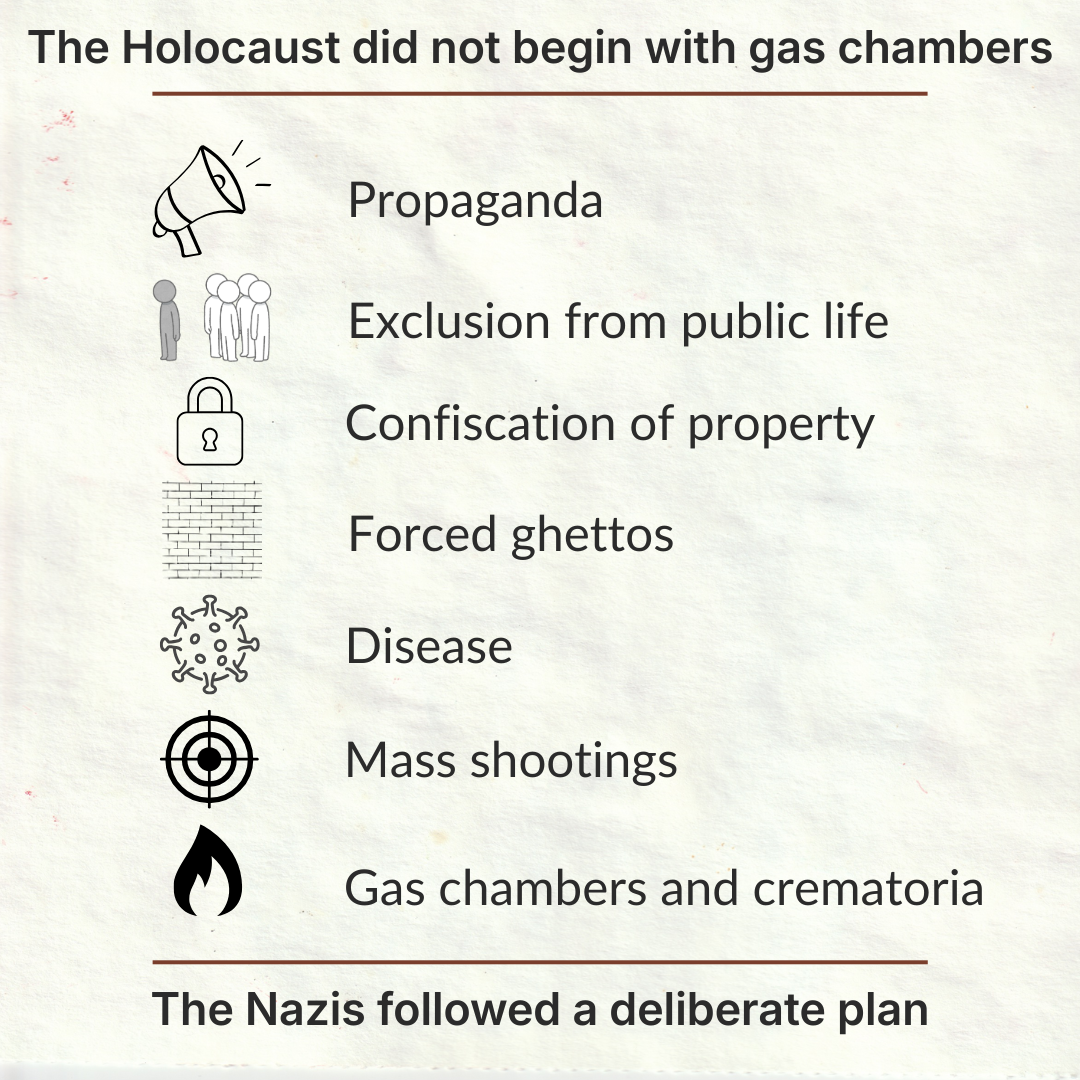
The Nazi genocide was not spontaneous. Adolf Hitler and the Nazi regime pursued a deliberate plan to eliminate all Jews – starting with the systematic extermination of Europe’s Jewish population. This plan unfolded over years of inflammatory news coverage and outright propaganda, discriminatory laws, economic dispossession and forced isolation – long before gas chambers were used for mass murder. Understanding this intent and process matters because it reveals how societies slide into catastrophe gradually – through policy choices and public acceptance – rather than through a single explosive act of violence.
5. Learning from the Holocaust is a moral obligation of humanity
The Holocaust is not distant history. Its consequences are carried by Jewish families and communities still living today – many of whom exist only because someone survived – only one or two generations removed from annihilation. When societies minimize or ignore what happened, they risk repeating the same patterns of exclusion, dehumanization and silence. Learning from the Holocaust protects our shared humanity by recognizing where unchecked hatred can lead.
6. Other genocides deserve recognition on their own terms
Acknowledging other genocides is important. The Armenian, Bosnian, Cambodian and Rwandan genocides had distinct causes, perpetrators and consequences. Few know that Germany committed the first genocide of the 20th Century against the Herero and Nama peoples in southwest Africa. Treating all genocides as interchangeable flattens history and obscures responsibility. Honest remembrance requires precision. Recognizing each genocide on its own terms allows those crimes to be fully understood.
|