|
The future might just be a step nearer…
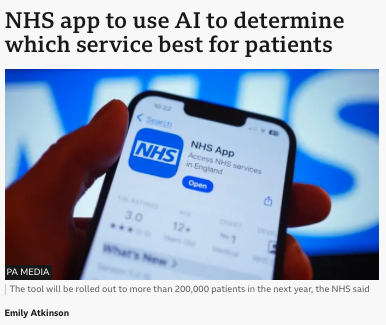
The NHS has announced the rollout of AI note-taking.
Stand-by for the usual nonsense; robots replacing doctors, computers making decisions, artificial intelligence taking over healthcare…
… forget it. That’s not what this is.
Actually, this is probably one of the most sensible uses of AI we are likely to see.
The idea is simple. A doctor talks to a patient. The patient talks to the doctor. The computer listens quietly, and…
… drafts the consultation notes, summarises what was discussed and prepares the record.
The clinician checks it, approves it and moves on.
The doctor looks at the patient instead of a screen. The nurse listens instead of typing. A computer does what computers were invented to do…
… the boring stuff.
What’s not to like?
Well… maybe nothing, but… there’s a question.
Not ‘can it work?’ The pilots suggest it can. The real question is…
… how will it work?
A digital future might be the meat and drink of the NHS but perhaps it could learn a lesson from the men and women who actually do the meat-and-two-veg…
... the catering department.
Years ago, during the great debates about hospital food, we discovered something important…
… it wasn’t enough to have better ingredients, improved menus, smarter kitchens, or even celebrity chefs.
The meal still had to reach the patient…
… hot, appetising and looking like something we actually wanted to eat.
All too often the kitchen did its job but somewhere on the journey to the bedside things went wrong.
We learned the ‘last nine yards’ of that journey mattered the most.
How the meal was delivered and served.
AI has the same problem. The clever bit is not getting a computer to write a note. That’s the kitchen. The hard bit is getting that note safely and reliably to where it needs to be.
That journey determines whether the note becomes useful.
Whether it reaches the patient’s phone, inbox or letterbox… the clinician’s screen… the pharmacist on the high street... the coders buried deep inside the NHS, because…
… the NHS is not one digital system.
It is a collection of hundreds of systems connected together with years of clever workarounds, patches and persistence.
GPs use different systems. Hospitals use different systems. Departments inside the same hospital can use different systems.
The AI can create a perfect consultation note. Then what? Where does it go?
Does it update the GP record? Does it update the hospital record? Create the letter? Does the patient see it? Does it become useful information or just another beautifully written document sitting somewhere?
I’ve seen both sides of this.
During my ongoing treatment at a London teaching hospital, their patient app has been excellent; appointments arrive, results appear, letters are available…
… it works, but…
… it isn’t the NHS App.
It’s another app. Another digital front door, and…
… the perfect example of a local NHS organisation solving a problem.
Across the NHS, clever people have created clever solutions. The difficulty is not a lack of innovation. The difficulty is joining all the innovation together.
Every organisation solved its own problem. Now the NHS has to solve the problem created by everyone solving their own problem.
The NHS has always been good at pilots because they have enthusiasts, support, attention and energy.
The test comes afterwards. Scale.
The rainy Monday morning. The clinic running late. The tired doctor. The patient who has already told their story three times.
That’s when technology either helps… or becomes another thing to feed.
This time there is reason to be hopeful.
AI note-taking is not trying to replace the judgement of clinicians. It’s trying to remove the work that stops them using their judgement.
Attacking the hidden bureaucracy of healthcare.
The productivity gain isn’t the note.
The productivity gain is what the note does next...
The letter that doesn’t need typing.
The form that doesn’t need filling.
The information that doesn’t need chasing.
The conversation that doesn’t need repeating.
If we get this right, AI won’t replace doctors.
It might give doctors back the time to be doctors, but…
… success will not depend on the cleverness of the algorithm. It’ll depend on something much less glamorous… the delivery system.
The NHS has cooked the meal. Now comes the difficult bit.
Getting it to where it needs to be…
… while it’s still hot.
|