|
Despite widely published claims that it’s “hotter than in the history of ever,” we’re happy to share truly encouraging news. Data from our ongoing assessments of state and regional climates show no evidence of human-caused warming in Virginia, Texas, Arkansas, Wyoming, or the American Midwest. And reviews currently underway for Montana and Colorado indicate the same.
Instead of the crisis so often described in headlines, we find modest, natural changes — mostly beneficial — that are helping agriculture, ecosystems, and people thrive.
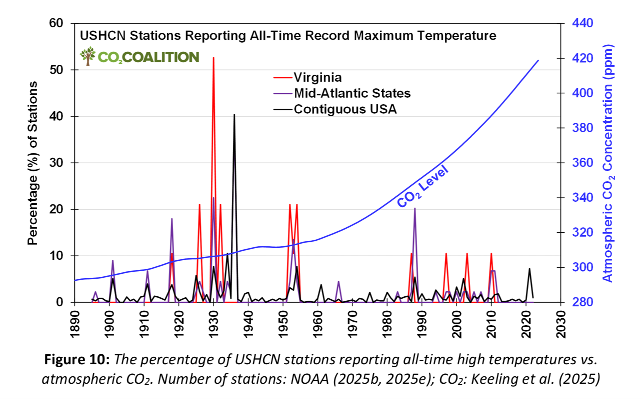
From our Virginia and Climate Change report (March 2026), we learn there is “no unusual nor unprecedented warming.” Virginia’s most intense heat waves were in the 1930s, and life in the Commonwealth has been relatively benign and productive in recent decades — great news for our farmers and families.1
The Texas and Climate Change report (August 2025) tells a similarly heartening story: Recent temperatures are “similar to those found more than 100 years ago” and “nearly identical to those experienced in the early 1900s.” There is no trend in maximum temperatures, fewer extremely hot days, and no increase in droughts or extreme weather.2
In the Arkansas and Climate Change report (July 2025), the findings are crystal clear: “Arkansas has seen no warming at all over the last 100-plus years.” Despite rising CO₂ levels, annual temperatures remain nearly unchanged, with no statistically significant trend. In fact, maximum temperatures have declined more than 1 °F since 1900, and the worst heat waves occurred in the 1930s.3
Arkansas truly is the “Land of No Man-Made Warming!”
In Wyoming, temperatures have risen only a modest 1.2 °F over 120 years — mostly warmer nights that are extending growing seasons and helping crops and wildlife. Daytime highs peaked long ago in the 1930s and have been trending downward ever since. The report beautifully reminds us that Wyoming is benefiting from natural warming that began centuries ago.
And the American Midwest and Climate Change report (June 2023) confirms that recent temperatures are “comparable to those measured nearly 100 years ago,” with “no discernible trend of increasing summer heat or heat waves.”4 The most severe heat came during the Dust Bowl era when CO₂ levels were much lower.
Across all these wonderful parts of America, the story is consistently positive: The main effect of increases in atmospheric CO2 from industrial emissions has been more robust plant growth and crop harvests. Moreover, natural warming since the end of the Little Ice Age 170 years ago also has been beneficial. There simply is no climate crisis and no reason to expect one from human activity.
I invite every policymaker, community leader, and concerned citizen to read these reports for themselves. The evidence speaks for itself — and it is very good news!
1. Virginia and Climate Change (pp. 10, 13, 24)
2. Texas and Climate Change (pp. 5, 28)
3. Arkansas and Climate Change (pp. 5–6, 8, 10, 29)
4. American Midwest and Climate Change (p. 3)
Please visit CO2coalition.org to explore our publications and related resources.
|