|
Daily Transportation News
May 27, 2026
| | | House Surface Transportation Bill Would Codify FTA Taxicab Exception | |
Transportation and Infrastructure Committee Chairman Sam Graves (R-MO) | |
On May 17, the House Transportation & Infrastructure Committee released the draft “BUILD America 250 Act,” a five-year surface transportation reauthorization bill covering FY2027–2031 that includes major provisions impacting transit, micromobility, autonomous vehicles, intercity bus access, and public-private transportation partnerships. The approximately $580 billion package comes as Congress races to renew key Infrastructure Investment and Jobs Act (IIJA) surface transportation authorities before their September 30 expiration deadline. Among the most closely watched provisions for the for-hire transportation industry is language that would formally codify and clarify the Federal Transit Administration’s longstanding “taxicab exception” under federal drug and alcohol testing rules.
The proposal arrives amid ongoing controversy surrounding the FTA’s December 2024 proposed reinterpretation of the exception, which would have significantly narrowed the ability of transit agencies to partner with taxis and Transportation Network Companies (TNCs) without triggering full federal drug and alcohol testing requirements. Transit agencies, accessibility advocates, and mobility providers across the country raised concerns that the proposed FTA policy could disrupt paratransit operations, first- and last-mile programs, and innovative Mobility-as-a-Service partnerships that have expanded dramatically over the last decade.
Under the draft legislation, the Secretary of Transportation would generally be prohibited from classifying taxi and TNC drivers as covered individuals under FTA drug and alcohol testing regulations when transit agencies provide riders with more than one transportation provider option for each trip and disclose differences in testing requirements between providers. The legislation also expressly extends the framework to TNCs and requires that any such services “supplement, not supplant” fixed-route public transportation. Supporters view the language as an attempt to balance federal safety oversight with the operational flexibility needed for modern multimodal transit partnerships.
| |
The bill language closely aligns with recommendations outlined in IATR’s 2025 draft report, FTA’s Taxicab Exception: Modernizing Public Transit for a Multi-Modal Future, which urged Congress to preserve and codify the exception during the next surface transportation reauthorization process. While the bill language does align with the report, IATR is open to hearing other views at and before its 39th Annual Conference, taking place September 14th - 17th in Las Vegas. There, we will take a deep dive and discuss the issue further during our sessions titled "Public Transit Partnerships with Taxis, FHVs and TNCs: The Status of the FTA Taxicab Exception Debate."
The BUILD America 250 Act remains in draft form and is expected to evolve as it moves through the committee and legislative process. Nevertheless, transportation stakeholders nationwide are likely to view the inclusion of the taxicab exception language as one of the clearest signals yet from Congress regarding the future of multimodal public-private partnerships and the evolving role of taxis and TNCs in federally supported transit systems.
Click Here for BUILD America 250 Act Details
Click Here for the IATR’s Taxicab Exception Report
| | |
Matt Daus Speaking at August NEMTAC Transform Conference in Orlando
Nominations for Industry Awards End This Friday May 30
| |
|
NEMTAC Transform is taking place in Orlando, Florida, August 16-19!
Matt Daus, IATR President, will be speaking at the nation’s leading conference dedicated to advancing non-emergency medical transportation. Bringing together providers, brokers, payers, regulators, and technology partners, Transform delivers real-world insights to improve safety, reliability, and equitable access to care.
Hosted by NEMTAC®, an ANSI-accredited standards developer, the conference serves as a national hub for collaboration—aligning operations, policy, and innovation across the NEMT ecosystem. Attendees gain practical strategies, engage in cross-sector dialogue, and access the latest developments in standards, compliance, and system performance.
A highlight of the conference is the presentation of the NEMTAC Industry Awards, which honor the individuals, organizations, and partners who are making a difference in non-emergency medical transportation through their commitment to operational excellence, innovation, safety, and access to care. If there is a provider, broker, partner, technology leader, or industry professional whose work deserves recognition, we encourage you to submit a nomination before the Friday, May 30th deadline here.
| | |
Tampa International Airport CEO Shares Vision for an Air Taxi Hub
Tampa International Airport CEO Michael Stephens shared the concept of air taxis at Thursday’s Tampa City Council meeting. “It is important that even though we bring people in at 600 miles an hour, that they can get around and they’re connected to this city and to this region,” Stephens said.
Click Here to Read More
Philly Principals Say They Need the $1-per-Ride Uber Tax to Keep Schools Afloat
The proposed Uber tax is still in play, and budget details are expected to be hammered out soon, with first passage of a city budget in early June. Mayor Cherelle L. Parker has proposed imposing a $1-per-ride tax on services such as Uber and Lyft to generate about $50 million to stave off the classroom cuts, including 148 teaching jobs and 119 climate staff positions.
Click Here to Read More
Miami Beach Rolls Toward Micromobility Safety Rules
Miami Beach commissioners are advancing safety regulations for operators of micromobility devices. The rules would require lights and helmets for younger riders, among other measures. Commissioners cite national safety data showing that injuries related to micromobility devices have increased as their use has expanded.
Click Here to Read More
| |
BYD Opens an Electric Bus Plant in Canada
The first buses to roll out of the production lines will be addressed to Toronto Transit Commission, the country’s largest transit operator, that will receive ten zero emission buses with an option for 30 more.
Click Here to Read More
Saint-Denis Street Is losing Its Car-Free Status This Summer
For the first time in four years, Saint-Denis Street in Montreal’s Quartier Latin will remain open to traffic this summer, to accommodate nearby traffic. The decision that sparked mixed reactions from merchants in the area.
Click Here to Read More
New Electric Ice Explorer Challenged by Athabasca Glacier’s ‘Very Unique Environment’
A company that organizes tours of the Columbia Icefield has unveiled a brand-new electric vehicle to take guests to the Athabasca Glacier. The pilot shows the technology is ready for Jasper National Park’s incredibly demanding operating environment, where the vehicle must climb and descend very steep hills while hauling a lot of weight. The vehicle features six kilowatts of solar on the roof, which puts back approximately 12 per cent on an average day into the battery.
Click Here to Read More
| |
Man Dedicates 5 Years to Becoming a London Taxi Driver, Succeeds after 55 Tries
After 55 attempts over five years, Anshu Moorjani finally completes “the Knowledge” series of exams, earning a London black cab license. The Transport for London “Knowledge” test is an intensive multi‑year exam process that requires would‑be London black cab drivers to memorize and accurately navigate thousands of streets and landmarks within a six‑mile radius of Charing Cross, proving they can give the fastest routes anywhere in the city from memory
Click Here to Read More
How the English Devolution Act Could Reshape Micromobility
The recently passed English Devolution and Community Empowerment Act 2026 cedes more control over transportation matters to regional and local authorities, which is set to reshape the micromobility industry in that nation.
Click Here to Read More
Aberdeen, Scotland Consultation Finds Divided Views on Taxi Test's Future
A consultation on a street knowledge test for taxi drivers in Aberdeen has suggested opinion is divided on its future. The ride-hailing app, Uber, had urged the city council to remove the test, which it feels would see more drivers enter the trade, and help meet demand from customers. The taxi industry said there was no need to change the current system as it was "working".
Click Here to Read More
| |
Lyft Is Coming for Corporate Travel
Lyft CEO David Risher outlines that companies’ strategy to adapt to the rise of autonomous vehicles by appealing to higher-end customers who will pay a premium for chauffeured transportation.
Click Here to Read More
How Flying Ferries Could Bring Commuters Back to the Water
Candela’s “flying ferries” are electric hydrofoil boats that lift out of the water, cutting drag by around 80 percent, slashing energy use and emissions, and offering a smoother, faster ride than conventional diesel ferries. From its Stockholm factory, Candela is now scaling up production to deliver vessels to operators in India, Thailand, the Maldives, Saudi Arabia, the US; paradoxically, Europe is currently its slowest‑growing market.
Click Here to Read More
Kazakhstan Prepares to Launch Driverless Taxi Service in 2026
Kazakhstan plans to launch a pilot project for driverless taxis in the second half of 2026, accelerating the country’s push toward autonomous transport technologies and the digitalization of urban mobility. Preparations for the project were announced by Kazakhstan’s Ministry of Artificial Intelligence and Digital Development.
Click Here to Read More
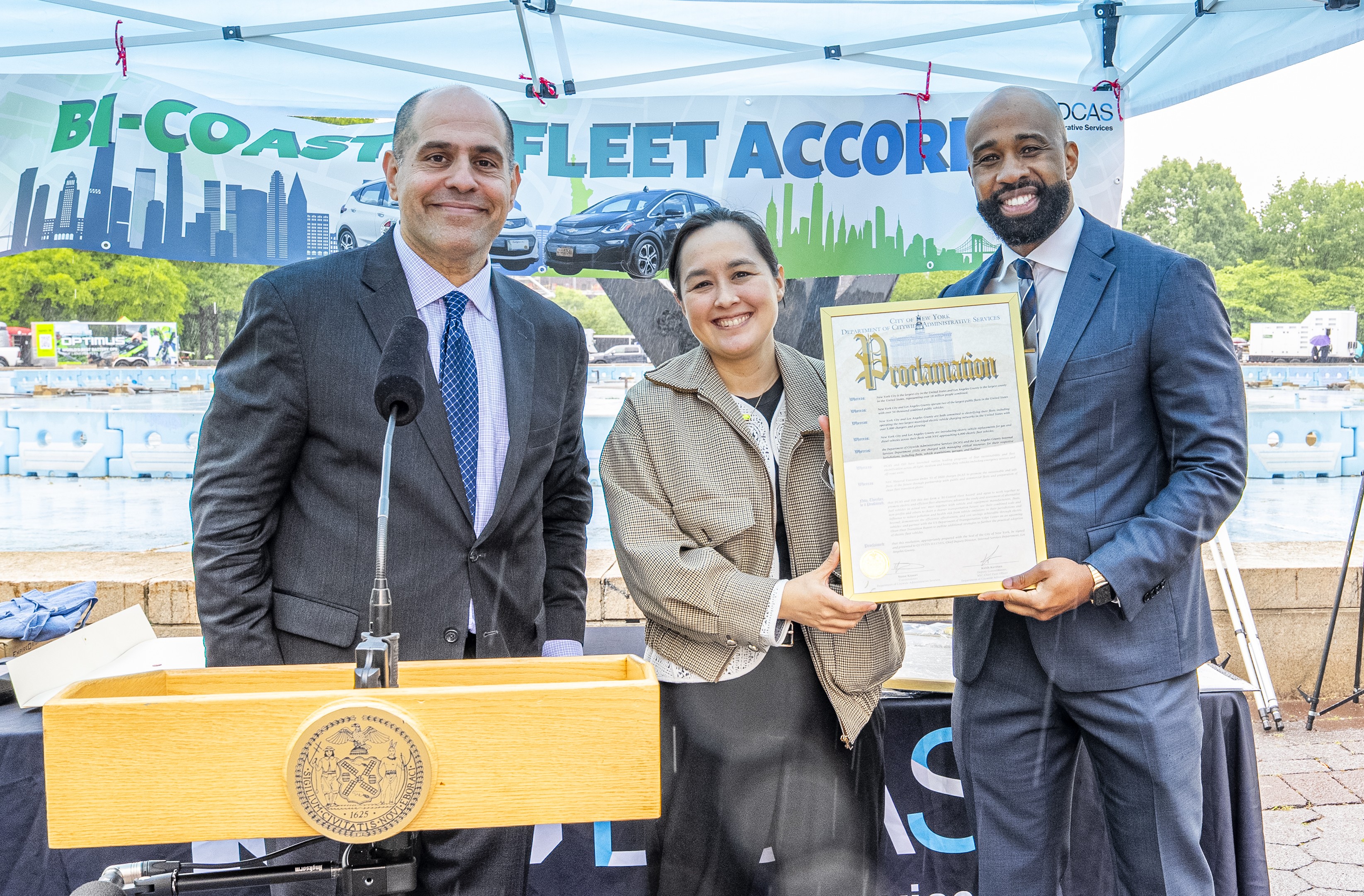
| | NYC, LA County Form Municipal Fleet Partnership to Advance Zero-Emission Vehicles | |
From Left: DCAS Deputy Commissioner of Fleet Management and Chief Fleet Officer Keith Kerman; DCAS Commissioner Yume Kitasei; and Los Angeles County ISD Chief Deputy Director Quintin Haynes | |
The New York City Department of Citywide Administrative Services and Los Angeles County Internal Services Department have launched the Bi-Coastal Fleet Accord, a first-in-the-nation municipal vehicle partnership designed to support clean fleet goals through mutual support, advocacy, and scale.
The accord was recently announced at the 37th Annual Equipment & Vehicle Show. According to DCAS, the partnership aligns the nation’s largest city and the nation’s largest county, which operate the largest municipal fleets and charging networks, into an advocacy block focused on supporting the transition to zero-emission vehicles and sustainable fleet operations.
Through the Bi-Coastal Fleet Accord, New York City and Los Angeles County will look to promote continued investment, purchasing, and innovation for alternative-fueled vehicles. The two municipalities will also work together to support a more comprehensive transition to zero-emission vehicles across both locations.
“The City of New York and Los Angeles County operate two of the largest municipal fleets in the country, and through the Bi-Coastal Fleet Accord we are unlocking transformative potential,” said DCAS Commissioner Yume Kitasei. “By aligning with Los Angeles County, DCAS is accelerating fleet electrification and helping to shape a more efficient and sustainable future for cities nationwide.”
Quintin Haynes, chief deputy director of the County of Los Angeles Internal Services Department, said the partnership establishes a “Bicoastal Bridge” that will allow the two governments to combine institutional knowledge and support municipal fleet transformation.
“New York City and Los Angeles County have been independently pursuing ambitious programs of sustainable and electric fleets,” said DCAS Deputy Commissioner and NYC Chief Fleet Officer Keith Kerman. “Effective today, the nation’s largest city and largest county are in this effort together through the Bi-Coastal Fleet Accord.”
Source: ACT News
Click Here to Read More
| |
|
Message from IATR President Matthew W. Daus
At the International Association of Transportation Regulators (IATR), our regulators are at the forefront of addressing both the challenges and opportunities facing the mobility paradigm. Our IATR members, partner organizations, and regulated industries will continue on our shared quest to fulfill the mission of our non-profit educational organization - to bring about Multi-Modal Mobility Innovation for All! This mission can best be accomplished through information sharing, collaboration, identifying and promoting best practices, and educating our membership. These educational updates and electronic media clips are affectionately known as “IATR snips” and endeavor to cover all aspects of mobility around the globe - especially news and developments involving safety, technology innovation, multi-modal integration, automation, sustainability, electrification, accessibility, regulatory modernization, and equity.
If you would like more information about the IATR, you can visit our website at www.iatr.global. Current members can renew their memberships when you log in to your IATR portal on the top right-hand side of our website, or click here. If you forgot your membership password, please email our Membership Director, Eric Richardson, at erichardson@iatr.global.
| | | | | |
|
RENEW YOUR MEMBERSHIP FOR 2026:
Weekly news snippets
Access to the membership database
Videos and files from recent conferences
Discounted rates for future conferences, and more!
Renew your membership at http://www.iatr.global or email info@iatr.global for any questions!
| | | | |