|
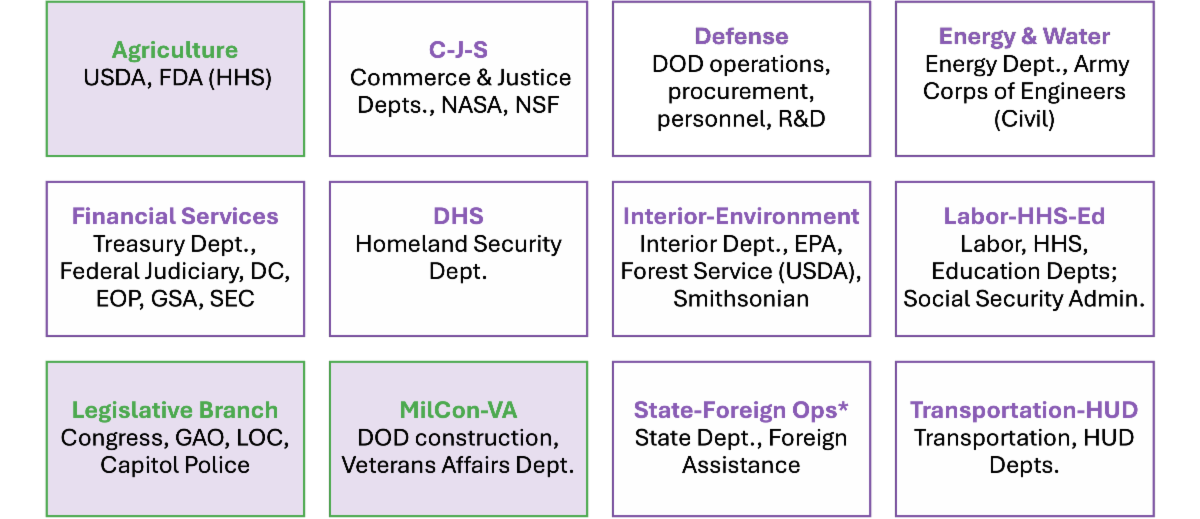
The Senate has hopes of advancing a package of five appropriations bills, including the two largest, which are Defense and the Labor-HHS-Education Appropriations bills, along with the Commerce-Justice-Science, Interior-Environment, and Transportation-HUD spending bills. To do so, they will have to handle a whole host of “holds” by invidual Senators with complaints about the proposed package. House Appropriators, for their part, prefer a smaller package, excluding Defense and Labor-HHS-Education, to keep pressure on to pass all the annual spending bills by the January 30th deadline.
No Clear Plan on ACA Subsidies Extension; PBM Reform, Possibly.
Senate HELP Committee Chairman Bill Cassidy’s (R-LA) this week unveiled a plan to expand Health Savings Accounts (HSAs) in the place of extending the enhanced Affordable Care Act premium tax credits ("ACA subsidies"), similar to the preferred position of President Trump. However, that plan isn’t going anywhere with Senate Democrats, who continue to press for an extension of the ACA subsidies “as is.”
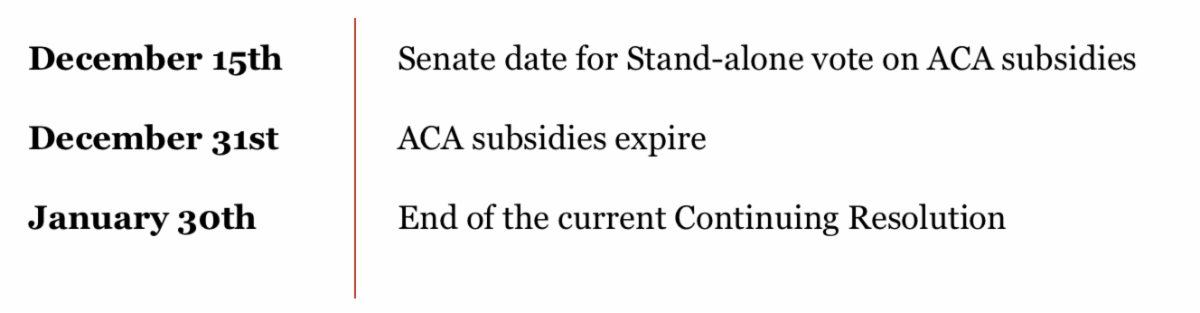
The current subsidies expire next month. Without an extension, 20 million Americans will face significantly higher costs for their health care coverage. Aside from the policy implications and politics surrounding the ACA subsidies, as a practical matter there is little time to craft major or even minor changes to the ACA before the December 15th deadline by which Senate Republican Majority Leader John Thune (R-SD) promised a stand-alone vote on ACA subsidies in the Senate. Hardline conservatives in the Senate, along with key White House officials, hinted this week they may attempt a second budget reconciliation package that would only require Republican votes to advance a fix. Such a strategy would face long odds on a short timeline. Separately, Senate Finance Committee Chair Mike Crapo (R-ID) and ranking member Ron Wyden (D-OR) are set to revive a bipartisan effort to crack down on the intermediaries known as Pharmacy Benefit Managers (PBMs) which previously passed the panel on a bipartisan basis under Democratic control in 2023 by a vote of 26 – 0. This measure could move as part of any ACA agreement, or separately, as part of a measure on government spending for the remainder of FY2026.
For more reading on ACA and Health Care:
Tariff Developments
While President Trump and Treasury Secretary Bessent continue to tease the idea of tariff refunds of up to $2,000 per American (meeting particular income criteria), critics and key Members of Congress have noted it will require Congressional action to implement. Further, the tariff revenues that would finance the refunds can’t be counted on as the Supreme Court continues to weigh the legality of some of Trump’s core tariff policies implemented using an emergency authority known as IEEPA. In the meantime, the President and his trade team continue to herald bilateral trade agreements and the easing of tariffs on some key agriculture products to address complaints on affordability and adverse impacts on US consumers.
National Defense
The House and Senate Armed Services Committees continue to meet informally to reach agreement on the annual FY2026 National Defense Authorization (NDAA). While expectations remain that the annual NDAA will be finalized in early to mid-December, there are still some key items to resolve, including the Senate’s call for significantly higher spending levels. Meanwhile, the Department of Defense continues to roll out major initiatives, including acquisition reform (WSW Summary in Brief on Acquisition Reform).
Key Dates:
|