Weekly update from the National Housing Conference | | News from Washington | By Brittany Webb | | |
Housing for the 21st Century Act coming to House floor
The U.S. House of Representatives is reportedly eyeing a vote on the bipartisan Housing in the 21st Century Act the week of February 9th under suspension of House rules, likely on Monday evening when the House convenes for votes at 6:30 PM. NHC, alongside other housing groups, sent a letter to Speaker Mike Johnson (R-La.) and Minority Leader Hakeem Jeffries (D-N.Y.) urging their support. We recommend organizations who support the legislation to reach out to members of the House before the vote on Monday. Click here to find your Representative’s information.
The bill includes a range of provisions that seek to address the housing supply and affordability crisis. In October, the Senate passed its bipartisan ROAD to Housing Act as an amendment to the National Defense Authorization Act and plans to advance it for an independent floor vote in the coming weeks.
The competing housing policy bills have many similarities. The latest version of the House bill also includes a bipartisan community banking title. Some House members have expressed concerns about provisions in the Senate’s housing policy legislation, though it’s unclear which specific provisions they are referring to.
The House’s consideration of its bill comes as Democrats on the Hill criticize the Trump administration’s actions on affordability, and Republicans look to highlight housing affordability in 2026.
“The most important accomplishment of passing housing legislation will be the fact that we passed housing legislation for the first time in a generation,” said David Dworkin, NHC's President and CEO. “This is a major confidence-building opportunity.”
| | | |
Register Today!
On April 8, 2026, the National Housing Conference will convene housing communications leaders from across the country for Solutions for Housing Communications, hosted at the National Press Club in Washington, D.C.
Panel discussions will spotlight strategies for clearly communicating complex and technical housing issues, working effectively with housing reporters, and understanding how technology and AI are reshaping public discourse. Sessions will also highlight the power of intergenerational storytelling, best practices for communicating before, during, and after natural disasters, and practical tools to help participants engage confidently across media platforms.
Members of the media receive complimentary registration.
Please contact kbeigay@nhc.org for more information.
| | |
Government reopens after brief shutdown
The federal government reopened after a four-day partial shutdown when lawmakers reached a compromise Tuesday. Spending bills for five agencies were finalized for fiscal year 2026, including funding for the U.S. Department of Housing and Urban Development (HUD); Department of Defense; Financial Services and General Government; Departments of Labor, Health and Human Services, Education, and Related Agencies; and National Security, Department of State, and Related Programs. The bill for the Department of Homeland Security (DHS) extends current spending levels through February 13, giving members of Congress additional time to negotiate DHS funding in the wake of widespread criticism of Immigration and Customs Enforcement (ICE).
The compromise legislation passed by a vote of 217 to 214 and funds about 95% of government operations through the end of September.
The total amount of gross funding for HUD is $77.3 billion, including: $38.43 billion for Housing Choice Vouchers, $18.54 billion for Project-Based Section 8, $1.25 billion for HOME Investment Partnerships, $3.3 billion for Community Development Block Grants, and $4.41 billion for Homelessness Assistance programs, among others.
| | | |
Democrats pen letter defending disparate impact
A group of Senate Democrats, led by Raphael Warnock (D-Ga.) and Elizabeth Warren (D-Mass.), are urging Office of Management and Budget (OMB) Director Russell Vought to rescind a proposed rule that would gut civil rights protections in lending. In a letter, the lawmakers argue that rescinding disparate impact would undermine the ability of the Consumer Financial Protection Bureau to enforce the Equal Credit Opportunity Act (ECOA) by narrowing the use of disparate impact analysis in fair lending oversight.
The Senators warned that limiting disparate impact authority will make it harder to detect and address discriminatory lending practices, particularly for communities of color and other historically underserved borrowers. They emphasized that fair lending enforcement plays a critical role in expanding access to credit and promoting equitable homeownership and said weakening these protections could exacerbate existing disparities in housing finance and affordability.
“The disparate impact test has been used for over 50 years to combat some of the most nefarious forms of discrimination and has been upheld by the Supreme Court repeatedly. The Trump Administration’s wrongheaded attempts to destroy this longstanding tenet of our civil rights protections and your defense of those actions—is callous, unjust, and yet another handout to industry on the backs of American consumers,” the letter reads.
| | | |
New episode released
On December 3, the National Housing Conference hosted its Solutions for Affordable Housing convening at the National Press Club. The event brought together policymakers and affordable housing stakeholders to discuss tangible, impactful, and achievable actions to address the nation’s most critical housing policy challenges.
In this week's episode, we revisit the panel, “Ending Homelessness: Successful Strategies for Sustainable Results,” featuring a discussion on the evolving dialogue on homelessness. Panelists shared insights on what’s working, where gaps remain, and how stronger alignment across systems can lead to more effective, sustainable support for individuals and families facing homelessness. Listen here.
| | |
Miran resigns from White House to stay at Fed
Michael Miran has resigned from his position on the White House Council of Economic Advisers to remain in his role as a Governor at the Federal Reserve. President Trump appointed him to fill a vacancy at the central bank through a term expiring January 31, though he can continue at the Fed indefinitely until a new member is confirmed.
“While I took an unpaid leave of absence from the Council to come to the Federal Reserve, I promised the Senate that if I should stay on the Board past January, I would formally depart the Council,” Miran said in his resignation letter. “I believe it is important to stay true to my word while I continue to perform the job at the Federal Reserve to which you and the Senate appointed me.”
| | | |
Fannie Mae highlights rental portfolio
Fannie Mae reported that it provided $74 billion in multifamily housing financing in 2025, a 34% increase from 2024, and the Enterprises’ largest annual volume since 2020. This includes a commitment of over $5 billion in Low-Income Housing Tax Credit (LIHTC) investments since Fannie Mae reentered the market in 2018, resulting in 100,000 affordable housing units.
"Fannie Mae's multifamily financing was exceptional in 2025, providing roughly $74 billion in loan production volume for the year and crossing $500 billion in our book of business, thanks to the continued partnership of our Delegated Underwriting and Servicing lender partners. Together, we unlocked tremendous new opportunities for multifamily borrowers and investors that will create and preserve thousands of housing units across the country," said Kelly Follain, Fannie Mae’s Executive Vice President and Head of Multifamily. "We're grateful to all our partners and, with $88 billion in capital allocation this year, we look forward to accomplishing even more in 2026."
| |  | |
VA invests in home health and counseling
The Department of Veterans Affairs (VA) announced an increase in its expenditure limit for in-home and community-based services for Veterans contending with complex medical needs. Previously, the affiliated VA program would only cover 65% of services for persons with spinal cord injuries, Amyotrophic Lateral Sclerosis, and other complex medical conditions. The change now covers 100% of the costs to make it easier for Veterans to remain in their homes.
“This important change will enable Veterans with complex medical conditions to continue receiving high quality care while remaining in their homes, surrounded by friends and family,” said VA Secretary Doug Collins. “By matching the expenditure cap for home and community-based services with the cost of care in our Community Living Centers, we are enabling Veterans to maintain their independence and home connections.”
The VA also announced that is hiring an additional 300 vocational rehabilitation counselors and specialists to help Veterans navigate career transitions and pursue education or training. The hiring recognizes that comprehensive vocational guidance needs tailored to each Veteran’s unique circumstances.
| | | |
Housing burdens reach new highs
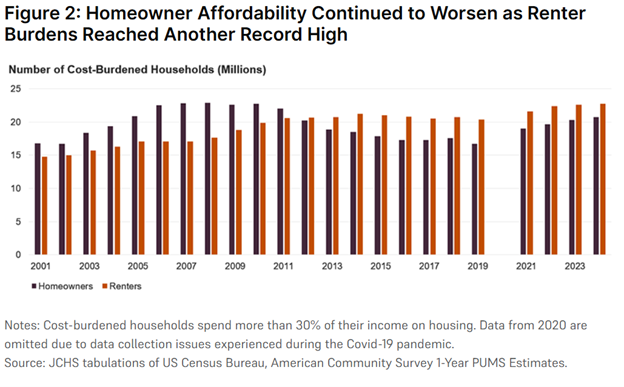
A recent analysis from the Harvard Joint Center for Housing Studies shows that both renter and homeowner cost burdens climbed to new highs in 2024, underscoring the breadth of the affordability crisis. The research finds that the number of cost-burdened households, defined as those spending over 30% of their income on housing, have set successive records for renters while homeowner pressures have intensified. Renter cost burdens rose steadily through the mid-2000s, then surged in the 2010s and early 2020s, leading to a total of 22.7 million cost-burdened renters in 2024. This marks the fourth consecutive year of setting record highs and represents nearly half of all renters. Homeowner burdens followed a different trajectory, spiking in the run-up to the Great Recession, falling as low interest rates and price declines took hold, and then rebounding as home prices and mortgage rates rose in the post-pandemic era. In 2024, there were 20.7 million cost-burdened homeowners, around 24% of all homeowners.
| | |
Enterprise Community Partners’ new report, “Curbing the Insurance Spiral: Policy and Practitioner Strategies to Help Stabilize Multifamily Affordable Housing,” examines how rising property insurance costs are straining affordable rental properties and threatening long-term viability. Drawing on interviews with owners, investors, and insurers, the report outlines practical steps such as improving building resilience, leveraging public risk-pooling and backstop mechanisms, and strengthening data sharing between insurers and housing providers to better place and manage risk. The authors also call for federal, state, and local policy changes to stabilize insurance markets in disaster-prone areas so that affordable multifamily housing can remain both insurable and financially sustainable over time.
A piece by Politico reports that Federal Housing Finance Agency Director Bill Pulte signaled the administration may back off earlier plans to pursue initial public offerings for Fannie Mae and Freddie Mac, while emphasizing that President Trump will make the final call. Pulte stated that “we don’t have to” take the government-sponsored enterprises (GSEs) public and framed the administration as well positioned to make “big, bold decisions” on housing, pointing to the recent move to purchase $200 billion in mortgage bonds to address affordability concerns. The shift marks a noted change from past signals to take the GSEs out of conservatorship.
A new Brookings analysis examines proposals to expand the capital gains exclusion on owner-occupied home sales as a way to unlock housing supply, finding the policy would mostly benefit a narrow slice of high-income, high-wealth households. Under current law, the authors show that 95% of all households, and 90% of those age 65 and older, would owe no federal capital gains tax if they sold their primary residence, meaning a higher exclusion would not change their selling behavior. The piece concludes that expanding the exclusion is unlikely to meaningfully increase turnover or ease housing shortages and would instead add to already generous tax preferences for advantaged homeowners, arguing that policies targeting land use and construction barriers are better suited to improving affordability.
| | |
Sunday, February 8
Commercial/Multifamily Finance Convention and Expo | MBA, February 8-11, 2026
Monday, February 9
No events listed.
Tuesday, February 10
Proposals For Better Housing Affordability: How Much Can the GSEs Help and What Does It Mean For Their Future? | NYU, 12:00 PM ET
The Next Chapter of Community Development Finance and Place-Based Investment | Urban Institute, 3:00 - 4:45 PM ET
Wednesday, February 11
No events listed.
Thursday, February 12
No events listed.
Friday, February 13
No events listed.
| | The National Housing Conference is a diverse continuum of affordable housing stakeholders that convene and collaborate through dialogue, advocacy, research, and education, to develop equitable solutions that serve our common interest. | | Defending Our American Home since 1931 | | Copyright © 2024. All Rights Reserved. | | | | |