Weekly update from the National Housing Conference | | News from Washington | By Brittany Webb | | |
CDFI funds apportioned, new restrictions forthcoming
The Office of Management and Budget (OMB) apportioned $289 million in FY25 dollars for the Community Development Financial Institutions (CDFI) Fund, after months of delays and uncertainty, allowing the funds to move into the Treasury for obligation. Bipartisan housing groups and CDFIs have been advocating for the release of funds, and recently sent a letter to National Economic Council Director Kevin Hassett, noting that there is a total of $613 million in funding appropriated in FY25 and FY26 that could be building affordable housing. The funds for the Capital Magnet Fund, the Emergency Capital Investment Program, and the Bond Guarantee Program were excluded from OMB’s apportionment and remain in limbo. The President’s Budget, released last week, once again included a complete elimination of the CDFI Fund.
The Department of Treasury also announced a new rule proposal under the Personal Responsibility and Work Opportunity Reconciliation Act of 1996 that will seek to apply new restrictions to CDFIs, namely to ensure that federal dollars are not used for what the Administration views as diversity, equity, and inclusion-motivated services, and strict limitations on funds benefiting noncitizens. It further emphasized compliance with antidiscrimination laws and discouraged programs that emphasize services with preferred focus on certain groups.
“Under President Trump’s leadership, we are enforcing the law and preventing the abuse and misuse of CDFI Fund grants intended solely for American citizens and lawful residents,” claimed Secretary of the Treasury Scott Bessent in the press release. “Treasury will continue to use its authority to prevent waste, fraud, and abuse in all forms, including by safeguarding taxpayer money awarded by the CDFI Fund.”
The announcement further stated that noncompliant CDFIs can expect vigorous exercise of remedies, to the extent permitted by law by the CDFI Fund, including potentially decertification of CDFI status, termination of unused funds, and recapture of funds. The timing of the new rule proposal is unclear.
The apportionment was met with cautious relief from many CDFI groups.
“At the same time, we are reviewing the new requirements tied to these awards,” said Scott Simpson, America's Credit Unions President and CEO. “It is important that implementation supports, not complicates, the ability of these institutions to serve their communities. Today’s funding is welcome, but the work is not done. We will continue working with policymakers to ensure the CDFI Fund remains strong, stable, and focused on expanding opportunity in the Main Street communities that need it most.”
| | | |
New JEC report links tariffs, economic uncertainty to worsening housing crisis
A new report from Democrats on the Senate Joint Economic Committee (JEC) finds that recent tariffs and broader economic uncertainty are compounding the nation’s housing affordability challenges, adding new pressure to an already constrained market. The report concludes that rising construction costs are tied to tariffs on key building materials, alongside elevated interest rates and persistent supply shortages. Copper and copper products rose 25% compared to 2025, steel mill products rose by 21%, and ovens from key retailers rose by 9%. Further, permits for construction slowed, with August 2025 showing the lowest issuance for residential permits since May 2020.
The report highlights estimates that tariffs could increase building costs between $10,900-$17,000 per home, underscoring how policy-driven cost increases ripple through the housing ecosystem, from developers facing higher input costs to consumers confronting higher monthly payments. It also notes that uncertainty in the broader economy has slowed housing production at a time when the U.S. faces a significant housing shortfall.
“Home builders are sounding the alarm about the ways in which the President’s tariffs are driving construction costs higher. This report shows how the President’s policies are leading to fewer houses and apartment buildings being built in America, which is the last thing we need when facing a severe shortage of affordable housing,” stated Senator Maggie Hassan (D-N.H.).
“In the midst of a housing supply and affordability crisis, increasing the price of any component of housing is shortsighted and counterproductive,” NHC’s President and CEO David Dworkin is quoted in the report. “We need an all-of-government approach to address our nation’s housing supply and affordability crisis, and that includes materials costs, supply chain challenges, and workforce constraints.”
| |
Treasury, IRS release new Opportunity Zone guidance
The Treasury Department and IRS released new guidance outlining how states will nominate census tracts for designation as Qualified Opportunity Zones (QOZs), advancing implementation of the program’s next phase following its permanent extension under the One Big Beautiful Bill Act. Beginning July 1, states will have a 90-day window to submit eligible low-income census tracts, with final designations taking effect January 1, 2027.
The updated framework reflects changes aimed at better targeting investment, including expanded incentives for rural communities and a more structured selection process. States may designate up to 25% of eligible tracts, with more than 25,000 census tracts identified nationwide as potential candidates. Notably, Treasury will allow states to nominate tracts outside the pre-approved list if they can justify eligibility, with the state holding the burden of proof. All submissions made during the nomination window will be treated as if received at the end of the period. The guidance also clarifies that existing Opportunity Zone designations in Puerto Rico will expire at the end of 2027, one year earlier than previously expected, and that 2020 census tract boundaries will remain in place for the full duration of the next designation cycle, regardless of any changes following the 2030 census.
| |
NEPA reviews streamlined
The U.S. Department of Agriculture (USDA) finalized a sweeping overhaul of its National Environmental Policy Act (NEPA) regulations, aiming to streamline environmental reviews and speed up project delivery. The rule narrows the scope of analysis to focus on impacts that are reasonably foreseeable and within the agency’s authority, a shift intended to reduce delays for infrastructure, energy, and rural development projects that rely on USDA funding or approvals.
The update is part of a broader effort across federal agencies to modernize permitting and cut administrative burdens, with potential implications for housing and community development projects that can face barriers and delays from NEPA regulations. Supporters argue the changes will improve efficiency and reduce duplicative reviews, while critics warned in the past that NEPA changes will limit consideration of cumulative environmental impacts.
“NEPA is a procedural statute meant to ensure the government considers reasonable environmental analysis before making a final decision,” said USDA Deputy Secretary Vaden. “It has morphed into the greatest roadblock to everything from protecting our National Forests from devastating wildfires to constructing much needed roadways. With this reform, we return NEPA to its intended role of requiring analysis and unleash the ability of USDA to once again get the American people’s work done.”
| |
NAREB calls on FHA to revise spousal debt requirements
The National Association of Real Estate Brokers (NAREB) is urging the Federal Housing Administration (FHA) to eliminate an unfair underwriting requirement that factors in the debt of non-borrowing spouses when evaluating mortgage applications in community property states. According to the group, the policy can disqualify otherwise creditworthy borrowers by requiring lenders to account for a spouse’s financial obligations, even when that spouse is not listed on the loan, limiting access to FHA-insured mortgages and disproportionately affecting prospective homebuyers in these states. Further, a spouse’s income is not allowed to be included unless they are officially listed as a co-borrower. The policy can ultimately discourage married couples from applying for FHA-backed loans.
“FHA regulations create a punitive double standard that unfairly excludes creditworthy households from achieving the American dream of homeownership," said NAREB President Ashley Thomas. "When we force lenders to count a spouse's debts without counting their income, we are actively punishing married couples. This outdated practice restricts mortgage access and severely hurts families trying to become homeowners.”
NAREB officials stated that removing the requirement would expand the pool of eligible borrowers, particularly among first-time and minority homebuyers, and help address persistent homeownership gaps.
| |
HUD releases Fair Housing Month message
U.S. Department of Housing and Urban Development (HUD) Secretary Scott Turner released a Fair Housing Month message offering the Trump Administration’s interpretation of what fair housing means. In his remarks, Turner emphasized HUD’s shift away from data-based policy, describing disparate impact as a “toxic legal doctrine” and characterizing recent enforcement rollbacks as a restoration of originalist integrity to the Fair Housing Act. Secretary Turner also cited the termination of regulatory actions that he claims, “empowered illegal aliens at the expense of property owners.” Secretary Turner concluded that “the words ‘fair housing’ finally mean something again at HUD.”
NHC continues to recognize the importance of disparate impact, which the Supreme Court upheld in a 5-4 decision in 2015, as part of the broader fair housing framework. As policymakers and stakeholders explore ways to address housing supply challenges, workforce considerations, including the role of foreign-born workers in construction, remain an important part of the conversation.
|
| | |
Freddie Mac integrating small balance loans into conventional platform
Freddie Mac is integrating its small balance loan (SBL) business into its conventional multifamily platform, aiming to streamline operations and improve access to financing for smaller multifamily properties. The shift is designed to create a more unified lending experience while leveraging the scale of its broader platform, with the goal of increasing efficiency for both lenders and borrowers in a segment critical to naturally occurring affordable housing. By consolidating SBL into its conventional platform, Freddie Mac aims to standardize processes while preserving support for smaller properties and borrowers.
“We are not stepping away from small loans. We are consolidating them into the conventional platform,” said Freddie Mac’s Vice President of Multifamily Production and Sales Meg McElgunn. “We’re still going to remain very active in the space, and we think this is a much more efficient and effective way of doing business going forward.”
| |  | |
Enterprise seeks Housing Innovation applications
Enterprise Community Partners opened applications for its 2026 cycle of the Housing Affordability Breakthrough Challenge, a national grant competition aimed at unlocking proven, innovative solutions to the housing affordability crisis. The Challenge invites local governments, developers, nonprofits, and cross-sector partnerships to propose innovative ideas that can expand housing supply, reduce costs, and remove systemic barriers to development. Winners will align with one of three focus areas: design and construction, finance, service delivery and programs.
Selected applicants will receive $2 million in grant funding and technical support to advance high-impact, scalable solutions. Applications will be accepted through May 15, 2026.
| | | |
NHC seeks experienced policy director
The National Housing Conference, the nation’s oldest and broadest housing coalition, seeks an experienced Policy Director to represent our diverse coalition on Capitol Hill, within the Administration, and among key stakeholder groups. This role will help shape and advance NHC’s federal policy and advocacy initiatives, working closely with Congress, federal agencies, and national partners to drive practical, bipartisan housing solutions. Reporting to the president and CEO, the Policy Director plays a central role in convening members, leading key working groups and events, and collaborating across research, communications, and coalition-building efforts. NHC offers a dynamic, team-oriented environment and the opportunity to play a leading role in shaping national housing policy at a pivotal time for the industry.
| | |
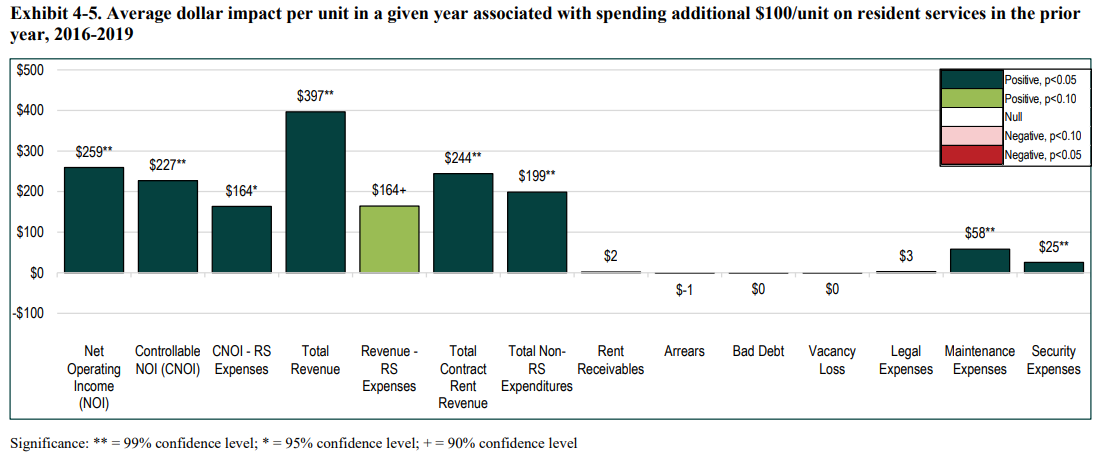
Resident services positively impact operating income
Stewards of Affordable Housing for the Future commissioned new research from ABT Global titled The Impact of Resident Services on Property Financial Performance. The report evaluates the role of resident services, including eviction prevention, financial education, health and employment support, and community buildings, and the impact of including such services on overall asset health. The results demonstrate that for every additional $100 per unit spent on resident services, there is a $259 higher net operating income and $397 more in total revenue per unit. The pattern suggests that resident services are not just added expenses but may drive higher revenues and stronger operating performance. Effects on arrears, bad debt, vacancy loss, and legal expenses are also shown to be small or near zero.
| | |
The Progressive Policy Institute released a report arguing that institutional investors play only a minor role in the U.S. housing crisis, accounting for just one percent of single-family home purchases. Despite political claims that these investors are driving up housing costs, the report states the real issue is a long-standing shortage of housing caused by restrictive zoning laws and limited supply. It urges policymakers to focus on solutions like streamlining permitting, easing zoning restrictions, and modernizing construction methods to boost housing availability. The report also notes that institutional investors can have positive impacts, such as improving property management, renovating homes, and increasing the supply of rental housing.
HousingWire reports that Zillow’s AI-first home search platform is adapting to how consumers are searching in the era of AI. The article discusses that Zillow has already been adding natural language search features and related tools that interact in a conversational manner, exploring factors like commute time, affordability, schools, and nearby points of interest. The model is designed to manage appropriate interactions informed by fair housing standards and continues to expand the technology to meet the ongoing needs of consumers.
The Bipartisan Policy Center provides an overview of the FY2027 housing budget, highlighting major policy changes and funding shifts across federal housing programs. The proposal includes budget cuts and eliminations, including a 13% reduction in funding for HUD. Additionally, programs including rental assistance and public housing, homelessness assistance, Native American housing, Community Development, Family Self-Sufficiency, and Fair Housing are all experiencing proposed cuts or complete elimination of funds. The article presents the budget as a significant restructuring of federal housing priorities rather than a routine funding update.
The Federal News Network’s The Federal Drive with Terry Gerton sat down with Gwen Roy-Harrison, a multifamily and fair housing attorney, to discuss HUD’s fair housing guidance. The discussion centers on the agency’s first-year reset of fair housing policy and how it is changing the way federal housing rules are being interpreted. Roy-Harrison notes that HUD cited the withdrawal of long-standing fair housing guidance because of a broader deregulatory shift, moving away from acting as a detailed resource for housing providers and toward a narrower role that reduces compliance burdens. Most importantly, the Fair Housing Act still applies, but providers will now have to rely more on state and local rules and on the courts for interpretation.
| | The National Housing Conference is a diverse continuum of affordable housing stakeholders that convene and collaborate through dialogue, advocacy, research, and education, to develop equitable solutions that serve our common interest. | | Defending Our American Home since 1931 | | Copyright © 2024. All Rights Reserved. | | | | |