Weekly update from the National Housing Conference | |
News from Washington | By Brittany Webb
| |
|
Scott Turner, former Trump official, tapped to lead HUD
President Trump has selected Scott Turner, Chair of the Center for Education Opportunity at the American First Policy Institute, as Secretary for the U.S. Department of Housing and Urban Development (HUD). A former Texas state representative for the 33rd District, Turner served in President Trump’s first administration as the Executive Director of the White House Opportunity and Revitalization Council. In this role, Turner oversaw the development of opportunity zones – designated areas in economically distressed communities where investments are encouraged through tax incentives. The program aims to attract private investment to promote economic growth, create jobs, and support the construction of affordable housing in underserved areas.
NHC’s President and CEO David Dworkin issued the following statement in response to Turner’s nomination:
“Scott Turner has a well-established commitment to community development and was a vocal advocate for investing in underserved communities in the first Trump administration. We look forward to working with him in the years ahead.
He has been a vocal advocate for the Opportunity Zone program and we anticipate working with him to extend and expand the program to incentivize the construction of housing affordable to first-time home buyers, especially first-generation homebuyers.”
| | |
|
Senate discusses disaster relief needs, White House requests funding
The U.S. Senate Committee on Appropriations held a hearing to review the critical need for disaster funding as the nation grapples with the impacts of frequent extreme weather events. The Biden administration also requested nearly $100 billion in disaster supplemental appropriations last week, noting requests from several Federal agencies lacking funds to replenish disaster response programs amid multiple, overlapping disasters. The Small Business Administration reported it is currently managing 36 disasters across 24 states. The request noted a long history of providing for communities on a bipartisan basis, including over $90 billion in aid after Hurricane Katrina in 2005; over $50 billion following Hurricane Sandy in 2013; and over $120 billion following Hurricanes Harvey, Irma, and Maria in 2017.
“As I've said before, you don't argue over whether to put out a fire. You don't debate how much water to use or how many people to save. You roll up your sleeves, you get to work, and you get help out the door, as much as needed, as fast as possible,” said committee Chair Patty Murray (D-Wash.) during the Senate hearing. “Right now, there are a lot of people in our country needing help and yet this is one of the longest times in my memory that we've gone without Congress providing disaster funding. That's unacceptable.”
Witnesses for the hearing included: Senator Jon Ossoff (D-Ga.), Senator Thom Tillis (R-N.C.), Pete Buttigieg, Secretary for Transportation; Isabel Guzman, Administrator of the Small Business Administration; Xochitl Torres Small, Deputy Secretary of the U.S. Department of Agriculture; Adrianne Todman, Deputy Secretary Performing the Duties of the Secretary of the Department of Housing and Urban Development; and Deanne Criswell, Administrator of the Federal Emergency Management Agency. The agency heads discussed the overwhelming status of natural disasters, from droughts to wildfires to hurricanes.
In a letter sent for the record, the Bipartisan Policy Center highlighted the need for consideration of broad backlogs of disaster relief funding, and the need to immediately address current funding as well as improving federal disaster assistance programs in order to overcome the shortcomings of our disaster assistance system. Specifically, it cited the need for greater appropriations to HUD’s Community Development Block Grant Disaster Recovery program, which is not a permanently authorized program and exists only when Congress appropriates funds, causing funding gaps and concerns of equity difference for disaster survivors.
| | |
|
SOLD OUT!
Waitlist and virtual registration available!
On Dec. 4, the National Housing Conference will host its Solutions for Affordable Housing convening at the National Press Club in Washington, DC. Join Congresswoman Debbie Dingell (D-Mich.) and affordable housing stakeholders as they discuss today’s most pressing housing issues and focus on solutions that are tangible, impactful, and achievable.
NHC members can take advantage of exclusive member rates by using the following discount codes.
| |
|
In-Person Tickets (WAITLIST)
$175
Use Code: Member2024
| |  |
|
Virtual Tickets
$125
Use Code: MemberVirtual2024
| |
|
FHFA boosts support for rental housing
The Federal Housing Finance Agency (FHFA) announced higher multifamily loan purchase caps to expand support for rental housing through Fannie Mae and Freddie Mac (the Enterprises) in 2025. Each Enterprise will have a multifamily loan purchase cap of $73 billion, resulting in a combined total of $146 billion for the multifamily market, an increase of more than 4% from 2024. FHFA sets caps annually to ensure liquidity in the multifamily market that simultaneously does not crowd out private capital. FHFA noted that the new caps are reflective of the market forecast, but it will not reduce the caps should the actual size of the 2025 market be smaller than predicted. FHFA is further continuing the requirement that at least half of multifamily businesses be mission-driven and continues to exempt workforce housing as it is a critical area of growth.
“The 2025 multifamily loan caps reflect the Enterprises’ strong commitment to provide liquidity to make renting a home more affordable,” said FHFA Director Sandra Thompson. “Additionally, the ongoing workforce housing exemption will continue to enhance the Enterprises’ ability to support properties that preserve affordable rents, including properties preserved or created through corporate-sponsored affordable housing initiatives.”
“Freddie Mac will continue to adapt to market conditions and meet our mission to provide liquidity, stability and affordability throughout all market cycles,” said Kevin Palmer, head of Multifamily for Freddie Mac in a press release. “FHFA’s requirements create the conditions for us to deliver on our priorities. In 2025, we will continue our day-to-day focus on supporting affordable rental housing for families across the country.”
| | |
|
Ginnie Mae Acting President steps down
Sam Valverde, the current Acting President of Ginnie Mae, announced that he will step down from his position at the end of November. Valverde, who has been Acting President since May, previously served as Principal Executive Vice President and Chief Operating Officer. He was also Ginnie Mae's first Latino executive and leader.
"The opportunity to lead Ginnie Mae has been the most impactful and rewarding work of my career in public service. I am deeply honored to have had the chance to serve my country while championing a borrower-focused and market-driven housing finance agenda,” said Valverde in a press release. “I am immensely proud of all that we have achieved on behalf of the borrowers, issuers, and investors that we serve."
Gregory Keith, Senior Vice President and Chief Risk Officer, will take over the responsibilities of Acting President upon Valverde’s departure. Keith has over 35 years of housing finance experience and is noted as having been instrumental in stabilizing Ginnie Mae’s portfolio.
HUD Agency Head Adrianne Todman thanked Valverde for his leadership stating, “Mr. Valverde’s tenure has been groundbreaking and has set the foundation for a people-first philosophy in Ginnie Mae’s crucial mission to support affordable housing for people across the nation."
| | |
|
FDIC Chair Gruenberg to resign
Federal Deposit Insurance Corporation (FDIC) Chair Martin Gruenberg announced he will resign from his position on January 19. Gruenberg, who has served as chair since 2021 and has been with the FDIC for over a decade, played a significant role in overseeing the agency's response to various banking challenges, including the bank failures of 2023. Gruenberg’s leadership came under scrutiny in November 2023 after reports of widespread misconduct throughout the agency. In May, FDIC released a report from an independent third-party review that found the FDIC fostered an unsafe environment for its employees. The independent review comes after a Nov. 2023 article in The Wall Street Journal that described misconduct allegations throughout FDIC, prompting deep concerns about the corporation's culture and calls for Gruenberg to resign.
“It has been the greatest honor of my career to serve at the FDIC,” Gruenberg said in a message to FDIC employees. “I have especially valued the privilege of working with the dedicated public servants who carry out the critically important mission of this agency.”
| | |
|
Treasury announces technical assistance, clean energy tax credit expanded access
The U.S. Department of the Treasury (Treasury) has announced $76 million in Technical Assistance (TA) awards as part of its 30th anniversary of its Community Development Financial Institutions (CDFIs) Fund. The funding will go to 256 CDFIs nationwide to help build capacity and provide financial products and services to underserved communities. The TA awards are aimed at providing new training and education, hiring new staff, increasing lending capabilities, and analyzing appropriate financial products, services, and lending procedures. Days prior, the CDFI Fund opened its 2024-2025 round of New Market Tax Credits with $10 billion in Allocation Authority available. The first deadline for application registration is December 5.
Treasury, alongside the IRS, also released final regulations that expand the reach of the Inflation Reduction Act. The final rules facilitate the use of direct pay, an elective payment option that allows entities with little or no federal tax liability, such as state and local governments, Tribes, public school districts, and non-profits, to benefit from clean energy incentives. Previously, many of these entities were unable to take advantage of clean energy tax credits.
“Direct pay is helping more clean energy projects be built quickly and affordably, and American communities are benefitting as a result. Today’s rules will increase the availability of capital for clean energy projects by providing certainty and flexibility for state and local governments, Tribes and territories, non-profits, and more to benefit from these resources,” said U.S. Deputy Secretary of the Treasury Wally Adeyemo.
| | |
|
HUD delivers over $1.4 Billion in climate resilience funding
HUD announced the completion of its Green and Resilient Retrofit Program (GRRP), delivering more than $1.43 billion in funding from the Inflation Reduction Act. This final round of funding provides approximately $30 million to 45 properties in 23 states, benefiting over 4,700 homes. The GRRP, launched in 2022, aims to improve energy efficiency and climate resilience in multifamily properties that participate in HUD’s project-based rental assistance programs. The initiative has been instrumental in supporting low-income families, seniors, and individuals with disabilities, ensuring they have access to safer and more sustainable living conditions.
HUD Agency Head Adrianne Todman expressed pride in the program’s swift implementation, stating, “Thanks to not only the leadership of our President and our Vice President, but the incredible work of the HUD team, we have now delivered more than $1.4 billion to the American people in record time. These investments will help preserve and modernize affordable homes for countless individuals for years to come”
The funding will improve energy and water efficiency, reduce emissions, and promote green building materials. John Podesta, Senior Advisor to the President for International Climate Policy, noted the program’s positive impact on vulnerable populations by making their homes safer and more comfortable. With this final allocation, HUD has successfully executed 12 funding rounds under the GRRP within just over a year, marking a significant achievement in federal efforts to combat climate change while addressing housing insecurity.
| | |
Renew your NHC membership today! | |
Watch this video to learn more about how NHC represents diverse leaders across the housing spectrum, including lenders, homebuilders, affordable housing advocates, real estate professionals, housing development corporations, housing finance agencies, and more, to address today's pressing housing issues. | |
|
Your involvement is essential to addressing today’s housing challenges, and NHC relies on active members to maximize our impact and remain a leader in tackling today’s housing issues.
NHC membership offers exclusive networking opportunities, access to our weekly Member Brief, and other key housing resources such as our Housing Resource Center, Paycheck to Paycheck database, and Employer Assisted Housing Toolkit. We look forward to working with you to address America's housing challenges.
| |
|
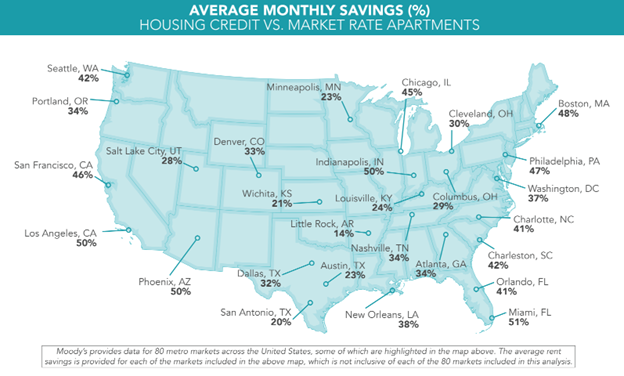
Tax credit properties save renters nearly $8k annually
New research from the Affordable Housing Tax Credit Coalition reveals the average rents for Low-Income Housing Tax Credit (LIHTC) homes are 38% lower than market-rate rents across 80 of the largest metro areas. The project analyzes Moody’s data to find an average savings of $653 per month at LIHTC properties when compared to market rate, an average annual savings of over $7,800 per low-income household. In some states the savings are higher, with Miami, Fla.; Phoenix, Ariz.; Indianapolis, Ind.; and Los Angeles, Calif. all showing savings of 50% or more for LIHTC participants. The data highlights the important role that LIHTC plays in the overall affordable housing market by supporting low-income residents across the nation with monthly savings.
| |
|
TIME reported on how housing emerged as a pivotal issue during the presidential election, with both candidates discussing affordability in depth. As President Donald Trump prepares for his second term, he has promised to tackle the housing crisis by reducing regulations, opening federal lands for construction, and implementing mass deportation to lower housing prices, although economists warn that such measures may not effectively address affordability issues. Housing advocates are now watching how President Trump’s policies will unfold, particularly regarding interest rates and potential budget cuts to housing programs, as they anticipate changes in the housing landscape under his administration.
An article by Bloomberg reported how Fannie Mae and Freddie Mac (the Enterprises) could be released from conservatorship as part of President Trump’s administration. The Enterprises have been under government conservatorship since the 2008 financial crisis, and housers have long debated if and how they should be released. Investor optimism surged after the election, with shares of both Enterprises rising significantly since the potential for privatization could yield a significant return for taxpayers. Challenges remain, however, in aligning Treasury and FHFA goals, determining necessary capital requirements, and navigating the complex political landscape to ensure a successful transition from governmental oversight.
A report published by the Lincoln Institute of Land Policy titled, Preserving Affordable Homeownership Municipal Partnership with Community Land Trusts, examines the evolving collaborations between community land trusts (CLTs) and municipal governments. It draws insights from 115 CLTs across the U.S., detailing increased municipal support through initiatives like land grants, regulatory concessions, and stewardship responsibilities to maintain affordable housing. The report emphasizes the importance of sustainable partnerships that balance development with long-term affordability, recommending policies that enhance CLT operations while addressing challenges such as racial equity and climate change.
Bilt Rewards introduced a new rewards program that allows renters to earn points when purchasing their first home, adding to their comprehensive initiative to help renters transition into homeownership and make homeownership more accessible and beneficial. Under this new program, members can earn one point for every $2 spent on a home purchase, potentially accumulating up to 200,000 points on a $400,000 home. These points can be redeemed for various rewards, including travel and fitness classes, effectively turning the costly home-buying process into a valuable opportunity. Additionally, Bilt has developed an innovative home search tool that simplifies the buying process by offering transparent all-in monthly payment estimates, personalized financial profiles, and comparisons of buying power across different cities.
| |
Your go-to resource for housing policy | |
The National Housing Conference is a diverse continuum of affordable housing stakeholders that convene and collaborate through dialogue, advocacy, research, and education, to develop equitable solutions that serve our common interest. | |
Defending Our American Home since 1931 | |
Copyright © 2024. All Rights Reserved. | | | | |