|
NEW ORLEANS, LA (Nov 27, 2026) - In an era when independent music festivals are disappearing almost as quickly as they arrive, four Morehouse College graduates have spent the last decade proving that a different model is possible.
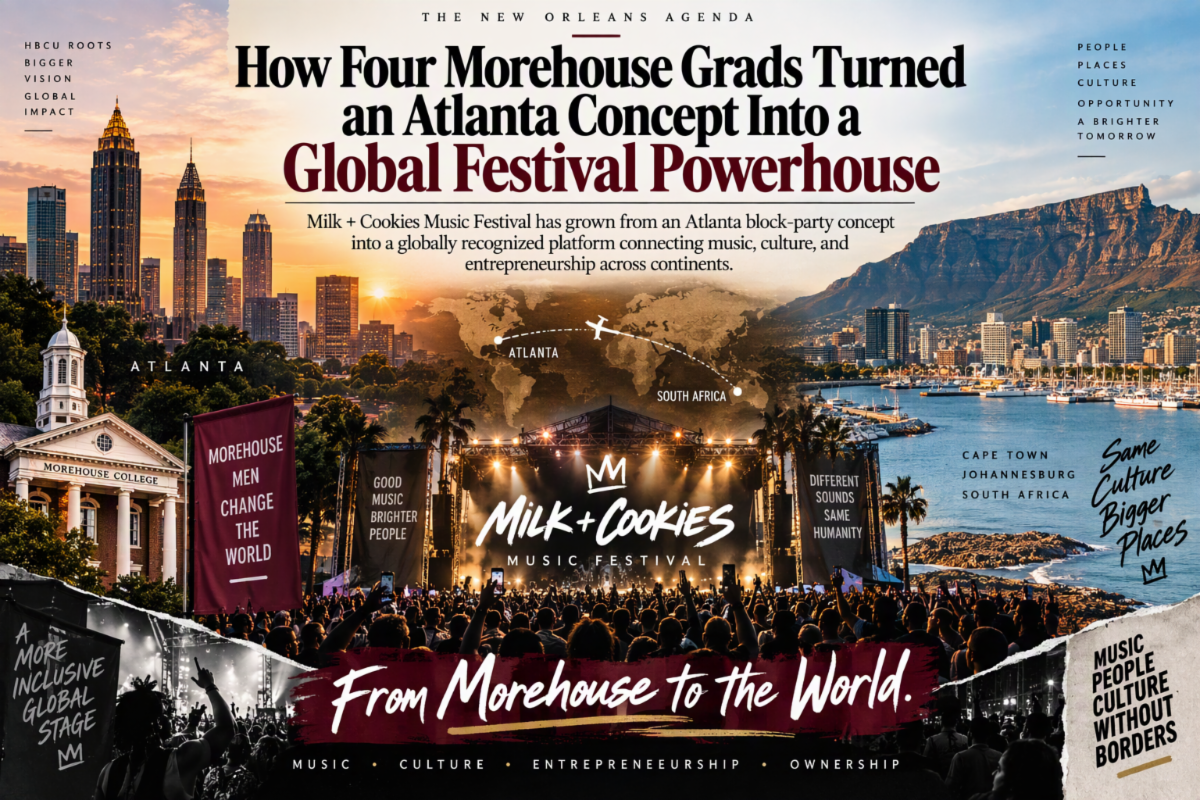
What began as college event promotion in Atlanta has evolved into an international cultural platform attracting tens of thousands of attendees across two continents. Through Milk + Cookies Music Festival, founders Chase Freeman, Jhordan Gibbs, Gregory Burton Jr., and Kevin Reese have transformed a student-led entrepreneurial venture into one of the most intriguing independent success stories in live entertainment.
Their journey began at Morehouse College, where the four friends built their reputation producing events under Atlantic Division Entertainment. Like many campus promoters, they learned how to fill rooms, market experiences, and connect with audiences. Unlike many of their peers, however, they envisioned something larger than a series of successful concerts.
In 2015, they launched Milk + Cookies Music Festival, inspired by a simple but ambitious concept: creating a space where different sounds, communities, and cultural influences could coexist. The inaugural festival immediately signaled their aspirations. Canadian producer and DJ Kaytranada headlined the very first edition, setting the tone for a brand that would prioritize curation, discovery, and cultural connection.
Over the next decade, Milk + Cookies quietly grew into a respected festival property, building an audience through consistency rather than hype. While larger festivals relied on corporate backing and increasingly expensive production models, the founders focused on developing a sustainable brand and cultivating a loyal community.
Their most significant gamble came when they looked beyond the United States.
Rather than pursuing the more familiar festival destinations of Europe or Latin America, the founders identified South Africa as the ideal location for the brand's first major international expansion. The decision reflected both business strategy and cultural vision. South Africa offered one of the world's most dynamic music and creative economies, while also serving as a bridge between African and African American cultural experiences.
The move was not a short-term activation or a celebrity-driven excursion. Instead, the founders committed to building local relationships and infrastructure before launching the festival abroad.
That approach paid off.
Milk + Cookies South Africa debuted in January 2025 with Kaytranada once again serving as headliner. The festival drew approximately 20,000 attendees across Cape Town and Johannesburg, validating the founders' belief that the brand's community-centered model could travel internationally.
One year later, the momentum accelerated. The 2026 edition, headlined by Atlanta rapper Gunna, attracted more than 30,000 attendees and further established Milk + Cookies as a growing force in South Africa's live entertainment landscape.
Yet attendance figures tell only part of the story.
At a time when conversations about cultural exchange often focus on extraction rather than investment, Milk + Cookies has sought to embed itself within South Africa's creative ecosystem. The company works extensively with local talent, venues, fashion brands, and creative professionals while expanding opportunities for emerging artists and content creators.
Its Creator Residency initiative and South Africa Artist Search program are designed not merely to showcase talent but to create pathways into the broader music industry. Through those efforts, emerging artists gain access to audiences, industry exposure, and performance opportunities that might otherwise remain out of reach.
The strategy reflects a philosophy that distinguishes Milk + Cookies from many international entertainment ventures. Rather than arriving as outsiders looking to capitalize on an existing culture, the founders have emphasized collaboration and long-term participation within the communities they serve.
That philosophy can also be seen in the festival's next phase of growth.
The 2027 season marks the company's most ambitious international expansion to date. Instead of limiting activities to a single festival weekend, Milk + Cookies plans to create a two-month cultural season in South Africa. The programming will begin during December's Music Week with Kaytranada before returning in January for festival events featuring British singer-songwriter Olivia Dean.
The evolution from a one-day festival to a multi-month cultural platform underscores how dramatically the founders' vision has expanded.
Perhaps the most remarkable aspect of the story is not the scale they have achieved but the ownership they have maintained along the way.
As Gregory Burton Jr. has noted in previous conversations about the industry, large-scale events have traditionally been controlled by established gatekeepers. For decades, festival ownership remained concentrated among major promoters, corporations, and entrenched industry players.
Freeman, Gibbs, Burton, and Reese challenged that reality by building their own intellectual property, controlling their production infrastructure, and creating a platform that belongs to them.
Their success offers a powerful example of entrepreneurship emerging from Historically Black Colleges and Universities. What started as student promotion work at Morehouse College has become an internationally recognized cultural enterprise with influence extending from Atlanta to Johannesburg and Cape Town.
Ten years after transforming a block-party idea into a festival, the founders of Milk + Cookies are demonstrating that ownership, cultural authenticity, and global ambition are not mutually exclusive. They are proving that independent platforms can still thrive, expand, and shape culture when they are built with patience, purpose, and community at their core.
For four Morehouse graduates who once promoted campus events, that may be the most important headline of all.
|