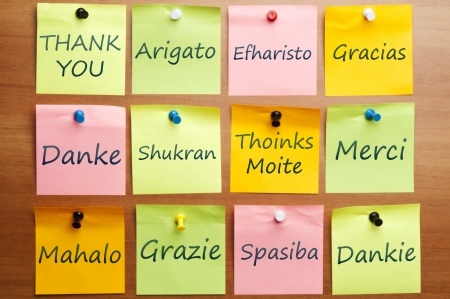
Do you ever notice that you are saying "Thank You" over and over?
For me, it's in restaurants. I tend to thank the server each time he stops at my table.
For others, it may be when you're shocked and happy with a service or response and you can't seem to tell the other person enough!
Too Much Praise
It's easy to go overboard when expressing praise. But many times, this leads to a service person thinking, "Of course, that's my job!" Or a gift-giver thinking, "But it was your birthday."
And it can get old. Thank-yous need to feel special in order to have the "magic word" effect that we teach our children to express.
Giving too much praise can also result in not being taken seriously when you have a critique or feedback to state.
It's not necessary to compliment for doing something that truly is expected. Does anyone thank you for not going through a red light? For saying your "r's" correctly? For holding your fork correctly?
When we get too much of something we tend to devalue it. It begins to feel insincere. Words can lose their meaning both to the person speaking and the one hearing.
Switch it Up
Saying thank you too much is also mis-using incentives. It is sometimes viewed as showing off.
Switch "thank you" and "thanks" with other expressions to keep your reaction spontaneous and sincere, and keep yourself "gratitudinally" fit.
- Let someone know specifically what you are thanking them for or what you appreciate.
- Eye contact, a nod, and a smile can serve as a thank-you. I've also found that this is a kind of self-test to see if it "feels" right. When I look at someone I've thanked, I can only give one of the substitutes. More would feel too much.
- Say something else:
- "I'm honored that..."
- "You've added to the overall group contribution.
- "The little things you do really add up."
- "Your generosity is deeply felt."
- "You add value to this restaurant."
- "You have added value to my experience."
- Show thank-you in your actions by giving something of reciprocal value.
- Leave a generous tip.
- If you've had a good experience, tell management and "reward" the service you received.
- Help create a pleasant environment with your attitude. A server, employee, or student will value this.
An Insincere Perception
Praise feels more important on the receiving end than for the person offering the compliment or gratitude. And for people listening in, your expressions of gratitude are making an impression.
Are you presenting yourself as a sincere, grateful person? Or are you presenting yourself as an insincere suck-up? If you are over-indulging on the thank-yous, it can diminish another's perception of your judgement. "He compliments the servers too much. What if he's doing that to me just to win a sale?"
The etiquette for extending gratitude should always be:
1)
Genuinely
2)
Gracefully
3)
Gratefully
Use these 3 Gs of gratitude to ensure your thanks is always accepted with the sincerity in which it is intended.
How Many is Too Many?
Sincere gratitude is felt even when expressed only once. But depending on the situation, saying thank you a few times can be appropriate.
When you receive a kind gesture, once or twice is enough during a verbal exchange. And sending a note of thanks afterwards is always appreciated.
During a service transaction, between one and three times is fine, depending on the length of the transaction. For example, in a restaurant you might thank the person who seats you, thank the server who takes your order, and then thank the server again when your glass is refilled.
Additional acts of service can be acknowledged with eye contact and a nod or smile.
However, the words "thank you" are kind and welcomed. And it is possible to deliver them sincerely multiple times.
If, by saying them, you are applying the three Gs as above, and not delivering a rote reaction to something a person does or says, then by all means say thank you again. And again.