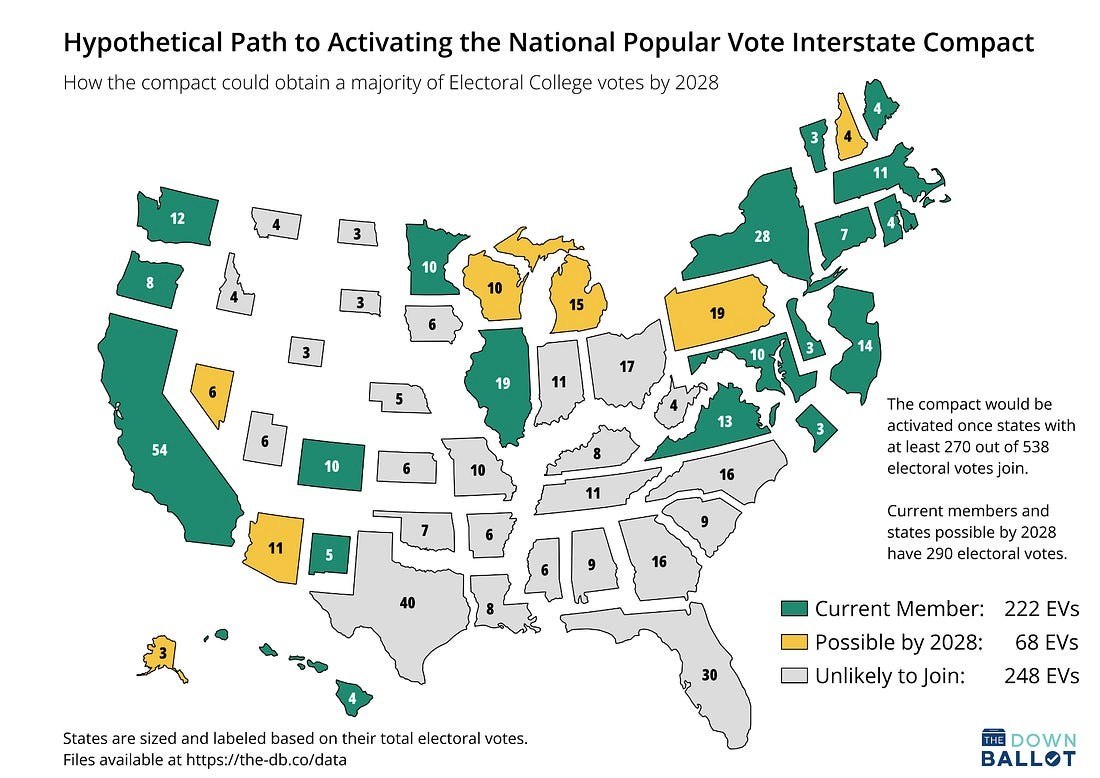
|
The Downballot continues:
While there’s nothing inherently partisan about the proposal, Republicans have almost universally opposed the idea over the last decade. As a result, the compact’s ultimate fate will likely depend on Democrats, who’ve already passed it in every state they currently control and now need just 48 more electoral votes to put it over the top.
That could happen this week if Democrats make sufficient gains and hold on to their existing power in seven states, which collectively have 68 electoral votes—20 more than are needed to reach 270.
Below we catalog exactly what needs to happen for Democrats to succeed in each of these states:
• Alaska (3 electoral votes):
Pickups needed: governor
Holds needed: state Senate and state House (both are run by bipartisan coalitions)
• Arizona (11):
Pickups needed: 3 state Senate seats and 4 state House seats
Hold needed: governor
• Michigan (15):
Pickups needed: 4 state House seats
Holds needed: governor and state Senate
• Nevada (6):
Pickup needed: governor
Holds needed: state Senate and state Assembly
• New Hampshire (4):
Pickups needed: governor, 5 state Senate seats, and 22 state House seats
• Pennsylvania (19):
Pickups needed: 3 state Senate seats
Holds needed: governor and state House
• Wisconsin (10):
Pickups needed: 2 state Senate seats and 5 Assembly seats
Hold needed: governor
Multiple combinations could yield the 48 electoral votes needed to reach 270, but in practice, Democrats likely need both Michigan and Pennsylvania, plus two out of three of Arizona, Nevada, and Wisconsin. ...
If these five states were to join the compact, it would reach 283 electoral votes—13 more than needed. ...
Congressional approval may also be necessary. The Constitution’s text formally requires that all interstate compacts receive the “Consent of Congress,” though the Supreme Court has held that this mandate only applies to agreements that “may encroach upon or interfere” with federal power.
Read full article from The Downballot
Support The Downballot
|