Weekly update from the National Housing Conference | | News from Washington | By Brittany Webb | | |
New HUD data shows first decrease in homelessness in a decade
The U.S. Department of Housing and Urban Development (HUD) released its 2025 Annual Homeless Assessment Report (AHAR), showing that homelessness declined by 3% nationwide between 2024 and 2025, the first annual decrease since 2016. The report found that approximately 745,652 people experienced homelessness on a single night in January 2025, with 266,320 of those living unsheltered. The report was delayed for five months, though HUD did not provide an explanation for the stall.
HUD used the report’s release to renew criticism of the long-standing Housing First model, arguing that homelessness has increased 27% since 2013 despite significant federal spending. HUD Secretary Scott Turner has argued that homelessness policy should focus more directly on underlying behavioral health and substance use challenges. Advocacy organizations continue to push against the narrative, responding that the reductions shown in the report happened during the end of President Biden’s term, and were likely driven by greater access to resources like the Emergency Housing Voucher program as opposed to criminalization efforts.
“The ‘housing first’ experiment failed Americans by warehousing the vulnerable without results. This ideology promised to end homelessness. Instead, billions of taxpayer dollars were spent while homelessness increased to record levels. Housing alone will not solve a crisis driven by addiction and mental illness. Under President Trump’s leadership, HUD is making necessary reforms to put recovery first,” said Secretary Turner.
Notably, the AHAR report shows a 2.8% decrease in people experiencing homelessness in California after Governor Gavin Newsom intensified efforts to dismantle encampments. Other states with fewer people experiencing homelessness overall also saw declines; Illinois saw a 44% decrease, Hawaii a 41% decrease, and Florida an 11% decrease. Colorado, Maine, and Alabama each show decreases of just over 10%.
“These reductions are a relief, but make no mistake that homelessness remains a crisis. Over the course of 2024, an estimated 17,500 people a week entered into homeless systems for the first time,” said Ann Oliva, CEO of the National Alliance to End Homelessness in a statement. “HUD’s data proves that even with the unrelenting demand for assistance, the housing-focused programs and strategies at the heart of homelessness response can and do work when they are appropriately resourced.”
HUD also published its new Continuum of Care (CoC) notice of funding opportunity (NOFO), offering over $4 billion in funding for CoCs after its 2025 NOFO led to litigation. The new NOFO continues to emphasize underlying causes of homelessness, and HUD stated it will continue shifting toward approaches that emphasize recovery, treatment, job training, self-sufficiency, and transitional housing.
| | | |
Pulte tapped to lead intelligence agency
President Trump has appointed Federal Housing Finance Agency (FHFA) Director Bill Pulte as Acting Director of National Intelligence, elevating the housing finance regulator to one of the federal government's most prominent national security positions. Pulte will continue serving as FHFA Director, as well as chairman of Fannie Mae and Freddie Mac, while assuming the intelligence role. The selection has drawn scrutiny on Capitol Hill, with lawmakers from both parties raising questions about a lack of experience in national security and intelligence matters.
In announcing the appointment, President Trump cited Pulte's experience overseeing FHFA and managing the safety and soundness of the housing finance system, noting that he currently supervises more than “$10 trillion” in assets through Fannie Mae and Freddie Mac. Pulte has been an outspoken critic of the President’s perceived political foes, having previously sought to weaponize mortgage data as a basis for claims of fraud against high-profile elected officials.
The appointment became even more politically controversial after Democrats threatened to stop the process to renew Section 702 of the Foreign Intelligence Surveillance Act (FISA), which expires mid-June, unless the appointment is withdrawn.
For the housing industry, the move has prompted concerns about how Pulte's expanded responsibilities could affect FHFA priorities, including oversight of Fannie Mae and Freddie Mac, housing affordability initiatives, and long-running discussions about the future of the government-sponsored enterprises and efforts to release them from conservatorship.
| |
New episode released!
"Communicating Before, During, and
After a Natural Disaster"
On April 8, the National Housing Conference hosted its Solutions for Housing Communications convening at the National Press Club. The event brought together policymakers and affordable housing stakeholders to discuss tangible, impactful, and achievable actions to address the nation’s most critical housing policy challenges.
In this week's episode, we revisit the panel, “Communicating Before, During, and After a Natural Disaster,” featuring a discussion on how to communicate clearly and credibly before, during, and after a disaster. Panelists share practical messaging strategies, discuss common communication pitfalls, and offer guidance on reaching residents, policymakers, and the media at each stage of a disaster. Listen here.
| |
ROAD negotiations continue
Negotiations are reportedly continuing for the 21st Century ROAD to Housing Act after the House overwhelmingly passed its version of the housing legislation, though few details are clear. House Financial Services Committee Chairman French Hill (R-Ark.) told POLITICO, “Senator Scott and I are visiting about it, and Leader Thune and Leader Johnson’s staff are having visits about it. We want to see what is a final barrier to this going to the president’s desk,” Hill said. “I’ve invited people to be very specific and have a very logical, concrete reason why the Senate bill, as amended by the House, is [not] a best-of-class compromise to get to the president’s desk, and we’re willing to work on other topics along the way.”
Both the House and Senate have passed a version of the wide-ranging housing bill with remarkable bipartisan support, but the two chambers remain at odds on final language. The House bill earned a stamp of approval from President Trump, and its path forward now lies with the Senate.
“I know for us members with relationships with our various senators and allies and colleagues over there [in the Senate], we’re reaching out and hopefully, hopefully we’ll be able to see a point where they’ll come around and see that this is a product that almost all of us can get on the same page with,” said House Financial Services Committee Vice Chair Bill Huizenga (R-Mich.) in an interview.
In an op-ed in the Wall Street Journal, Chairman Hill said the legislation “isn’t a silver bullet, but lawmaking is about progress, not perfection. The House-amended 21st Century Road to Housing Act will have a meaningful effect, increasing housing supply across the country.”
| | | |
THUD funding advances through committee
The House Appropriations Committee advanced its FY 2027 Transportation, Housing and Urban Development (THUD) appropriations bill, approving legislation that would provide $71.4 billion for the U.S. Department of Housing and Urban Development (HUD) and sending the measure to the House floor on a 34-27 vote. The committee adopted several amendments during the markup, including a provision blocking HUD’s proposed rule restricting rental assistance for mixed-status families and an amendment tying certain federal funding to local cooperation with federal immigration enforcement.
THUD Subcommittee Chair Steve Womack (R-Ark.) said the bill “addresses affordability concerns and ensures a responsible safety net for our most vulnerable citizens—the elderly, disabled, our veterans, and the working poor.”
Democrats criticized the legislation for reducing funding for several housing programs, including a $750 million cut to the HOME Investment Partnerships Program, a $256 million reduction in homelessness assistance, and lower funding for fair housing enforcement. The committee also rejected amendments that would have restored funding for HOME and PRO Housing grants or blocked potential future work requirements for assisted households.
| |  | |
Bipartisan bill introduced to extend LIHTC carryback
Reps. Mike Carey (R-Ohio) and Jimmy Panetta (D-Calif.) introduced legislation last week to further strengthen the Low-Income Housing Tax Credit (LIHTC) program. The Affordable Housing Credit Carryback Act would extend the LIHTC carryback period from one year to five years, allowing investors greater flexibility to apply tax credits against prior-year tax liabilities and aligning LIHTC with other federal tax incentives that receive more favorable treatment under the tax code. Supporters note that the change would make LIHTC more attractive to investors and help spur additional private capital for affordable housing development.
“Affordable housing projects depend on stable investment, but the current one-year carryback limit puts the Low-Income Housing Tax Credit at a disadvantage compared to other credits in the tax code,” stated Rep. Carey. “Expanding the LIHTC carryback period to five years will provide greater certainty for investors, strengthen the housing credit market, and help support the development of more affordable housing across the country. I want to thank Congressman Panetta for co-leading this legislation that recognizes the importance of keeping affordable housing projects moving forward for working families.”
| | | |
Building homes near jobs, stores, and transit can reduce infrastructure costs
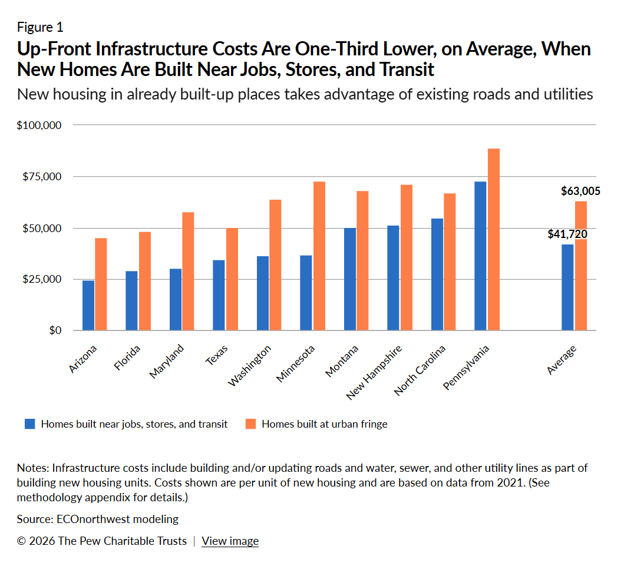
A new analysis from The Pew Charitable Trusts found that up-front infrastructure costs are 33% lower, on average, when new homes are built near jobs, stores, and transit rather than in locations farther from existing development. Examining data from 10 states, researchers found that the average cost of roads, water systems, and other infrastructure was approximately $21,000 less per home in areas with greater access to destinations and services. The findings suggest that development patterns can have a significant effect on public infrastructure spending for local and state governments. Pew notes that the research demonstrates the advantages of removing outdated regulations that limit homebuilding in established areas, where new housing can take advantage of existing infrastructure and public investments.
| | |
A blog from the Harvard Joint Center for Housing Studies reports that homelessness declined in the most recent national count but remains near record highs. While there was a modest year-over-year decrease, the total number of people experiencing homelessness is still exceptionally elevated compared with historical levels. It situates this shift within broader recent trends, noting that homelessness has increased significantly since the mid-2010s and remains well above earlier lows. The analysis underscored that even with recent improvement, the scale of homelessness continues to reflect persistent housing affordability and supply challenges nationwide.
The National Bureau of Economic Research published a working paper proposing a methodology for measuring rental property ownership in the United States. The paper focuses on developing a framework to identify and classify ownership of rental properties using administrative and tax data, with the goal of improving how ownership structures are captured in housing research. It outlines challenges in accurately tracking ownership across entities and discusses how improved measurement could support a clearer understanding of the rental housing market and its composition.
A report from Enterprise Community Partners examines rising insurance costs and growing coverage challenges affecting multifamily affordable housing providers. The report finds that insurance costs are increasing and often outpacing revenue growth, creating financial strain that can affect property operations and long-term affordability. It also outlines a set of practitioner and policy strategies to address these challenges, including approaches focused on risk management, resilience investments, and policy tools intended to improve insurance access and stabilize costs in the multifamily housing sector.
| | |
Monday, June 8
Curbing the Insurance Spiral 3-Part Series: Policy and Practitioner Strategies to Help Stabilize Multifamily Affordable Housing | Enterprise
Tuesday, June 9
No events posted.
Wednesday, June 10
Leading by Design: Women Driving Innovation in Affordable Housing, 6 – 8 PM
AHTCC Affordable Housing Symposium, June 10 – 11
PHADA's 2026 Annual Convention & Exhibition, June 10 – 13
Thursday, June 11
IPED Annual Historic Tax Credit Summit, June 11 – 12
Friday, June 12
No events posted.
Saturday, June 13
REALTORS® Legislative Meetings, June 13 – 18
| | The National Housing Conference is a diverse continuum of affordable housing stakeholders that convene and collaborate through dialogue, advocacy, research, and education, to develop equitable solutions that serve our common interest. | | Defending Our American Home since 1931 | | Copyright © 2024. All Rights Reserved. | | | | |