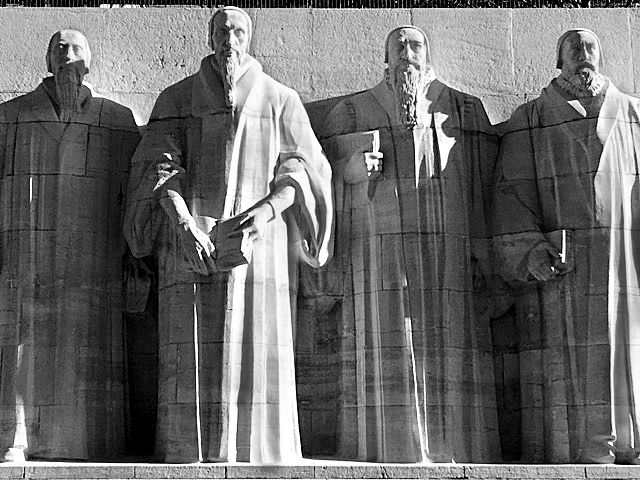
Pictured above is the famous "Reformation Wall" in the Parc des Bastions in Geneva, Switzerland. Depicted from left to right are four of the great figures of the Genevan Reformation: John Calvin, Guillaume Farel, Theodore Beza, and John Knox.
Most members and friends of the American Waldensian Society know that the Waldensian movement predated the Protestant Reformation by approximately 347 years. Along with the Hussites in Bohemia and the Lollards in England, the Waldensians were theological forebears to the Protestant Reformation. What some might not know is the role that the Swiss Reformer Guillaume Farel had in persuading the Waldensians to align themselves with the Reformation.
Our story starts in the community of Gap, in the Dauphine region of France - a region that was directly adjacent to the Waldensian Cottian valleys of Italy. Gap itself was heavily populated by Waldensians. Members of Farel’s family and many in his network of friends were Waldensian, and Farel himself spoke the French/Italian patois that was indigenous to the region. As a young adult, Farel went to Paris to study at the University of Paris under the tutelage of Jacques Lefevre d’Etaples, the humanist theologian and scholar. In 1521, Farel was called to serve as a Reformed preacher in northern France, but within a couple years he became impatient with the slow process of the Reformation in that region and he returned to teach at the University of Paris in 1523.
However, within a year, a wave of persecution against adherents to the new Reformation forced Farel into exile in Basel, Switzerland, where the Reformation was beginning to take hold. There he met Erasmus, the famous Christian humanist. Unfortunately, a dispute soon arose between Farel and Erasmus, which resulted in Farel’s banishment from Basel.
Farel pastored several Reformist congregations in various places in Switzerland until 1532, when he settled in Geneva, Switzerland, and served as the pastor of the Notre-Dame la-Nueve Chapel. Farel’s preaching, according to the Reformed theologian Theodore Beza, “was like thunder” in its power and persuasiveness. It was Farel’s singlehanded persuasiveness, his sound reasoning, and his sense of urgency, that led the community leaders of Geneva to pledge their support to the Protestant Reformation. When the 27-year-old John Calvin arrived in Geneva on his way to Basel where he had planned to do further study, Farel persuaded him to stay in Geneva and become Farel’s assistant. Soon, Calvin gained equal status with Farel and eventually become the main leader of the Swiss Reformed movement.
Now the focus of our story shifts from Geneva across the Alps to the Waldensians in the valleys just to the west of Turin. There a number of Waldensian pastors (who were affectionately called “uncles” or “barbes”) had read some doctrinal works and biblical commentaries written by leaders in the new Reformation. As a result, some of them began questioning their own practices, including primarily their clandestine efforts to hide their worshipping communities from being discovered by the Roman Catholic Church and by the armies which sought their annihilation. They recognized that their secretive worship and preaching ran counter to the gospel mandate to “go and make disciples of all nations.” The barbes were also aware of problems that were created by their literal interpretation of Scripture as well as their selective preference for certain books of the Bible.