Wednesday Weblog for January 22, 2025 | |
|
Smart people learn from everything and everyone.
Average people learn from their experiences.
Stupid people already have all the answers.
-Socrates
| |
Leading Off: No Superbowl This Year | |
|
As a die-hard New England sports fan, I have not enjoyed the last few years of being a Patriots fan, if you know what I mean. I am optimistic today for a single reason: the newly named head coach of the team is NOT in his role for the first time and is not in over his head, and likely will not be fired soon after getting the job.
How do I know this?
After years of analysis, I believe that I am able to identify the behaviors and leadership styles of those who are in over their heads or doing something for the first time. I've also had several times in my career when I was in over my head or doing something for the first time.
I recognized some of these traits this past season with the Patriots first year coach. I watched all the games, analyzed all the decisions, and realized that he was following the script for how to get fired after you've been promoted. Here's that script, and if you are interested, how to avoid getting fired after you've been promoted.
| |
How to Get Fired, After You've Been Promoted | |
|
If you are really into the Patriots, you have developed your own reasons for the first-year head coach not getting a chance for a second year.
- You might say his 4-13 record was the reason. You’d be partially correct.
- You might say the way his team performed was the reason. You’d be partially correct.
- You may say that his behavior and his spoken words were the reasons. You’d be partially correct.
- You might say he ‘lost the locker room’ if you are a former athlete or deeply invested in reading about the team. You’d be partially correct.
- You might even say all of the above. You'd be partially correct.
But I think I know the real reasons he was not successful, and I say that with the confidence of seeing and working with dozens of leaders in my career: many who succeeded, and many who failed after being promoted.
This specific category of failed leaders who are in over their heads or doing something for the first time and make too many mistakes is more common than you might think.
| |
|
Let’s back up and look at ''promotions' logically:
There are only three times leaders can be promoted or get significantly more responsibility:
-
At the perfect time: When they have exactly the right amount of training, experience, and knowledge for the increased responsibility.
-
After they've been ready for a while: When they have more than enough training, more than enough experience, and more than enough knowledge and they wonder why those in charge didn’t recognize their talent sooner, or they were in an organization that didn’t offer or have much upward mobility.
-
Before they are ready: When they are thrown into the deep end of the pool because of turnover, or big changes, or other external or internal reasons for leadership to take a chance on them.
| |
|
At The Perfect Time:
How often are people promoted or get more responsibility at the perfect time?
It depends, but when or if it does, it is probably accidental that they are ready for the increased responsibility rather than a planned thing because most promotions have some element of surprise for the person promoted. They were ready, and history will be the judge.
Sure, some organizations aggressively manage succession planning, but most do not, and those that do spend time on it, don’t usually spend a lot of time on it. People are likely to succeed or fail in a role when promoted at the perfect time based on their own dedication and engagement and external factors they know how to handle.
After They've Been Ready for a While:
How often does this happen?
It depends, but when it does, it is very likely that the individual is ready for the increased responsibility, and they likely were a while ago. They are more likely to succeed than fail in the role based of their own dedication and engagement and knowledge.
Before They Are Ready
How often does this happen?
It depends, but when it does, it is very likely that when someone is not really ready for the increased responsibility, it can be rough. They are more likely to fail than succeed in the role when promoted too soon, and it is not based completely on their own dedication and engagement and external factors, but more likely on what they don't know.
This is what happened to the Patriot’s Head Coach in January.
He was promoted before he was ready and made two leadership errors based on that inexperience that, if avoided, may have led to a different outcome.
| |
|
Realistically, when someone is in over their head, or doing something for the first time, they are going to make mistakes.
- Whether it is driving in Boston for the first time (good luck); or
- Subscribing to ChatGPT and realize you are clueless about giving solid prompts
- Buying tickets at Fenway Park for the first time and thinking that Section 1 must be the best (it is among the worst); or
- Staying in a hotel in a tourist area that was listed at $100 per night, but turns out to be $160 a night with taxes and fees or
- They have been promoted to a leadership position and think that they can just do what they wish the prior bosses did (not so fast); or
- You become the Head Coach of the New England Patriots without any Head Coaching or high-level professional coaching experience.
There is only one way to succeed when someone is in over their head or doing something for the first time: rely on others. Yep, it is that simple. But there are two types of 'others' that are needed to succeed.
The recent Patriots coach, as far as I can see didn’t rely on the right 'others' and, like many people in the same situation, set himself up for failure.
Here are three of the most common reasons for failure after promotion and the two types of 'others' that can save someone who is in over their head or doing something for the first time.
| |
|
Reason for Failure #1: Reversal Syndrome:
(My own expression) Some people, when new in position, have the urge to change everything that the person before them did or left in place.
It is a fairly common reaction, especially if the predecessor did not succeed: I’ve done this myself. But the reason the reversal syndrome fails more often than not is that someone new in position never sees ALL the reasons that something was in place in the first place, but thinks they do.
Word on the street is the recently terminated Patriots Coach wanted to create a culture 180 degrees from his predecessor. Not a good idea if you are doing it for the first time or in over your head, and if you are following a Six-Time Superbowl Champion.
By the time he realized that not everything the prior coach did should be discarded, it was too late to recover, although he did try to reinstate some things.
| |
|
Reason for Failure #2: Stupid Mistakes:
We all make them, but we all can avoid them, too.
The way mistakes can be avoided is by careful decision making, obviously, but also relying on others to help in your decision making.
To succeed when doing something for the first time, one of the biggest needs is someone or someones on the team who will shoot straight when they see the course of action heading for a cliff or about to be a big mistake.
A leader needs a support system or team that has the courage to share their knowledge and wisdom, or who had experience of making the same mistake the leader COULD make.
So, what did the leadership team look like? In addition to a first-time head coach, it had a first-time front office leader, a first-time defensive coordinator, a first time play caller, a first-time wide receiver coach, and a first-time linebacker coach, among others. You get the picture.
Too many people who were doing it for the first time and/or in over their heads who couldn’t provide the wisdom to let him know he was traveling down the wrong road.
| |
|
Reason for Failure #3: Lack of Talent:
Some people who are reading this think the above two explanations pale in comparison to the lack of talent on the team as the reason. They blame the owner and previous coach for poor talent acquisition as the main reason for the terminated coach’s poor performance, but they’d only be partially correct.
The team wasn’t going to the Superbowl, but if they had performed to their capabilities, as an experienced coaching staff was more likely to achieve, they could have won eight or nine games instead of four. (For reference: Seattle and Tennessee were overtime losses, they lost to the Colts by one point and to the Bills by 3 points).
Both casual fans and sports commentators know that each one of the close losses could be attributed to inexperienced coaching.
So, if you are in a position where you are in over your head or doing something for the first time, how do you succeed?
The two ways I’ve observed in my leadership career, and the two ways that saved me when I was in over my head or in a role for the first time are obvious but sometimes ignored.
| |
|
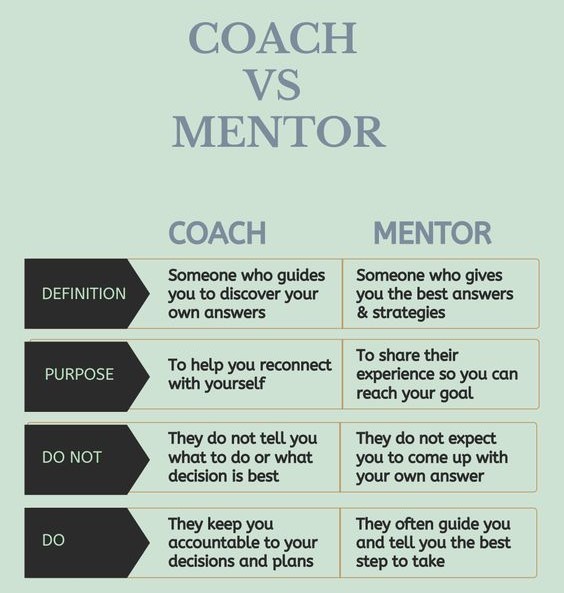
Solution #1: Mentors-The First Kind of 'Others'
Mentoration is a word I invented several years ago when I was training for my first Boston Marathon. I had a physical therapist guide me every step of the way (pun intended).
Mentoration means taking advantage of someone with more knowledge and experience than you have. It doesn’t mean just listening to them or just meeting with them.
It means diving in and extracting every last bit of knowledge and experience you can get from someone, so you become ‘wise beyond your years’ and learn from mistakes: but from THEIR mistakes.
I haven’t always had a mentor as good as Sarah, my marathon mentor, but I’ve always had a someone who had ‘been there and done that’ enough to give me insight, to bounce ideas off, to warn me about common mistakes and to encourage me, both when I made a misstep or accomplished a goal.
-
RVP: I was a Vice-President of Operations for large territories in California, with no formal experience or education in leading a team that large.
-
CHRO: I became the Chief Human Resources Officer for a very large company with no formal HR experience before I took the position.
-
Executive Director: I became a non-profit executive director with no non-profit management experience, only volunteer experience.
-
Consultant: I became a consultant five years ago with no consulting experience.
In each situation, I didn’t always realize it at the time, and didn’t always call it that, but I was 'mentored' by someone or someones or had people I could bounce ideas off before decisions were made. In each of the roles above, I called somebody, or someone stepped up to mentor me.
That benefit of learning from the mistakes of others was/is invaluable and critical to whatever success I achieved when dropped in the deep end of the pool.
| |
|
Solution #2: Smart Followers-The Second Kind of 'Others'
When I was in a leadership role, I operated with the following philosophy: “I didn’t have to be right all the time, I just had to make the right decision.” Nothing pleased me more than losing a debate on a course of action with a member of my team.
If their idea was so good it was better than my carefully thought-out idea, it must be worth taking. Too many leaders think, because of their title, they need to be the smartest person in the room. Wrong.
It doesn’t matter who the smartest person in the room is, it matters that the right, or best, decision is made, or the right or best action is taken. Leaders are not judged on their brains, but on their decisions and actions.
Think about leading a team where everyone was smarter than you and you listened to them? Wouldn’t that be a powerful combination? Too many new leaders, and I’m referring to those in over their heads or doing something for the first time, view the label of not being the smartest as a sign of weakness, but it is not.
I have not always succeeded in my roles. (I’ve been terminated a couple of times). But the times I succeeded, or thrived, or reached a level of excellence were times when the team I was leading was characterized by members who were smarter than me and aided or enhanced my decision making. Several of them are reading this now and nodding their heads. You know who you are.
The times I failed, I did not have the same caliber of support. After a couple of this type of failure early in my career, I decided that the best course of action was to work to hire people smarter than me to make my job easier and to get more solid ‘support’ for my decision-making.
We all know someone who was in over their heads or doing something for the first time, and we've seen some fail and some succeed.
Moving forward in your career, there are only three times you can be promoted or get significantly more responsibility:
1. At the perfect time
2. After you’ve been ready for a while
3. Before you are ready
When you are not ready, you are in over your head, and/or doing something for the first time, you are going to make mistakes. Unless you know how to be mentored and avoid being the smartest person in the room, in which case you'll make fewer mistakes.
When you can learn from the mistakes of others, and benefit from their knowledge and experience to make the right decisions and take the right actions, you'll naturally have a better chance to succeed.
If you don't....
| |
Surprise Photo at the End: Both are Important | |
Joe's Positive Post of the Week | |
Join the Smart Subscribers | |
If you are reading this on a social media platform, click below and you'll automatically receive a 'different' story every week on Wednesday. | |
|
The Roll Call of states and countries where readers reside: Arizona, California, Colorado, Connecticut, Delaware, Florida, Georgia, Hawaii, Illinois, Indiana, Iowa, Kansas, Kentucky, Louisiana, Maine, Massachusetts, Michigan, Mississippi, Missouri, Montana, New Hampshire, New Jersey, New Mexico, New York, North Carolina, North Dakota, Ohio, Pennsylvania, Puerto Rico, Rhode Island, South Carolina, South Dakota, Tennessee, Texas, Vermont, Virginia, Washington and Washington DC, Wisconsin plus Canada, Conch Republic, Australia and the United Kingdom.
| |
Refer a friend to Sign Up for the Wednesday Weblog | |
|
Ed Doherty
774-479-8831
www.ambroselanden.com
ed-doherty@outlook.com
Forgive any typos please.
| |
| | | |