MAY 2026

FROM OPENNOTES

OpenNotes director appointed as Keane Chair at Harvard Medical School


OpenNotes is proud to announce that our Executive Director, Catherine (Cait) M. DesRoches, DrPH, has been appointed as the John F. Keane & Family Associate Professor of Medicine at Harvard Medical School. The Keane Chair was established to advance a vision central to OpenNotes’ mission: improving healthcare through open, transparent communication among patients, families, and clinicians. Dr. DesRoches’ appointment reflects decades of scholarship and leadership dedicated to making health information more accessible, understandable, and useful. Read more.

How to use artificial intelligence (AI) and large language models (LLMs) to understand your health information


OpenNotes has launched a new educational resource to help patients, care partners, patient advocates, and clinicians with using AI to understand health information. The resource is written at 5th-8th grade reading levels, and is freely available in English and Spanish. Learn more.

IN THE MEDIA

Test Results in the era of Instant Access

"Before the doctor sees it: Test results in the era of instant access"


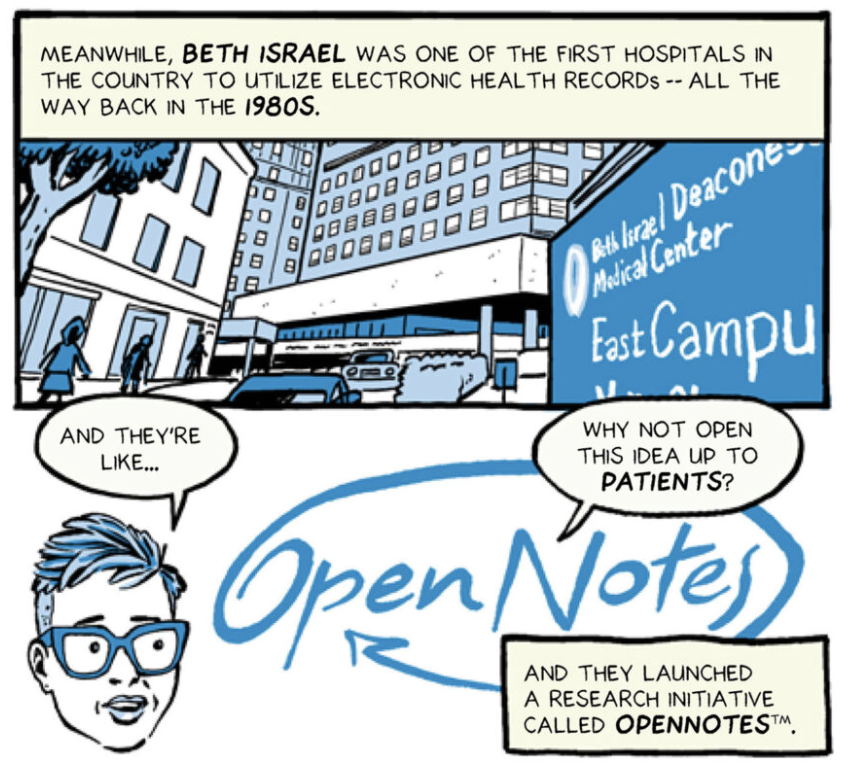
A New York Times bestselling comics journalist explores the implications of the 21st Century Cures Act, the law that allows patients to see lab results as soon as they are ready. It features research by Bryan Steitz, PhD, and Liz Salmi in JAMA Network Open. The comic was published in the Boston Globe Magazine, is available under a Creative Commons license and can be shared widely. Read the comic.

"AI in the doctor's office"


Hard Fork, a podcast produced by The New York Times, interviewed physician and AI researcher Adam Rodman, MD, of Beth Israel Deaconess Medical Center. They talk about the most significant ways AI is changing how doctors treat patients. Listen to the podcast.

WHAT WE ARE READING

"Errors in AI-Transformed Patient-Centered Mental Health Documentation Written by Psychiatrists: Qualitative Pre-Post Study"


A study in JMIR Mental Health qualitatively analyzed errors that were introduced by large language models (LLMs) when transforming notes written by psychiatrists into patient-facing formats (open notes). Five categories of clinically relevant errors were identified. Despite improvements in the readability of AI-converted notes, the errors still occurred. Read more. (open access)

"Adaptive Driving After Brain Surgery: The Hidden Costs of Neurological Disability"


In a letter to the editor of Neuro-Oncology Practice, OpenNotes' Liz Salmi shares what happens when the medical system clears one to return to life but not to the road. A patient’s daily autonomy, including the ability to drive, remains under-recognized in neuro-oncology care and survivorship. Read more. (paywall)

"Show us the evidence for the value of medical AI"


This editorial in Nature Medicine calls for a consistent evidence-based framework to apply to the use of artificial intelligence (AI) in healthcare environments. It warns against premature implementation and argues for rigorous metrics to evaluate new tools. Read more.

Nature Medicine

Social Media Spotlight

LinkedIn

YouTube

OpenNotes.org

Read our archived newsletters