|
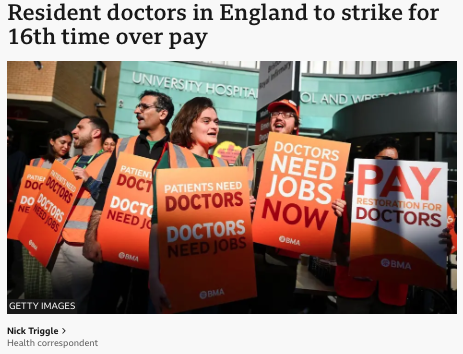
The resident doctors are going back on strike.
After 69 previous days, it’s not really news any more.
From the back of a fag packet; resident doctors may have lost roughly £7k–£14k gross, depending on grade, before allowing for tax, NI, pension and student-loan effects.
Trusts are getting really good at managing strikes and have got interruption down to a minimum.
Cost to the taxpayer?
The Jim Reaper moved Trusts from, ‘shut down and do-as-little-as-possible’, to a more radical strategy of, ‘keep-going and do more-of-what-you-can’…
… diagnostic imaging and straightforward day cases, but…
… in the end, people will be left waiting. Most likely a hidden build up of older patients with co-morbidities that come with a risk to smooth surgery pathways.
A&E does well… there’s a whole other story there.
As for the strike…
… the prospects for peace are probably better than the headlines suggest, but…
… not because the dispute is close to being solved.
The key variable is not simply pay. It’s politics, timing and leverage.
The new Health Secretary, James Murray, the biscuit-boy, changes the atmosphere immediately. New ministers arrive with what management theorists call ‘authority front-loading’.
He may offer talks, tea and biscuits? (Or a Jaffa Cake)
In the first 90 days the’ll be at his strongest; people projecting hope onto him, before reality intrudes. Junior doctors will know this. So will the Treasury, but…
… Murray also arrives with constraints.
He is not a grandee with enough political capital to tear up Treasury discipline. In fact, his background at the Treasury may make him more cautious, not less.
Treasury people instinctively look for precedent, affordability and containment.
They worry less about winning an argument and more about what happens if every other public sector union asks for the same deal.
That means any settlement is unlikely to be a dramatic victory for either side.
What is more likely is a staged de-escalation;
- a multi-year framework;
- some restoration of morale through non-pay concessions;
- movement on training, rota gaps and career progression;
- perhaps a mechanism linking future pay to inflation or independent review, and…
… a face-saving formula both sides can describe as ‘constructive’.
The problem is neither side fully controls events.
HMG is entering a period of NHS chaos; reorganisation, management redundancies, uncertainty over the workforce plan, pressure on finances...
... and now the accelerating arrival of AI and automation, for which it is entirely unprepared.
Against that backdrop, prolonged industrial action becomes dangerous for ministers because it compounds the sense that the NHS is ungovernable.
The doctors have risks as well.
Every strike has diminishing, marginal returns. Public sympathy is not infinite. In a recent YouGov poll; 55% opposed (22% somewhat, 33% strongly), the strikes.
The original moral clarity… ‘pay erosion’… becomes blurred once the public sees repeated disruption, cancelled appointments, ministers changing, and…
… a look at their own packets.
There is also the danger the government quietly accelerates a growing trend:
-
more international recruitment,
-
more non-medical roles,
-
more substitution by technology,
-
more task shifting, and …
… ultimately fewer traditional training posts than doctors expect.
That’s the strategic shadow hanging over the dispute.
The really interesting question is whether both sides now need a truce more than a triumph.
Murray probably needs a period of operational calm to establish authority.
The doctors’ leadership needs to show they can extract concessions while the political window is still open.
Neither side benefits from a war of attrition running into winter.
There is another factor that matters… the NHS is not a normal employer…
… in most industries, prolonged strikes threaten profits and market share. In the NHS, demand never disappears. The pressure simply rolls forward into longer waiting lists, exhausted staff and deferred care.
That changes the psychology of negotiation. The system absorbs pain rather than resolving it.
So peace is possible, but…
… it will not look like peace in the traditional industrial sense. It will look more like an exhausted armed truce…
… in the shadow of what is to come.
The public are already bypassing the NHS with AI tools for advice, navigation and interpretation of results. Big-tech becomes the new front door and a service that can expand without expanding its labour.
This is way beyond ‘reform’. This is a data platform, a prevention engine, and a continuously learning, AI-assisted decision system.
Public service reform not planned around the workforce and the 1990’s.
This may well turnout to be the resident doctors’ last hurrah.
Have the best weekend you can.
|