Tidbits from Past or Future Issues of:

The Quarterly Review of Food Hydrocolloids

(Click on the Logo above if you wish to add a new email recipient of these Tidbits)

Dear Hydrocolleague:

Welcome to this week’s edition of Tidbits! Each week we bring you a mix of industry highlights, quick updates, and a few insights designed to spark new ideas. We’d love to hear from you. Send us topics you’d like to see covered in future issues.

Corrections and Clarifications


We welcome feedback on these tidbits, and will always correct errors of facts.

Matters of opinion, however, remain just that.


Hydrogen Dioxide is NOT Water

Thank you to the Hydrocolleagues that quickly identified a mistake in last week's tidbits. Hydrogen Dioxide is NOT water as was implied.

The correct chemical designation for water is Dihydrogen Monoxide. But this is no friendlier on a food label than Hydrogen Dioxide. We tried to track down why so many, including Dennis, fall for the misconception that hydrogen dioxide is water. No answer.

Wikipedia provides interesting background on using chemical names for innocuous compounds to address how mis-perceptions are created in consumer minds:


The dihydrogen monoxide parody is the satirical phenomenon of referring to water (H2O) by its unfamiliar chemical systematic name "dihydrogen monoxide" (DHMO) and describing some of its properties using alarming language – such as its ability to accelerate corrosion (rust) and cause suffocation (drowning) – often calling for it to be banned, regulated strictly, or labeled as a hazardous chemical.

The parody satirizes the irrational anxieties around chemicals (chemophobia), demonstrating how exaggerated analysis, information overload, and a lack of scientific literacy can lead to misplaced fears.

Sometimes other unfamiliar technical names are used: "hydrogen hydroxide", "dihydrogen oxide" and "hydric acid".


Let us know if you have other examples of chemical names or perfectly safe ingredients that would scare ill-informed consumers. A common consumer mis-conception related to hydrocolloids: "Gelatin is made from Hoofs 'n Horns". We have no explanation for the origin of this misconception. Consumers just need to be etter informed.


IMR will continue to work at correcting hydrocolloid mis-perceptions wherever possible.

----------------------------------------------------------------------------------------------------------------

Guar - No US Tariff from Mexico


Last week we indicated that guar from India, Pakistan AND Mexico was all subject to a 10% US import tariff.


In the case of Mexico at least, we know for a fact that there is no import tariff into the US for guar gum produced in Mexico. Indian guar, by contrast, is subject to a 10% tariff. Pakistan is subject to the 10% tariff. More on the Indian guar tariff below.

Guar Supply - Mexico Ranks Third


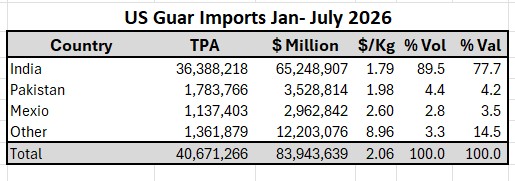
Guar from Mexico is a relatively new source but one that has rapidly grown to nearly equal that of Pakistan, the second-largest source in the world.


To be fair, both Pakistan and Mexico are distant 2nd and 3rd sources when compared to India, which accounts for 90% of the volume and 78% of the guar value.


Guar from Mexico is more costly than guar from India or Pakistan, but it is probably more readily available with a shorter supply chain. If a 10% tariff is applied to the $1.79/kg for guar from India, the price becomes $1.97/kg.


The high average price for "guar", $8.96/kg, from "Other" countries is probably due to a misclassification. Locust bean gum is often coded (by mistake or deliberately?) as guar gum. The $8.96/kg price is closer to LBG than to guar. More detail in the next issue of The Quarterly Review of Food Hydrocolloids.

Guar Tariffs - India


Expectations are that the US-India tariff exchange will escalate as India increases energy imports from Russia because of the Hormuz situation. Some industry observers expect tariffs of up to 100%, which India will likely respond to in kind. Normally, such a tariff would eliminate supply from the tariffed source. India, however, accounts for 90% of US guar imports. No other country has the capacity to fill that void.


Guar remains an important component in the oilfield industry, not to mention several other non-food applications.


Uncertainty is the bane of commerce but at the same time offers opportunities on how to deal with uncertainty.


We will continue to monitor the volatile US tariff situation and issue corrective statements as and when we are made aware of them.

Social Certification - Fair for Life vs Fair Trade Hydrocolloids


A google search about the difference between Fair for Life and Fair Trade certification:


Fair for Life certification encompasses a broader range of criteria than traditional Fair Trade certification, including social and environmental responsibilities throughout the entire supply chain, while Fair Trade primarily focuses on fair compensation for producers. Both aim to promote ethical practices, but Fair for Life emphasizes a holistic approach to sustainability and community impact.


We know of a few hydrocolloids which have Fair Trade certification. Now, there is at least one now that has a Fair for Life certification. The number of certifications, both social and quality continues to increase. There are even, "Certifiers of Issuers of Certifications". Certifications can be costly and suppliers can be expected to recoup some of those costs with price premiums. Details of which hydrocolloid and who is supplying in the next Quarterly Hydrocolloid Review (coming soon, 1st week of October).

There is much more detail in each issue of

The Quarterly Review of Food Hydrocolloids.

The next issue will appear the first week of October 2026 (number 142)


If your company is not a subscriber and would like to become one;

The subscription/confidentiality agreement is HERE. Our motto says it all with


"Good Information = Good Decisions"


Subscribers become partners and are invited to contact IMR

at any time with follow-up questions.

If at any time you wish to stop receiving our tidbits, simply click "unsubscribe" below. If you received this as a forwarded message and want to add your name to our Hydrocolleague list, just click HERE.

Regards,
Dennis Seisun - +1-858-776 2930 dseisun@hydrocolloid.com
Nesha Zalesny - +1-619-871 1415 nzalesny@hydrocolloid.com

DSeisun@hydrocolloid.com | +1-858-217- 5024

NZalesny@hydrocolloid.com | +1-619-871-1415

www.hydrocolloid.com

 
See what's happening on our social sites:
Facebook  Linkedin