|
If you require assistance accessing this information or require it in an alternative format, contact the Michigan Department of Transportation’s (MDOT) Americans with Disabilities Act (ADA) coordinator at Michigan.gov/MDOT-ADA. | | |
Welcome to the I-94 e-newsletter! These newsletters are intended to inform you about the Michigan Department of Transportation's (MDOT) I-94 modernization project in Detroit, the ongoing progress and future developments. To learn more about the I-94 modernization project and read previous e-newsletters, visit I94Detroit.org.
This edition highlights information on:
- Project Fast Facts
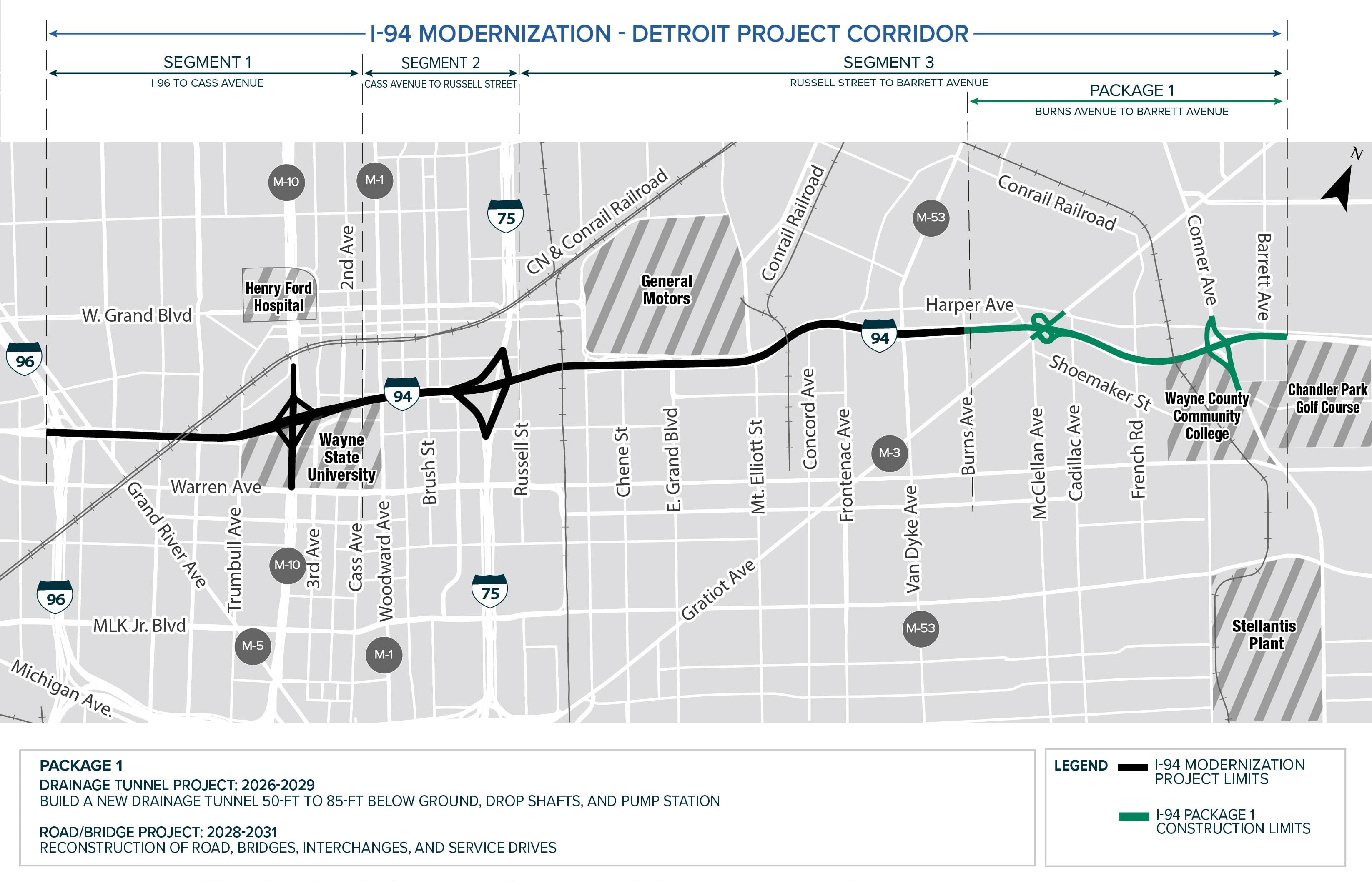
- I-94 modernization project overview from I-96 to Barrett Avenue, including planned corridor improvements and benefits.
-
I-94 modernization package 1 construction project overview (I-94 from Burns to Barrett avenues), including details on the drainage tunnel, timeline and key community benefits.
- MDOT's coordination with workforce development organizations supporting training and job-readiness for upcoming construction projects and their contact information.
- Schedule updates on the Brooklyn Street pedestrian bridge removal and
I-94 resurfacing between Second Avenue and M-3 (Gratiot Avenue).
- Updates on ongoing private utility relocation projects in the community.
- Overview of MDOT's Transportation Service Centers (TSCs) and their role in supporting regional mobility and project delivery.
| | Detroit I-94 modernization fast facts | | |
MDOT is moving forward with the I‑94 modernization project, a multi‑segment effort to rebuild approximately 7 miles of freeway between I‑96 and Barrett Avenue in Detroit. This portion of I-94 was built in the late 1940s/early 1950s and its design and function are outdated. This project will focus on replacing deteriorated bridges and pavement while bringing the corridor up to modern design standards to ease congestion, reduce crashes and improve travel time reliability.
In July 2020, the Federal Highway Administration (FHWA) approved the Combined Final Supplemental Environmental Impact Statement and Record of Decision (Combined FSEIS and ROD). The approval of this key document allows MDOT to move forward with the design and construction of a series of critical road, bridge, interchange, service drive and drainage system improvements, shaped by years of extensive community engagement and feedback. Throughout the earlier phases of the project, MDOT incorporated community concerns about neighborhood connections, mobility and flooding, which led to significant design refinements, including a redesigned drainage system featuring the new underground tunnel.
The approval of the Supplemental EIS allows MDOT to get federal funding for the project. This funding will help improve safety, traffic flow, neighborhood connections and the condition of roads, service drives, bridges and interchanges, making the corridor safer and easier for Detroit residents to use.
| |
Detroit I-94 modernization fast facts
-
The project is divided into three segments and multiple construction packages. Package 1 (Burns Avenue east to Barrett Avenue) on the east side is the area that will be rebuilt first. The timing of the design and construction of the remaining packages of the I-94 modernization project will be determined based on funding availability.
-
The interchanges at Conner Avenue, Gratiot Avenue, M‑10 (Lodge Freeway) and I-75 (Fisher Freeway) are planned to be modernized, including the removal of outdated left‑lane entrance and exit ramps.
-
More than 60 overpasses in poor condition are planned to be replaced on I-94 between I-96 and Barrett Avenue, improving neighborhood connectivity and providing safer crossings for drivers, walkers and cyclists.
-
Project plans also include replacing outdated structures at Lemay, Rohns, Helen and Iroquois streets with new, multimodal neighborhood connector bridges that will improve safety and access for drivers, pedestrians and cyclists. This also includes a new nonmotorized crossing aligned with the Iron Belle Trail, strengthening connections between communities on both sides of I-94.
-
One additional lane will be added to I-94 in each direction, improving safety, traffic flow and travel time reliability.
-
Entrance and exit ramps will be lengthened, giving drivers more space to merge safely.
-
Service drives will be rebuilt and converted to two‑way traffic at select locations, improving local access and neighborhood connectivity.
-
Auxiliary lanes that connect the entrance and exit ramps between the Conner and Gratiot avenue interchanges will improve safety and traffic operations, reducing conflicts for merging traffic.
-
Safety improvements will help reduce crash rates, which currently average about 1,200 crashes per year in this area, including an injury‑crash rate 1.5 times the statewide average, and will address wrong‑way driving at the Gratiot Avenue interchange, which has the highest number of wrong‑way incidents in Michigan.
Crash data from Michigan Traffic Crash Facts (2021-2024).
-
I-94 serves as a major economic corridor positioned between the region's key international border crossings, including the Gordie Howe International Bridge, the Ambassador Bridge, the Detroit-Windsor Tunnel and the Blue Water Bridge, making it essential to regional economic activity, trade flow and long‑term economic development.
I-94 Package 1 fast facts
-
This initial phase, known as Package 1, includes two major construction efforts:
-
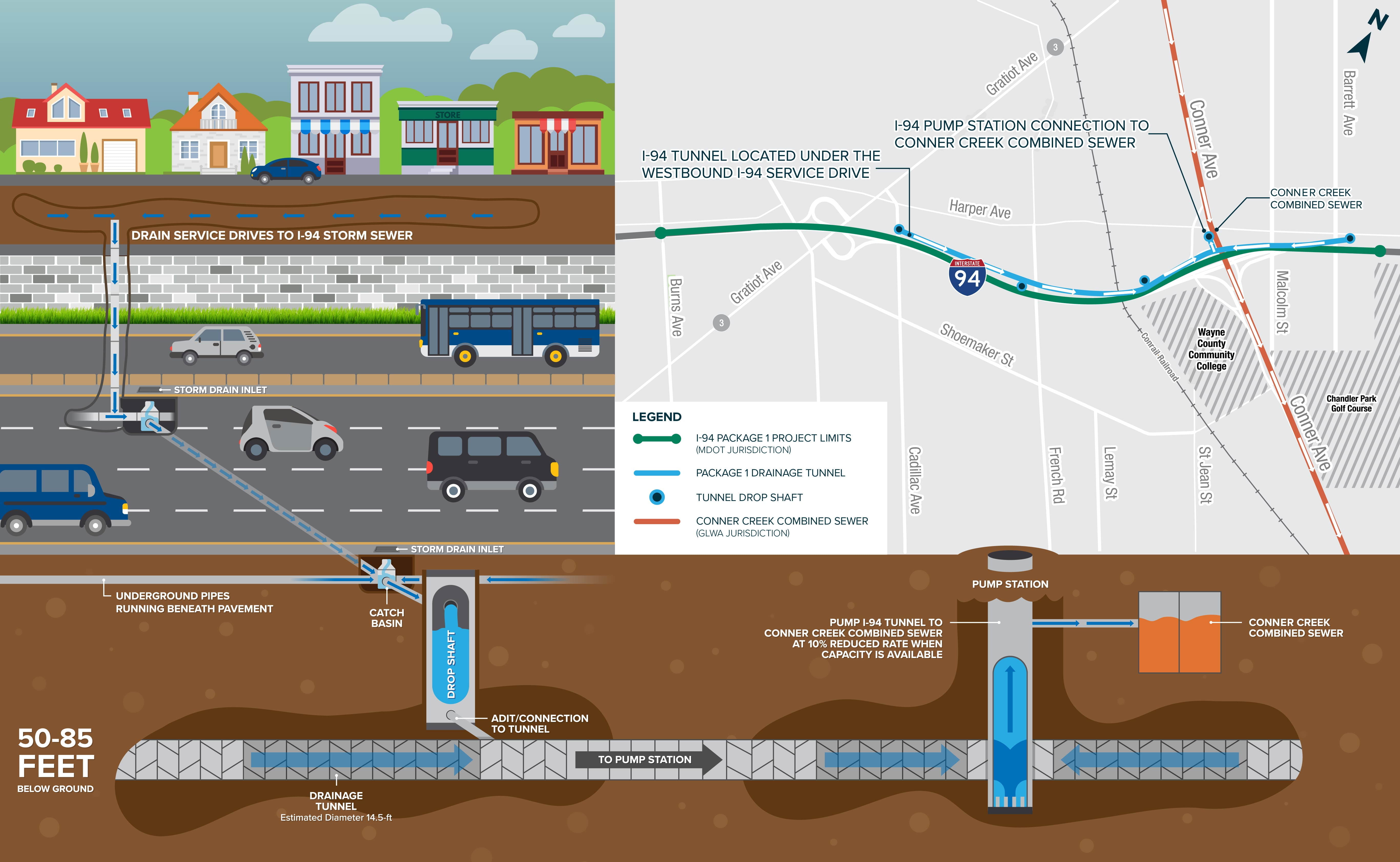
A drainage tunnel built from Cadillac to Barrett avenues, anticipated to begin in late 2026 or early 2027 and be completed by 2029.
- Rebuilding the freeway, bridges, interchanges and service drives between Burns and Barrett avenues, expected to take place between 2028 and 2031.
| |
Drainage tunnel: Recent developments
-
MDOT is issuing the Request for Proposals (RFP) this spring, inviting qualified design‑build contractors to submit proposals to design and build the drainage tunnel.
-
An Industry Forum was held in September 2025, giving contractors, engineers and design‑build teams an early look at the project, including the scope, anticipated qualifications and schedule.
-
Contractor proposals will be due in July 2026, and MDOT expects to award the design‑build contract this fall based on best value, a weighted score of cost and technical approach.
- Construction staging, roadway closures and potential detour planning are underway, ensuring that both tunnel work and future freeway construction can move forward while keeping traffic flowing safely. More information will be provided at the upcoming community meetings.
| |
-
The I-94 modernization project will begin with Package 1 since it is the least complex segment to build and delivers the greatest immediate benefit, improving the busiest and most congested section of I‑94 and helping protect nearby neighborhoods through the early construction of the new drainage tunnel.
-
The new underground drainage tunnel will be built first to create the stormwater foundation needed so future bridge and roadway reconstruction can move forward safely and efficiently.
- The drainage tunnel was designed in partnership with the Detroit Water and Sewage Department (DWSD), the Great Lakes Water Authority (GLWA) and the Michigan Department of Environment, Great Lakes, and Energy (EGLE) to handle more frequent and intense wet weather events. This modern system will help reduce the risk of flooding along I‑94 and in surrounding neighborhoods.
-
The tunnel will reduce peak stormwater flow from I‑94 to the city's Conner Creek combined sewer system by 82 percent, freeing up critical capacity during major storm events and helping protect infrastructure and communities.
- Because the drainage system needs to sit 50 to 85 feet underground to avoid existing utilities, tunneling is the safest and most cost‑effective approach. Most work will take place below ground and out of sight, reducing impacts and interruptions affecting drivers and nearby residents.
-
The freeway, bridges, interchanges and service drive construction project of Package 1 will replace eight overpasses above I-94 at Rohns Street, Lemay Street, the Conrail Railroad crossing, the Iron Belle Trail, Conner Avenue (two), Malcolm Street and Barrett Avenue.
For more details on Package 1 and its benefits, read the October 2025
e-newsletter.
| |
Workforce development opportunities
MDOT is helping Detroit residents prepare for future I‑94 construction jobs by partnering with Detroit at Work, Access for All, and Wayne County Community College District (WCCCD) to provide training and job‑readiness support.
Visit our Partnering with workforce development organizations page on MDOT's
I-94 website for more details and contact information for the three organizations.
| | Schedule update:
I-94 improvements outside of
Package 1 shift to 2027 | | |
Two previously planned I-94 projects outside of Package 1, the removal of the Brooklyn Street pedestrian bridge and resurfacing between Second Avenue and M-3 (Gratiot Avenue), have been rescheduled from 2026 to 2027.
Brooklyn Street pedestrian bridge
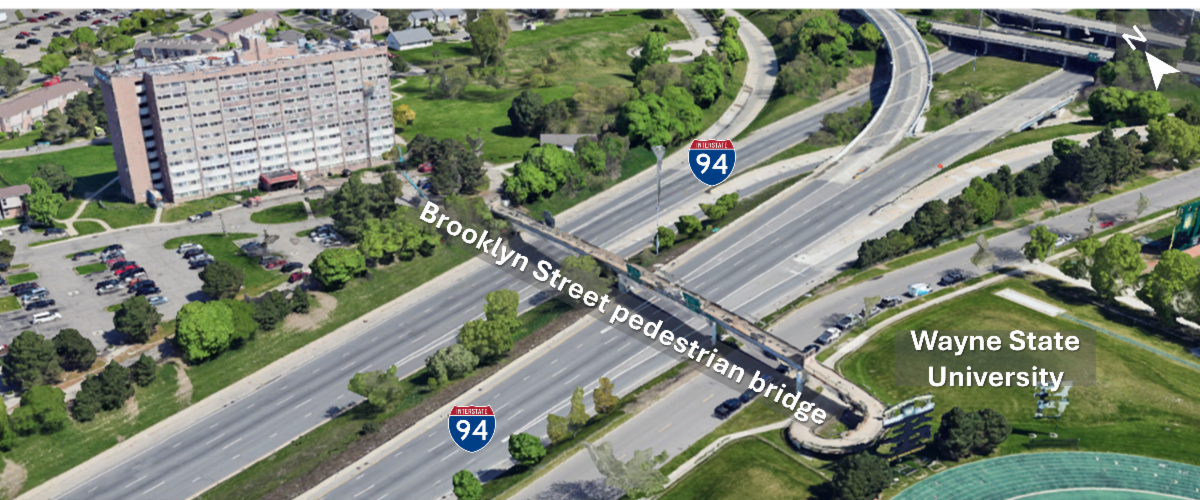
The Brooklyn Street pedestrian bridge over I-94, connecting the Trumbull Crossing Apartments to Wayne State University, has been closed to the public since 2022 due to structural deterioration. The overpass is scheduled for removal and will not be replaced since its location conflicts with future plans for modernizing the I-94/M-10 interchange.
| | An aerial view of the Brooklyn Street pedestrian bridge over I-94, which has been closed to the public since 2022. | | I-94 resurfacing: Second Avenue to M-3 (Gratiot Avenue)
MDOT also plans to resurface 4 miles of I‑94 between Second Avenue and M-3 (Gratiot Avenue), including the travel lanes, shoulders, and entrance and exit ramps to extend the freeway's service life ahead of future phases of the I-94 modernization project. | | What's next?
Both projects have been shifted to 2027 to better coordinate with other projects and events in the area. All work related to the bridge removal and I-94 resurfacing is expected to be complete by the end of 2027. MDOT will issue advance public notices with closure dates, times and detour information as the construction period approaches. | | Ongoing utility projects in the community | | DTE has ongoing electrical work at Holcomb Street and at the Conner Avenue interchange, including Harper Avenue and Beniteau Street, Conner Avenue and Olga Street. There is also ongoing gas work at Springfield Street. These projects are expected to be finished this spring. | | Other work in your neighborhood:
MDOT's Metro Region TSCs | | |
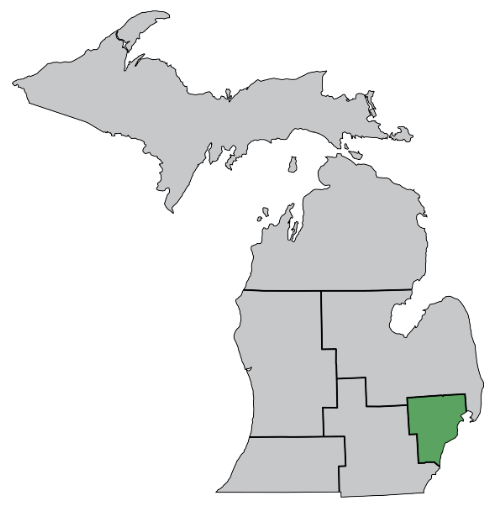
MDOT's Metro Region plays a central role in delivering major transportation projects and improvements for communities across Macomb, Oakland and Wayne counties. MDOT staff within the Metro Region and TSCs oversee planning, construction, maintenance and day‑to‑day operations on some of Michigan's busiest corridors with several projects in the area, including the I-94 modernization project.
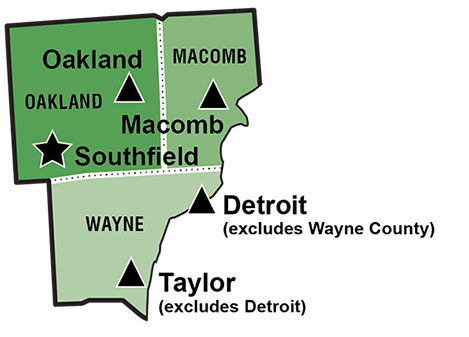
With four TSCs across the Metro Region, MDOT provides local support for construction, maintains state-owned roads and bridges, issues permits, supports traffic operations and coordinates with local partners. Staffed by MDOT professionals who live and work in Metro Region communities, TSCs serve as local points of contact for maintenance needs, project coordination, utilities and right‑of‑way permits, traffic control planning and responding to urgent transportation needs.
| | Map of Michigan showing the Metro Region highlighted, along with a map of Macomb, Oakland and Wayne counties, identifying the locations and service areas of the region’s TSCs. | | The Metro Region is one of seven MDOT regions (Metro, Grand, University, Bay, Southwest, North and Superior) that oversee transportation programs across the state. Together, these regions include 22 TSCs, strategically located so that no Michigan resident is more than an hour away from a center.
To connect with your local TSC or learn more about MDOT's Metro Region, visit Michigan.gov/MDOT/About/Regions/Metro or email
MDOT-METRO-DetroitTSC@Michigan.gov. | | © 2026 I-94 Project Office. All rights reserved. | | | | |