|
Where We Were
In January I said the 10-Year Treasury will have a 4 in front of it for a while. My reasons:
- Geopolitical uncertainty, including Venezuela, Greenland, and Iran.
- The out of control and rising US federal deficit, projected at ~6% of GDP, with massive Treasury issuances.
- Stubbornly high inflation, running around 2.7%, well above the FED's 2% target.
- Concern that Trump's tariff policies could push inflation higher.
- All resulting in a weaker US dollar.
These concerns have global and institutional investors pulling money out of Treasuries and into gold and silver. BRICS nations (led by China and Russia) are pushing to cut reliance on the US dollar in trade, making it worse.
Bottom line: Treasuries have to offer higher yields to attract buyers.
What’s Changed
Since my last post, the world got more complicated, not less.
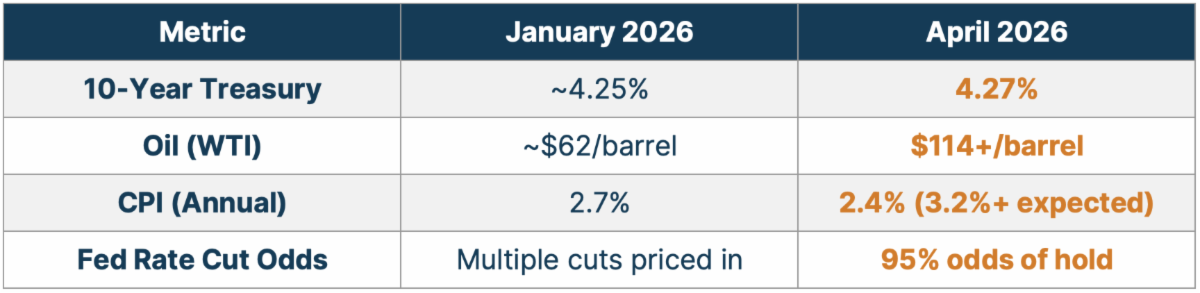
Iran blew up after the U.S. and Israel struck on February 28. Iran closed the Strait of Hormuz, the Houthis jumped in with ballistic missiles at Israel, and oil was above $114/barrel before the cease fire, which is now in effect for 2 weeks, and oil dropped to $95.86 on that news. Meanwhile Israel is still attacking Lebanon and Iran just said the Strait of Hormuz will remain closed if Israel does not stop attacking Lebanon. I think everyone has a hard time thinking a deal will be reached.
The Supreme Court struck down the original "Liberation Day" tariffs in February - ruled the President can't impose tariffs under IEEPA without Congress. But the administration pivoted fast: new pharma tariffs at 100% and retooled metals duties on the way. Tariff uncertainty isn't going anywhere.
- Inflation was 2.4% in February, but that was before oil spiked. Gas prices jumped 30%+ since late February, and the March CPI (due April 10) is expected to be an ugly - prediction markets are pricing in 3.2%-3.4%. If oil stays above $100/barrel, we’re looking at the CPI pushing toward 3.5% or higher by mid-year.
- Bonds sold off hard in late March as investors priced in higher-for-longer rates. The 10-year Treasury hit 4.44% on 3/27 and has settled around- its highest sustained level since mid-2025. The 2-year Treasury climbed to 3.86%. as of April 8, the 10 year treasury now sits at 4.27%
- CME FedWatch shows a 94.8%probability the FED holds rates at the April 29-30 meeting. A few months ago the market was pricing in multiple cuts for 2026. Now the conversation has shifted to whether the next move is a hike.
BRICS and Treasury Demand
- China cut US Treasury holdings by roughly $86B, India $51B, Brazil $33B, and Russia is basically out. Combined, BRICS members have sold $140B+ of US Treasuries a year since 2024.
- However, total foreign holdings remain above $9 trillion, about 24% of total US debt, with countries like Japan, UK, and Canada actually increasing their holdings.
- Hedge funds, banks, institutions and even stablecoins are stepping in and are large buyers of Treasuries. 57% of global reserves are still in the USD, with Treasuries remaining the most liquid market in the world.
- The trend is gradual BRICS diversification away from US Treasuries with no destabilization yet, but rising yields and weaker auctions suggest softening demand.
US Debt: The Numbers That Matter
- Debt-to-GDP: stands at 120-125%. Above the 90-100% level where growth historically slows. This is higher than post-WWII, but we don't have the same post-war growth tailwinds.
- Interest expense-to-revenue: Stands at 18-22% and rising fast. When it goes too high it crowds out spending for defense, Social Security, etc., and forces more borrowing resulting in spiraling debt. The US is above levels last seen in the early 1990s.
- Deficit-to-GDP: ~6%, which is very high for a non-recession period. Normally you'd see this during a crisis like the 2008 Financial Crisis, not during a stable economy.
- Debt-to-revenue: 600%+, which shows how many years of revenue it would take to repay debt, highlighting how dependent the system is on continued borrowing, economic growth and low-to-moderate interest rates.
Individually, none of these guarantees a crisis. The risk isn't immediate collapse - it's a gradual loss of flexibility, where policy options shrink, and markets demand higher yields.
What This Means for Borrowers
With the FED on hold and the 10-year at 4.27%, fixed-rate borrowers can continue to expect a 4-handle for the foreseeable future. Good news: Commercial mortgage rates are starting in the mid-high 5s for strong sponsors, so all-in fixed rates are actually better than the Treasury headline suggests.
Floating-rate borrowers - rates aren't coming down. If you underwrote your refi assuming rate cuts, you need a new plan.
Bottom Line
It seems obvious we are in for a higher 10-year Treasury Yield for the foreseeable future, which will at least have a 4 in front of it and possibly heading towards 5% if the ceasefire breaks and oil gets back above $100 for an extended period.
Where we can help
If your rate lock is expiring, your refi is coming due, or your lender is pulling back - give Spencer or me a call if you are not already working with one of our other GSP team members. We handle everything from standard refinances, acquisitions and construction financing to the tougher stuff: bridge, mezz, pref-equity, JV and GP capital, rescue capital, note purchases and sales, C-PACE, portfolio loans and land loans.
|