I-site newsletter is a global educational newsletter FOR HEALTH CARE PROVIDERS launched in 2009, that monthly provides independent updates from the international literature on specialty (R)GP lenses such as corneal, orthokeratology and scleral lenses and related topics. View as Webpage
|
|
With the Global Specialty Lens Symposium (GSLS) just a few weeks behind us now, I feel a need to express my unconditional love for a couple of things, including the meeting itself. Not having been able to travel to Vegas due to governmental COVID restrictions, I felt more than ever what it means to miss out. Despite all the turmoil, a group of about 600 specialty eye care practitioners got together and discussed the things that we need to discuss: how to best take care of the patients in need of specialty lenses. The downside, and the beauty at the same time, of this field is that not everything is or can be evidence-based. Along that line, a live online event planned for June - the virtual GSLS 2022 - will be held with that in mind. Karen DeLoss, Lynette Johns, Patrick Caroline and myself will present the evidence-based literature, including the BCLA CLEAR papers and more; but then the session will dig into the REAL world of specialty lens fitting after the presented 'evidence' and why it is not always as simple as A-B-C. Talking about 'unconditional': we may sometimes focus a bit too much on the solution (e.g., the product) rather than on the condition. Our procedures may be a bit unconditional, so to speak. The preference for one lens option over another really should depend on the needs of the patient, not on the practitioner’s preference. So stay tuned for the virtual GSLS, and in the meantime, this newsletter will provide some educational material that puts the conditions first—such as keratoconus, with its many management options, and ocular surface disease. But first: another unconditional love of mine.
|
|
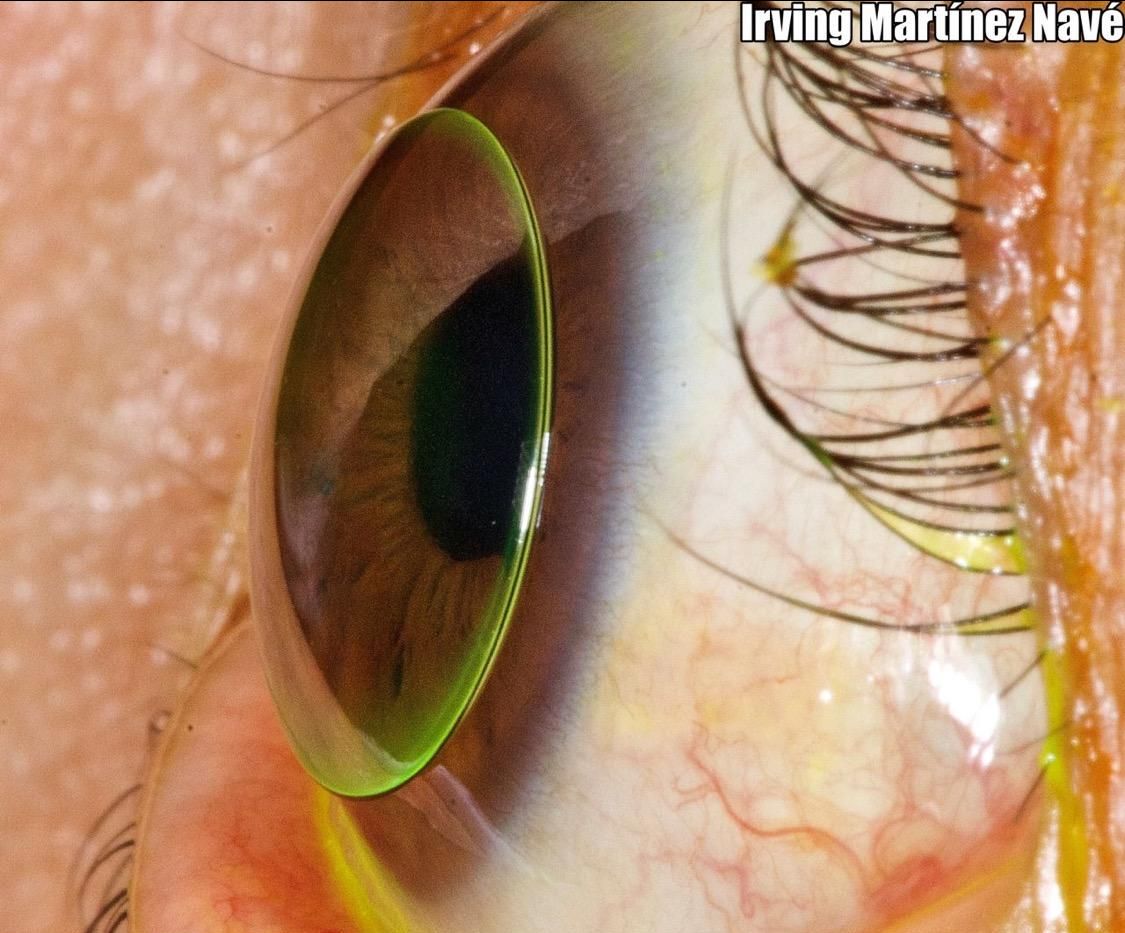
As said, we should be careful not to automatically bypass some options and always 'rush' into sclerals. Corneal GPs - my first love - have my unconditional love as an alternative to sclerals—but of course, only if desired and needed by the patient, as previously said. See the lovely picture of a corneal GP adjacent to this item from our colleague and friend from Mexico, Irving Martínez Navé. A number of posters at the recent GSLS actually dug into corneal GP lenses as an option. A nice one by Lauren Zabaleta discussed contact lens options post-DSEK and PKP secondary to Fuch’s endothelial corneal dystrophy in a 66-year-old Caucasian female. While scleral lenses are an option, downsides related to corneal edema, hypoxia, and endothelial cell damage exist. Corneal GP lenses can effectively correct both irregular astigmatism resulting from PKP as well as significant corneal and refractive astigmatism while maintaining corneal health in post-PKP and DSEK eyes, the poster states. And what if a corneal GP wearer has his or her suture removed after a corneal transplant? In another GSLS 2022 poster, Jessica Sun looked at the effect of post-penetrating keratoplasty suture removal on corneal GP lens fitting. Topographical changes following suture removal can occur as early as 15 minutes following the procedure, and any induced astigmatism can recover/stabilize after 1 hour. Some cases comparing keratometry and manifest refraction measured at 1 hour after suture removal and after 6 months reveal minimal changes, but this is not always the case. It is important that new research such as this is put into corneal GP lenses going forward. For a full overview of all GSLS 2022 posters, see link below.
|
|
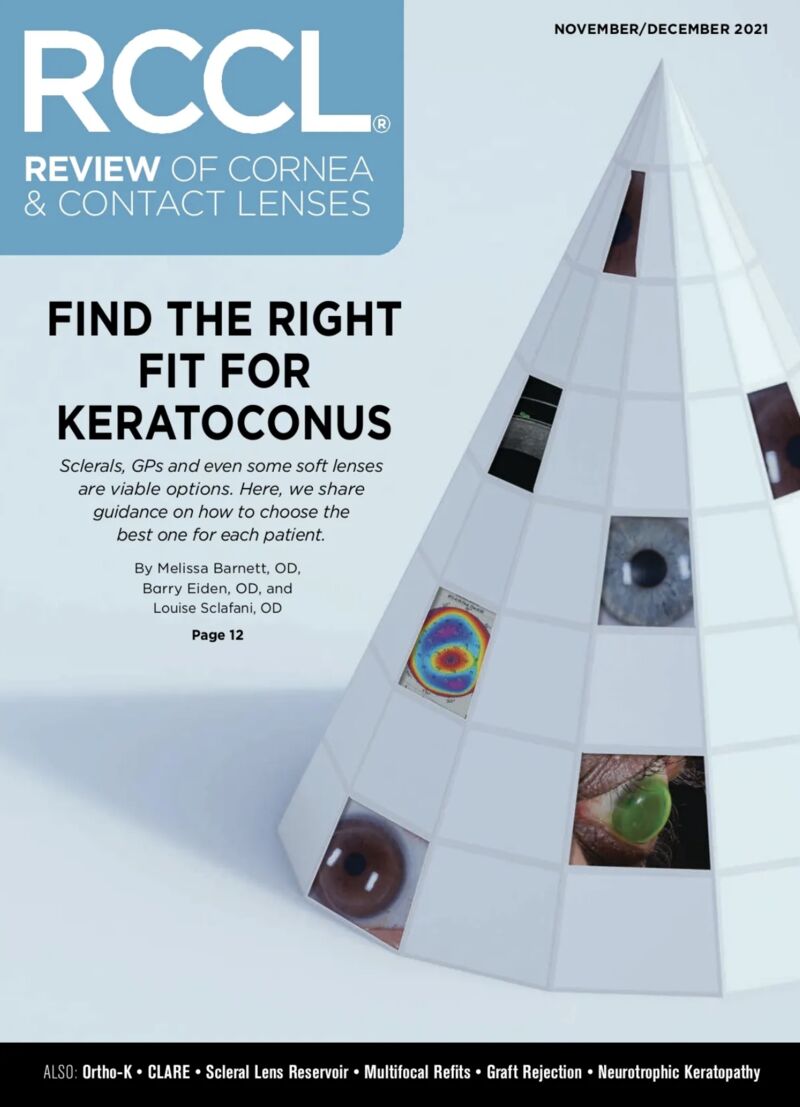
Speaking of making the condition central, this paper in Review of Cornea & Contact Lenses does just that. The patient in your chair has keratoconus, how do you manage that? Instead of simply rushing into a scleral, let’s review the options. Certainly corneal GPs, and hybrids and also soft custom lenses are potential viable management options. Melissa Barnett, Barry Eiden and Louise Sclafani explore the field. Keratoconus care is a team sport, they state. Successful management of keratoconus requires a comprehensive approach. The mainstays of management include early diagnosis, control of disease progression, vision rehabilitation and reduction of disease severity. Early diagnosis is essential in preserving visual function given that we can control disease progression through corneal cross-linking and other efforts. Co-management between the primary eye care provider and the keratoconus specialist is a way to maximize outcomes as well as to improve the level of experience for the primary eye care provider. To maximize outcomes, we have contact lens options to support the patient. Which management option is best depends on the patient, it should not depend on the practitioner. |
|
One of the top most downloaded and most cited papers from the BCLA journal Contact Lens and Anterior Eye is by M. Romero-Jiménez et al from 2010: A Review of Keratoconus. You know what? A fresh new update was just generated based on that: Keratoconus: An updated review. The open access paper states that traditionally, the condition has been described as a noninflammatory disease; however, more recently it has actually been associated with ocular inflammation. The condition affects all ethnicities and both sexes. The prevalence and incidence rates of keratoconus have been estimated to be between 0.2 and 4,790 per 100,000 persons and between 1.5 and 25 cases per 100,000 persons/year, respectively, with the highest rates typically occurring in 20- to 30-year-olds and in Middle Eastern and Asian ethnicities. A family history, eye rubbing, eczema, asthma, and allergy are risk factors for developing keratoconus. Detecting keratoconus in its earliest stages remains a challenge. Corneal topography is the primary diagnostic tool for keratoconus detection. In incipient cases, however, the use of a single parameter to diagnose keratoconus is insufficient, and in addition to corneal topography, corneal pachymetry and higher-order aberration data are now commonly used. Keratoconus severity and progression may be classified based on morphological features and disease evolution, ocular signs, and index-based systems. This article provides an updated review that wraps up the definition, epidemiology, histopathology, aetiology and pathogenesis, clinical features, detection, classification, and management and treatment strategies for keratoconus. |
|
Ocular Surface Disease Index |
|
Dry Eye Scores with Sclerals |
|
The role of scleral lenses in the management of corneal and ocular surface disorders is well documented in the literature, but it does not always get the attention it deserves. Investigators from BostonSight evaluated the impact of scleral lens devices on symptom outcomes based on the Ocular Surface Disease Index (OSDI). Forty-three patients who received a scleral lens device and underwent treatment completed a baseline OSDI survey. The most common treatment indications were keratoconjunctivitis sicca (n=27) and corneal ectasia (n=16). Baseline OSDI in the subject population improved by an average of 54.7%±27.6% following treatment. All patients, except for two, showed improvement in OSDI score. Statistically significant improvement in OSDI score occurred regardless of underlying diagnosis, with no statistically significant difference based on age, sex, mental illness, or device diameter and with no statistical correlation with average wear time or with duration of lens wear. |
|
Ocular Disease & Specialty Contact Lenses |
|
For a 'mini-guide' on scleral lenses, Manveen Bedi provides exactly that in a recent update (Jan 2022) that is ‘fresh from the oven’ in Eyes on Eyecare. It covers the fitting philosophy of scleral lenses, selecting lens parameters and also indications for conditions such as keratoconus but also Salzmann’s nodular degeneration, neurotrophic corneas and limbal stem cell deficiency. In the troubleshooting section, midday fogging and poor lens wettability are highlighted. In other coverage in Eyes on Eyecare, Caitlin Morrison looks at scleral lens technology: wavefronts, impressions, and more. She tries to help narrow down the vast array of incredible instrumentation and tools that we have available to us. Going the extra mile for hard-to-fit cases can help foster lifelong doctor-patient relationships while also improving practice profitability, Morrison states. Clinicians who routinely fit scleral and specialty contact lenses should consider updating their scleral lens technology to better suit their patients’ visual needs, as patients can benefit immensely by implementing some of these tools, accoring to Morrison. Photo: Silke Sage Global Contact
|
|
Scleral Lenses & Scuba Diving |
|
Call to Partake in a Patient Survey |
|
Visser Contact Lens Practice and the Diving Alert Network (DAN) are conducting a research project to investigate scleral lens wear under scuba diving conditions. Currently, daily disposable soft lenses are the first choice to wear, but gas-permeable scleral lenses while diving are being used increasingly worldwide. How these lenses perform under scuba diving conditions has not been investigated to date, though, and the questions of whether scleral lenses are safe to use while diving and provide clear underwater vision remain unanswered. For this research, we are looking for scleral lens wearers who are involved in the act of scuba diving with scleral lenses, and we ask them to complete a questionnaire about their experiences. For this reason, we reach out to specialty lens practitioners and ask them to approach scleral lens wearers who can partake in the questionnaire via one of the following two links below. Thank you kindly for your participation.
|
|
Amsterdam, Netherlands
Copyright © 2021. All Rights Reserved
This newsletter is kindly supported by:
|
|
|
I-site is an educational newsletter that is distributed on a monthly basis and provides an update on rigid gas permeable-related topics (scientific research, case reports and other publications worldwide). I-site is objective and non-political. Disclosure: I-site's editor Eef van der Worp, optometrist PhD FAAO FBCLA FIACLE FSLS, receives educational grants from a number of industry partners but is not related to any specific company. |
|
|
|
|
|
|