I-site newsletter is a global educational newsletter FOR HEALTH CARE PROVIDERS launched in 2009, that monthly provides independent updates from the international literature on specialty (R)GP lenses such as corneal, orthokeratology and scleral lenses and related topics. View as Webpage
|
|
There are many 'hot topics' that will regularly reappear in the coming year in the specialty lens arena. Sclerals are one topic that will continue to dominate the scene, I suppose. But another one, with the most questions and with possibly the most potential, will be myopia control. First, because we have only scratched the surface when it comes to its efficacy. Most of the current lens designs are simply historical developments that were not intended for myopia management per-se. Now, with the smaller optical zones, pupil-diameter controlled and more plus in the periphery compared to what the standard ortho-k mechanism generates, we can most probably 'upgrade' the efficacy to unknown heights. One of the problems with myopia management is its success, though. It is virtually impossible and ethically undesirable to put a cohort of kids in a control group that will not receive the myopia treatment when we know by now that it works to a smaller, or larger, degree. I know how I would feel if it was my kid in that control group. But we still need good randomized, controlled studies (long term) to judge the effectivity, while at the same time we are limited by its very effectivity. Fitting one eye with ortho-k and the other one as a control is not an option either. Medical-ethical commissions now even frown upon cross-over design studies (in which halfway through, the treatment group becomes the control group and vice versa). In short: controlling myopia control isn't that easy, to be quite frank. But exactly that proves that we are heading in the right direction. It promises to be an exciting year. |
|
Global Specialty Lens Symposium |
|
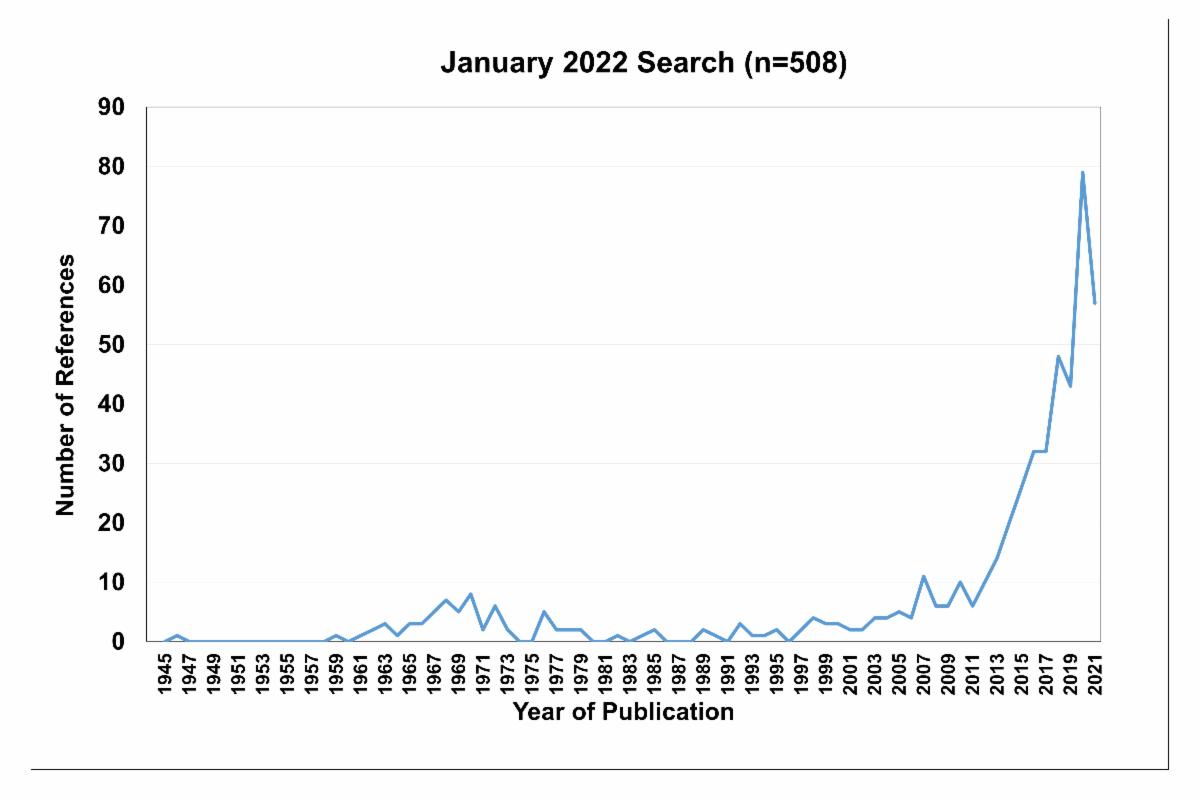
The annual 'harvest' of the scleral lens publication count is always done under a controlled methodology by Rute Macedo de Araújo from the Universidade do Minho in Braga, Portgual. The January 5th search using the keywords "scleral contact lens" retrieved a total of 971 articles, but only 507 were related. The graphs shows that the number of publications is 'going through the roof' when it comes to sclerals, which is special for a modality that is still very much a niche when considering the entire contact lens industry. The annual Eurolens Research survey estimates corneal (R)GP lenses to account for about 11% of all lens fits - and scleral lenses to be 22% of that (e.g., the proportion of sclerals within the rigid lens category), as reported in the January issue of Contact Lens Spectrum. From the new graph we can see that 2021 (57 papers) could not match the record 79 peer-reviewed articles of 2020. But with these still staggeringly high numbers - and not counting all non-peer-reviewed publications - scleral lenses seem to be officially 'too big to fail.’ The good news being that these lenses that provide such a happy view to many are not limited anymore to just a happy few. Happy new year to everyone. Curious, and looking forward, to what 2022 will bring in terms of scleral lens publications.
|
|
At the Global Specialty Lens Symposium (GSLS), opening later this week, specialty lens care conquered its own session. Lens care is often overlooked as one of the main factors in contact lens success: specialty or non-specialty. See link below to a paper by Ten et al from the School of Optometry and Vision Science at the University of New South Wales in Sydney (AU): 'subjective responses to various filling solutions in the posterior fluid reservoir of miniscleral lenses at application'. This topic of filling solutions will be covered in a separate session on sclerals, wil be covered at the upcoming GSLS. Dryness symptoms were more likely to improve at a slower rate post-lens application with saline alone compared with the addition of enhancing lubricating agents, the paper states. The addition of enhancing lubricating agents was more effective than saline alone was in improving symptoms of fluctuating vision, grittiness/burning/stinging and foreign body sensation more quickly. So: possibly, enhancing lubricating agents can help making scleral lens wear even more comfortable than it already is, at least in normal eyes and in experienced soft lens wearers. Photo by yan lee on Unsplash
|
|
Link between Keratoconus and Posterior Segment Parameters of the Eye |
|
'A good read' to get the year started: Keratoconus has been typically known as a disorder with effects limited to the cornea. Because of this viewpoint, less attention has been devoted to its effects on the posterior segment structures. This review paper aimed to provide a comprehensive overview of the literature to understand the potential link between keratoconus and posterior segment structures and their functions. It is clear from the extensive evidence in the literature that keratoconus can be associated with morphological and functional changes in different parts of the posterior segment. It is worth noting that anatomical changes have been noted not only in several layers of the retina but also in the optic nerve head and the choroid. Several mechanisms have been proposed to explain this observation, including oxidative stress in keratoconic corneas and retinal adaptations to the distorted image that lands on the retina. Consequently, when keratoconus has been diagnosed, it seems worthwhile to consider assessing the retinal and choroidal profile using the latest technology, the authors state.
|
|
Another ‘good read' - and potentially a headstart for the year to come - to get some basic understanding of the potential of myopia control efficacy using higher-order aberrations (HOAs): see this fascinating review paper by the team at Queensland University of Technology in Brisbane (AU). They describe HOAs as follows: “HOAs are optical imperfections of the eye that alter retinal image quality despite optimal correction of spherical defocus and astigmatism. Since higher order aberrations reduce retinal image quality and produce variations in optical vergence across the entrance pupil of the eye, they may provide optical signals that contribute to the regulation and modulation of eye growth and refractive error development. The magnitude and type of higher order aberrations vary with age, refractive error, and during near work and accommodation. Furthermore, distinctive changes in higher order aberrations occur with various myopia control treatments, including atropine, near addition spectacle lenses, orthokeratology and soft multifocal and dual-focus contact lenses.” In other words: there is work to do, but there surely is (a lot) of potential. Photo by Maria Teneva on Unsplash
|
|
Ortho-k Lens Fitting Based on Sagittal Height Simulation Software |
|
In the other category of 'good news’: technology and big data are 'coming to the rescue' with regard to making adjustments to lens fit in orthokeratology. Researchers from Beijing (China) evaluated a novel sagittal height fitting algorithm for estimation of alignment curve radius for ortho-k lenses. Adolescent patients (103 eyes) were enrolled. The alignment curve radius of one group was calculated by the novel fitting algorithm, while in the other group this was decided by the optometrist using flat K readings and eccentricity values. The numbers of trials for the novel algorithm and for the traditional method were 1.2±0.4 times versus 1.4±0.5 times, respectively, and the difference between the two methods was statistically significant. According to the authors, the new sagittal height simulation software can accurately calculate the alignment curve value of this ortho-k lens suitable for Chinese patients. Photo by Clay Banks on Unsplash
|
|
The Scleral Lens Education Initiative |
|
Curated by John Gelles and Melissa Barnett, this document on scleral lenses has the goal to provide a comprehensive scleral lens resource featuring the latest published research, evidence-based clinical recommendations, and expert-backed insights. It includes chapters such as:
-
The Early Days and Beyond by Lynette Johns
-
Review of Indications for Scleral Lens Wear by Muriel Schornack
-
Getting Started with Scleral Lenses by Brooke Messer
-
Co-managing Scleral Lens Patients by Karen DeLoss
-
Scleral Lens Design & Troubleshooting by Sheila Morrison Daddi Fadel
-
Laboratory Consultation by John Gelles and Melissa Barnett
-
Scleral Lens Patient Management and Follow Up by Karen Lee
-
Scleral Lens Business Management by Stephanie Woo
-
Alternatives to Scleral Lenses by Tiffany Andrzejewski.
|
|
Amsterdam, Netherlands
Copyright © 2021. All Rights Reserved
This newsletter is kindly supported by:
|
|
|
I-site is an educational newsletter that is distributed on a monthly basis and provides an update on rigid gas permeable-related topics (scientific research, case reports and other publications worldwide). I-site is objective and non-political. Disclosure: I-site's editor Eef van der Worp, optometrist PhD FAAO FBCLA FIACLE FSLS, receives educational grants from a number of industry partners but is not related to any specific company. |
|
|
|
|
|
|