I-site newsletter is a global educational newsletter FOR HEALTH CARE PROVIDERS launched in 2009, that monthly provides independent updates from the international literature on specialty rigid contact lenses such as corneal, orthokeratology and scleral lenses and related topics. View as Webpage
|
|
Recently, papers keep popping up on the effect of repeated low-level red light therapy for myopia prevention and reduction. Among a number of already classical papers is the one by Jiang et al (2022, open access) in Ophthalmology. They found a difference in axial elongation and in spherical equivalent refraction progression of 0.26 mm and –0.59D between the low-level red light therapy group and a control group. Another paper in that category is the one by Zhou et al in OPO (2022). At 9 months, the mean spherical equivalent refraction in the red light therapy group was −2.87D ± 1.89D, significantly greater (0.7D) than that of the control group (−3.57D ± 1.49D). Axial length changes were −0.06mm ± 0.19mm and 0.26mm ± 0.15mm in the light therapy and control group, respectively (0.2mm difference). Both studies show significantly more effect than what any other current therapy can offer. For more explanation on the topic, watch the excellent webinar by Jeff Walline on the GPLI platform. A recent paper published in JAMA by He et al (2023, open access) looked at children with pre-myopia in China and found a 54% reduction in incident myopia with the light therapy. So, is this a done deal? Well, let’s not get ahead of ourselves. We don't know anything about the long-term effects and things such as the rebound effect. There may be some red flags, but we simply don't know. Surely something to follow as we go along, but lets make sure we are not running a red light on this one.
|
|
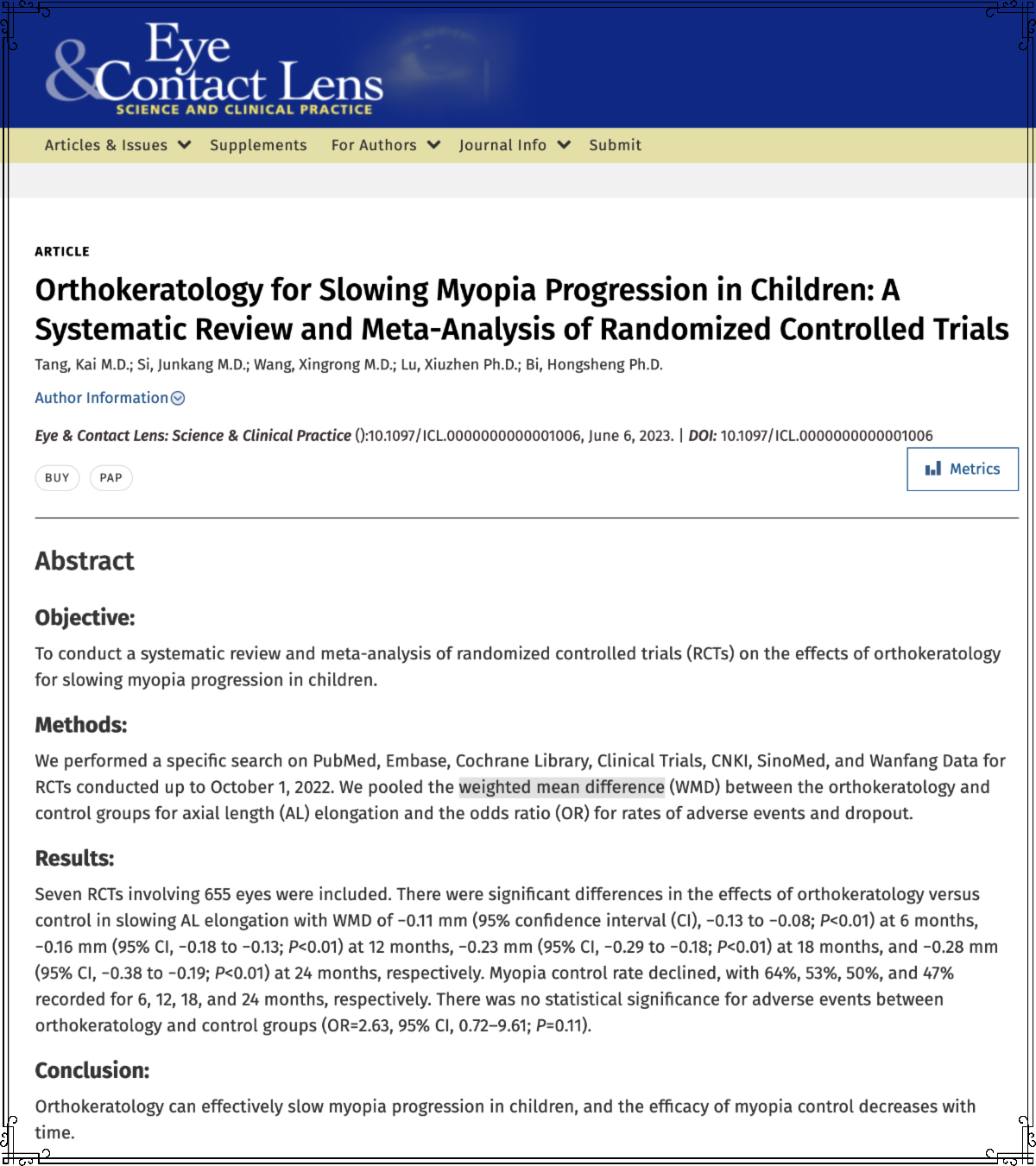
A meta-analysis is a statistical analysis that combines the results of multiple scientific studies, thus creating a new investigation with new results and conclusions. Not a simple task, typically. Tang et al conducted such a systematic review and meta-analysis of randomized controlled trials on the effects of ortho-k for slowing myopia progression in children. Seven randomized controlled trials involving 655 eyes were included. Significant differences were found in the effects of ortho-k versus control in slowing axial elongation, with a weighted mean difference of −0.11mm at 6 months, −0.16mm at 12 months, −0.23mm at 18 months and −0.28mm at 24 months. Myopia control rate declined, with 64%, 53%, 50%, and 47% recorded for 6, 12, 18, and 24 months, respectively. There was no statistical significance for adverse events between orthokeratology and control groups. They concluded that ortho-k can effectively slow myopia progression in children, but the efficacy of myopia control decreases with time.
|
|
The purpose of this study was to investigate the effects of ortho-k lenses with aspheric and spherical base curve designs on corneal refractive power and peripheral refraction. In this 3-month study, 33 subjects were assigned to a base curve aspheric (BCA) and 29 subjects to a base curve spherical (BCS) lens (right eyes only). At the 3-month follow-up visit, the mean refractive power in the BCA group (2.08D ± 0.65D) was significantly greater than that in the BCS group (1.32D ± 0.81D). The BCA group (-1.82D ± 0.65D) exhibited a larger absolute peripheral refraction change compared to the BCS group (-0.98D ± 0.54D. In conclusion: consistent with previous studies, it was observed that the corneal optical surface gradually changed from the corneal center to the mid-periphery after treatment in both the BCA and BCS groups; however, the corneal surface shape in the two groups were different in the central cornea: in the spherical lens group it formed a “U” shape, while a V-shaped curve was observed in the BCA group. The peripheral shape with the BCA is steeper than that with the BCS; therefore, the aspheric base curve could produce a sharper decline in the central refractive power after lens wear, resulting in a more aspheric treatment zone. The asphericity of the treatment zone has been linked with myopia control effects. |
|
Two papers evaluated quality of life (QoL) scores with ortho-k lens wear. Ren et al wanted to determine whether changes in various ocular parameters of subjects (aged 18 to 38 years) wearing ortho-k lenses had an effect on their levels of satisfaction and quality of life (QoL) after commencing treatment. Forty-four subjects completed the study. Axial length was shortened significantly at the 12-month visit by −0.03mm compared to baseline. A significant number of subjects in both groups presented with overall and central corneal staining, but the majority were mild (grade 1). Central endothelial cell density was reduced by 40/mm2 (loss rate 1.4%). High scores were obtained in the satisfaction questionnaire, with no significant differences between visits. These results suggest that ortho-k can be an effective and safe myopia correction technique for adults with low-to-moderate myopia, improving daytime vision without serious adverse events. Satisfaction with ortho-k lens wear was high, particularly in those who were dependent on vision correction and found spectacles or contact lenses limiting for specific activities or cosmetically undesirable. Yang et al compared the health-related quality of life (HRQoL) outcome among children with myopia in three different groups: ortho-k, glasses with peripheral lenslet design (PLD), and single-vision (SV) spectacles. The PLD spectacles had a significantly higher HRQoL than the OK and SV spectacles among children in this study. This data indicates that PLD spectacles may be considered as an alternative for myopia management in children and adolescents.
Photo by Ben White on Unsplash
|
|
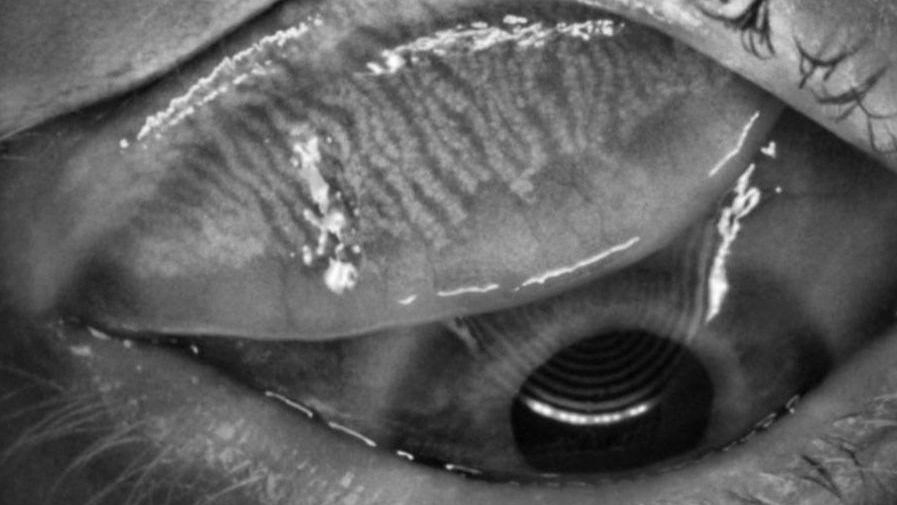
Zhai et al evaluated the changes in meibomian gland (MG) morphology in asymptomatic children in a group wearing overnight ortho-k lenses and a group wearing soft lenses. The retrospective study was conducted on 89 participants with ortho-k and 70 with soft lenses. The average follow-up time was 20.8 ± 10.8 months. The MG width of the upper eyelid significantly increased and the MG vagueness value significantly decreased in both the ortho-k and the soft lens group. MG tortuosity of the upper eyelid significantly increased after ortho-k. Tear mensicus height and non-invasive break-up time was not affected. In conclusion: the current study showed that the meiboscore did not differ significantly, but the quantitative MG indicators analyzed, such as the MG height, width, tortuosity, density and vagueness value, showed significant differences—pre- and post lens wear—in both ortho-k and soft lens wear. |
|
The GPLI Eye Care Professional Membership is a new program that gives eye care practitioners access to premier resources to help advance their specialty contact lens practice at a low annual fee. The membership supports the ongoing efforts of the GP Lens Institute, and member benefits include free printed materials (US only), coding and billing module, staff module, building your practice with rigid lens multifocals, archived webinars, free quarterly COPE-approved webinars, bi-monthly member newsletter, access to recent cornea and contact lens residents' symposium presentations, quarterly GPLI podcast (“GPLI Radio”), member directory and more.
|
|
Amsterdam, Netherlands
Copyright © 2023. All Rights Reserved
This newsletter is kindly supported by
Bausch + Lomb Specialty Products
|
|
|
I-site is an educational newsletter that is distributed on a monthly basis and provides an update on rigid gas permeable-related topics (scientific research, case reports and other publications worldwide). I-site is objective and non-political. Disclosure: I-site's editor Eef van der Worp, optometrist PhD FAAO FBCLA FIACLE FSLS, receives educational grants from a number of industry partners but is not related to any specific company. |
|
|
|
|
|
|