I-site newsletter is a global educational newsletter launched in 2009, that monthly provides independent updates from the international literature on specialty (R)GP lenses such as corneal, orthokeratology and scleral lenses and related topics. View as Webpage
|
|
Obituary—Rigid contact lenses (2010) |
|
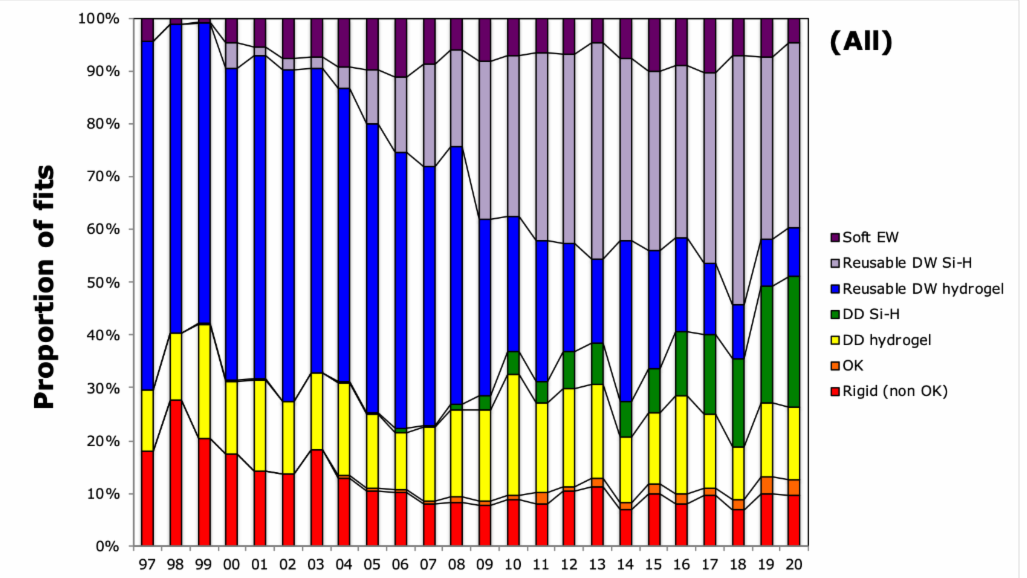
Ever since 'the demise of rigid gas permeable lenses' predicted by Nathan Efron about 10 years ago...nothing has changed really. Or actually, something has changed: the decline in rigid lens fits worldwide stopped the moment Efron made his famous (or infamous according to some) prophecy. The new 2020 Eurolens research data are in. An incredible achievement by Philip Morgan and his team in Manchester (UK) to, despite a worldwide pandemic, collect data on 13.311 lens fit in 25 countries. The graph below sums it up quite nicely.
|
|
The bottom red and orange bars represent rigid lenses (orange representing orthokeratology). With (or even without) the latter, there is hardly a decline visible in rigid lenses over the last decade; if anything, it is the opposite (a slight increase). This includes scleral lenses, which of course have been a bit of a game changer for the industry. All in all: it looks like a pretty stable industry to be in, if you ask me. Happy to be part of that.
Eef van der Worp
|
|
Multifocal Orthokeratology for Myopia |
|
Multifocal OK vs. Conventional OK |
|
A recent study was published that evaluated the myopia management efficacy of a novel orthokeratology lens utilizing a center-distance multifocal design (MOK) in comparison to traditional orthokeratology (OK). Thirty children with myopia of –1.25 D to –4.00 D in the age group of 10 to 14 years were evaluated for efficacy in slowing axial eye growth. The MOK lens molds a center-distance, multifocal surface onto the anterior cornea, with a concentric treatment zone power of +2.50 D. Children wore the MOK lens in one eye and the conventional OK lens in the fellow eye nightly for 18 months. MOK-treated eyes showed significantly less axial expansion (axial length change: MOK 0.173 mm less than OK; p < 0.01) and inner axial length (posterior cornea to anterior sclera change: MOK 0.156 mm less than OK, p < 0.01) compared to OK-treated eyes. New developments such as this may allow practitioners to treat their patients more effectively with more options so that they can potentially better tailor treatments to the individual needs of each patient. This study suggests that a novel lens design for OK treatment may provide better control of myopia progression compared to that with more traditional designs.
Image: Massimo Ferrari (IT)
|
|
Hydrogen Peroxide vs. (R)GPs |
|
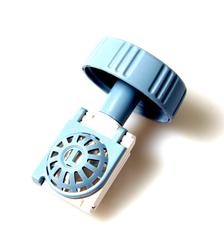
Given that (R)GP lenses are the safest contact lens wearing modality out there in the field, lens care and particularly the use of care systems and their compatibility with (R)GP lenses doesn't always get too much attention. One concern with exposing contact lenses to any form of disinfection system is whether the solution might have an effect on the lens material or cause changes in lens parameters. Lens compatibility testing with the indicated types of lenses is a standard part of the regulatory review and approval process for any contact lens care solution. Gabriel et al looked into this with (R)GP materials, and of course at antimicrobial efficacy. The hydrogen peroxide lens care solution used in this study was subjected to a large variety of tests to assess cleaning, disinfection, compatibility, and safety performance when used with (R)GP contact lenses. In real-world conditions, it was shown to be effective against clinically relevant bacterial strains isolated from adverse events and against the two forms, trophozoites and cysts, of resilient Acanthamoeba species. Compatibility tests with two types of (R)GP lens materials indicated that the physical and/or optical parameters of lenses are unaffected through 30 cycles of simulated use with the care system, indicating that peroxide systems seem well suited for cleaning and disinfection of (R)GP contact lenses. |
|
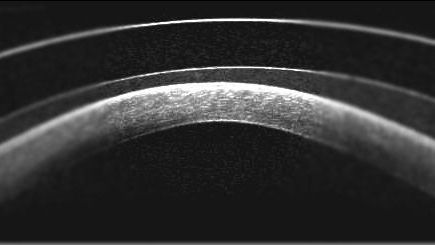
Michaud and Courey from the Université de Montreal (CA) studied whether tear fluid reservoir thicknesses may influence the presence of residual astigmatism and visual acuity in scleral lens wearers. In general, the results indicated that residual astigmatism is present at a low level (−0.50 D to −0.75D), with limited impact on visual acuity. All lenses were found to be similarly decentered inferiorly by 0.10 to 0.15 mm. Higher-order aberrations, mostly vertical coma, were clinically significant but not statistically different between lenses. Overal results indicate that residual astigmatism is influenced by the fluid reservoir thickness, independently of the lens thickness. There is no correlation between over-keratometry over the lens and residual astigmatism. This means that flexure is most likely not the cause of this residual astigmatism. |
|
MGD in Soft and (R)GP Lens Wear |
|
Investigators from Turkey looked at the association between meibomian gland loss and soft and rigid contact lens wear. This prospective, multi-center, cross-sectional study included 44 soft lens wearers, 21 (R)GP lens wearers, and 26 healthy non-wearers, and it evaluated the structural changes in meibomian glands (MGs) and whether there was meibomian gland dysfunction (MGD). The mean percentage of meibomian gland loss was 25.3 % in soft lens wearers, 34 % in (R)GP lens wearers and 18.4 % in the control group. Mean OSDI (ocular surface disease index) score was higher in soft lens wearers (15.5 ± 18) than in the control group. The authors suggest that lens wear may cause MGD, and this effect may potentially be more pronounced in rigid lens wearers than in soft lens wearers. |
|
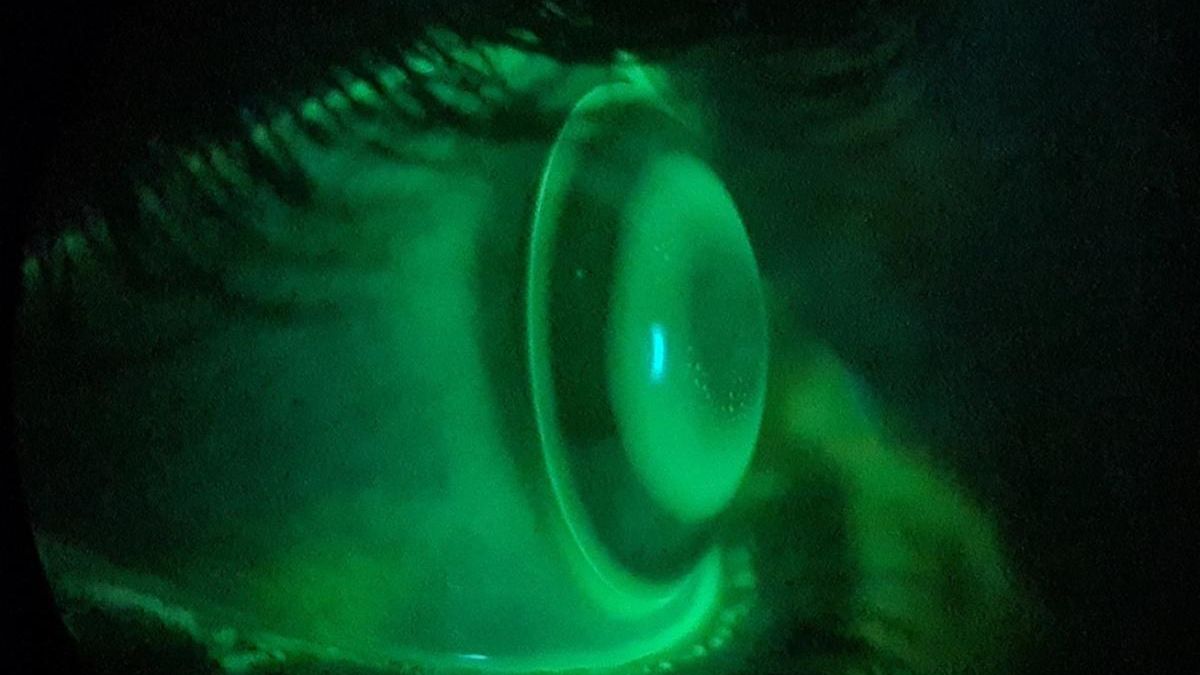
Greg DeNaeyer from Columbus OH (US) reports on this graft-versus-host-disease (GVHD) patient complaining of visual disturbance while wearing a 2.5-year-old scleral lens. Within seconds (see movie below), the lens shows obvious surface crazing as the surface starts to dry after the blink. This emphasizes the importance of scleral lens material selection and of regular replacement of scleral lens devices. Movie clip courtesy of Greg DeNaeyer.
|
|
Amsterdam, Netherlands
Copyright © 2020. All Rights Reserved
This newsletter is kindly supported by:
|
|
|
I-site is an educational newsletter that is distributed on a monthly basis and provides an update on rigid gas permeable-related topics (scientific research, case reports and other publications worldwide). I-site is objective and non-political. Disclosure: I-site's editor Eef van der Worp, optometrist PhD FAAO FBCLA FIACLE FSLS, receives educational grants from a number of industry partners but is not related to any specific company. |
|
|
|
|
|
|