I-site newsletter is a global newsletter, educational in nature and launched in 2009 that monthly provides independent updates from the international literature on specialty (R)GP lenses and related topics. |
|
Usually announcements of webinars worth viewing are listed at the bottom of I-site newsletter. But not this time: we start with one, as two talented young researchers shared their results with an online audience at the SUMMIT, an online platform hosted by Daddi Fadel and Mindy Toabe. In the webinar, Rute Macedo de Araújo from Portugal coined the term 'scleral footprint.' She discussed the impact of three hours of lens wear on the conjunctiva. This impact is most notably present in the nasal region. Among many other things, she looked at the practitioners' learning curve in fitting sclerals. During the first 20 fittings, 2.35±0.18 trial lenses were needed to achieve a successful lens fit; after 20 lens fits, this number decreased to 1.56±0.13. She also looked at the handling learning curve for sclerals on the patients' side. Handling issues were reported to be one of the key factors for lens discontinuation, but marked improvements can be seen over time, so investment in lens handling seems worthwhile. Debby Yeung from Canada looked in the webinar at the importance of limbal clearance: we don't want this to be too low, but we don’t want it too high either, as excessive limbal clearance can reduce oxygen transmissibility. Limbal hyperemia could be a sign of 'pressure' or compression, which needs to be investigated. Her advice is to assess scleral lens fit in each quadrant, and sectorial scleral lenses may be needed for optimal results. Limbal clearance is primarily assessed behind the slit lamp using a modified Van Herrick method (used to assess anterior chamber depth). If you 'see green' (fluorescein), she states, then at least 30 microns of clearance is present. Rute added that central corneal clearance could also be assessed by using axial length measurement instruments. Go see the entire webinar (free after registration): there is much more to learn #borntobespecialist
Eef van der Worp
|
|
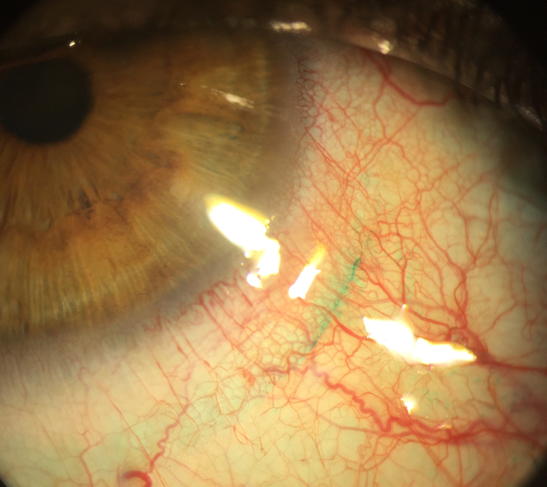
Daddi Fadel, in the scleral lens issue (August) of Contact Lens Spectrum, looks at different dyes used for scleral lens assessment. In essence, she states that when it comes to assessing scleral lens fit, using two dyes should be considered rather than just one. While fluorescein may be used with fitting scleral lenses to determine whether the lens is bearing on the cornea and to estimate the depth of the fluid reservoir, it may not be the appropriate dye to assess the lens fit over the scleral zone, because its orange color has a reduced contrast with the white sclera. Thus, the most indicated dye to assess the scleral area is potentially lissamine green. First suggested by Hector Velasquez from Venezuela, the lissamine green application could be used to better evaluate scleral lens alignment on the conjunctival tissue, highlighting the lens periphery and/or edge lift, scleral toricity, any influx of the stained fluid into the tear reservoir, conjunctival impingement, and conjunctival tissue integrity, because its green color has a higher contrast with the white sclera. With these considerations, it is stated that both of these dyes could be needed in scleral lens practice. A table in the featured article summarizes characteristics of both dyes. The use of different slit lamp light conditions helps to evaluate the two dyes separately; cobalt blue light will enhance the appearance of the fluorescein, and white light is used for lissamine green.
Image: Hector Velasquez
|
|
Overnight Orthokeratology Effect |
|
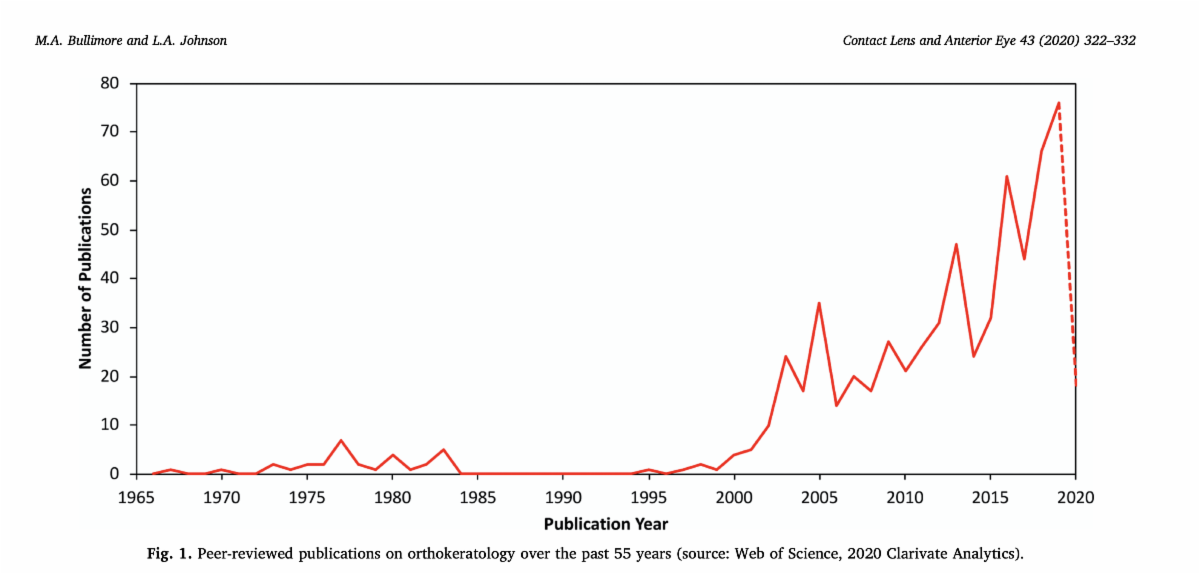
While the past decade has seemed to be 'the decade of scleral lenses,' the period prior to that can perhaps be viewed as 'the decade of orthokeratology,' (OK) starting roughly in 2000, at least from a peer-reviewed publications point of view. Knowledge on the topic keeps expanding, and Mark Bullimore and Leah Johnson wrote a nice review article in Contact Lens & Anterior Eye (open access) to highlight that. One of the key features of course is that OK is reversible: around half of the myopia reduction will be lost after 24 hours, and 90% within 72 hours, the article states. According to the Eurolens research survey, 1.2% of all new fits globally are with OK, ranging from 0% in some countries to about 6% in the Netherlands. Compared to non-OK lenses, OK lenses are fit to a younger population (25±13 vs 40±15 years). The paper also concludes a discussion that had gone on for a while in the international community: the refractive changes in OK result from local changes in corneal epithelium thickness - central thinning and mid-peripheral thickening - thereby flattening the central cornea. The paper further, and extensively, looked at the myopia controlling effect of OK and other modalities. A strong case is made for OK and multifocal soft lenses processing the same underlying mechanism (peripheral defocus). Image: Bullimore, Johnson - Contact Lens Ant Eye 2020
|
|
Scleral Lens Issues and Complications |
|
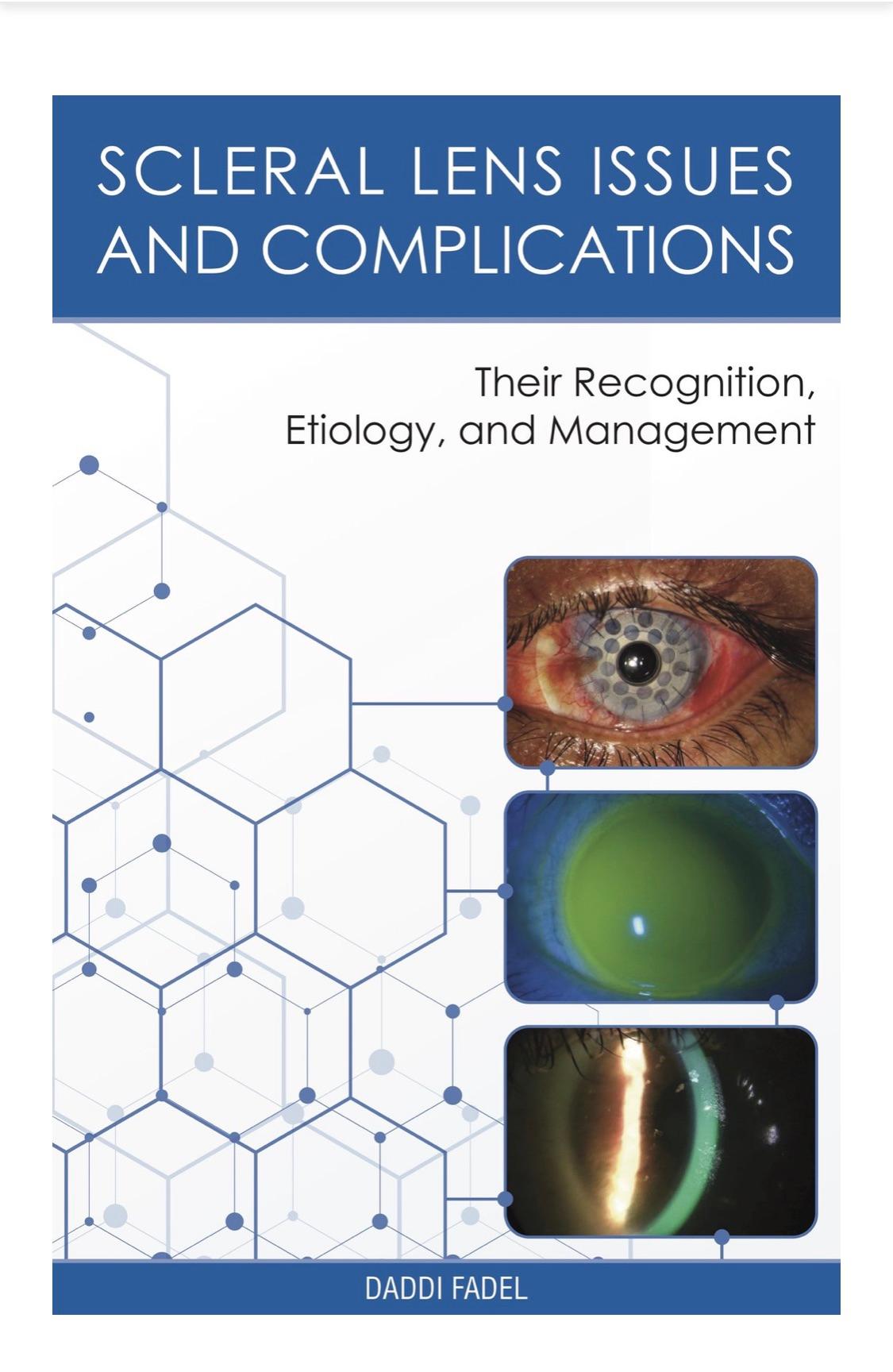
The benefits of scleral lenses are now clear to anyone in the eyecare field, presumably. Now is the time to also look at their issues and complications too, to do even better with scleral lenses than we have done so far. That is exactly the intent of a new book by Daddi Fadel: Scleral Lens Issues and Complications, their Recongnizion, Etiology and Management, which just published. It provides an excellent overview, in a very structured way, about all clinical signs that we may encounter with scleral lens wear as well as how to observe them (slit lamp technique used, etc.) and how to manage them. It even covers topics such as scleral shape and front surface optics, which are helpful but are not the main benefit of the book. The primary added value is that it’s a clinical lifeline in a highly educational form and shape for every single complication imaginable that is categorized by area (cornea, limbus, conjunctiva, etc.) and by complaint (vision, comfort, etc.) - all supported by fantastic photographs provided by an array of scleral lens experts illustrating the items discussed. A 'must read' problem solving guide for anyone in the field, with the latest and most up-to-date knowledge: evidence-based where possible - based on clinical wisdom elsewhere.
|
|
Myopia Abstracts from Virtual Meeting |
|
The annual Association for Research in Vision and Ophthalmology (ARVO) meeting typically brings together the largest community of eye and vision researchers in the world. The meeting was cancelled this year, but online abstracts and recorded presentations have been made available, so we still have access to the latest and greatest myopia science 'right to your inbox,' Myopia Profile Digest writes. The best part of the Digest is the 'What this means for your clinical practice' section that is added by the Myopia Profile team at the bottom of each scientific abstract in very insightful and understandable language. As an example, the abstract 'Capillary perfusion of superficial retina and hemodynamics of central retinal artery in myopic eyes' is analyzed as follows: 'this adds to the growing body of knowledge that myopic stretching of the eye causes multiple ocular health complications - needing glasses is just the tip of the iceberg! These findings don't yet allow for clinical use of a central OCT scan to determine a patient's peripheral vascular risk profile, and whether this could provide some idea of risk for complications.' See links below for the ARVO volume 1 and volume 2 coverage on myopia by Myopia Profile Digest. For more on myopia: see Global Myopia Symposium (next item). |
|
Amsterdam, Netherlands
Copyright © 2020. All Rights Reserved
This newsletter is kindly supported by:
|
|
|
I-site is an educational newsletter that is distributed on a monthly basis and provides an update on rigid gas permeable related topics (scientific research, case reports and other publications worldwide). I-site is objective and non-political. Disclosure: I-site's editor Eef van der Worp, optometrist PhD FAAO FBCLA FIACLE FSLS, receives educational grants from a number of industry partners, but is not related to any specific company. Please contact us at:
|
|
|
|
|
|
|