Governor's Office of Planning & Research (OPR) |
|
Integrated Climate Adaptation & Resiliency Program (ICARP) Updates |
|
Advancing a climate-resilient California for All. Learn more
|
|
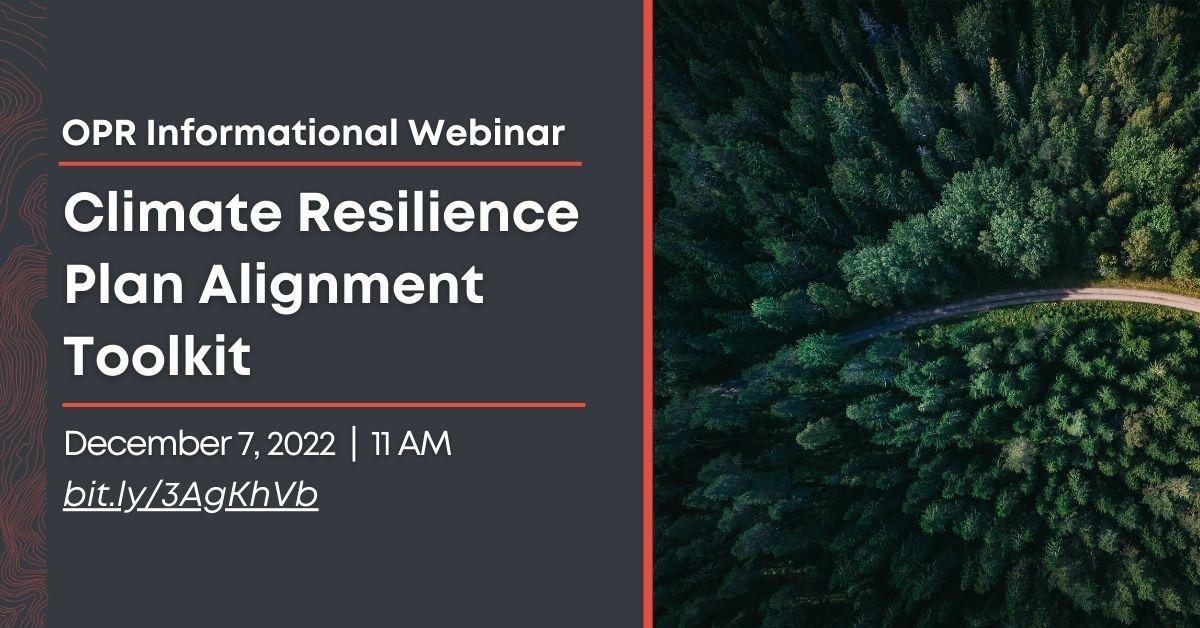
ICARP Releases Climate Resilience Plan Alignment Toolkit on the Adaptation Clearinghouse
Today ICARP’s Climate Services team launched the Climate Resilience Plan Alignment Toolkit on the Adaptation Clearinghouse to support local and regional planning. The Toolkit features a new Wildfire Guide and Flood-After-Fire Guide, as well as the original Coastal Compass Guide released in 2018.
The toolkit is designed to help communities meet state climate and hazard resilience planning requirements, balance multiple planning priorities, conduct risk and vulnerability assessments, advance equitable outcomes and community engagement, and build funding capacity to plan and implement solutions. The Toolkit includes:
-
Printed plan alignment booklets, which can be ordered in advance by emailing icarp@opr.ca.gov with your mailing address to request a free physical copy. Booklets currently available focus on wildfire, flood-after-fire, and coastal hazards. PDF versions are also available for download.
-
The online Toolkit, accessible on the State Adaptation Clearinghouse at https://resilientca.org/plan-alignment. The online version features interactive guides, case studies, a decision-support tool, and community engagement resources.
ICARP will host an informational webinar on December 7, 2022, at 11am; register at the link below to attend.
|
|
The Toolkit was developed by the Office of Planning and Research in partnership with local, regional, state, and federal agencies to support communities in developing and implementing more holistic and effective resilience plans and processes. For more information, contact ICARP staff at icarp@opr.ca.gov.
|
|
OPR & SGC Welcome New Climate Resilience Staff
Join us in welcoming our newest team members!
|
|
Ben McMahan
Program Manager
ICARP Climate Services
|
|
Emely Anico
Strategic Engagement Specialist
5th Climate Change Asessment
|
|
Adaptation Planning Grant Program Updates and Intent Survey Released
We wanted to take a moment to thank all who have supported the Adaptation Planning Grant Program (APGP) to date through workshops, public comments, and ongoing discussion. Throughout the APGP Draft Round 1 Guidelines public comment period (09/28-10/28), over 400 individuals participated and sent 273 unique public comments. This is very exciting and now we have our work cut out for us. Over the next two months, APGP staff will be processing the public comments, incorporating feedback, drafting a document highlighting the changes made, and updating the guidelines and application materials.
Application Process Updates
-
We anticipate releasing the NOFA on January 6. Applications are anticipated to close March 31, 2023.
- Each project team, comprised of a Lead Applicant and/or Co-Applicant(s), must complete the intent survey to indicate intent to apply for a Round 1 APGP grant.
- The survey takes approximately 10 minutes to complete.
- This survey enables APGP staff to better understand your prospective projects and ask questions if needed.
- This survey is also a requirement for prospective Applicants to gain access to an individualized SharePoint folder where all application materials will be uploaded before March 31, 2023.
- APGP staff strongly encourage applicants to fill out the survey as soon as they are able to.
- Feel free to reach out Abby Edwards if you have any questions (abby.edwards@opr.ca.gov).
|
|
Fifth Assessment Research Process Webinar TODAY
Wednesday, November 16, 2022 | 3:00 to 4:00pm
California’s Fifth Climate Change Assessment team is hosting a Research Process Webinar on Wednesday, November 16 from 3:00 to 4:00 p.m. to learn about the individual research the Governor's Office of Planning & Research, the California Energy Commission, and the California Natural Resources Agency are leading and how you can get involved.
The presentation will share an overview of overall Fifth Assessment priorities, CNRA’s Core Climate Research, Fifth Assessment Regional and Topical Reports, and the Tribal Research Program and Grant Program.
For more information about the Fifth Assessment, visit the webpage.
|
|
Now Available: Regional Resilience Grant Program (RRGP) Stakeholder Engagement Summary
During the summer of 2022, the ICARP team held a series of public listening sessions, conducted interviews, and released an online survey to gather feedback and input to inform the RRGP’s draft guidelines. During these sessions, the team heard from a wide range of stakeholders, including community groups, local and regional government agencies, Tribal communities and governments, and state and federal agencies. Key takeaways from stakeholder engagement and further information on the Regional Resilience Grant Program can be found on the RRGP website.
|
|
Policy & Guidance Updates |
|
EPA Seeks Public Input on Inflation Reduction Act Programs to Fight Climate Change, Protect Health, and Advance Environmental Justice
EPA has announced initial public engagement and input opportunities for a subset of new and existing programs funded by President Biden’s Inflation Reduction Act. These programs, which include funding for air quality and climate projects addressing clean energy, transportation, methane emissions, and climate super-pollutants, will advance the President’s bold agenda to combat the climate crisis, protect public health and advance environmental justice.
EPA’s engagement strategy for these programs includes:
-
Request for Information (RFI): Issuing a request for public input to inform program design;
-
Expert Input: Soliciting expert input on key program design questions from EPA’s Federal Advisory Committees including the Local Government Advisory Committee, Clean Air Act Advisory Committee and the National Environmental Justice Advisory Committee;
-
Listening Sessions: Launching a stakeholder listening session series to enable key stakeholders including environmental justice communities, state and local governments, clean energy advocates, labor, and others to provide input directly to EPA staff; and
-
New Webpage: Creating a one-stop shop for information on the implementation of Inflation Reduction Act programs managed by EPA’s Office of Air and Radiation.
EPA's Request for Information (RFI) seeks public comment on core design aspects of multiple Inflation Reduction Act programs, a crucial first step as the Agency works to implement historic levels of funding from this legislation. These initial engagements will help ensure the design and implementation of the programs reflect input from a broad coalition of stakeholders to ensure the full economic and environmental benefits of this historic investment are realized by all people, particularly those who have been most burdened by environmental, social, and economic injustice.
The RFI provides background information and questions for the public to consider as they provide their input. EPA will gather and organize information received on the RFI in six public dockets that correspond to Inflation Reduction Act provisions in the law. Comments are due by January 18, 2023. In addition, the agency will conduct extensive public engagement as it works to implement the law.
|
|
Biden-Harris Administration Announces Selection of 29 EPA Environmental Finance Centers to Help Communities Access Funds for Infrastructure Projects
The U.S. Environmental Protection Agency (EPA) announced the selection of 29 Environmental Finance Centers (EFCs) that will help communities across the country access federal funding for infrastructure and greenhouse gas reduction projects that improve public health and environmental protection. The EFCs will deliver targeted technical assistance to local governments, states, Tribes, and non-governmental organizations to protect public health, safeguard the environment, and advance environmental justice. Thanks to President Biden’s Bipartisan Infrastructure Law, the selected EFCs will help underserved communities that have historically struggled to access federal funding receive the support they need to access resources for water infrastructure improvements.
EPA will award up to $150 million in grants to EFCs over the next five years, once all legal and administrative requirements are satisfied. The Bipartisan Infrastructure Law provides $98 million of the total investment through EPA’s Clean Water State Revolving Fund (CWSRF) and the Drinking Water State Revolving Fund (DWSRF), with the remainder of funds coming from EPA appropriations.
The newly selected EFCs will work to strengthen communities through projects focused on drinking water, wastewater, stormwater, solid waste, clean air, greenhouse gas reduction, and toxic substances—and a focus of their work will be supporting overburdened and underserved communities. EPA will be engaging with the selected grantees to ensure communities in need receive this critical technical assistance.
|
|
CAL FIRE’s Fiscal Year 2022-2023 Forest Health Draft Grant Guidelines
CAL FIRE’s Forest Health Program is asking for your input! The FY 2022-2023 Forest Health DRAFT Grant Guidelines are now available on the Forest Health Grant webpage. Please review the grant guidelines and provide any comments, recommendations, and/or feedback by email before December 8, 2022. Please email ForestHealth@fire.ca.gov with the subject line “Grant Guidelines Public Comment” to ensure your comments are received and reviewed.
The Forest Health program is excited to announce 4 grant types to apply for in the upcoming solicitation including: Forest Health, Post-Fire Reforestation and Regeneration, Tribal Wildfire Resilience Implementation, and Tribal Wildfire Resilience Planning.
CAL FIRE will open the FY 2022-2023 Forest Health grant solicitation on December 15, 2022. Final grant guidelines, applications, supporting documents, and a recorded workshop will be posted on the Forest Health Grantees Resources web page. Application will be due by 3pm on February 28, 2023.
|
|
North Coast Resource Partnership seeks community and partner input on draft Vision for North Coast Resilience
The North Coast Resource Partnership (NCRP) is pleased to release a draft plan entitled “A Vision for North Coast Resilience: Priorities for Enhancing Watershed, Forest and Community Resilience in the North Coast Region”. This plan was made possible through the support and guidance of the California Department of Conservation Regional Forest and Fire Capacity Program, with funding from California Climate Investments. The draft was informed by hundreds of partners and technical experts in the North Coast Region and beyond, including North Coast Tribes, NGOs, RCDs, agencies, cities, counties, and private citizens and businesses. The plan aligns with and is guided by the objectives of the California Wildfire and Forest Resilience Task Force, as well as an array of Tribal, state and federal priorities for community and landscape resilience. The North Coast Resource Partnership Leadership Council – comprising appointees from the North Coast Region’s Tribes and counties – provided oversight during the plan development process, ensuring that the priorities of their many constituents are reflected in the draft plan.
Public Review Period: November 1 - 21, 2022. The Draft Plan link can be found here. Email Comments can be sent to Karen Gaffney, or feel free to call 707-443-7377 with questions.
NCRP staff will integrate public comments into the draft planning process. The final draft plan will be considered for approval by the North Coast Resource Partnership Leadership Council at its meeting on December 9, via zoom. All are welcome at every NCRP meeting. Please sign up on the North Coast Resource Partnership website to receive meeting notifications and other information about the Partnership. The plan is adaptive in nature, and will continue to be updated with new information, priorities and projects.
|
|
California Agricultural Land Equity Task Force Seeking Applications
As announced in the California Budget Act of 2022 (AB-179), the California Agricultural Land Equity Task Force will develop recommendations to equitably increase access to agricultural land for food production and traditional tribal agricultural uses. The Task Force will convene on a quarterly basis over a three-year period and deliver a full report of recommendations at the end of the three years.
SGC is seeking Task Force applications from individuals with experience and expertise in issues affecting socially disadvantaged farmers and ranchers. Applications will be accepted November 1 – December 15, 2022.
Applicants recommended for the Committee will be notified in January 2022. Membership recommendations will be considered at the Strategic Growth Council’s February 2023 meeting.
Learn more about the Task Force here and apply here.
|
|
Partner Updates and Resources |
|
Report released: Indicators of Climate Change in California
The Office of Environmental Health Hazard Assessment (OEHHA) has released the fourth edition of the report: Indicators of Climate Change in California. The report presents 41 indicators that track observed changes in the state’s climate and how these have impacted the physical environment, vegetation and wildlife, and human health. The report contains a new section highlighting how California Tribes have witnessed climate change. The report is available for download here.
|
|
SGC Partners Advancing Climate Equity (PACE) Releases Final Reports and Curriculum
The Strategic Growth Council PACE program has launched a blog post releasing all of the materials developed through their Partners Advancing Climate Equity Pilot (PACE)!
PACE is a capacity-building pilot program that launched in February 2021 for frontline community leaders across California to connect and learn with peers, take their skills to the next level, and inspire transformative change. The 22 participating leaders represented various community-based organizations, Tribal-serving organizations, and California Native American Tribes and work across an array of issues at the intersection of climate and equity.
|
|
Seeking Technical Assistance Providers for Round 1 of the Regional Climate Collaboratives Program
SGC released a Request for Proposals (RFP) seeking technical assistance (TA) providers to provide implementation assistance to Round 1 Regional Climate Collaboratives Grantees.
This Request for Proposals (RFP) establishes a competitive process for selecting an experienced Contractor team that can develop a robust and thoughtful approach to providing Grantees with implementation technical assistance. The implementation assistance will be comprised of three components: operational activities, evaluation, and peer-to-peer learning.
Access the RFP here. The deadline to submit proposals is Monday, November 21, 2022 by 5:00pm PST. Learn more here.
|
|
Strategic Growth Council is Hiring a Deputy Director for Community Investment and Planning (DDCIP)
The DDCIP is an integral part of the SGC Leadership team. Under the general direction of SGC’s Executive Director, they are responsible for portfolio management of SGC’s community development and infrastructure investment portfolio which is approximately $1 billion in program grants annually and includes the Affordable Housing and Sustainable Communities Program (AHSC) and the Transformative Climate Communities Program (TCC), Sustainable Agricultural Lands Conservation, Climate Resiliency Centers (CRC), and the Community Resilience Centers (CRC) along with managing staff on joint efforts with High Speed Rail Authority on site activation works and Housing and Community Development’s Regional Early Action Plan (REAP) program.
|
|
Strategic Growth Council CACE Program Looking for Program Associate
The Community Assistance for Climate Equity Program provides technical assistance and capacity building services to help under-resourced communities access critical funding resources, implement high-impact projects, and enact community-led initiatives. The CACE Associate will work with SGC team members, technical assistance providers and recipients, program grantees, and other stakeholders to ensure successful development, implementation, evaluation of CACE programs and effective communication about them. This position represents an opportunity to make significant impact across California communities, particularly those impacted by social, environmental, and racial injustices, to build capacity and increase access to critical resources. The position will work to expand SGC’s commitment to technical assistance as a key equity strategy and will engage in activities related to grant program development, communications, stakeholder engagement, and data collection and analysis. Apply on CalCareers by Wednesday, November 30. |
|
CivicSpark Now Accepting Applications for January Starts
It's official, CivicSpark will be hosting a 7.5-month fellowship for the 22-23 service year. This new group will join and engage with the existing 11-month cohort! We are now accepting applications for this 7.5-month fellowship for Fellows!
CivicSpark is a national service program implemented by the CivicWell (formerly the Local Government Commission), dedicated to supporting organizations and local public agencies to address community resilience issues such as climate change, water resource management, housing, and mobility.
|
|
New tools from Headwaters Economics
Headwaters Economics recently announced 2 items that may be of interest:
Neighborhoods at Risk is an easy-to-use website with interactive maps, charts, and resources to help communities identify neighborhoods that may be more impacted by climate change. It shows where people may experience unequal impacts from hurricanes, flooding, and extreme heat.
Green Infrastructure can provide long-term, cost-effective solutions to flooding and can help communities adapt to climate change. Headwaters Economics has assembled a cost breakdown for eight green infrastructure practices that can help communities consider which solutions might work best.
|
|
PG&E's Resilient Together Survey
PG&E is seeking input to ensure that as climate hazards increase in frequency and severity, those who are most vulnerable have access to services and resources that keep community members safe.
Take this quick survey to share how you and your community deal with extreme heat wildfire smoke, and other climate issues. Your feedback will inform PG&E’s planning and decisions related to climate resilience and infrastructure, helping to create a safer, more equitable, and reliable energy system.
|
|
Public Health Institute Announces State of Equity Program
Our colleagues with State of Equity (formerly the Public Health Institute Health in All Policies program) have just announced their new website and newsletter! To stay in the loop about State of Equity’s health and racial equity efforts across California, you can sign up for their mailing list linked below.
Our State of Equity partners have been instrumental in the launch and ongoing work of advancing health and racial equity in State government since 2010. They currently co-facilitate State government capacity building efforts such as the Health in All Policies Task Force and the Capitol Collaborative on Race and Equity (CCORE).
Sign-up for the State of Equity Mailing List here.
|
|
Science-Based Adaptation Strategies for Climate Change and Wildfires
USFS scientists of the Pacific Northwest Research Station reviewed the latest adaptation strategies that address fire regimes restoration and climate resilience in western North American forests. The authors answer 10 common questions about climate adaptation and realignment treatments in these forests, exploring a range of management strategies from thinning to prescribed burning.
A link to their publication can be found here.
|
|
AHSC Rural Innovation Project Area Webinar
Thursday, November 17, 2022 | 10:00 to 11:00am | REGISTER
In collaboration with the Strategic Growth Council (SGC), the California Coalition for Rural Housing (CCRH) is inviting you to a Rural Innovation Project Area Webinar for the Affordable Housing and Sustainable Communities program (AHSC) on Thursday, November 17, 10:00 - 11:00am.
This webinar will be geared toward Rural and American Indian Tribal communities who are interested in learning more about the AHSC program in advance of Round 7. Attendees will learn about the program framework and requirements, best practices to develop a competitive application, and opportunities to receive technical assistance. Please share this training opportunity with your networks!
|
|
CA Transportation Commission Workshop - Draft Guidelines for the Local Transportation Infrastructure Climate Adaptation Program
Thursday, November 17, 2022 | 10:00am to 12:00pm | REGISTER
Join the California Transportation Commission on November 17 from 10am - noon to provide feedback on their draft Guidelines for the Local Transportation Infrastructure Adaptation Program. About $400 million is available from state and federal funding sources to support local agencies in the development and implementation of transportation infrastructure projects that bolster resilience to climate impacts. More information can be found on the CTC website.
|
|
Climate Research Symposium: Understanding Current and Future Energy Use in Los Angeles
Wednesday, November 30, 2022 | 10:30am to 12:00pm | REGISTER
This event will feature research that can help move the City of Los Angeles toward becoming the world’s most sustainable megacity by 2050. Join us to hear recent findings from UCLA and California State University Northridge researchers related to how climate change impacts our current and future energy use in Los Angeles.
|
|
Building a Resilient and Equitable Grid for the Future Webinar
Wednesday, December 7, 2022 | 10 to 11:30am | REGISTER
This is the second webinar in the Envisioning a Climate-Safe California: Stories and Solutions series.
This webinar will lay out a vision for the future of California’s electricity system and highlight the people and organizations working to create it. We’ll explore the role of local governments, Community Choice Agencies (CCAs), and municipal utilities in helping to plan for the use of clean, distributed energy in a way that maximizes benefits to the community and provides reliable, affordable electricity for all.
Speakers will include urban sociologist Dr. Jesus Hernandez, Marin Clean Energy's (MCE) Manager of Strategic Initiatives Alexandra McGee and Lorenzo Kristof, an expert on energy policy.
|
|
Mark Your Calendar: 2023 UC Davis WiReS Conference & Tradeshow
WiReS aims to focus on how we can better prepare and respond to wildfires in the western U.S., bringing greater attention to long-term and short-term solutions for improving wildfire resilience of buildings worldwide. The hybrid in-person and virtual conference aims to catalyze solution implementation - bringing together stakeholders from academia, government, construction, insurance, manufacturing, emergency response, real estate, and housing, to address wildfire mitigation solutions for the built environment to support resilient and equitable communities.
The Tradeshow portion of the event will create a unique opportunity for participants to engage in interactive, hands-on demonstrations - highlighting the technical and practical applications of fire mitigation tools and technologies. The exhibition will include a range of products and solutions related to wildfire adaption and WUI risk mitigation.
Participating exhibitors will establish new US and international connections, present products directly to industry leaders and policy makers, and stay on top of the latest advances in the science. Please contact the Conference Manager, Olivia Schlanger for more information or visit the website.
|
|
Submit Questions to Inform Climate Smart and Disaster Ready Program
Questions deadline: November 18, 2022 | Learn more
This grant will fund innovative and applicable adaptation solutions in communities at greatest risk to climate-related disasters in current and foreseeable humanitarian settings. The program will focus on local, inclusive climate solutions and partnerships and work across communities to reduce the risk of climate-related disasters and improve communities’ resilience to climate change.
The umbrella Annual Program Statement (APS) outlines the goal, objectives, expected results and priorities of the Climate Smart and Disaster Ready program, with future amendments that will announce Rounds of Applications. This APS is open till amended. The deadline to submit questions is November 18, 2022.
Challenge on Climate Innovation Funding Opportunity
Deadline: November 30, 2022 | Learn more and apply here
The Google.org Impact Challenge on Climate Innovation commits $30 million to fund big bet projects that accelerate technological advances in climate information and action. Selected organizations may receive up to $5 million in funding - along with access to Google’s technical expertise and products - to accelerate progress toward a more sustainable and resilient future.
AB 617 Community Air Grants Program
Deadline: December 4, 2022 | Learn more and apply here
The purpose of Community Air Grants (CAG) is to provide community-based organizations with logistical and technical assistance to support their efforts in improving local air quality. Projects are intended to further the purposes of AB 617 and AB 32 by designing and executing projects that build capacity in communities through supporting community-based organizations’ and community members’ participation in the Community Air Protection Program.
Outdoor Recreation Legacy Partnership (ORLP) Program
Deadline: December 15, 2022 | Learn more and apply here
Cities, counties, state agencies, federally recognized Native American Tribes, and Joint Powers Authorities would be eligible to receive a maximum award amount of $10 million for the acquisition or development of new parks, or substantially renovating parks in economically disadvantaged cities or towns of at least 30,000 people.
Nonpoint Source Pollution (NPS) Control Program
Deadline: December 19, 2022 | Learn more and apply here
$4.5 million is available in the current funding cycle for implementation proposals for impaired waters, or projects that implement practices to improve impaired waters. As funding is available, the program may fund planning proposals, proposals for post-fire recovery, and proposals for protection of high-quality waters.
Regional Early Action Planning Grant Program (REAP)
Deadline: December 31, 2022 | Learn more and apply here
Funds projects that increase housing planning and accelerate housing production, including preparing, adopting, and implementing plans that streamline housing approvals, facilitate compliance with the sixth cycle Regional Housing Needs Allocation (RHNA), activities, infrastructure planning, and financing that will accelerate housing production. Applications for the MPO Direct Allocation are currently being accepted on an Over-The-Counter basis, and for the Tribal and Rural Allocation.
Proposition 1 Integrated Regional Water Management (IRWM) Implementation Grant Program
Deadline: February 1, 2023 | Learn more and apply here
$193 million is available in the current funding cycle for projects and programs throughout the state including climate change adaptation, providing incentives for collaboration and setting priorities in water resource and infrastructure management, and improving regional water self-reliance. Councils of Governments, other regional entities, and Tribal governments are welcome to apply and applications for Round 2 two will be accepted in two windows.
Clean Energy Technology Deployment on Tribal Lands
Deadline: February 9, 2023 | Learn more and apply here
For Native American tribal governments or organizations to install clean energy generating systems and energy efficiency measures for Tribal Buildings, deploy community-scale clean energy generating systems or energy storage, or install integrated energy system(s) for autonomous operation.
Legacy Disposal and Illegal Disposal Site Abatement Grant Programs
The Legacy Disposal programs provide financial assistance in the form of reimbursement grants up to $750,000 in matching funds for eligible costs to assist public entities requiring financial assistance, and committed to accelerating the pace of cleanup, restoring sites, and protecting public health and safety and the environment.
The Illegal Disposal program provides financial assistance in the form of reimbursement grants up to $500,000 to help public entities accelerate the pace of cleanup, restore sites, and turn today’s problems into tomorrow’s opportunities.
Marine Mammal Health in a Changing Climate
The Marine Mammal Commission is particularly interested in learning about changes in marine mammal population health driven by climate change and encourage proposals that investigate how environmental factors that will be affected by a changing climate, such as prey availability or nutritional quality, HAB toxins, pathogens, temperature, or salinity, influence health of marine mammals. Proposals that increase the inclusion or representation of people from underserved groups in marine mammal research, management, or conservation are strongly encouraged.
|
|
Investing in Adaptation
Explore funding, investment, and economic analysis resources on the State Adaptation Clearinghouse Investing in Adaptation topic page.
|
|
OPR Federal Grant Resources
The OPR Federal Grant Administrator provides technical assistance to state agencies, local governments, institutions of higher learning, and nonprofit organizations, on how to find, apply and manage federal grants. Resources include regular updates on new funding opportunities, trainings, and more.
|
|
California Grants Portal
The California Grants Portal (a project by the California State Library) is an access portal to all grants and loans offered on a competitive or first-come basis by California state agencies. Search the portal for program overviews, timelines, application information and guidance, and more at https://www.grants.ca.gov/.
|
|
|
|
1400 Tenth Street
Sacramento, CA 95814
(916) 322-2318
|
|
|
|
|
|
|
|