GDP shrank in Q1, mostly because of sharp spike in imports ahead of expected tariffs. This Daily Shot graph illustrates the situation: 

Picture2 image

As of March 2025 

image image

As of March 2025 


State of the State Budget 


If last week’s report from the Economic Forum is correct, Nevada will see approximately $191 million less in revenue over the next two years than the group forecast in December 2024. The group said it expected decreases in tax revenue and a drop in tourism to Nevada because of President Trump’s federal economic policies (aka tariffs). 


Because the Nevada Constitution requires the Legislature to pass a balanced budget, lawmakers will have to factor in the reduction through budget cuts or the death of one of 300 proposed bills that came with price tags. 


And that’s not all: A revenue forecast for the State Education Fund obtained by The Nevada Independent shows close to a $160 million decrease from previous projections. 


Government Debt-to-GDP 


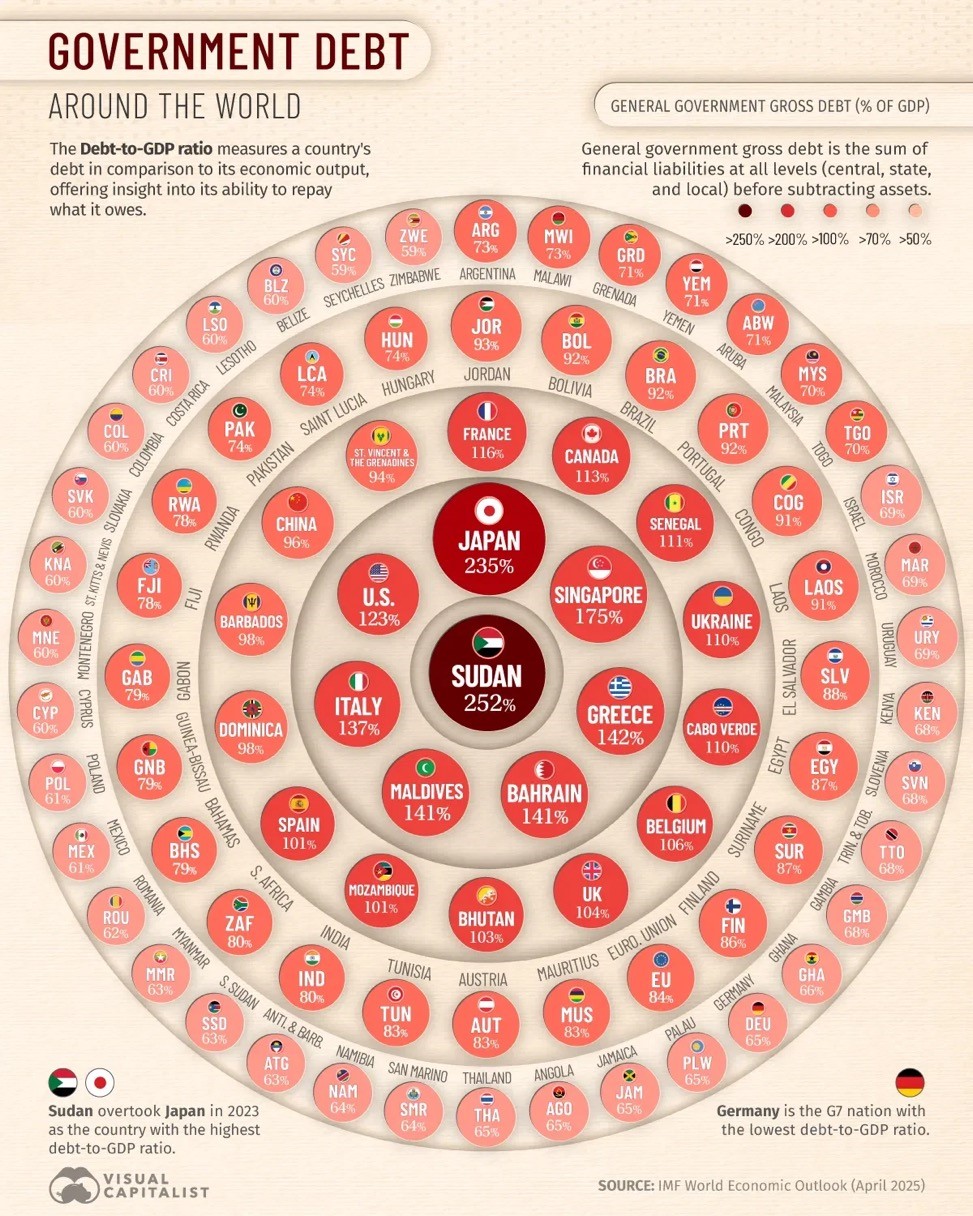
With global economics in a state of flux, it’s worth noting which nations owe most in comparison to their economic output. The U.S. ranks 8th, with gross public debt at 123 percent of GDP, largely a result of continued deficit spending: 

As of April 2025 


Notable notes: 


  • The average debt-to-GDP ratio of advanced economies is 110 percent, and that of emerging markets and developing economies is 74 percent. 


  • Germany has the lowest debt obligations of all G7 nations at 65 percent of its GDP. 


HighTower Las Vegas wealth management advisor and Fact Pack co-publisher Mike PeQueen on why the metric matters: 


Government debt is typically driven by a variety of factors which may include the effects of monetary policies, periods of slow or negative economic growth, sudden global price decreases for primary exports, unsustainable levels of public spending, and ballooning interest. 


Excessive government debt carries risk including the possibility of insolvency, which results in the inability to borrow further and currency depreciation. We saw this occur in 2017 when Venezuela defaulted on $65 billion in external debt and its currency became essentially worthless, and in 2010 when the debt crisis in Greece led to significant hardship and created a ripple effect through the entire European Union.  


Las Vegas Visitors 


For the first three months of 2025, Las Vegas visitation was down close to 7 percent compared to 2024, with decreases in all three months — the first such occurrence since the pandemic. Here are the March numbers from the Las Vegas Convention and Visitors Authority (LVCVA): 

image-2 image

LVCVA Vice President of Research Kevin Bagger said in a statement that the Southern Nevada market is facing “unclear impacts of evolving federal policies rippling through international and domestic markets.” 


(Note for those who missed it last week: Southern Nevada saw a 12 percent drop in visitation in February over the prior year, but it was attributed to the Super Bowl LVIII bump from a year earlier.) 


Eggs 


Fact Pack readers may be ordering omelets with fewer eggs next time they brunch in Switzerland. The nation known for its lovely views and excellent chocolate presently has the world’s most expensive eggs — an average of $7.31 per dozen — nearly twice what residents pay in neighboring Italy, and more than seven times what consumers are paying in India. 

Screenshot-2025-05-06-065052 image

Source: Visual Capitalist As of 4/24/25 


Making Stuff 


Global manufacturing stats for 2024 will soon be known so we thought this 2023 Visual Capitalist infographic was worth getting on the record: 

Screenshot-2025-05-06-064441 image

As of 2023 


Percentage of global value: 

Picture1 image

Source: Visual Capitalist As of 2023 


Tech 


Global research and development (R&D) spending spiked over the past 20 years, nearly tripling in real terms from $1 trillion in 2000 to $2.75 trillion in 2023, according to data from the World Intellectual Property Organization. China has been narrowing the “innovation gap” with the U.S., as illustrated in this Visual Capitalist graph: 

image-4 image

As of 2023 


Apple  


Amid a tangled tariff web, analysts will be closely examining the fiscal reports of publicly traded companies for effects. Though Apple’s Services division revenue fell a bit short of Wall Street expectations for the quarter ending in March — it grew to $26.65 billion, an annual increase of 11.65 percent, but less than 2024’s year-over-year growth of 14.2 percent— the firm’s overall fiscal-quarter revenue of $94.66 billion was just above forecasts. 


Apple’s profitable Services line items include iCloud, Apple Music, and Apple TV+ subscriptions, warranties, and search licensing deals including its agreement with Google. 


As for tariff troubles, CEO Tim Cook said in an interview with CNBC that Apple already sources about half of the iPhones it sells in the U.S. from India, and most of its other U.S. products — including the majority of Macs, iPads, AirPods, and the Watch — from Vietnam, where tariffs are lower than they are from China. Cook also noted that the iPhone uses many U.S.-made chips, and that Apple plans to buy 19 billion chips this year from the U.S. 


Motor City Slowdown 


General Motors last week said it expects to incur $4 billion to $5 billion in gross losses in 2025 because of supply chain disruptions and levies on parts because of President Trump’s tariffs, and that it plans to offset at least 30 percent of those expenses through efficiencies and cuts. 


Ford Motor Company exceeded Wall Street’s projection for revenue for Q1, but its report Monday said it expects a net impact of $1.5 billion this year after remediation actions due to supply chain disruptions related to President Trump’s tariffs. 


Read more on both situations at CNBC.


Travel Up and Comers 


As slowdowns in travel to the U.S. continue to make headlines, a Daily Passport article on some of the world’s fastest-growing leisure travel destinations caught our eye. On the list: 


North Macedonia became an independent nation after the breakup of Yugoslavia in 1991. The Balkan state is rich with hundreds of historic sites, some dating back to 200 BC, and its proximity to Greece — one of the three most popular travel destinations in the world — boosts the attraction. 


image-1 image

Map source: Wikipedia as of 2025


  • Population: Approximately 1,819,000 (2025 estimate) 


  • Urbanization: 61.6 percent urban, 38.4 rural  


  • GDP (nominal): $17.422 billion (2025) 


  • Unemployment: 13.2% (2023) 


  • Currency: 1,000 Macedonian Denars = about $18.30 U.S. (as of 5/5/25) 


Tunisia, which encompasses the northernmost point of North Africa and is bordered by Algeria to the west and Libya to the east, saw a substantial increase in tourism after 2011, when its autocratic government was replaced by a democracy. The country is home to nine UNESCO World Heritage Sites, including the Amphitheatre of El Jem — a Roman ruin that held 35,000 spectators. Visitors increased from 6.4 million in 2022 to an about 8.5 million people in 2023 (UN estimate). 


image-3 image

Map source: WorldAtlas.com as of 2025


  • Population: Approximately 12.3 million (2025 estimate) 


  • Urbanization: 71.7 percent urban, 28.3 percent rural  


  • GDP (nominal): $48.5 billion (2023) 


  • Unemployment: 13.2% (2023) 


  • Currency: 1,000 Tunisian Denars = about $336 U.S. (as of 5/5/25) 

On the Horizon


Mike PeQueen: Wednesday’s meeting of the Federal Open Market Committee could provide insight into how the Fed really feels about cutting interest rates. No one expects a cut this month — but one may possibly come in June, depending on inflation numbers. 

Data & Dialogue About the Economy


The Fact Pack is a monthly business e-report co-authored by Mike PeQueen of Hightower Las Vegas and John Restrepo of RCG Economics, which combines important metrics relevant to business decision makers and financial commentary on the current issues facing the economy.


See what's happening on our social media sites!

Facebook  X  LinkedIn
Mike PeQueen
Hightower Las Vegas
John Restrepo
RCG Economics