|
Dear IDARM Network member,
We are excited to officially begin the next chapter of the IDARM (Italian Diaspora Archive Resource Map) project under funding from the National Endowment of the Humanities (NEH). We extend our appreciation to each of you who contributed to the IDARM working group. Your expertise and insights have not only shaped our dynamic network, but have also provided direction for the three of us to develop a successful NEH grant proposal that illuminates our tri-state region's collections related to the Italian Diaspora. We encourage you to share the news of this Foundations-level Humanities Collections and Reference Resources grant with your professional networks, funders, and administrators. Here is a full list of 2024 NEH grant winners.
Most importantly, this award will provide all of us with the opportunity to solidify and expand the ecosystem of the material culture of the Italian Diaspora within our tri-state region. We hope you will join us this fall at the Heinz History Center to build our institutional community.
Please share this newsletter with the librarians, archivists, museum professionals, records managers, and other stewards of research collections related to the Italian Diaspora. Encourage them to subscribe to keep informed about the IDARM network. You can expect to hear from us bimonthly for the next two years.
With gratitude,
Melissa, Lina and Nancy
| |
Meet the IDARM Project Directors | |
|
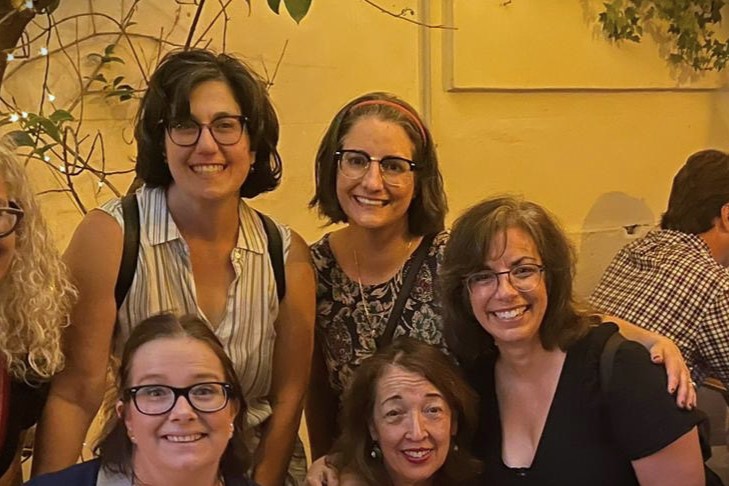
Back row from left: Lina Insana, Melissa E. Marinaro, and Nancy Ann Caronia with friends in Rome, Italy, 2023
Meet Nancy Ann Caronia
I’m a writer, educator, and scholar who centers collaboration and community. With the assistance of NEH, West Virginia Humanities Council, and West Virginia University (WVU) Humanities Center fellowships, I have worked with archives in the United States, Italy, and Scotland. I have also had the opportunity to collaborate with the West Virginia & Regional History Center, sharing with students and other educators collections about the Italian Diaspora, including the hand-written drafts of West Virginia writer Denise Giardina and the Monongah Mining papers of Thoney Pietro and the Monongah Mining Relief Committee papers. I look forward to this next chapter of the IDARM project and to working with and growing our network.
Meet Lina Insana
I’m a literary scholar by training, but archives of various kinds—from authors’ manuscripts to organizational documentation to digitized newspapers—have always been vital to my research and teaching. I’m a native Pittsburgher, a proud Sicilian-American, and, since 2000, a member of the Italian faculty at the University of Pittsburgh. My long-standing institutional ties to the Heinz History Center’s Italian American Program led organically to my participation in the IDARM Project, which is now poised to become an important regional hub of collaboration and resource-sharing that can only solidify and amplify the incredibly rich Italian Diaspora material culture that we enjoy in the PA-OH-WV area. After almost four years of remote conversations across the region, I’m really looking forward to meeting our regional partners in person in October!
Meet Melissa E. Marinaro
I'm a museum professional and curator that's worked in the Arts and Culture sector since 2008. I moved to Pittsburgh in January 2013 to join the History Center's staff as the steward of the Italian American Program. I work with members of the public to bring collections related to the Italian Diaspora in Western Pennsylvania into the museum's object collection and the Detre Library & Archives. I've collaborated with University of Pittsburgh and West Virginia University to provide students with internships, classroom experiences with primary sources, and research support; many students are Americans of Italian descent from the Ohio River Valley and the Appalachian Mountains. I'm excited about this opportunity to make our region's resources visible to students, scholars, and researchers across the region.
| |
|
IDARM Network Gathering
October 9-11, 2024
Heinz History Center, Pittsburgh, Pa.
Join the IDARM network for 3-days of workshopping, professional development, dialogue, and planning. We will be joined by our Digital Humanities Project Consultant Daniel Pitti of the International Council on Archives, University of Pittsburgh Outreach and Engagement Librarian Leslie Poljack, and staff from the History Center's Detre Library & Archives.
A portion of our NEH funding allows for 20 travel grants to be distributed to eligible network partners. Travel grants of $745 may be used to pay for lodging, mileage, flights, and other travel-related expenses. Travel grants will include 2-days of per diem.
Applicants must represent institutions holding material culture (archives, artifact collections, and/or libraries) related to the Italian Diaspora from Ohio, Pennsylvania, and West Virginia. We will prioritize applicants living more than 50 miles from Pittsburgh; organizations with annual budgets under $500,000; and organizations whose resources are particularly limited.
Applicants may contact the IDARM project directors at IDARM@heinzhistorycenter.org ahead of the deadline to discuss applications in further detail. Applications are due July 1, 2024. Travel grant winners will be notified by August 1, 2024.
| |
|
Funding Opportunity for Pa. Institutions
The Pennsylvania Historical & Museum Commission (PHMC) is excited to announce the reinstatement its Historical & Archival Records Care (HARC) grant program, which is now accepting applications. The application deadline is August 1, 2024.
Funding is available to historical records repositories such as: historical societies; libraries; universities; local governments; and school districts for collections care, including surveying; inventorying; preserving; arranging; and describing historical records significant to Pennsylvania, as well as for records reformatting and equipment.
Please direct any questions to Grant Manager Natasha Margulis at nmargulis@pa.gov or (717) 705-1676.
| |
|
Want to share news about funding available to institutions and individuals in the IDARM network? Send us details for our next e-newsletter for wider circulation in Pennsylvania, Ohio, and West Virginia!
| |
|
West Virginia & Regional History Center
Morgantown, West Virginia
The mission of the West Virginia & Regional History Center (WVRHC) is to acquire, provide access to, and preserve information resources in all formats that elucidate the history and culture of West Virginia and the central Appalachian region. As the Special Collections division of the WVU Libraries, the WVRHC also preserves selected information resources beyond the state and regional scope that contribute to the teaching, research, and service mission of West Virginia University. Hal Gorby, an IDARM working group leader from WVU says, “The West Virginia and Regional History Center houses a number of vitally important collections related to the Italian American experience in West Virginia. With so many immigrant families arriving to find work in the state’s coalfields and industrial towns, some of the richest materials come from records about work."
| |
|
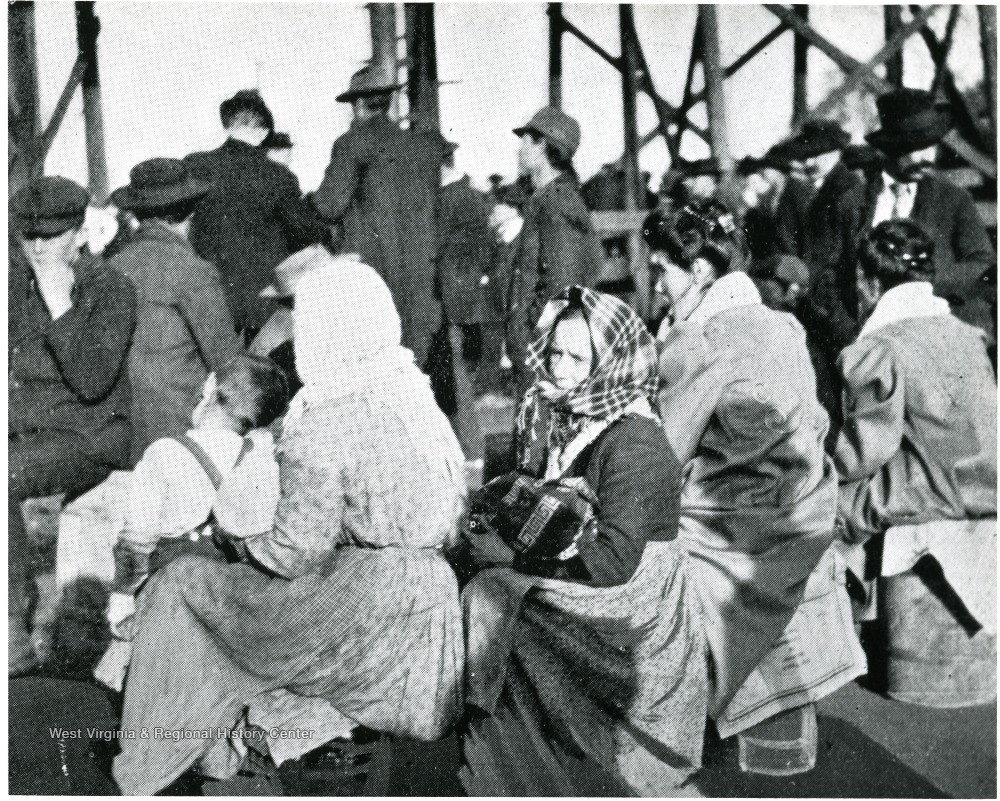
Wives Waiting for Husbands at Mine No. 8 after Monongah Mine Disaster, Marion County, W. Va., 1907
Lori Hostuttler, WVU University Library Director and IDARM working group member says, "Although largely unknown outside of the region, West Virginia has a significant Italian American population. In the early 20th century, many Italians immigrated to West Virginia to work in the coal mines and other industries. They formed communities and shared traditions and customs that are now part of West Virginia's culture. The West Virginia & Regional History Center at WVU Libraries holds a rich collection of materials that tell their stories, from discrimination and hardship to success and celebration. The IDARM project will help us share these records with researchers across the globe. We are very excited about the potential for new audiences to learn about Italian American history in the state and region."
The WVRHC includes collections that include books, newspapers, microfilms, oral history, printed ephemera, and a folk music collection in and about West Virginia. Some of the more prominent documentation of the Italian immigrant experience include "key records that help document the working lives and struggles of Italian immigrant families is in the Monongah Mine Relief Committee papers. These document the efforts of local residents to assist the families who lost loved ones in the worst mining disaster in American History at Monongah, located in Marion County. Many files detail the efforts to aid Italian families, including letters back home documenting charitable and social welfare needs," according to Gorby.
| |
|
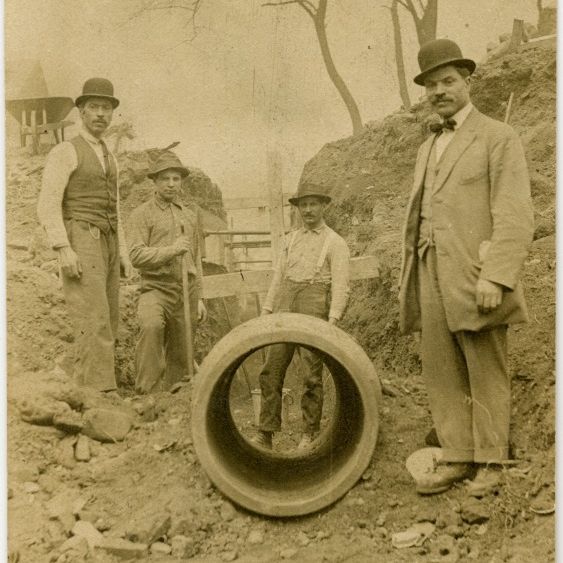
Thoney Pietro with Company Pipe Laying Crew, Beaver Falls, Pa.,
c. 1913-1914
Additionally, the Archives and Manuscripts collections include personal, family, and business papers, most of which have a connection to West Virginia or Appalachia such as those of Italian immigrant and business owner Thoney Pietro. Today, the Archives and Manuscripts division of the WVRHC contains more than 4,000 collections consuming nearly 20,000 linear feet of shelf space.
Gorby notes, "North Central West Virginia has a vibrant Italian heritage (seen most commonly in the popularity of the West Virginia pepperoni roll). With the ability to fully document and list relevant collections available at WVU, I hope that scholars outside of the state and nation, can see the importance of studying the role of immigrant/ ethnic communities outside of major metropolitan areas.” The WVRHC has been engaged in a digitization project since 2004 and has digitized over 52,000 historical photographs from its broad and deep holdings as of 2017.
| |
Contact Information
The WVRHC is located on the 6th floor of the Downtown Library at West Virginia University and is open Monday and Friday from 9:30 a.m. to 4:30 p.m. and Tuesday, Wednesday, and Thursday from 9:30 a.m. to 7:00 p.m. WVRHC Phone: (304) 293-3536
Appointments are now recommended for Archives and Manuscripts materials, as well as Oral Histories, Folk Music, Printed Ephemera, and physical newspaper collections. It is strongly encouraged that patrons make reservations at least two business days in advance, but walk-in appointments are welcome as space allows.
A maximum of 10 items can be requested in advance. All other requests can be made during your visit. No appointment is necessary for our microfilm collection or reference books.
To book an appointment, visit this page.
| |
Any views, findings, conclusions, or recommendations expressed in this newsletter, do not necessarily represent those of the National Endowment for the Humanities. | | | | |