|
March is the month of justice: the practice of joyful resistance!
Now, perhaps you’re wondering what resistance has to do with justice. I admit, the connection isn’t always exactly obvious, especially if we rely on our current understanding of justice as our society has structured it. The unfortunate truth is that our current system of “justice” was for the most part designed to protect the wealthy and powerful - and in particular, to protect their property. When one subscribes, as our religious and ideological forebears the Puritans did, to the notion that wealth proves ones piety (one’s “goodness”) in life, then it is a quick logical jump to assume that the rich and powerful, and all their stuff, is what is worth protecting. The purpose of our current justice system is to punish those who are poor, and to restore wealth to those who already hold it. But this conception of justice isn’t how our religious ancestors framed it, and it isn’t how modern civil rights activists have framed it either. Drawing on his Christian faith, Rev. Martin Luther King, Jr., said, “Justice is love correcting that which revolts against love." This came out of both his understanding of the Hebrew scriptures (the “Old Testament”) and the words of Jesus (the “New Testament”).
In the Hebrew scriptures, justice is always collective. Justice is laid out as making sure the collective community has all it needs, every single person. And that means, again and again in the Bible, taking care of the widow, the orphan, the immigrant, and the poor. In fact, the Bible mentions this quartet of folks who deserve particular care numerous times, a fact our Christian nationalist siblings seem to have conveniently forgotten. The trio of the widow, orphan, and the stranger is mentioned together no fewer than 19 times. Separately, these four are mentioned over 400 times in relation to the Hebrew words for justice. As for the New Testament, it is full of Jesus’ parables that demonstrate true justice is not transactional. (If you’d like an example, look up the Parable of the Workers in the Vineyard, Matthew 20:1-16.)
In King’s conception, justice is collective. Justice is not the process of one party getting retribution. Real justice is the process of returning the entire community to health. It is saying, “An unloving action was committed. How do we address the wrong done to one party AND address whatever is missing in the physical, emotional, or spiritual environment of the wrongdoer? How do we go forward in a way that is lifegiving to the whole community?”
Because real justice is the realization that a wrong done is an act of disconnection, an act of severing the interconnection that defines who we are as human beings. An act that does not hold up or cultivate the inherent divinity of either the perpetrator or the victim. Real justice is the restoration of all parties to wholeness.
In our current climate, this requires joyful resistance: Resistance because our laws, customs, and policies aren’t built to uphold these ties, or to respect the divinity of people. And so true justice requires true resistance to the proposition, built into our legal system, that justice means protecting power. Joyful because we know we are forging a new way that honors our commitment as Unitarian Universalists to the holy flourishing of all divine creatures. So…how will you joyfully resist in the name of justice this month?
| |
| |
The Power of Uncertainty
Laura Andes
My “word” for this year is uncertainty. For those who know me well, this is a significant shift. I am full of strong opinions. My tendency towards decisiveness has been both a strength and, undeniably, a limitation. The pursuit of uncertainty is an uncomfortable area of growth, demanding that I cultivate curiosity and humility. This is not a passive acceptance of doubt, but an active commitment to live more deeply into the space of not knowing, particularly concerning the "correctness" of my own perspectives and points of view. As the year continues, I am challenging myself with these and other questions:
- Are my deeply held views about politics, policy, and current events truly correct?
- What perspective or experience might I be fundamentally missing?
- Why do others, who are just as intelligent and well-intentioned, see the world so differently?
These inquiries have become incredibly powerful tools for self-reflection. In a modern landscape where everyone (including me) feels compelled to offer an immediate and authoritative "hot take," being uncertain forces me to pause. It is a deliberate choice to wait and consider. There is profound power and immense wisdom in delaying a response, in waiting for a fuller picture to emerge, in allowing the initial surge of emotion to fall away, and in consciously leaning into alternative viewpoints, even those that feel uncomfortable or contradictory. And I find myself changing my mind!
This commitment to uncertainty and humility feels important to me as we begin our monthly exploration of the theme of Justice. I am struck immediately by the complex, multifaceted nature of this concept. We, as UUs, often center on social justice, an area focused on the fair and equitable treatment of all people, particularly those marginalized by societal structures. However, justice also holds a legal definition: the application of laws to redress wrongs, enforce contracts, and punish crimes.
Both of these definitions, social and legal, ultimately require defining what constitutes fairness and what is right and wrong. In both contexts, someone ultimately gets to decide and make critical decisions "in the name of justice." These decisions are not abstract; they have tangible, real-world consequences, both beneficial and detrimental, for individuals and communities.
While our own view of what is just, grounded as it is in our deeply held Universalist values, may feel clear, righteous, and unimpeachable, I am constantly reminded that others operating from entirely different moral or legal frameworks may feel just as certain and grounded in their alternative view of justice. In both cases, whether driven by a certainty in one's own righteousness or a lack of humility in assuming the moral high ground, the failure to acknowledge alternative perspectives can lead directly to unintended, and often harmful, consequences. Therefore, as we explore this weighty theme, it is clear that our search for justice must be tempered by an active embrace of uncertainty and humility. Our values and principles are complementary and reinforcing as they point us towards our covenantal commitment as a congregation.
| | |
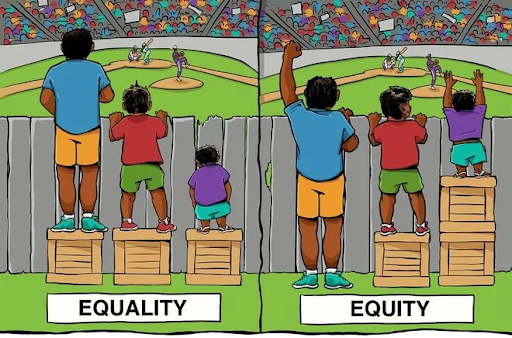
Last month, our children worked on creating and analyzing this image on the right:
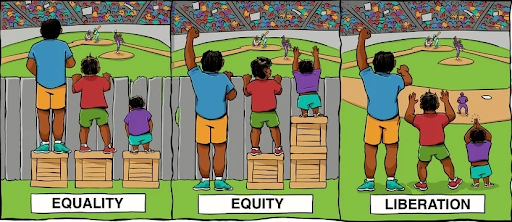
As I mentioned in my previous article, while this image is helpful, it is also troubling. The equity side does not meet everyone’s needs. However, we will explore another side to this image: JUSTICE.
| | | | | |
What changed when we removed the fence's barrier, and why is this a form of Justice? We will discuss this and create our own box this month. There are many ways to approach this image and create one that represents and more just and Joyful world. I am excited to see what the children come up with.
The pursuit of justice is a large part of why I have chosen this faith as my own, and why I am so grateful for the opportunity to serve this church.
| | |
The other day, I was listening to a Throughline podcast talking about Amos T. Akerman. He was a former Confederate soldier who served as Attorney General during Reconstruction. A fervent advocate for Black Suffrage, he was determined to take down the Ku Klux Klan in the South, prosecuting hundreds in his time in office. Unfortunately, he was asked to resign, and many of the Klan members he had indicted were released from any charges. Sound familiar? I found myself screaming in my car, “I am so tired of Racism!”
This is our call. To love radically, and to serve respectively. I know that this call will live well beyond my lifetime, as we are still hundreds of years in this democratic experiment. However, my faith helps me hold hope that there are people in this country, in this world, who will hold this call with me, in resistance and joy.
| | |
Justice: what a huge word to wrap our heads around. When I was younger (admittedly, not that much younger) justice looked like super hero movies. In order to really deliver justice to the world, one would need some sort of super-human mutation, as well as a latex body suit. Super heroes have always been appealing to a large audience, kids and adults alike, and it’s no wonder why! It’s really quite comfortable to sit back with our coke and popcorn, and watch someone else save the world.
But we all learn, at some point or another, that spiders and bats can’t give you super powers (at least, not that we’ve found so far). How terrible and wonderful to realize that we don’t need to be anything more than a regular human being in order to fight for justice. We have always been the ones with both great power and great responsibility.
Truly, the Justice League has it easy. Wouldn’t it be nice to fend off an objectively evil “bad guy” and call it a day? In the real world, justice often feels big and complex and, candidly, unattainable. So, in a personal quest for a little bit of hope, I’ve been pondering what “the act of joyful resistance” means. Sometimes, justice feels like going to protests, donating to mutual aid in Minneapolis, and wearing my “protect trans kids” sweatshirt. But, if I’m being honest with myself, these things don’t always feel “joyful.” Instead, I’m left asking myself “what’s next?” and “was that even meaningful?” Maybe you’ve taken big actions and made big statements, and you walk away with similar questions.
If so, let me offer what joyful resistance feels like, to me: finding common ground with my family members who wear red hats, smiling at strangers even in the mornings, identifying social media trolls as fellow human beings, listening hard and speaking slowly. I'm not really great at these things, yet, but I do feel loads of joy when I try. After all, without any superheroes making executive decisions, we’ve gotta work together. In my own experience, joy comes sometimes when I'm taking action, and always when I'm looking for the inherent worth and dignity in every person.
I have loved watching all of you at JUC pursue justice this past year (can you believe it? I've been your communications person for a whole year!), and I always get very excited about sharing this wonderful place with our larger community. In this digital age, one of the best ways to share our pursuit of justice and our collective joy with the world is with photos and videos! If you are one of those folks who always has a full camera roll, first of all, I love and appreciate who you are. Second of all, please share your JUC photos and videos with me! You can upload your photos and videos here, or email them to me at ray@jeffersonunitarian.org. I can't wait to keep fighting for justice and finding joy with all you super humans in 2026!
| | | | |