| |
Fall is finally here! (And it’s about time, if you ask me.) Fall has always been my favorite season, I think, for the usual reasons - the crisp air, the smell of bonfires, the turning leaves, the distinct lack of 95-degree heat… And of course, Halloween!
So naturally, I’m thinking about masks. And in this month of October, I’m also thinking of our theme - the “connect authentically” portion of our mission statement. Often, when we put on a Halloween mask, we’re intentionally trying to assume - just briefly - an identity that isn’t ours. Halloween gives us permission to put on a show - to try on an identity that isn’t ours. In the case of Halloween, this is usually harmless fun - though it’s worth mentioning that some kinds of “masking,” like the kind that neurodivergent people do to fit neurotypical norms, has effects that can be less entertaining and more harmful for the masker.
At the same time, I’ve recently been rereading my grandfather’s memories of growing up in Dominica in the 1920s, and the season of Carnival. “Rooted deep in the folkways of the West Indian islands of French background was the annual “Carnival” (pronounced with the accent on the “val”). Held before Ash Wednesday, the street celebration is still observed in New Orleans. In Dominica the local name would be translated as “running masquerade.” It was feverishly prepared for by the general populace as an opportunity to dance in the streets masked and to let your hair down. Consequently it was often used as a time for rather unrestrained hoodlumism and the settlement of grudges. British and police authorities always had their hands full curbing excesses of too exuberant, drunken or vengeful celebrants.”
Made popular in Italy during the early Renaissance, then imported to the Caribbean, masquerade balls - where one can arrive with one’s identity disguised - have, as Grandpa wrote, often encouraged people to do and say those forbidden things that they might wish to do all year, but only feel secure enough to do under cloak of anonymity.
In this case, I wondered, which is more “authentic” - the day-to-day connections that people make as their “real” selves? Or the actions they perform when freed from their usual persona? If a mask allows you to say and do those things that you’d never dare in “real life,” wouldn’t the masked version of you in some ways be the more authentic?
I think what the masquerade ball really speaks to is how much of our inner lives we’re encouraged to keep from one another. Now, in some cases, like the ominous “settling of grudges” that my grandfather mentioned, this is probably a good thing. Some impulses really should be kept to ourselves. But there are other thoughts, experiences, emotions, that we’re often taught not to share because our vulnerability might be perceived as weakness, or we might inconvenience others or make them uncomfortable. Or because our society encourages us to be so busy producing that we don’t even have the time and space to create and develop relationships that allow us to share deeply.
Yet we know from our own experience and from research that sharing our emotions has numerous benefits in terms of physical and mental health, happiness, and social cohesion. So I ask you as we begin this month of connecting authentically, which parts of you - joyful, sad, serious, frivolous - might come out, if they were given a chance to? What would your masquerade mask look like?
|  | |
|
When I think about what makes a meaningful life, authentic connection is at the top of the list. We all have stories of those rare and wonderful times when we felt an instantaneous connection with someone. More frequently, however, authentic connections take nurturing. This month’s theme, “We nurture religious community in which we connect authentically” helps to illustrate the importance of the role of nurturing in authentic connection.
How do we nurture community in order to facilitate authentic connection? The first step is simply showing up. Showing up on Sunday morning can lead to authentic connection, especially for those among us who are not afraid to strike up a conversation with a stranger in the commons. Slightly easier for forming connection (but harder logistically) is participating in an identity group such as the Moms group, Queer Connections, We are Parents, etc. These groups are designed to nurture community and connection.
The next step is to embrace vulnerability as a path toward authentic connection. Joining a Going Deeper group can lead more quickly to authentic connections as the group members learn about each other through responses to deep reflection questions. Getting brave and sharing your story with someone, whether as part of a small group, or just in conversation creates authentic connection.
For our youth, showing up is equally important. In a recent Faith Exploration class, I observed two children who did not previously know each other, deep in conversation about Minecraft. I could see the delight on each of their faces as they described their favorite Minecraft strategies. My sincere hope was that they both come back to church the next Sunday to continue their conversation and increase their connection.
Our lives are full - often too full. We are all trying to figure out what it means to live in modern America. Another commitment can feel overwhelming. Choosing church, choosing activities that are designed to help us make meaning in our lives through authentic connection can ultimately help us feel less overwhelmed and more able to get through our busy days. I hope you will join us!
|  | |
|
Song of the Month: Do by Lawrence
As I was driving in to the church this week pondering what song might best communicate my thoughts on how we connect authentically, the great spiritual entity that is my Spotify shuffle sagely answered my question – everybody just do!
In my career as a teacher and teacher of teachers, I've spent so much time thinking about how to build spaces in which my students feel comfortable enough to connect with each other and with me. I’ve studied the psychology and experimented with the logistics, and after 15 years of
being in and creating these spaces, I’ve realized something…No matter how well crafted the space is, authentic connection doesn’t happen until we all just do. We have to be brave and bold, break free from the confines of our comfort, and risk something—risk an awkward moment, risk that persistent fear of rejection.
Now, let me write directly to my fellow introverted friends. That risk feels real and scary. I’m now a few months into my second major relocation in my adult life and trust me, I know how anxiety-inducing it is to extend beyond your comfort zone and try to build new connections. I’ve read too many self-help books on the subject, and truly, genuinely, the secret is to just do. Be bold. Take the risk, recover, and then take it again. Imagine the new opportunities, friends, and perspectives we might be greeted with if we all just accepted that “we’ve got nothing to lose, so everybody just do!”.
| |
Steve DeCaluwe
This month, I find myself contemplating “what’s in a name?” It’s an adage so well-worn to have been ground to cliché, but it really does bear examination—what is truly in a name?
All summer long, we have heard powerful testimonials from our fellow congregants in the “Power of Naming” series. Stories of how a name can elevate values as a means of accountability. Meditations on the legacy we pass on when we choose a name. Some talked about how a name endured, even when its meaning changed, while others reflected on how their name has evolved to reflect changing life circumstances. For one
congregant, a new name helped them realize that their spiritual home did not support their values, eventually leading them to JUC.
In many ways, this series is an extension of conversations that have surfaced over the past several years at Jefferson Unitarian Church—sometimes in the subtext, and
sometimes front and center.
Recently, we have collectively weaved together the threads of our shared experience to name the Mission, Values, and Ends of the Church. Through deep conversation, authentic listening, and a fair bit of work, we have come together around what surfaced as the central tenets of what we do here at Jefferson Unitarian Church. For me, the results provide inspiration, a lens to reflect on how I lean on Unitarian Universalism to make sense of my life, and a way to hold myself accountable in aligning my actions and beliefs.
In May, we voted to adopt the 8th Principle of Unitarian Universalism, committing to “accountably dismantle racism and other oppressions in ourselves and our institutions.” As a board and as a congregation, we are still figuring out what it means to live into this principle and our broader identity as an anti-racist organization. What behaviors and practices require reevaluation, both within the church and in our communities?
Bringing these two threads together, the board in recent years has grappled with our name—Jefferson Unitarian Church—and whether it best reflects who we are. Let us not beat around the bush: Thomas Jefferson’s legacy as a slaveholder has prompted this conversation. I’ve been reading, to better understand Jefferson’s views and actions on slavery. To be sure, he was a complicated human. Like us all, he possessed both tremendous gifts and glaring flaws, and contradictions where those two collided. On the issue of slavery, his actions failed to live up to his professed ideals. Unlike most of us, these failings played out on a national scale, with terrible, unspeakable consequences
that still reverberate, today.
However, turning the discussion of our name into a referendum on Jefferson’s legacy misses a greater opportunity. After the summer speaker series, I’ve wondered: What role does our current name play for us? What does it communicate about us to community partners with whom we want to engage? What does it say to people who might walk through our church doors on a Sunday morning, as we strive to build a multi-generational, multicultural religious community? Jefferson’s legacy echoes through these questions, for sure. But while definitively resolving how we should contextualize
the failings of our forefathers feels daunting, I find it much easier to answer the question: Is this the person we want as our namesake?
I want to be clear—while three separate board votes have concluded that the name “Jefferson” is not a suitable representation of our values, no decision has been made to change the name of our church. Rather, over the coming year, we will engage in a shared conversation on “The Power of Our Name.” Whether we as a church choose a new name or not, I view this conversation as an opportunity to continue our recent work. It is an opportunity to come together to identify, elevate, and celebrate all that which makes our church such a wonderful and important place.
I wholeheartedly look forward to joining you all in this work.
| |
|
With the upcoming theme being Connect Authentically for the month of October I find this to be the perfect opportunity to let you all know about the types of groups here at JUC! There are 5 main types of groups here:
Ministry – These groups are run by staff or the Ministry. They help to run services, or engage the congregation in growth. Examples: Choir, Welcome Team, FE, or any of our Social Justice Task Forces.
Spiritual Practice – These groups are created by Lay Leaders that want to develop Spiritual Practice in a specific way. Examples: CUUPS, Yoga, Meditation, or Tai Chi.
Small Group – These are groups created by JUC Staff for the growth of the individuals. Examples: Wellspring or Going Deeper.
Identity – These groups are created to bring people together that share a part of their identity. Examples: Moms, Wombats, Women’s, and Queer groups.
Shared Interest – This used to be called “affinity” groups. These are ones that people join to connect, grow and have fun with an interest that is shared. Examples: Union of Unitarian Universalist Gamers, Great Books Discussion, Drumming, or Creative Writing.
There are so many wonderful ways to connect here at JUC. Check out the list of all the groups. You can also grab a Get Connected Pamphlet from the Commons at church on Sunday! We love to see how you can connect and find the ways you want to grow. The goal is to truly Connect Authentically. If you need help getting connected, let me know. I am happy to help you find the best group for you!
| |
|
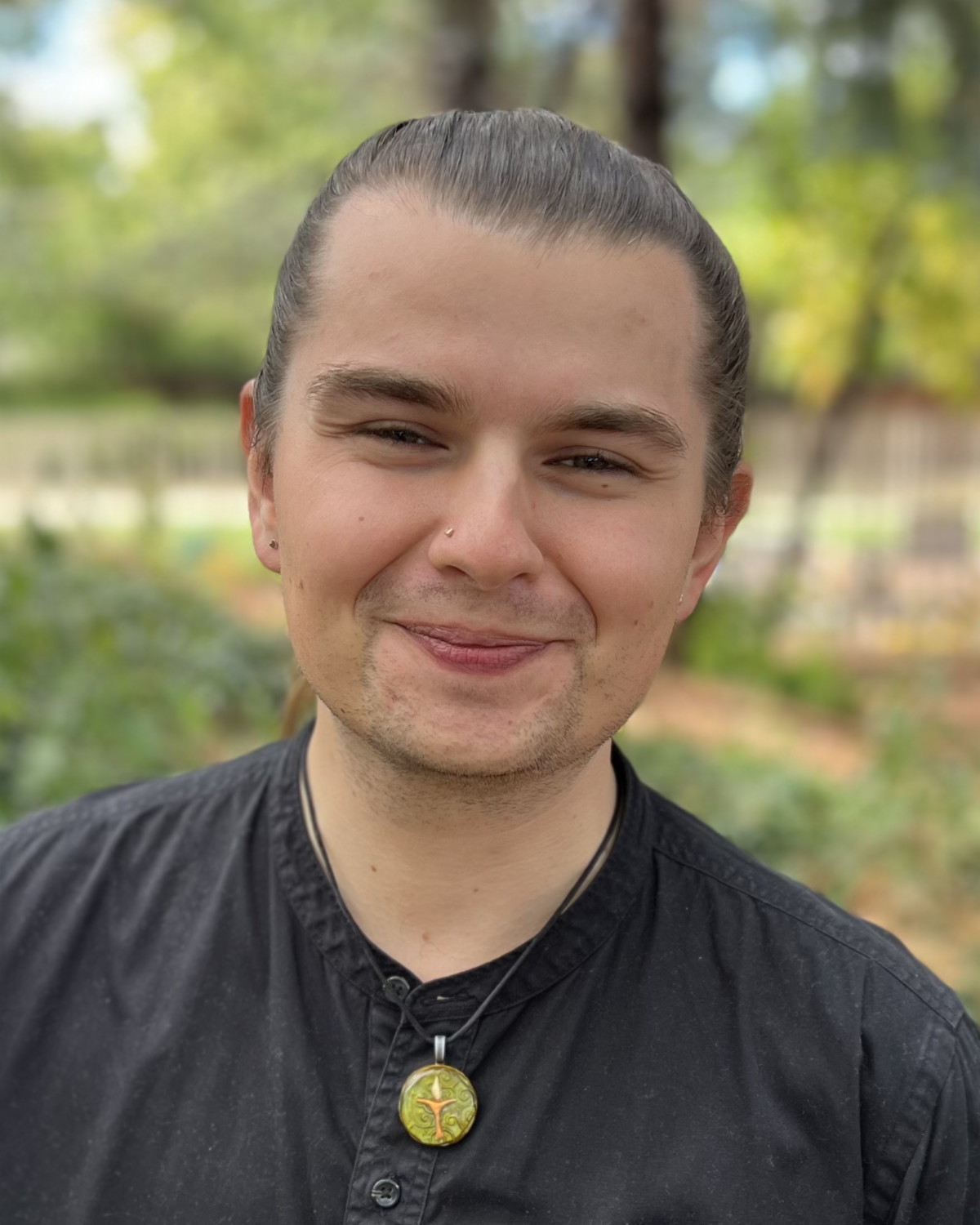
Beloveds, what a joy it is to write you for the first time as your new Intern Minister! Thank you to all of you who have warmly welcomed me into this community over the last few weeks. I’ll be serving with JUC full-time for this church year, concluding my time with you all in early June.
As I begin my time with you all and as we kick off this month of Connecting Authentically, I want to share a bit about who I am because who I am influences how I show up in my ministry. I’m nonbinary and use they/them pronouns. I grew up without a faith tradition but with lots of Catholic influences from my grandparents. I found my way to Unitarian Universalism in my early twenties and am now an Aspirant for UU Ministry with hopes of one day serving as a congregational minister. This summer was one of many transitions for me and my family. In May, my partner Pearl and I both graduated from Union Theological Seminary in New York City before packing up our things and moving across the country.
And while all of that is important to how I show up in ministry, there’s something even more important to my ministry… you! For me, ministry is the work of making manifest the Love that is at the center of our UU faith. My job is to offer care and support (and sometimes nudging!) to you all as we live into that Love together. I’m here to authentically connect with you all so that we can connect together with the Mission and Values of this community.
And so, this month, I’ll be dropping into as many JUC committees and events as I can. I hope to meet many of you there. Please continue introducing yourselves and telling me about who you are and your connections to JUC. I'll be sure to do the same.
| |
The Church "Miracle"
I have written in the past about bequests (IGNITE July 2016, IGNITE June 2017) and the difference they have made in JUC's financial landscape. Our JUC "miracle" is a member who has made a difference after their death with a planned gift to JUC.
You may know that the church fire alarm panel completely died near the beginning of August. After consulting with fire safety professionals, we learned that our entire system was aging and needed to be replaced to the tune of over $45,000. While we do have reserves to cover something like this, it is a significant expenditure and would deplete our reserve for capital projects significantly.
The "miracle" is that just two days after I signed the contract for the system overhaul, we received word of a bequest from Steve Sargent in what might turn out to be almost exactly the amount of the bill! Steve was a long-time member of the church. He joined in 1982 and died just this last February. Steve didn't know what we would need the money for, or probably even if there would be any left to give at the time of his death, but he named his church as one of the beneficiaries of assets that remained.
I have told this story in several circles and many people say it gives them goosebumps. It does seem at least extremely coincidental if not truly miraculous. I'll report back when we get the final distribution as to whether Steve's posthumous gift is an exact match to our alarm system bill.
Most of you know that my father is John Bradford, another very long-term member of the church, who died at the end of July. I just learned that he named JUC as a beneficiary of an IRA account. I didn't know about this, but was not surprised when I received word of the gift.
I feel real gratitude for those members who have left, or who plan to leave something to the church after they are gone. It really does make a difference!
You can make your own miracle for our congregation someday. If you would like more information on planned giving, you can contact me or Bud Meadows. There is also more information on our website.
| |
Be An Informed Voter
JUC CAN (Community Action Network)
Members of UU the Vote at Jefferson Unitarian Church (UUTV at JUC) and the JUC Community Action Network (JUC CAN) met to discuss the issues on the 2024 ballot. The following is based on our research and our understanding of our UU values.
One of the key principles of Unitarian Universalism is the use of the democratic process within society. This upcoming election gives you an opportunity to participate in that democratic process. Take the time to learn more about what a YES or a NO vote means and vote for what you value.
There will be a complete UU guide to all the ballot measures available online the first week of October, including the actual names used on the ballot. You can also pick one up in the south commons or call the office to request a print copy. In the meantime, here is a quick summary of
our recommendations and some dates and links to help you. If you don’t see a measure below,
we are neutral.
RECOMMEND SUPPORT
- Jeffco Measure 1A – Tax Retention Measure
- RTD 7A – Regional Transportation District
- Amendment 79 – Constitutional Right to Abortion
- Amendment G – Modify Property Tax Exemption for Veterans with Disabilities
- Amendment H – Judicial Discipline Procedures and Confidentiality
- Amendment J – Repealing the Constitutional Definition of Marriage
- Proposition KK – Firearms and Ammunition Excise Tax
RECOMMEND OPPOSE
- Amendment 80 – Constitutional Right to School Choice
- Proposition 128 – Parole Eligibility for Crimes of Violence
- Proposition 130 – Funding for Law Enforcement
- Proposition 131 – Establishing All-Candidate Primary and Ranked Choice Voting
General Elections
Important Dates:
- Friday, October 11: Local ballots mailed, drop boxes open
- Monday, October 21: Vote centers open
- Monday, October 28: Last day to mail your ballot (please include required postage)
Tuesday, November 5: Election Day; last day to register to vote and to VOTE by 7 pm. Register to Vote or Check/Update Your Voter Registration Information GoVoteColorado.gov
Other Jefferson County Voter Information Links:
| |
Jeffco Interfaith Partners (JIP) Update
Cathy and Bruce Martin
The aspens are starting to turn so it must be time to turn pumpkins into houses. No, not the Cinderella fairy godmother kind of magic but rather the magic of many hands supporting JIP’s October pumpkin patches in our yearly fundraising project to support the Metro Denver Habitat for Humanity (MD H4H).
There are two pumpkin patches operating. The first is at Mile High Church at Alameda and Garrison in Lakewood. If you wish to help unload the semi-truck load of pumpkins, that will happen twice, once on Thursday, October 3 at 4 pm and again on Sunday, October 13 at 11 am. Register for these sessions. And the ongoing pumpkin sales will be in two shifts daily (10 am to 2 pm and 2 pm to 6 pm) from Friday, October 5 through the 31st. Register for these sessions.
The second pumpkin patch is at Community of Grace, 7755 Vance Street (near 78th and Wadsworth) in Arvada. The unload of pumpkins will occur there on Friday, October 11 at 4 pm. And the daily pumpkin selling shifts (10 am to 2 pm and 2 pm to 6 pm) will start on Saturday, October 12. Sign up for either task in Arvada.This year any hours given to these projects before October 19 can also be reported for credit toward our JUC fall social challenge goal. We hope to see you out there practicing the magic of turning pumpkins into houses.
| | | | |