IIVS, Advancing Science & Animal Welfare Together | Sept 2026 | | Beyond the Positive in Genetox: Mechanistic Follow-Up Testing at IIVS | | |
Genetic toxicology testing plays a critical role in identifying compounds that may damage DNA or chromosomes and potentially contribute to carcinogenic risk. Traditional in vitro assays such as the Ames test, in vitro micronucleus assay, chromosome aberration assay, and comet assay serve as important screening tools and are widely used throughout product development.
However, these assays do not always provide clear answers. Conflicting, borderline, or unexpected results can create uncertainty and leave sponsors searching for additional information to support scientific decision-making.
This is where the IIVS Genotoxicity Program provides value.
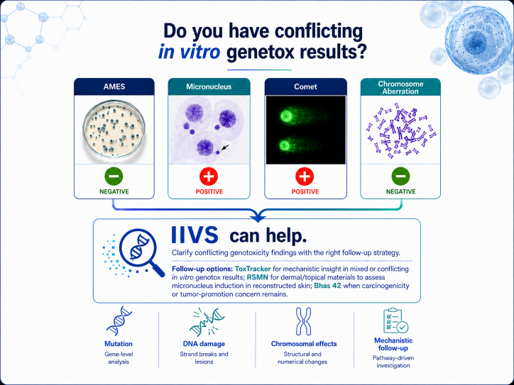
The IIVS Genotoxicity Program focuses on advanced follow-up assays that provide mechanistic and biologically relevant information beyond the standard genotoxicity battery. These assays are often used to investigate positive, equivocal, or contradictory findings from tests such as the Ames assay, in vitro micronucleus assay, chromosome aberration assay, and comet assay, helping sponsors better understand a substance's true genotoxic potential.
| | |
ToxTracker is a stem cell-based reporter assay that provides mechanistic information on multiple cellular stress pathways associated with genotoxicity and carcinogenicity. The assay can distinguish between:
✅ Direct DNA Damage
✅ Oxidative Stress
✅ Protein Damage
✅ General Cellular Stress
By identifying the underlying mode of action, ToxTracker helps investigators better understand positive genotoxicity findings and prioritize next steps.
Importantly, ToxTracker recently achieved a major milestone with the publication of OECD Test Guideline 446A, representing a significant step toward broader regulatory acceptance. As the field continues to evolve, mechanistic assays such as ToxTracker may increasingly play a role earlier in testing strategies, helping organizations make informed decisions before committing to more resource-intensive studies.
The Reconstructed Skin Micronucleus (RSMN) assay evaluates chromosomal damage in a three-dimensional human skin model, providing a more physiologically relevant assessment than conventional cell culture systems. The assay is particularly valuable for chemicals, cosmetics ingredients, agrochemicals, and other products where dermal exposure is a primary route of human contact.
The Bhas 42 Cell Transformation Assay (CTA) is an advanced in vitro method used to evaluate a substance's potential carcinogenic activity by measuring its ability to induce malignant cell transformation. Unlike traditional genotoxicity assays that focus on direct DNA or chromosomal damage, the Bhas 42 assay detects key cellular events associated with tumor formation, including both tumor initiation and promotion mechanisms. As a result, the assay can identify carcinogenic hazards that may not be detected through conventional genotoxicity testing alone.
Supporting Modern Risk Assessment
Regulatory agencies and industry stakeholders increasingly recognize the importance of mechanistic data to support risk assessment and reduce uncertainty. By combining traditional genotoxicity endpoints with targeted follow-up assays, organizations can gain a more complete understanding of a substance's biological activity and potential hazard.
At IIVS, our Genotoxicity Program is designed to provide these deeper insights, helping clients navigate challenging datasets and make informed development decisions with greater confidence. Contact clientservices@iivs.org for help with your genetox testing.
| |
Leadership Changes Position IIVS for Continued Growth | | |
As IIVS continues to grow and expand its scientific and operational capabilities, we are implementing several leadership changes designed to strengthen both our business operations and scientific programs. These changes recognize the expertise of internal leaders while ensuring continuity in key areas of the organization. As part of this transition, Holger Behrsing, Ph.D., will move from his management role into a consulting position with IIVS, where he will continue to provide scientific expertise, mentorship, and strategic guidance in respiratory toxicology.
| | |
Gertrude-Emilia Costin Promoted to Vice President of Laboratory Operations
We are pleased to share the promotion of Gertrude-Emilia Costin, Ph.D., MBA, ATS, ERT, to Vice President of Laboratory Operations. In this role, Emilia is leading the organization's operational strategy, oversees key laboratory functions, supports organizational planning and growth, and coordinates and prioritizes resources across the company. She will also serve as GLP Test Facility Management, providing management oversight to help ensure GLP-compliant operations are maintained.
Emilia has been with IIVS for nearly 2 decades, having served in progressively responsible scientific and management positions, including Study Director, Program Leader, Manager of Scientific Services, and Director of Laboratory Services. Her extensive background in toxicology, laboratory management, client support, assay validation, staff development, and business planning uniquely positions her to bridge scientific excellence with operational effectiveness.
| | |
Vivek Patel Promoted to Head of Respiratory Toxicology
We are also pleased to announce the promotion of Vivek Patel, Ph.D., to lead the Respiratory Toxicology Program. In this capacity, Vivek will be responsible for the strategic and operational management of the program, including scientific and regulatory oversight, personnel development, resource planning, research activities, testing schedules, and program growth.
Since joining IIVS in 2019, Vivek has been instrumental in building and advancing the organization's respiratory toxicology capabilities. He has led the development of respiratory research models and testing approaches, worked closely with clients and collaborators, managed internal research initiatives, and contributed to numerous scientific publications and presentations. Prior to IIVS, his academic and postdoctoral research focused on pulmonary toxicology, respiratory disease, particulate matter exposure, and lung immune responses. His scientific accomplishments have earned recognition from the Society of Toxicology and other professional organizations.
These leadership changes reflect IIVS's commitment to investing in its people, developing expertise from within, and positioning the organization for future growth and impact in advancing human-relevant science and non-animal testing approaches.
| | IIVS is presenting our work this Fall. Hope to see you there! | | | IIVS is always interested in the needs and requests from researchers interested in advancing the awareness, acceptance and use of alternative methods. If you have any input on methodologies of interest, please don't hesitate to contact us at clientservices@iivs.org. | | | | |