|
|
|
Friday's Labor Folklore
Con Carbon, Minstrel of the Mine Patch
|
|
| |
|
|
|
Historic labor song
recording discovered
at the
Library of Congress
by
Saul Schniderman
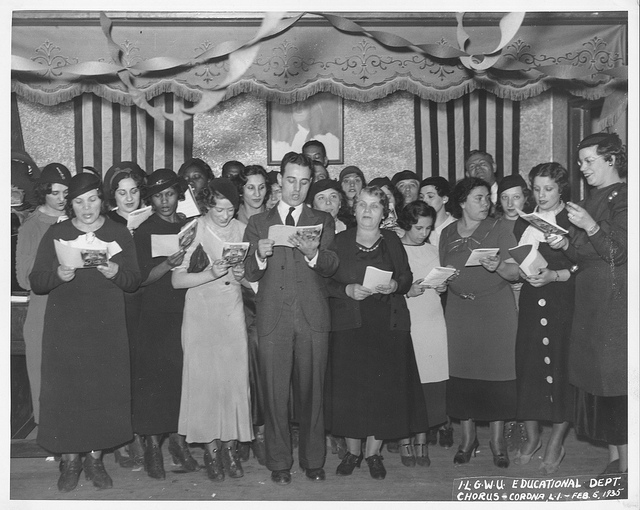
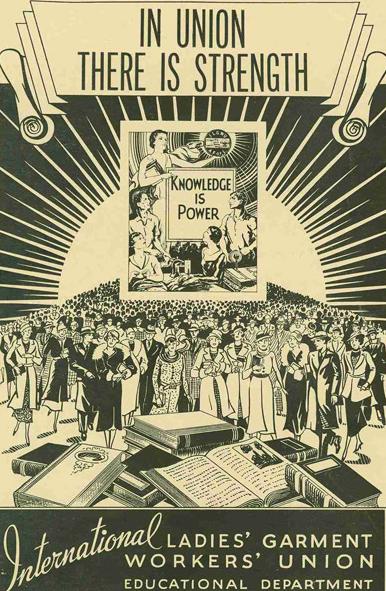
In 1935, the Education Dept. of the International Ladies Garment Workers Union (ILGWU) in New York City produced two twelve-inch 78-rpm records of labor songs performed by the International Singers, an all-male chorus. Each record sold for fifty cents.
The first record featured: "The ILGWU Anthem," "Dressmaker's Victory Song," "Internationale," "Picket Line," "Soup Song," and "Solidarity." The second included "Hold the Fort," "Please Mr. Boss," "March of the Toilers," "Song of Local 91," "Song of the Neckwear Workers," "Bread and Roses," and "Uprising of the Twenty Thousand."
In his
Discography of Songs of American Labor, Industrialization, and the Urban Work Experience Recorded on 78 and 33 1/3 rpm Albums,
1941-1980 folklorist Richard Reuss (1940-1986) described this recording as a "milestone" because it is the first known recording of labor songs in the United States produced and distributed by a union.
As a researcher and collector of laborlore Reuss searched in vain for these two 78s but reported that "no actual copies of these records have been located to date."
Reuss completed his discography in 1981 and it was published two years later. After it was published, he received a letter from Deborah George, a Washington, DC-based broadcast journalist, who reported that she had stumbled upon the two records while doing research in the Rodgers and Hammerstein Archives of Recorded Sound in the New York Public Library. George recounted that, in the late 1970s, she was researching the Triangle Shirtwaist Factory Fire of 1911. She traveled to New York to interview union officials and others who remembered the fire and it was there that she discovered the ILGWU records.
According to labor folklorist Archie Green (1917-2009) "Reuss was ecstatic." The discovery of the ILGWU recordings "signified one more chip in work culture's mosaic, a building block in our continuous effort to represent and re-present the expressive treasures of working people." (Songs about Work : Essays in Occupational Culture for Richard A. Reuss edited by Archie Green, 1993.)
Folklore, according to Archie Green, is not only created within the union movement but "
material flows to it and from it constantly." Archie mentored many young people interested in workers' culture and I was greatly influenced by his work, as I was by George Korson, "the folklorist of the coal fields." (See
Only a Miner : Studies in Recorded Coal Mining Songs by Archie Green and
Minstrels of the Mine Patch by George Korson.)
In 2012 I was working as a cataloger in the Copyright Office at the Library of Congress. I wandered into the Recorded Sound Research Center in the Library's Madison Building and spoke with a reference librarian who works there. Had she ever heard of these rare 78-rpm recordings? "Let me check," she said and she began thumbing through a vertical file when I heard her say the word "bingo!" She had found a reference to the ILGWU recordings and she directed me to the Library's National Audio Visual Conservation Center (NAVCC) in Culpeper, Virginia where they were housed.
The Library of Congress is a great library and its NAVCC helps preserve the world's audiovisual heritage. The recorded sound engineers in Culpeper digitized the 2 records, copied them onto a cd and - after paying a nominal fee - I was gleefully listening to them in a booth in the Music Division during my lunch hour.
I was shocked. Considering that the ILGWU had issued these recordings in 1935 they were in excellent condition -- the sound was great, not a scratch on them!
The songs featured on the ILGWU records were sung by the International Singers -- a vibrant, spirited chorus. Their 1935 recording heralded the praises of their union - the International Ladies Garment Workers Union. One of the songs - "The
Dressmakers' Victory Song" - has been mounted on You Tube. The lyrics are included so give a listen.
(read the lyrics -- if desktop, click "show more"
if mobile device, click down arrow)
Labor song enthusiasts often cite
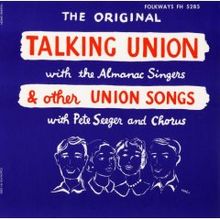
Talking Union as the most famous and influential album of American union songs ever recorded. Released in 1941 by Pete Seeger and the Almanac Singers
Talking Union was a record "album" - a collection of
78-rpm discs bound in a thick book resembling a photo album.
Talking Union featured: "Get Thee Behind Me Satan," "Union Maid," "All I Want," "Talking Union," "Union Train," and "Which Side Are You On." (The album was reissued - in 1955 - in an expanded version.) Some of these songs became labor classics and are still being sung today.
The ILGWU International Singers' recording precedes
Talking Union by 6 years. These records were produced and distributed by a union that was founded primarily by Jewish immigrants, many of whom were socialists. The Garment Workers would go on to establish a unique brand of "social unionism" organizing choruses, mandolin orchestras, drama clubs, reading groups and other activities coordinated by their education department. (Kheel Center, Cornell University)
|
Music for Hall and Home
On January 15, 1936
Justice - the official publication of the ILGWU - published the following article on its "Workers Education" page.
And for those locals and members outside of New York City we also have some good news. Maybe you have, as yet, no orchestra or choir. Possibly your members want to sing but doubt their power and are shy. For you we have made records of 6 songs to be used on your Victrola at home or in the local meeting.
We have a special record for use in radio broadcasting by the locals in Kansas City, St. Louis, Chicago, Baltimore and Buffalo. Canned music, yes, but good beer comes that way too nowadays. And we "canned" 8 good male voices led by Jim Phillips (whose face has been made familiar by the movie "Marching On") and the enunciation is good to the last syllable.
The songs thus made available for world wide and permanent use are:
ILGWU Anthem, Victory Song of the Dressmakers, Internationale, Picket Line, Soup Song
Solidarity.
You can have all this on a standard 12 inch, double-sided record. Sent to you postpaid for 50 cents. The records for broadcasting stations are provided free for any local having enough enterprise to use the radio for trade union propaganda.
Later on that year - 1936 -
Justice published another story about this pioneering sound recording.
The first phonograph record of six union songs issued by the ILGWU Education Department has been widely used on the radio from Buffalo, New York to Puerto Rico and from Boston, Massachusetts to San Francisco, California to strikes including that of the rubber workers in Akron, Ohio and in meetings of union members and the unemployed; the record has already been put to good use with and without amplifiers. This has encouraged the production of a second phonograph record.
The songs now recorded and made available for radio and phonograph are:
The Song of Local 91, The Song of the Neckwear Workers, Bread and Roses (well known as
The Son
g of Local 89 in Sam Friedman's English translation),
The Uprising of the 20,000, Hold the Fort Please Mr. Boss and the March of the Toilers.
As in the first recording Morris Novak, Director of WEVD, arranged the music and the rehearsals for Jim Phillips, heading the International Singers (8 male voices) whose clear enunciation and stirring, infectious vocalizing have evoked general praise.
Each 12 inch double-sided record costs 50 cents with 25 cents mailing. A good portable phonograph costs only $10.00. Why not liven up your local meetings? Why not use the records in your gym and dancing classes for rhythm? Our songbook "Let's Sing" has the words and now here is the music. Make it go round.
|
|
|
|
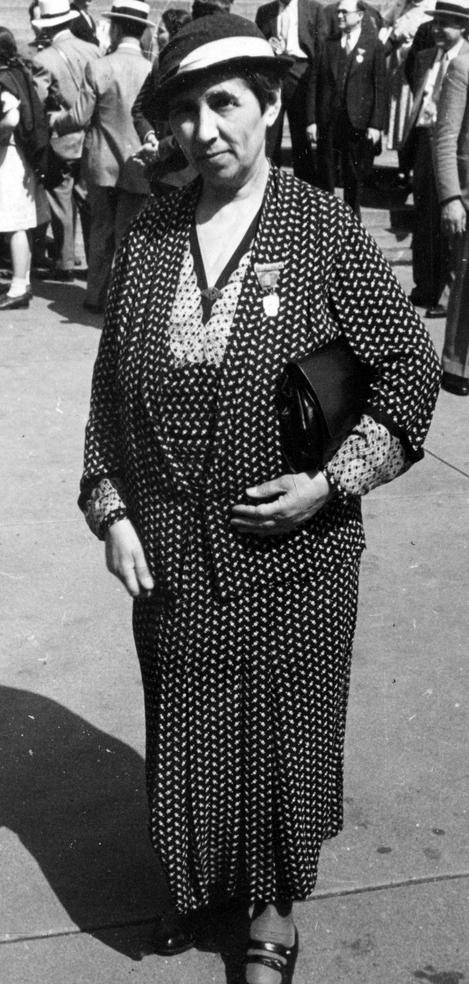
Fannia Cohn (1885-1962)
Labor Educator |
During my research I came to understand the amazing cultural work of the ILGWU Educational Dept. led by Fannia Cohn. During the 1930s, 40s and into the 50s this department sponsored choruses, sports teams, drama clubs, floats, dances, mandolin orchestras,
Unity House, etc. in which thousands of workers and their families participated.
Today's labor and social justice activists could learn important lessons from these early garment worker unionists. People who join organizations are often searching for a community where they can learn, meet friends and have some fun. (Susan Stone Wong in
Sisterhood and Solidarity, edited by Joyce Kornbluh and Mary Frederickson, 1984)
(Thanks to Tom Juravich of UMass Amherst Labor Relations & Research Center and former ILGWU member Carl Proper who, in 2013, assisted me in my research. Why did the Garment Workers promote education and cultural involvement as a centerpiece of union-building activity?
See:
All together different : Yiddish socialists, garment workers and the labor roots of multiculturalism by Daniel Katz.)
Saul Schniderman is the president of the Library of Congress Professional Guild, AFSCME Local 2910, the Chair of the Labor Heritage Foundation and the editor of
Friday's Labor Folklore.
|
|
|
ILGWU Educational Dept. Chorus, 1935
Photo: Kheel Center, Cornell University
|
|
|
| |
|
|
|
|
|