January 2, 2025


About Us

Membership

Advocacy

Events

News


In This Issue:


  • Congratulations - Dr. Michaela Schulte New District Three Trustee
  • AMA: Congress Fails Patients and Physicians With No Medicare Fix
  • IMA Influences AMA Rural Health Policy
  • 2025 Regence Policy to Cut Reimbursement When Using Modifier -25 
  • Mark Your Calendars - Two Important Events!
  • Join/Renew IMA Membership
  • IMA Education Webinars 2025

Congratulations IMA District Three Trustee, Dr. Michaela Schulte!


We are happy to announce Michaela Schulte, MD, was elected as Trustee for District Three to the IMA Board of Trustees. 


Each IMA Board member is a liaison between component societies and the association, represents, advocates for, and advises the societies, visits each society, and submits a report to the IMA House of Delegates regarding their trustee district.


IMA looks forward to a productive partnership in working with Dr. Schulte. Congratulations! 

AMA: Congress Fails Patients and Physicians With No Medicare Fix


On December 20, the US House and Senate avoided a government shut down and passed a continuing resolution to keep federal agencies and programs operating until March 14. Most of the earlier proposed health care package, including provisions that would have provided relief from the 2.83% Medicare cuts in 2025 for physician practices, were ejected from the final legislation. The following is the AMA's statement in response.


The following statement is attributable to:

Bruce A. Scott, M.D.

President, American Medical Association

“The Continuing Resolution utterly fails to address declining reimbursement rates for Medicare, pushing our health system down a path that will have predictable and deleterious results. For the fifth consecutive year, Congress has adjourned and allowed Medicare cuts. What will be the result? Patients struggling to access health care. Physicians closing or selling their private practices while others opt to leave the profession.

“Congress heads home today leaving in place a 2.83 percent cut for doctors. It did not provide a rational permanent, inflation-based update as the Medicare Payment Advisory Commission recommended. It didn’t even offer doctors a Band-Aid in the form of a cut reduction, as the cost of delivering care rises 3.5 percent next year. 

“With this new cut going into effect next year, Medicare payment rates have fallen by 33 percent over the past two decades, when adjusted for the costs of running a practice, leaving physicians struggling to figure out how they can continue to provide needed care to their elderly and chronically ill patients. 

IMA Influences AMA Rural Health Policy


Inequitable rural health trends are alarming—and unacceptable


Dec 13, 2024 

By: Andis Robeznieks, Senior News Write


People who live in rural areas of the U.S. are at greater risk of dying from heart disease, cancer, unintentional injury, chronic lower respiratory disease and stroke than their urban and suburban counterparts.


Rural residents also tend to be older and sicker and have higher rates of cigarette smoking, obesity and high blood pressure, according to the Centers for Disease Control and Prevention.


“The health trends in rural America are admittedly alarming,” AMA President Bruce A. Scott, MD, wrote in a Leadership Viewpoints column earlier this year.


“Our nation seems to expect that health outcomes will be worse—a lot worse—for people living in small towns, farming and ranching communities, and other places far from city lights and suburban sprawl,” added Dr. Scott. “Rather than accept this status quo, the AMA is working on multiple fronts to reduce these inequities, promote greater access to care, and significantly improve the health of people regardless of ZIP code.”


This commitment to end rural health inequity was demonstrated at the 2024 AMA Interim Meeting in Lake Buena Vista, Florida, where the AMA House of Delegates took several actions aimed at attacking this issue from several different angles.


Adopted at the meeting was a Board of Trustees report addressing shortcomings in a federal program designed to encourage primary care physicians and others to consider practicing in locations designated as health-professional shortage areas (HPSAs).


“Many HPSAs do not seem to receive scores that reflect their actual need and health indicators do not adequately measure health status” of residents, the report says. “These problems can lead to significant negative impacts on underserved populations.”


The potentially inaccurate scores can weaken the effectiveness of a federal program that offers vital scholarships and loan repayment in exchange for a commitment to practice medicine in underserved areas, according to the report, which was spurred by a resolution introduced at last year’s Interim Meeting by the Idaho Medical Association.


Delegates agreed that the actionable changes recommended in the report “can lead the way to better outcomes,” and called on the AMA to: 


  • Support the Health Resources and Services Administration’s effort to conduct a comprehensive reevaluation and assessment of the effectiveness and equity of the Health Professional Shortage Area scoring criteria to meet the physician-workforce needs of rural communities and underserved areas. 


  • Urge increased federal and state resources to improve the accuracy of the data used to determine HPSA scoring used by the National Health Service Corps loan repayment program to help meet physician workforce needs for the neediest rural communities and underserved areas.


"The primary care physician shortage is hitting rural areas hard, and it’s projected to get worse,” said AMA Trustee Alexander Ding, MD, MS, MBA. “Rural areas continue to face substantial challenges in getting scores that meet federal thresholds, and we urgently need to increase data accuracy and revamp the scoring system to ensure rural communities have access to health care they desperately need.”


This new policy reinforces the AMA’s long-standing commitment to bolstering rural health care access and follows past calls from the AMA urging Congress (PDF) to raise funding to strengthen the scholarship aspect of the National Health Service Corps loan repayment program.

2025 Regence Policy to Cut Reimbursement When Using Modifier -25 


We have recently learned that Regence plans to implement a policy revision (103) to cut the evaluation and management reimbursement by 50% when claims are submitted by the same provider, same date, as a minor procedure. While we assume the intent of the new policy is to cut reimbursement for services rendered in the same visit, we are deeply concerned this will have a consequential effect on patient care for separately identifiable services. The purpose of modifier -25 enables reporting of a significant, separately identifiable E/M service, on the same date, by the same physician above and beyond the usual pre- and post-operative care associated with the procedure or service performed. CMS and the MAC’s recognize this and provide full payment for each service, assuming the documentation is supportive.


The IMA and IDID have sent a joint letter to Regence explaining the impact to access and disruption to optimal care for patients by improperly reducing appropriate payment and contradicting established coding principles when a patient has multiple needs in a single encounter. We are urging practices to email Regence and explain how this will impact your practice. The policy will be effective March 1, 2025 if not rescinded.


You can read the full policy here: https://www.regence.com/provider/library/policies-guidelines/reimbursement-policy/modifier-25-mar2025


Read the IMA letter here: https://www.dropbox.com/scl/fi/0yczzdn7uvn3asyii0o1b/Regence-Letter-Reimbursement-policy-103-003.pdf?rlkey=8a9joqs4r6tqfm4q74owy2d3b&st=a5dbp9yl&dl=0


A letter can be sent to Daniel.Meltzer@regence.com and we recommend copying Rebecca@idmed.org and jana.gill@gillcompliance.com

Mark Your Calendars for Two Important Events!


January 16


The Idaho Humanities Council will moderate a discussion of “Respecting Life and the Dignity of Women in Idaho.” This discussion will take place at the Wassmuth Center on Thursday, January 16th, at 7:00 pm MT. Please register below and plan to bring a friend. The Pro-Voice Project will also be displaying their exhibit, “Worth of a Woman” at this event.

Learn More

January 25


On January 25th from 4:00 pm to 6:00 pm MT there will be an online debate moderated by the Braver Angels (braverangels.org). This moderated debate will discuss: “Resolved: Idaho’s abortion laws are harming women.” Please click the link below for more information.

Learn More

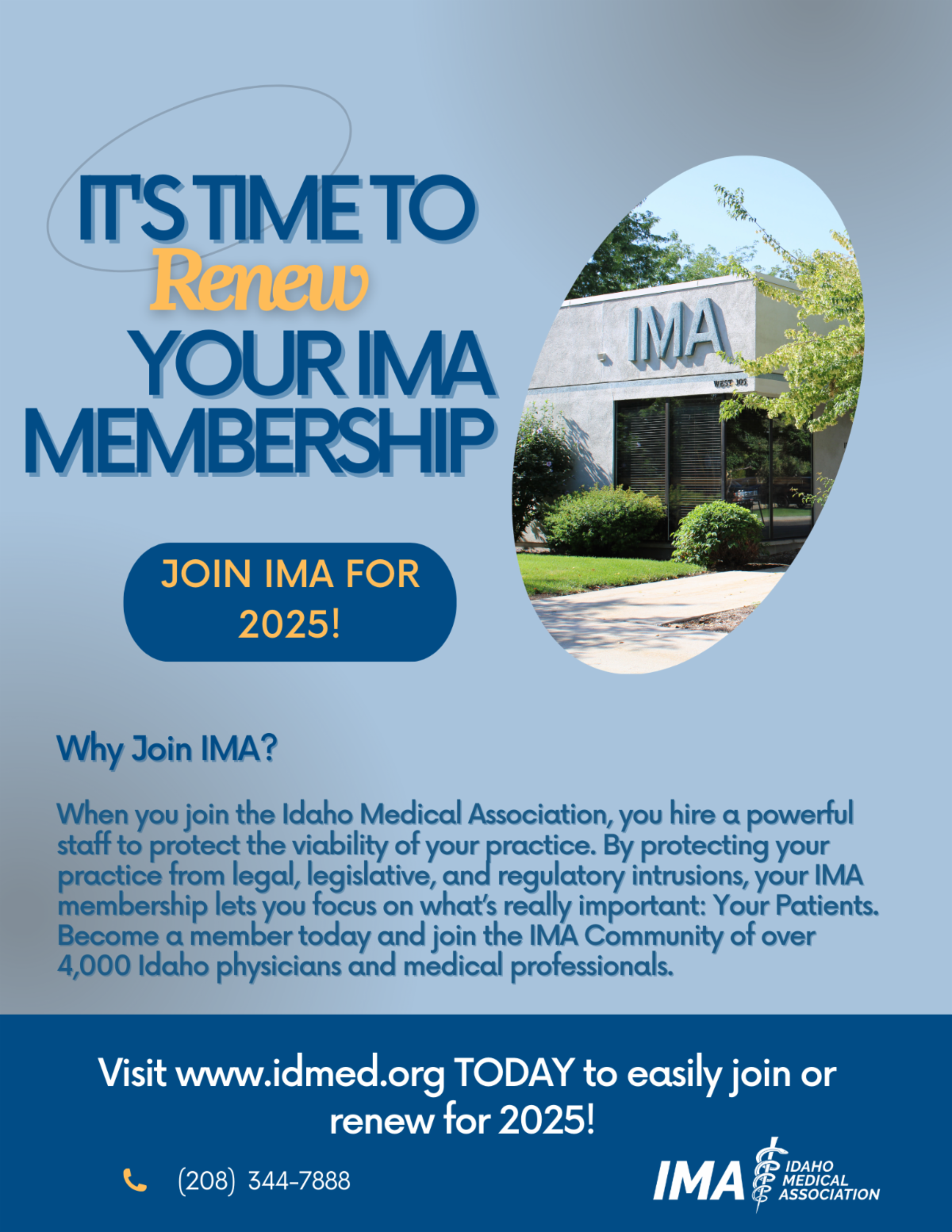
It's Time To Renew Your IMA Membership!


Why Join IMA?

When you join the Idaho Medical Association, you hire a powerful staff to protect the viability of your practice. By protecting your practice from legal, legislative, and regulatory intrusions, your IMA membership lets you focus on what’s really important: Your Patients. Become a member today and join the IMA Community of over 4,000 Idaho physicians and medical professionals.


* Join the AMA through IMA: Win-Win!  When you join the American Medical Association (AMA) and pay dues through IMA, it generates additional revenue for us. IMA receives commissions from AMA for promoting membership among Idaho physicians. Please submit your AMA membership through the IMA today! If you have any questions about your AMA membership, please email membership@idmed.org.


Visit www.idmed.org TODAY to easily join or renew for 2025!

Join / Renew Today!
Facebook  LinkedIn  Twitter