|
Welcome to the IMBeR's Newsletter.
Over the past year, IMBeR has continued to support capacity development through the Interdisciplinary Marine Early Career Network (IMECaN), internships, interdisciplinary forums and training opportunities. From August 2025 to July 2026, these activities helped strengthen scientific communication, collaboration and engagement across disciplines, regions and career stages.
This newsletter highlights selected capacity-building activities, including intern experiences, report the Ocean Sciences Meeting 2026 and the Blue Wave Doctoral Forum 2026, especially its panel discussions, and a preview of the upcoming 2026 training workshop on coastal blue carbon ecosystems.
| |
Intern Voices: Learning Through Participation
Through internships in communication, event coordination and programme support, students gained first-hand insight into how international scientific programmes operate and connect research communities across countries and disciplines.
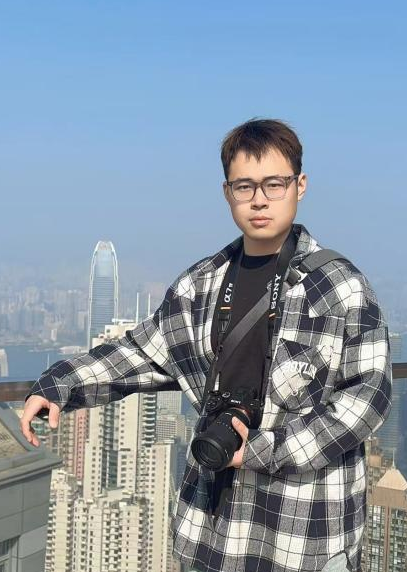
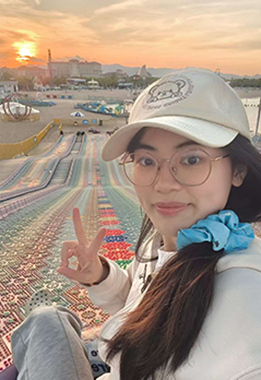
Since 2022, 33 interns have completed internships at the IMBeR International Project Office, with five interns in 2026 featured below. We are grateful for their contributions and for sharing their experiences, and wish them all the best in their future studies and careers.
| | |
Xinyun Chang - As a journalism student, my internship at the IMBeR International Project Office was a meaningful and inspiring experience. Before joining IMBeR, my understanding of international scientific programmes was limited, but this internship allowed me to see how academic communication, project coordination and global collaboration are carried out in practice.
What impressed me most was the professional and supportive working environment. Every piece of information needed to be treated with accuracy and care, and every communication task reminded me of the importance of clarity, responsibility and cross-cultural awareness. Through this process, I gradually realized that communication is not only about delivering messages, but also about building connections between people, institutions and different knowledge communities.
This internship also helped me reflect on my own academic and professional interests. Working in an international project office broadened my perspective beyond journalism and media studies, and encouraged me to think more deeply about the role of communication in scientific collaboration and public understanding. I learned to be more patient, detail-oriented and open-minded when facing unfamiliar topics and tasks.
I am sincerely grateful to the IMBeR IPO team for their guidance, trust and encouragement during my internship. This experience has strengthened my confidence in applying communication skills in international and interdisciplinary contexts, and it will continue to support me in my future studies and career development.
| |
 | | Chen Chen - My internship at IMBeR has been an invaluable journey of personal and professional growth. My main responsibilities included data visualization and mapping, translating and proofreading materials between Chinese and English, and compiling participant lists. The charts I created were primarily participant distribution maps, country distribution maps, and annual summaries—content focused on information organization and visual presentation. In this sense, I was essentially working from a scientific perspective on tasks with humanities-oriented characteristics. Through this experience, I learned to handle various types of information with greater precision and mastered the skill of presenting complex content through clear and intuitive visuals, which provided effective support for the team's management and external communications. What moved me most was the warmth and inclusiveness of the IMBeR mentors—they were always patient in guiding me and sincere in their encouragement, which helped build my confidence. As an estuarine and coastal science student, interning in such an international academic organization allowed me to see the value of integrating theory with practice. This experience broadened my perspective, enabling me to view ocean changes and estuarine evolution through a more scientific lens. What IMBeR gave me is not just work experience, but a deep sense of reverence and passion for the ocean and science.
| | |
Zhuohui Liao - The best part of my internship at IMBeR was the incredible encouragement I received from the team members, especially from my mentor, Kai Qin. Everyone was so supportive and friendly, and this relaxed environment gave me a tremendous boost in confidence. Even though my assignments, primarily data organization and validation for global projects, were demanding and I sometimes doubted my own precision, I never heard a single word of criticism. Instead, I received only sincere, gentle encouragement and instructive suggestions.
My core responsibility involved cleaning, structuring, and reconciling heterogeneous datasets from various international sources. I became proficient in advanced Excel functions, wrote simple scripts for data validation, and created systematic checklists to reduce errors. Beyond technical skills, I also learned how to collaborate with colleagues across time zones, adapt to different communication styles, and provide timely updates. This taught me that effective teamwork is built on transparency and mutual respect. I also assisted in preparing data summaries for internal reports, which sharpened my ability to present complex information clearly and concisely.
Working at IMBeR, a truly inclusive international marine research organization, I had the chance to deepen my understanding of ocean geography and pressing issues such as ocean warming and extreme weather. This exposure reshaped my worldview. As I have always believed, personal perception increases the clarity of the world. Now, through my daily handling of environmental data, I have begun to see the world through the lens of trends, anomalies, and silent numerical signals that speak volumes about our changing planet.
I am deeply grateful to Kai and the entire IMBeR team for their trust and support. This internship has not only honed my analytical and organizational abilities but also ignited a lasting passion for international collaboration and ocean sustainability.
| | |
Jie Ying Liu - I joined IMBeR as an intern and spent a wonderful three months working in this international project office. As a postgraduate student majoring in marine geology, this was my very first time working in such a global environment, making the entire experience both incredibly fresh and rewarding.
During my internship, my daily responsibilities were dynamic and completely different from my previous academic studies. Working entirely in English, I was responsible for organizing and managing office documents, which significantly improved my professional communication skills. Under the patient guidance of my supervisors, I also participated in designing and revising various event posters. This hands-on experience not only introduced me to professional design work but also trained me to be highly careful and rigorous. Furthermore, I learned how to write profiles tracking the academic journeys of prominent scholars in the marine domain.
For me, this internship was more like a valuable extension of my education. It greatly broadened my horizons, allowing me to catch up with the latest global research and news in marine science. Beyond the professional growth and practical office skills I acquired, the best part of this journey was the people. I am so grateful to have met and worked alongside such an amazing group of partners and fellow interns. Every day was filled with joy and support, and I am incredibly happy to have been a part of this warm community!
| | |
Bingran Zhang - The best part of this six-month internship at IMBeR was the incredible encouragement I received from everyone around me. From day one, my supervisors and colleagues treated me with kindness and patience. Whenever I submitted a draft—whether a translation or a report—they gave specific suggestions along with genuine praise. Even when I lacked confidence in my academic translations, I never heard a single critical word; instead, I was met with gentle guidance and endless affirmation. This relaxed yet supportive environment allowed me to focus on learning rather than worrying about mistakes.
As an environmental science major, I was familiar with data analysis and fieldwork, but this internship immersed me in the operational side of international research collaboration. I helped revise cooperative proposals, sorted and categorized contact information of global research liaisons into a clear database, and independently wrote analytical reports that fed into the project's international outreach strategy. I also handled bilingual translation of official documents and meeting minutes, ensuring smooth communication across countries. In addition, I coordinated the collection and verification of trainee applications from various nations, laying a solid foundation for subsequent selection and events.
Beyond these tasks, I explored new skills: formatting content for WeChat and Constant Contact, and even using Photoshop for simple designs. These were completely new to me, but the team's patient coaching made the learning curve enjoyable. Meanwhile, I gained deep insights into marine geography—ocean warming, extreme weather, sediment dynamics, and cyanobacterial blooms—all of which have changed how I observe the world. Like a painter who sees light and shadow, or an architect who sees structure, I now read rivers and coasts as nature's silent messengers, telling us about environmental changes we depend on.
This internship not only strengthened my writing, information-processing, and bilingual abilities, but also broadened my perspective and deepened my passion for marine science. I am sincerely grateful to IMBeR for this transformative experience, and I will carry forward the confidence and clarity it gave me.
| |
|
| We welcome students from all departments of East China Normal University (ECNU) to apply for our internship programs. Our programs are designed to cater to each student's field of study. We would like to express our gratitude to the State Key Laboratory of Estuarine and Coastal Research (SKLEC) and the Student Affairs Office of ECNU for their support. Please stay tuned for more capacity development opportunities in the future by subscribing to our updates. | | | |
IMBeR at the Ocean Sciences Meeting 2026
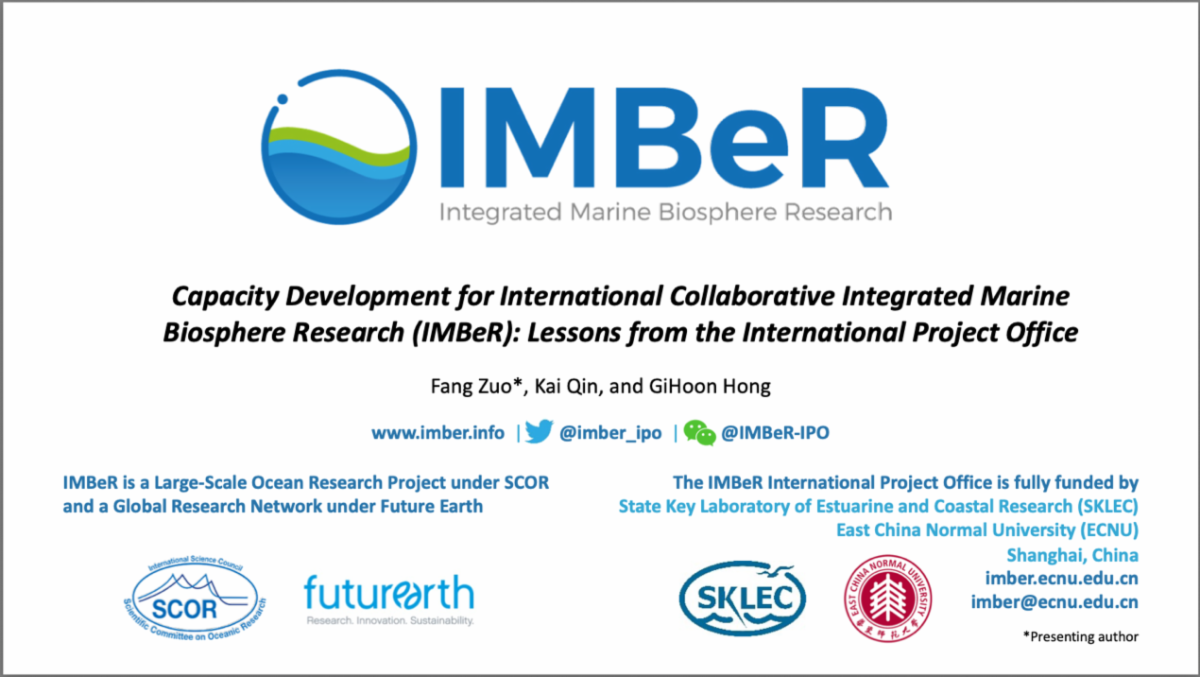
Invited to contribute to an ASLO cross-regional session, the presentation “Capacity Development for International Collaborative Integrated Marine Biosphere Research (IMBeR): Lessons from the International Project Office” highlighted strategies for establishing, supporting, and sustaining international working groups.
| | |
Within large international research programmes and networks, working groups often serve as the basic organizational units for collaborative research. However, establishing such groups from the ground up presents numerous challenges, particularly under funding constraints and for early career researchers.
In 2022, the IPO facilitated the establishment of three international Study Groups on: (1) marine biogeochemistry and biodiversity sustainability in the Indo-Pacific region, (2) ocean color-based plant species identification and carbon flux, and (3) post-eutrophication governance. Each group followed distinct developmental pathways and encountered different opportunities and challenges. Based on these experiences, transferable practices and key interventions throughout the full working group life cycle were identified and synthesized, demonstrating how targeted support can effectively enable international collaboration across diverse settings, with contributions of all Study Group collaborators.
This work has been published in 2026 Ocean Sciences Meeting preprint collection and can be viewed here. We welcome applications for new endorsed projects, endorsed activities, and study groups. Click here to explore the application forms and become part of IMBeR’s international network!
Application Forms:
IMBeR Project Endorsement Application Form
IMBeR Activity Endorsement Application Form
IMBeR Study Group Application Form
| |
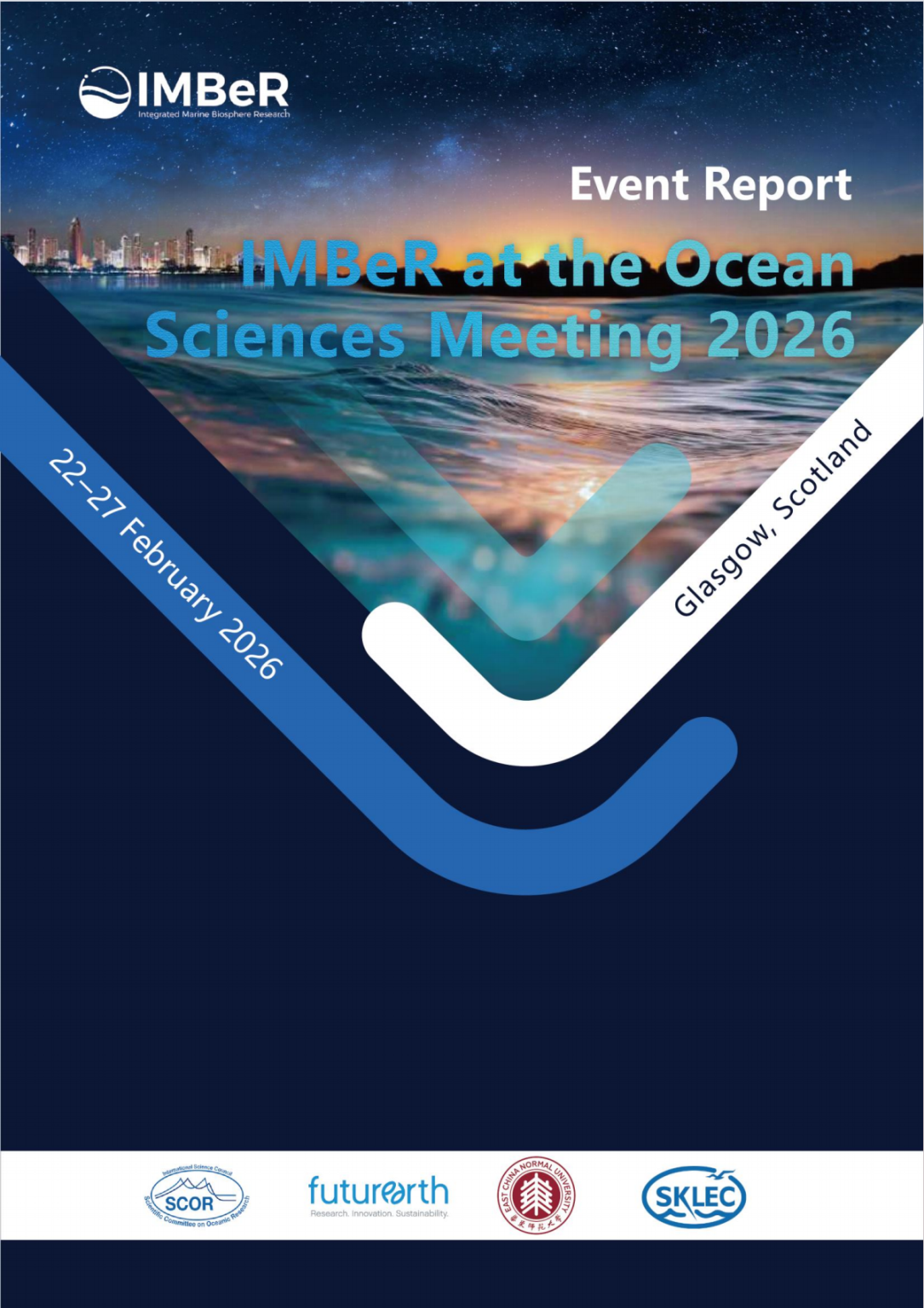
Broader outcomes from IMBeR’s participation in the Ocean Sciences Meeting 2026 are captured in the event report. These included the co-launch of the Integrated Ocean Carbon Research report (including its capacity development component), the IMECaN co-hosted town hall session, “Broadening the Ocean Science Workforce for a More Equitable, Inclusive, and Engaged Community”, and research highlights from early-career researchers. The full report is available through Zenodo.
Citation
Zuo, F., & Qin, K. (eds.).(2026): IMBeR at the Ocean Sciences Meeting 2026. IMBeR International Project Office, Shanghai, China. https://doi.org/10.5281/zenodo.19510889
| |
Blue Wave Doctoral Forum 2026
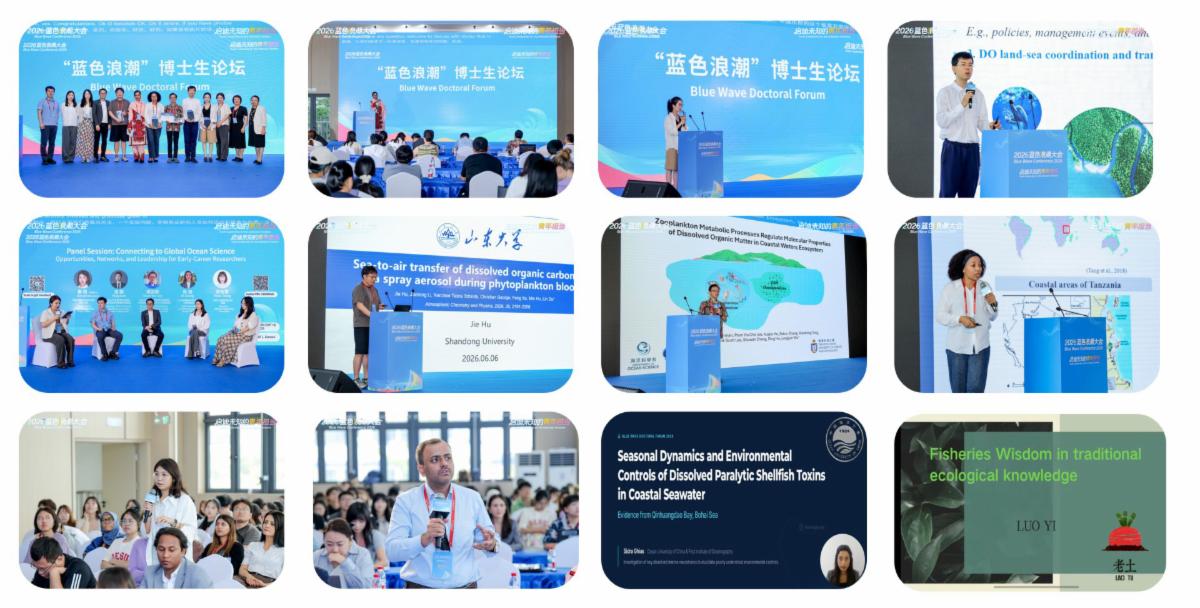
The Blue Wave Doctoral Forum 2026 provided an international platform for early-career researchers to present interdisciplinary research, exchange ideas and explore pathways into global ocean science networks.
| | |
Held on 6 June 2026 in Xiamen, China, as part of the Blue Wave Conference and World Oceans Day celebrations, the Forum focused on “Land–Ocean–Climate Nexus for Coastal Ecosystems.” Jointly initiated by IMBeR, CLIVAR, SOLAS, IMECaN, Future Earth Coasts and Anthropocene Coasts, it formed part of a wider conference attended by more than 240 participants from 35 countries and regions.
Five oral presentations and three lightning talks were selected through an open call for abstracts, covering topics such as dissolved organic matter cycling, mangrove carbon sequestration and coastal ecosystem responses to climate change. Nuruddin Muhammad Firman from the Hong Kong University of Science and Technology received the Best Presentation Award.
A special roundtable, “Connecting to Global Ocean Science: Opportunities, Networks, and Leadership for Early-Career Researchers,” complemented the scientific programme. Panellists shared practical advice on joining international scientific organisations, developing leadership experience and building long-term professional networks.
| | |
Panel discussions are particularly valuable in capacity-building activities because they move beyond technical research presentations. They create space for open conversation about scientific identity, collaboration, communication, uncertainty and long-term career planning.
Suggested Panel Takeaways
1. Interdisciplinary research requires translation.
Researchers working across disciplines need to learn how to communicate concepts, methods and assumptions clearly to audiences with different backgrounds.
2. International collaboration begins with active engagement.
Young scientists can build collaborations by attending meetings, asking questions, following up with speakers, and actively participating in joint discussions, working groups, data and method exchanges, and collaborative research projects.
3. Local research can have global relevance.
Studies focused on specific coastal systems, regions or communities can contribute to global understanding when framed around broader scientific questions.
4. Career development is not linear.
Panelists may emphasize that scientific careers often involve changes in research direction, methods, institutions and collaborations.
5. Early-career researchers should seek both technical and transferable skills.
In addition to data analysis, fieldwork and modelling, young researchers benefit from developing writing, presentation, project coordination and networking skills.
| | Capacity building is not only about training individuals. It is about creating networks, confidence and opportunities for long-term collaboration. | | |
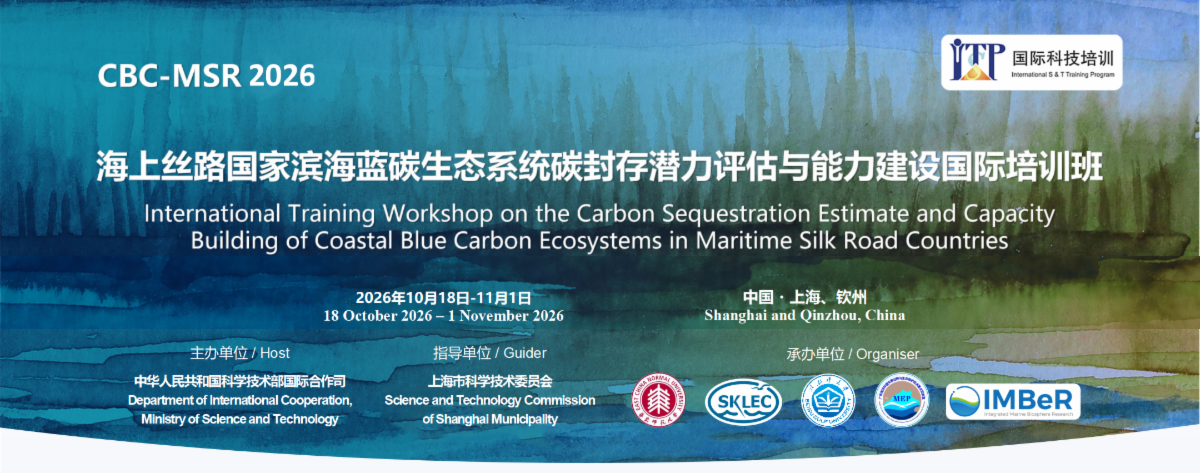
Second International Training Workshop on the Carbon Sequestration Estimate and Capacity Building of Coastal Blue Carbon Ecosystems in Maritime Silk Road Countries
Date: 18 October – 1 November 2026
Location: Shanghai and Qinzhou, China
CBC-MSR 2026 will focus on coastal blue carbon ecosystems, carbon sequestration estimation, monitoring methods and capacity building. The workshop will provide an international platform for students, early-career researchers, practitioners, policymakers and technical staff to strengthen knowledge and skills related to blue carbon research and coastal ecosystem sustainability.
Building on previous training efforts, CBC-MSR 2026 will support participants in understanding key concepts, methods and challenges in blue carbon science. It will also encourage exchange among participants from Maritime Silk Road countries and other developing regions, contributing to broader international collaboration in coastal carbon research.
Applications closed on 15 June, with 22 applications received from 14 countries, well exceeding the number of places available and demonstrating strong interest in the training. We sincerely thank everyone for their enthusiasm and preparation, and look forward to staying connected through this network and future opportunities.
| |
This training workshop has been endorsed as an official UN Ocean Decade Activity.
| |
Get Involved: Help Shape IMBeR 3.0 Capacity Building
IMBeR 3.0 invites researchers and partners worldwide to help build a more inclusive, connected and impactful marine science community.
| | |
Capacity building will be a core enabling component of IMBeR 3.0, with greater emphasis on equitable participation, early-career development and stronger engagement with researchers from the Global South and Small Island Developing States. IMBeR welcomes students, early-career researchers, mentors, institutions and partner programmes to help build an inclusive, interdisciplinary and globally connected marine research community.
Ways to contribute include:
- Participate in Summer Schools, CBC-MSR, the Doctoral Forum and IMECaN activities.
- Share research, data resources, methods or reflections through IMBeR events and communication channels.
- Support mentoring and cross-regional connections for doctoral students and early-career researchers.
- Help host or co-organise training activities, particularly in the Global South.
- Provide institutional, logistical or financial support for participants from underrepresented regions.
For early-career researchers, engagement with IMBeR offers opportunities to develop scientific networks, practical skills and international collaborations. For senior researchers and partner institutions, it provides a pathway to mentor the next generation, broaden equitable participation and contribute to the long-term delivery of IMBeR 3.0.
| | IMBeR is a Large-Scale Ocean Research Project under SCOR and a Global Research Project under Future Earth. | | |
Contact Us
IMBeR International Project Office
State Key Laboratory of Estuarine and Coastal Research, East China Normal University
500 Dongchuan Rd., Shanghai 200241, China
Tel: 86 021 5483 6463
E-mail: imber@ecnu.edu.cn
Chief Editor: Kai Qin | Editorial Coordination and Questionnaire Design
Editors: Fang ZUO, Suhui QIAN from IMBeR IPO
| | | | |