|
Interdisciplinary Marine Early Career Network Newsletter
September 2026
| | |
Welcome to the latest issue of the Interdisciplinary Marine Early Career Network (IMECaN) newsletter!
If you are interested in providing ideas, contributing a story or being featured in the newsletter, contact us at imecannetwork@gmail.com
In this newsletter:
- Somewhere, Another ECR Gets It.
- Research in 60 seconds | ECR Highlight
- Around the Blue Planet - Ocean news you might have missed.
- Upcoming Events, Opportunities and Funding!
| | |
Somewhere, Another ECR Gets It.
| | |
The rejected proposal. The experiment that refuses to work. The paper sitting in review. The funding you cannot seem to find. Watching others publish, travel and progress while wondering if you are falling behind.
Early-career research can sometimes feel remarkably lonely.
But somewhere across our global community, another ECR is facing a version of the same uncertainty. They are questioning their progress, figuring things out as they go, celebrating small wins and trying again after setbacks.
You are not behind. You are not alone. You are becoming.
Science was never meant to be a solitary journey. So ask for help. Share the unfinished idea. Reach out to another researcher. Celebrate the small progress.
And when you can, remind another ECR that they are not alone either.
We may be early in our careers, but we don’t have to navigate them alone.
Connect with other IMECaN members around the world on our socials: LinkedIn, Bluesky
| |
Research in 60 Seconds | ECR Highlight
| |
From Trainees to Leaders: ECRs Take Charge at Sea
There is a first time for everything—including taking charge of a research cruise.
During a recent research cruise off the coast of Ghana on the Ghana Navy Ship “Aflao”, early-career researchers (ECRs) working with the Ocean Margins Initiative (OMI) part of the OBVI project funded by Schmidt Sciences were given an opportunity that can be difficult to come by early in a scientific career: the chance to lead.
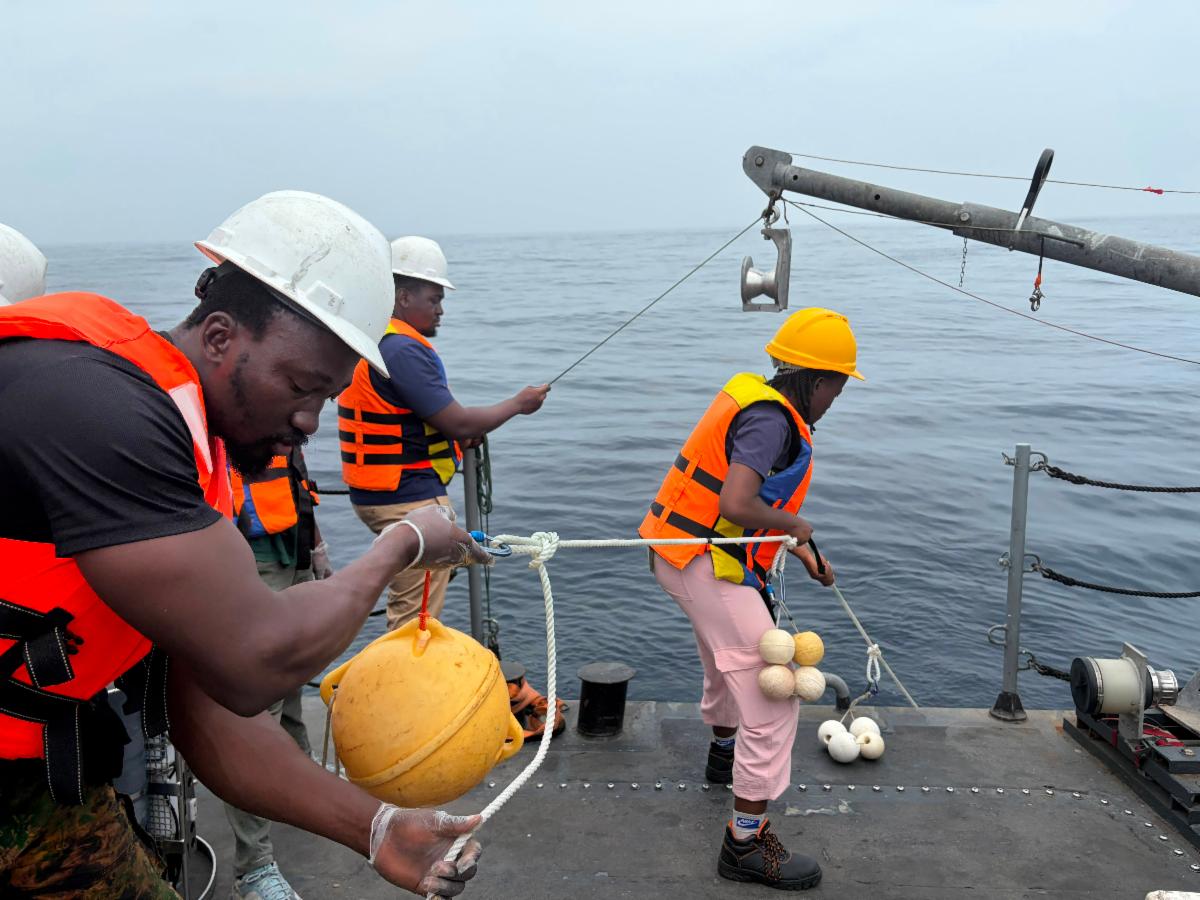
Rather than simply assisting senior scientists, the ECRs were entrusted by OMI's Principal Investigators to plan, coordinate and execute their own research activities at sea. From developing sampling plans and organizing teams to deploying equipment, collecting samples and adapting when things did not go exactly as expected, young researchers moved from learning how oceanographic research is done to taking responsibility for getting it done.
The experience reflects a larger goal of OMI: building lasting ocean-science capacity in West Africa. OMI, led by scientists from the University of Ghana, Woods Hole Oceanographic Institution and University of Rhode Island, is developing an observation and modelling system to better understand the Gulf of Guinea and the role of coastal upwelling in ocean carbon cycling.
Capacity building is intentionally embedded in that science. OMI is supporting graduate students and postdoctoral researchers, while research cruises provide opportunities for young scientists to gain practical experience in ocean observation and sample collection.
But this cruise went a step further.
It wasn't just training ECRs to participate in ocean science. It was trusting them to lead it.
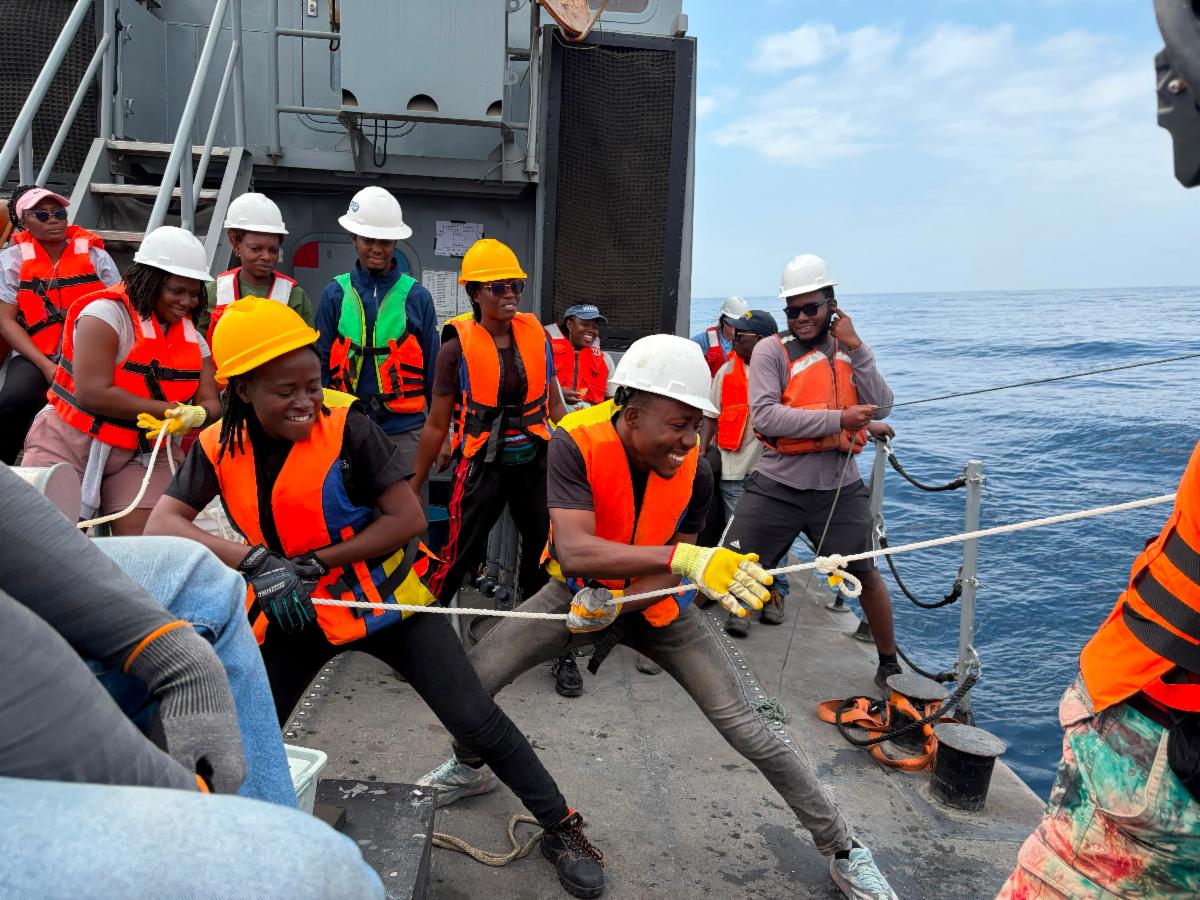
And judging by the teamwork in this photograph, leadership at sea can involve a fair amount of pulling together—quite literally.
| | |
Photo credit OMI: Young researchers work together aboard a research vessel during an OMI research cruise off the coast of Ghana. By putting ECRs in charge of planning and executing research activities, the cruise provided something beyond technical training: first-hand experience in scientific leadership, teamwork and decision-making at sea.
| | |
Kiran Johnson is a Boston-based science writer and environmental journalist, focused on agriculture, aquaculture, fisheries, and ocean science. She seeks to make technical topics understandable, engaging and relevant to the public by telling the stories of the scientists and the individuals impacted by the science. Her articles have been featured by research institutions, like in the Woods Hole Oceanographic Institution’s magazine; she has advocated for sustainable agriculture for non-profits like the High Atlas Foundation in Morocco and Eastie Farm in Boston; and she has been a reporter for a newspaper on Cape Cod, Massachusetts. Currently, she writes for One Fish Foundation, a non-profit focused on sustainable fisheries and aquaculture.
To give impactful science the reach it deserves—and the best chance of sparking real change and innovation—communicators and scientists need to work together. Storytelling can take the form of photos and data visualizations to podcasts and articles, and I think this range is crucial to meet people where they are and effectively communicate a variety of technical topics. By breaking down and disseminating science to broader audiences, she hopes to bring people around the world closer to new ecosystems, ways of living, and environmental solutions that they might not otherwise encounter.
|
Ocean stories you may have missed
-
AFRICA | When the ocean ran out of oxygen — Residents along South Africa's West Coast woke to large numbers of West Coast rock lobsters and fish stranded or dead on the shore. Scientists have now captured unusually detailed observations of what happened beneath the surface: oxygen levels crashed during the event, forcing lobsters out of the water. Autonomous ocean robots happened to be monitoring the shelf at the time, providing scientists with valuable data for understanding and potentially predicting future hypoxic events. Read the CSIR story
-
ASIA | Jeju's underwater coral gardens are “slumping” — Scientists and divers in South Korea are concerned about soft corals around Jeju Island literally sagging and collapsing. Rising sea temperatures and environmental stress are implicated, and researchers warn repeated episodes could reduce the reefs' ability to recover. Traditional haenyeo divers are also reporting changes in the marine life they harvest. Read the Reuters report
-
SOUTH AMERICA | A powerful El Niño has scientists worried about the Galápagos — Ecuadorian scientists are preparing for an unusually strong El Niño, with projections putting equatorial Pacific temperatures around 2.2°C above normal. In the Galápagos, warmer seas can reduce plankton and small fish, creating knock-on effects for penguins, sea lions, seabirds, corals and fisheries. More info.
-
EUROPE | Europe is upgrading its eyes on the deep ocean — A new four-year initiative called EMSO EVOLVElaunched on September 1 to advance Europe's deep-ocean observing infrastructure. The project aims to strengthen the sustained observations scientists need to understand changes occurring far below the ocean surface. More info.
-
OCEANIA | Students are heading across the Pacific as ocean scientists — Twenty Australian university students are setting sail from Brisbane to Fiji aboard CSIRO's RV Investigator for a 14-day research voyage. They'll receive hands-on training across physical oceanography, marine biology, chemistry, geology and atmospheric science—the first time Australia's CAPSTAN sea-training programme has ventured into international waters. Find out more.
-
ANTARCTICA | Scientists launch a major new effort to understand the Southern Ocean — 27 international research institutions have joined the €8.5-million SYNCHRONY project to understand rapid changes around Antarctica. Scientists will combine observations of the ocean, atmosphere and sea ice to investigate changes in Southern Ocean circulation, ecosystems and climate—and what those changes could ultimately mean for the rest of the planet. Find out more.
-
NORTH AMERICA | Deep-sea discoveries are becoming training grounds for ECRs — Ocean Census highlighted how an MRes marine biology student spent 30 days aboard R/V Falkor (too) participating in the Deep Wonders of Trinidad and Tobago expedition after receiving a 2026 Ocean Census Expedition Award—an example of ECRs moving from watching deep-sea exploration to actively participating in it. Explore Ocean Census stories.
-
CARIBBEAN | A record sargassum year starts to ebb, but the coast stays on watch. After one of the heaviest sargassum years on record, Caribbean shorelines are finally getting some relief. Mass influxes have hit the region since 2011, with 2015 marking the turn toward coordinated monitoring and response. The Great Atlantic Sargassum Belt swelled well above historical levels this summer, reaching roughly 12.5 million tonnes across the Atlantic, Caribbean and Gulf at the August peak, and while amounts have since fallen sharply, the University of South Florida expects the decline to run into November with beaching around the Lesser Antilles still likely. For a regional forecast, see the Sargassum Sub-regional Outlook Bulletin, developed by the University of the West Indies' Centre for Resource Management and Environmental Studies (CERMES).
| Upcoming Events (conferences, workshops, and symposiums) |
-
Blue Horizon Summit in-person and virtual conference in Tallahasse, Florida, October 8-10, 2026.
-
OCEANS 2026 Monterey in-person conference in Monterey, California, September 21–24, 2026.
-
Charting the Future of Ocean Passive Acoustics: From Observations to Science & Management in-person and virtual workshop in Ostend, Belgium, September 22–24, 2026.
-
PICES 2026 Annual Meeting – Actionable Science for a Changing Ocean in-person conference in Nanaimo, British Columbia, Canada, October 24–30, 2026.
-
13th U.S. Symposium on Harmful Algae in-person symposium in St. Augustine, Florida, October 25–29, 2026.
-
2026 Global eDNA Conference in-person conference in Seattle, Washington, October 28–30, 2026.
-
GCFI79 Annual Meeting of the Gulf and Caribbean Fisheries Institute in-person conference in Curaçao, November 2-6, 2026
-
OceanPrediction DCC Global Event 2026 virtual conference, November 3–5, 2026.
-
MonGOOS 2026 General Assembly & Workshop in-person meeting and workshop in Heraklion, Crete, Greece, November 3–5, 2026.
-
TREVOR-SAFARI 2026 International Symposium in-person symposium in Kochi, India, November 4–6, 2026.
-
Gulf Estuarine Research Society 2026 Biennial Meeting in-person conference in Houma, Louisiana, November 4–6, 2026.
-
IMCC8 (8th International Marine Conservation Congress) in-person conference in Edinburgh, Scotland, November 13–17, 2026.
-
World Conference on Marine Biodiversity 2026 in-person conference in Bruges, Belgium, November 17–20, 2026.
-
International Conference on Marine Data and Information Systems (IMDIS 2026) in-person conference in Split, Croatia, November 30–December 3, 2026.
-
2027 ASLO Aquatic Sciences Meeting in-person conference in San Juan, Puerto Rico, February 28–March 5, 2027.
-
2027 Ocean Decade Conference in-person conference in Rio de Janeiro, Brazil, April 7–9, 2027.
-
Global Symposium on Fisheries Management and Ecosystem Context (FIMEC) in-person symposium in Penang, Malaysia, May 10–13, 2027.
| Job and career development opportunities |
-
Doctoral Researcher in Marine Data Science — GEOMAR Helmholtz Centre for Ocean Research Kiel. PhD opportunity focused on marine data science at one of Germany's major oceanographic research institutes. Location:Kiel, Germany. Application deadline: September 16, 2026. View GEOMAR vacancies
-
FAO Fishery Officer – Aquatic Food Value Chains — FAO is also recruiting a P-3 Fishery Officer focused on aquatic food value chains. The appointment is initially for two years with possibility of extension. Location: Rome, Italy. Application deadline: September 18, 2026.
-
Postdoctoral Researcher – ElbeXtreme Project — GEOMAR Helmholtz Centre for Ocean Research Kiel.Early-career postdoctoral research position within the German Alliance for Marine Research's ElbeXtreme project. Location: Kiel, Germany. Application deadline: September 20, 2026. View GEOMAR vacancies
-
Researcher in Geomicrobiology – Research Assistance & Project Management — GEOMAR. Research position combining geomicrobiology with scientific project support and management. Location: Kiel, Germany. Application deadline: September 23, 2026. View opportunity
-
FAO Fishery Officer — A second current P-3 Fishery Officer vacancy is available with FAO's Fisheries and Aquaculture Division. Location: Rome, Italy. Application deadline: September 24, 2026.
-
World Bank Small AI for Development Hackathon Challenge — Open to young innovators worldwide to develop practical AI solutions addressing challenges in agriculture, health or tourism, particularly under conditions of limited connectivity and resources. The competition takes place October 3–4, and the three winners will travel to Seoul to present at the World Bank Group Global AI and Digital Summit. Location: Global/online challenge, with winners travelling to Seoul, South Korea. Application deadline: September 26, 2026.
-
Postdoctoral Associate for Fisheries eDNA — Northern Gulf Institute/Mississippi State University & NOAA.Particularly relevant to molecular marine scientists: the researcher will develop eDNA metabarcoding, qPCR/ddPCR and bioinformatics approaches for fisheries and biodiversity monitoring, collaborating with NOAA and fisheries scientists. Location: NOAA Atlantic Oceanographic & Meteorological Laboratory, Miami, Florida, USA. Application deadline: September 30, 2026; applications are reviewed on a rolling basis, so early application is recommended. View Fisheries eDNA opportunity
-
D. Ross Robertson Research Fellowship Awards for Field Studies of Neotropical Deep-Reef fishes — Open to PhD students formally enrolled at a university, and recent PhDs (up to 3 years after receipt of their degree) who are formally affiliated with a research- or teaching institution. The endowment supports field research on any aspects of the biology of living reef-fishes found between 40-300m, anywhere in the Neotropics.
-
Bioacoustician Specialist — Ocean Associates Inc./NOAA Southeast Fisheries Science Center. Marine bioacoustics opportunity supporting fisheries/ocean science work. Location: Miami, Florida, USA. Application deadline: September 30, 2026 or ASAP, according to the current listing. View opportunity listing
-
Student Assistant — Leibniz Centre for Tropical Marine Research (ZMT). An opportunity specifically aimed at students to gain experience within a major tropical marine research institute. Location: Bremen, Germany. Application deadline: September 30, 2026.
-
Knight-Hennessy Scholars at Stanford University — Fully funded graduate scholarship programme supporting eligible students pursuing graduate degrees at Stanford, including master's and PhD programmes. Applicants from all countries and fields may apply. Location: Stanford University, California, USA. Application deadline: October 6, 2026 at 1:00 p.m. Pacific Time. Applicants must separately apply to their Stanford graduate programme by the applicable programme deadline.
-
Doctoral Candidate – Reef Systems — Leibniz Centre for Tropical Marine Research (ZMT). PhD research opportunity within ZMT's Reef Systems working group, particularly relevant to students interested in tropical marine ecosystems. Location: Bremen, Germany. Application deadline: October 15, 2026. View ZMT vacancies
-
Doctoral Candidate – Systems Ecology — Leibniz Centre for Tropical Marine Research (ZMT). ZMT currently lists doctoral opportunities within its Systems Ecology working group. Location: Bremen, Germany. Application deadline: October 15, 2026. View ZMT vacancies
-
Student Assistant — Leibniz Centre for Tropical Marine Research (ZMT). An opportunity specifically aimed at students to gain experience within a major tropical marine research institute. Location: Bremen, Germany. Application deadline: September 30, 2026. View ZMT vacancies
-
Intern – Office for Knowledge Exchange — Leibniz Centre for Tropical Marine Research (ZMT). Full- or part-time internship providing experience in knowledge exchange within a tropical marine research institution. Location: Bremen, Germany. Application deadline: Continuously open rather than a fixed closing date. View ZMT internships and vacancies
-
Postdoctoral Investigator in Plankton Ecology and Trophic Dynamics — Woods Hole Oceanographic Institution (WHOI). Postdoctoral research investigating plankton ecology and trophic dynamics. Location: Woods Hole, Massachusetts, USA. Application deadline: No fixed closing date — applications are reviewed on a rolling basis and the position remains open until filled. WHOI explicitly recommends applying as soon as possible. View WHOI postdoctoral opportunity
-
At-Sea Positions — Schmidt Ocean Institute. SOI currently lists opportunities including Temporary Able Bodied Seaman/Ordinary Seaman and ROV Senior Supervisor aboard its research operations. These are more technical than academic research positions but may interest ECRs seeking sea-going experience. Location: At sea/international research expeditions. Application deadline: No fixed deadline shown; SOI also accepts open applications for future at-sea opportunities. Schmidt Ocean Institute employment opportunities
| |
-
Rufford Small Grants for Nature Conservation — Provides £7,000–£18,000 for field-based nature-conservation projects, including eligible marine and coastal conservation research. Particularly useful for ECRs conducting conservation projects in developing or emerging-economy countries. Eligible: Primarily current MSc/PhD students and recent graduates in the early stages of conservation careers; undergraduate students are not eligible. Projects must have a conservation focus, be conducted in an eligible country, and species-focused projects must concern threatened species. Deadline: No deadline — applications are accepted year-round. This is rolling funding rather than a “closes once a candidate is found” opportunity.
-
SCOR Travel Support Programme — Provides travel support enabling ECRs from developing countries to participate in ocean-science conferences, meetings, workshops and training programmes. Eligible: Ocean/marine scientists who are students or within 10 years of their degree, based in an eligible developing country, and presenting at a meeting or participating in training. Importantly, individuals do not apply directly; meeting organizers request the funding and select recipients. Next deadline: September 30, 2026, followed by December 31, 2026. Applications normally need to be submitted at least six months before the event.
-
National Geographic Society – Understanding Ecosystem Dynamics and the Ecology of the Okavango River Basin – Understanding Ecosystem Dynamics and the Ecology of the Okavango River Basin— Funds scientific research examining ecosystem structure, function and ecological dynamics across the Okavango River Basin in Angola, Namibia and Botswana. While broader than marine science, it is highly relevant to aquatic scientists, ecologists, hydrologists and interdisciplinary ECRs. Eligible: Applicants must be at least 18; additional project and geographic eligibility requirements apply under the RFP. Deadline: September 23, 2026. This is a fixed deadline, not rolling.
-
NSF Graduate Research Fellowship Program (GRFP) — Provides a five-year fellowship with three years of financial support, including a $37,000 annual stipend plus $16,000 annual cost-of-education allowance. Oceanography, marine biology and other qualifying ocean/geoscience research can fall within supported disciplines. Eligible: Eligible early-stage graduate students pursuing research-based master's or doctoral degrees in NSF-supported STEM fields; nationality and graduate-study-stage restrictions apply, so international students should check eligibility carefully. Deadline for Geosciences: October 23, 2026; Life Sciences applications are due October 19, 2026. Reference letters are due October 16.
-
NSF GEO Core – Ocean Sciences Program — A major research-funding programme supporting biological oceanography, chemical oceanography, physical oceanography, marine geology and geophysics, ocean technology and interdisciplinary ocean research. NSF specifically says it welcomes submissions from researchers earlier in their careers and encourages projects that create opportunities for exceptional early-career investigators. Eligible: Proposals generally need to be submitted through eligible institutions rather than by individual students; therefore this is more appropriate for ECRs who can work with a PI/institution than for a student seeking a personal fellowship. Deadline: No fixed deadline — proposals are accepted anytime. It does not close when a candidate is selected; proposals are received continuously.
-
Conservation Leadership Programme – Conservation Team Awards — Provides funding, training, mentoring and networking to teams of early-career conservationists undertaking biodiversity-conservation projects. Marine and coastal biodiversity projects can qualify where they meet the programme criteria. Eligible: Teams of early-career conservationists undertaking projects in eligible countries, particularly locally led conservation teams in biodiverse countries. Application status: The programme's site currently shows “Apply Now” for its Conservation Team Awards; applicants should check the current call for the applicable award level and closing date before submission.
| | | | |