|
MESSAGE FROM THE
PRESIDENT
| | | | |
I hope this message finds you well.
After this message you will find EnviroCert International's (ECI) formal letter to the U.S. Environmental Protection Agency (EPA) outlining ECI's position and final policy regarding the authority of Certified Professionals in Erosion and Sediment Control (CPESC) to perform and oversee field observations and inspections of erosion and sediment control (ESC) and stormwater Best Management Practices (BMPs).
Following this letter, you will find instructions on how to earn two (2) Professional Development Hours (PDHs) by reviewing the policy paper and providing your synopsis, comments, and professional opinions regarding this important clarification of CPESC practice.
Please note the name of the EPA contact has been redacted from the correspondence to avoid unnecessary communications being directed to that individual.
Summary of the New Policy
The policy can be summarized as follows:
CPESC-certified professionals possess inspection authority because erosion and sediment control and stormwater BMPs are fundamentally performance-based systems whose effectiveness must be evaluated under actual field conditions. Unlike purely prescriptive measures, BMP compliance depends not only on proper installation but also on achieving intended environmental and regulatory outcomes.
As a result, the same technical knowledge, professional judgment, and field experience required to plan and design these systems are also necessary to evaluate their performance, identify deficiencies, recommend corrective actions, and verify compliance. Accordingly, inspection authority is an inherent component of CPESC professional practice and a natural extension of the credential's expertise in both BMP design and functional performance.
The letter provides the full analysis and rationale supporting this position and should be reviewed in its entirety.
Why This Issue Was Examined
Many of you are aware that ECI has spent the past eight (8) years evaluating the CPESC Scope of Practice, particularly as it relates to field observations and inspections. While this issue had surfaced periodically over the years through various industry discussions, it came into sharper focus following questions and feedback received from the EPA.
It is important to emphasize that the EPA was never attempting to diminish the role, value, or authority of the CPESC credential. Rather, the Agency asked ECI to clearly articulate and document the basis for inspection authority within the framework of a professional certification program. In essence, they asked a reasonable question: What is the professional and technical foundation that supports this authority?
At first glance, the answer appeared straightforward. Many practitioners understandably responded:
"If we are qualified to design these systems, then we should also be qualified to inspect them."
For decades, this principle has been widely understood throughout the profession. In fact, many of the original CPESC practitioners and founders were engineers, scientists, regulators, and field professionals whose daily work naturally integrated planning, design, implementation, and inspection. As a result, field inspection authority was largely assumed as an inherent part of professional practice.
However, while that understanding existed throughout the profession, it had never been formally articulated, documented, or analyzed in the manner now expected by accreditation bodies, regulatory agencies, and modern professional certification standards. As ECI pursued accreditation efforts and continued to evaluate professional scopes of practice, it became increasingly clear that this issue deserved a thorough and carefully documented review.
Lessons Learned
The discussions surrounding this issue have been extensive, thoughtful, and at times passionate. If every conversation, meeting, email, and industry debate over the last eight (8) years were compiled into a single document, it would likely rival the size of a small library.
While the process has occasionally been frustrating, it has also highlighted an important lesson for our profession. Professional authority should not rest solely on tradition, assumptions, or historical practice. As professions mature and regulatory expectations evolve, organizations must be prepared to demonstrate a rational and defensible basis for the authority and responsibilities associated with their credentials.
This is particularly important in today's environment, where a growing number of certificates, training programs, and commercial credentialing organizations have created confusion regarding qualifications, competencies, and professional standards. The erosion and sediment control profession has not been immune to these challenges. As a result, clearly defining professional roles, responsibilities, and qualifications has become increasingly important for regulators, employers, clients, and practitioners alike.
A Personal Note
I recognize that many of you have been frustrated by the length of time it has taken to reach this conclusion. I understand those frustrations, and, in many cases, I share them.
On a personal level, I wish we had arrived at this position sooner. The delay was certainly not due to a lack of effort or commitment. Rather, ECI wanted to ensure that the final policy was based upon a comprehensive review of professional practice, legal principles, regulatory expectations, certification standards, and the realities of performance-based stormwater management.
As President and CEO of ECI, I would like to extend my sincere and personal apologies to ECI and the CPESC community for the time it has taken to fully resolve this issue.
I am confident that the position we have ultimately adopted is stronger, more defensible, and more enduring because of the rigor with which it was developed. Most importantly, I believe this policy provides long-awaited clarity regarding the role of CPESC-certified professionals and establishes a solid foundation for future recognition of the credential by regulators, agencies, employers, and stakeholders throughout the industry.
Before closing, I would like to point out that most of you rarely have an opportunity to see the amount of time, energy, and commitment that our volunteer Board members (past and present) contribute on behalf of the profession. Much of their work occurs behind the scenes, often without recognition, acknowledgment, or thanks. Yet these individuals consistently devote countless hours to advancing professional standards, protecting the integrity of our certifications, and addressing issues that affect every Certified Professional. They demand that myself and staff make every effort to do the best for the organization.
The development of this policy is a perfect example. Throughout the many years that ECI evaluated this issue, the Board of Directors continually challenged me to find a comprehensive and defensible solution. Rather than accepting assumptions or historical practices, they insisted that ECI establish a clear professional, technical, and rational basis for the authority exercised by CPESC-certified professionals.
In particular, I would like to recognize Mr. Francisco Urueta for his unwavering commitment to this effort. Francisco has been one (1) of the strongest advocates for resolving this issue and has consistently provided thoughtful input, perspective, and direction throughout the process via phone calls and emails providing me technical information and opinions to find a better solution. His passion for the profession, dedication to the CPESC credential, and persistence in pursuing clarity were instrumental in helping shape the policy ultimately adopted by ECI. Without his contributions, it is unlikely that we would have arrived at the comprehensive position presented in this paper.
While this policy reflects the collective efforts of many individuals over many years, it also serves as a reminder of the value of engaged leadership and the importance of volunteers who are willing to challenge the status quo in pursuit of a stronger profession.
On behalf of ECI, thank you for your patience, professionalism, and continued commitment to advancing the practice of erosion and sediment control and stormwater management.
| |
Professional Development Hours (PDHs): As part of ECI’s ongoing effort to improve communication, ECI Certified Professionals may earn two (2) PDHs by reviewing this entire announcement. To receive PDHs:
- Write a summary of your opinion on the article and provide us your thoughts.
-
Fill out a self-certification form and provide an attachment of your summary and opinion. Please email the letter to committees@envirocert.org.
- You may record the PDHs in your certification profile under Category (Self Study).
The PDH value reflects both the scope and depth of the material presented (approximately two (2) hours of professional content). ECI welcomes feedback on this format and encourages Certified Professionals to share comments or suggestions at wecare@envirocert.org.
| |
ECI LETTER TO THE EPA FOR
CPESC PERFORMANCE BASED INSPECTION AUTHORITY
| |
ENVIRONMENTAL PROTECTION AGENCY
1200 Pennsylvania Avenue, N.W.
Washington, DC 20460
| |
Dear Redacted:
This policy paper addresses the evolving role of Certified Professionals in Erosion and Sediment Control (CPESC) with respect to field observations, inspections, and performance evaluation of erosion and sediment control (ESC) measures and stormwater Best Management Practices (BMPs). As stormwater management and erosion and sediment control programs have increasingly shifted toward performance-based regulatory frameworks, the need for qualified professionals capable of evaluating both design intent and actual field performance has become increasingly important.
Historically, construction-phase inspections and field observations have been associated with a variety of professionals, including engineers, inspectors, regulators, contractors, and environmental compliance specialists. However, the growing complexity of stormwater management systems, increasing regulatory expectations, and widespread adoption of performance-based BMPs have highlighted the need for professionals who possess both design knowledge and practical field experience. CPESC-certified professionals are uniquely positioned to fulfill this role because their professional competencies encompass planning, design, implementation, inspection, performance evaluation, regulatory compliance, and adaptive management of erosion and sediment control and stormwater management systems.
Over the past eight years, through industry evaluations, professional surveys, regulatory reviews, and examination of the evolving scope of practice of CPESC-certified professionals, Environmental Compliance Inspections (ECI) has assessed the relationship between BMP design, field implementation, performance verification, and professional accountability. These efforts have consistently demonstrated that CPESC-certified professionals possess the requisite education, experience, technical knowledge, and professional judgment necessary to evaluate the installation, operation, maintenance, and performance of BMPs within the CPESC Scope of Practice.
This paper establishes the foundation for recognizing a performance-based inspection framework in which field inspection extends beyond simple verification of compliance with plans and specifications. In performance-based systems, inspection also includes evaluation of BMP effectiveness under actual site conditions, identification of performance deficiencies, assessment of maintenance requirements, recommendation of corrective actions, and documentation necessary to support regulatory compliance and environmental protection. Inspection therefore serves as the critical link between design intent and observed field performance.
The paper further recognizes that many CPESC-certified professionals began their careers performing field inspections, compliance evaluations, and construction-phase oversight activities before obtaining advanced professional credentials. As a result, a significant portion of the CPESC community has historically viewed inspection authority as an inherent component of CPESC practice because the knowledge required to design effective BMPs is inseparable from the knowledge required to evaluate their performance in the field.
This paper also clarifies the distinction between the CPESC credential and the CESSWI credential in terms of inspection authority. While the CESSWI certification provides specialized recognition of inspection-focused expertise and field management competencies, the CPESC credential represents a broader professional practice encompassing planning, design, implementation, inspection, performance evaluation, and adaptive management. The two credentials are complementary rather than competing, and both contribute to advancing professional excellence within the erosion and sediment control and stormwater management professions.
Both professional pathways represent critical and complementary areas of expertise within the erosion and sediment control (ESC) and stormwater management profession. The CPESC and CESSWI credentials support different, yet interconnected, aspects of project success, combining design, planning, performance evaluation, field implementation, inspection, and compliance management. Together, these skillsets are essential for achieving permit compliance, maintaining environmental protection objectives, and ensuring the effective implementation and performance of ESC and stormwater management systems.
Ultimately, this paper formalizes ECI's position that field inspection authority is an inherent component of CPESC professional practice within the CPESC Scope of Practice. Because the CPESC credential certifies expertise in both the design and functional performance of erosion and sediment control and stormwater management systems, CPESC-certified professionals are qualified to evaluate BMP implementation, performance, maintenance, and effectiveness in support of environmental protection, public welfare, and regulatory compliance. Recognition of this authority strengthens professional accountability, improves BMP performance outcomes, enhances regulatory confidence, and reinforces the role of CPESC-certified professionals as essential practitioners within modern performance-based stormwater and erosion and sediment control programs.
| |
I. INTRODUCTION
This paper establishes and memorializes the rational basis for ECI to formally recognize that holders of the CPESC credential possess the professional authority to perform field observations, inspections, and performance evaluations of Stormwater and ESC BMPs within the CPESC Scope of Practice.
This position is founded upon three fundamental principles:
- The performance-based nature of erosion and sediment control and stormwater BMPs;
- Established legal, professional, and ethical principles governing design responsibility and performance verification; and
- ECI's published CPESC Scope of Practice, which inherently recognizes the relationship between design competency, field performance evaluation, inspection, and professional accountability.
The purpose of this paper is not to expand the CPESC Scope of Practice, but rather to formally recognize and articulate a professional authority that is already inherent within the knowledge, competencies, and responsibilities required of CPESC-certified professionals. As demonstrated throughout this paper, the authority to evaluate BMP performance in the field is a logical extension of the expertise required to plan, design, implement, and manage performance-based erosion and sediment control and stormwater management systems.
Before addressing the basis for this recognition, it is important to establish a common understanding of the term "inspection," as the term is frequently misunderstood, narrowly interpreted, or reduced to a simple compliance verification function.
For purposes of this paper, inspection is defined as:
The systematic observation, evaluation, documentation, and professional assessment of erosion and sediment control measures, stormwater BMPs, site conditions, and related activities to determine whether they have been properly implemented, are functioning as intended, comply with applicable plans, specifications, permits, and regulatory requirements, and are achieving the performance objectives for which they were designed.
Inspection encompasses considerably more than the identification of physical conditions or completion of compliance checklists. Rather, inspection requires the application of technical knowledge, professional judgment, and practical field experience to evaluate the relationship between design intent, site conditions, installation quality, operational effectiveness, maintenance requirements, and regulatory performance objectives.
Within a performance-based framework, inspection serves four primary functions:
1. Verification of Conformance
Determining whether BMPs and erosion and sediment control measures have been installed, maintained, and operated in accordance with approved plans, specifications, permits, and applicable standards.
2. Evaluation of Performance
Assessing whether implemented controls are effectively achieving their intended objectives, including erosion prevention, sediment retention, runoff management, pollutant reduction, receiving-water protection, and overall environmental performance.
3. Identification of Deficiencies and Risks
Recognizing conditions, failures, maintenance needs, operational limitations, or site changes that may compromise BMP effectiveness, environmental protection, or regulatory compliance.
4. Support of Corrective Action and Adaptive Management
Providing the technical basis for repairs, maintenance, modifications, operational adjustments, or alternative control measures necessary to restore, improve, or optimize performance.
Accordingly, inspection should be understood as a professional evaluation process rather than a purely administrative, observational, or enforcement-oriented task. In the context of erosion and sediment control and stormwater management, inspection serves as the principal mechanism through which design assumptions, performance expectations, permit obligations, and environmental objectives are evaluated and verified under actual field conditions.
Because erosion and sediment control and stormwater management systems are fundamentally performance-based, effective inspection necessarily requires an understanding of BMP design principles, hydrologic and erosion processes, construction practices, regulatory requirements, maintenance considerations, and observed field performance. Inspection therefore represents the practical application of the same technical knowledge, professional judgment, and performance evaluation skills that underpin the planning and design of these systems.
Consequently, inspection should not be viewed as a separate discipline from design, but rather as an essential component of the continuous professional process through which BMPs are planned, designed, implemented, evaluated, maintained, and improved. The ability to assess field performance, identify deficiencies, recommend corrective actions, and document compliance is inseparable from the expertise required to develop effective BMP solutions. This principle forms the foundation for recognizing inspection authority as an inherent component of CPESC professional practice.
Finally, throughout the paper and in many discussions the term “inspection” and “observations” are interchanged. The following provides a simplified definition for purposes of this paper.
Field Observation: periodic professional review of site conditions and work progress to evaluate general conformance with design intent.
Inspection: a more formal evaluation involving observation, assessment, documentation, determination of compliance, and recommendations for corrective action.
While Civil Engineers, Architects, and other licensed professionals often draw strict distinctions between these terms, CPESCs routinely perform both functions as part of a performance-based practice model.
| |
II. DEFINITION AND ROLE OF PERFORMANCE-BASED SYSTEMS
A performance-based system is one that establishes measurable functional outcomes that must be achieved, while allowing flexibility in the methods, designs, or practices used to achieve those outcomes.
In contrast to prescriptive approaches, which dictate specific methods or installations, performance-based systems require that:
- Defined objectives (e.g., pollutant removal, runoff reduction) are achieved
- Designers exercise professional judgment in selecting solutions
-
Compliance is verified through observation, monitoring, and inspection
Accordingly, in a performance-based framework:
Verification of performance is an essential component of compliance, not an optional activity.
| |
III. PERFORMANCE-BASED NATURE OF STORMWATER AND ESC BMPS
Stormwater BMPs are inherently performance-based systems, designed to achieve measurable outcomes such as:
- Pollutant removal efficiency
- Runoff volume reduction
- Peak flow attenuation
- Sediment control effectiveness
These systems cannot be validated solely through design documents. Their effectiveness depends on:
- Site-specific conditions (soil, slope, hydrology)
- Construction quality and sequencing
- Maintenance and adaptive management
Therefore, field inspection is the primary mechanism by which design intent is evaluated against actual performance.
| |
IV. LEGAL AND PROFESSIONAL BASIS FOR INSPECTION AUTHORITY
The principle that design professionals retain authority to inspect their work is well established across regulated professions.
A. Engineering Practice
The National Council of Examiners for Engineering and Surveying Model Law defines the practice of engineering to include:
- Reviewing construction for the purpose of monitoring compliance with drawings and specifications.
This establishes that inspection for compliance is a core component of professional design practice.
B. Responsible Charge and Accountability
State engineering laws (e.g., California Professional Engineers Act) require that professionals in responsible charge:
- Maintain command of design decisions
- Understand construction methods and field conditions
- Be accountable for final outcomes
This framework inherently requires the ability to observe, inspect, and evaluate field implementation.
C. Architectural Parallel
Professional standards under National Council of Architectural Registration Boards recognize construction observation and evaluation as essential competencies, reinforcing that:
Design responsibility extends into verification of constructed work.
D. Performance Based Criteria in Regulatory Permit Programs
Federal, state, and local stormwater regulatory programs increasingly rely upon performance-based standards rather than purely prescriptive requirements. General permits issued by the U.S. Environmental Protection Agency (EPA) and delegated permitting authorities routinely establish performance objectives requiring permittees to evaluate, maintain, and adapt erosion, sediment control, and stormwater BMPs to achieve intended environmental outcomes.
Unlike prescriptive requirements, performance-based criteria require qualified professionals to assess whether BMPs are functioning as intended under actual field conditions. Compliance therefore depends not only upon design and installation, but also upon competent field observation, inspection, and evaluation of system performance.
The CPESC credential has been recognized throughout the United States and internationally in permit programs, regulatory frameworks, ordinances, specifications, and agency guidance documents as a qualification for stormwater and erosion and sediment control planning, design, implementation, and inspection activities. This recognition reflects the understanding that effective performance-based compliance requires professionals who possess both technical design expertise and a practical understanding of BMP performance under real-world conditions.
As a matter of professional practice, CPESC-certified professionals are expected to evaluate field conditions, assess BMP effectiveness, and apply professional judgment regarding compliance with performance objectives. These competencies form a foundational prerequisite for the preparation of Stormwater Pollution Prevention Plans (SWPPPs), erosion and sediment control plans, technical reports, corrective action recommendations, and other regulatory documents. Consequently, the field observation and inspection of BMP performance is not ancillary to CPESC practice but is an essential component of the professional knowledge and judgment upon which the credential is founded.
| |
V. ALIGNMENT WITH CPESC SCOPE OF PRACTICE
ECI’s CPESC Scope of Practice explicitly includes:
- Planning
- Design
- Installation
- Inspection
- Program administration
- Education
The scope further establishes that inspection requires:
- Interpretation of plans and specifications
- Understanding regulatory requirements
- Evaluation of BMP effectiveness in the field
An additional consideration supporting recognition of inspection authority for CPESC-certified professionals is the ongoing professional development required to maintain the credential. The practice of erosion and sediment control continues to evolve in response to changing regulatory requirements, advancing stormwater technologies, emerging environmental challenges, and increasingly complex land development activities occurring on more environmentally sensitive and technically challenging sites.
As permit requirements and performance expectations continue to evolve, CPESC professionals must likewise adapt and expand their knowledge to effectively plan, design, implement, and evaluate erosion and sediment control measures. For this reason, CPESC-certified professionals are required to complete annual Professional Development Hours (PDHs) as a condition of maintaining certification.
The purpose of continuing professional development, as recognized throughout professional certification and licensure programs, is to ensure that credentialed professionals remain current with emerging technologies, regulatory developments, evolving methodologies, and accepted standards of practice. This requirement recognizes that professional competency is not static, but must be continuously maintained through education, training, and practical application.
Significantly, a substantial portion of CPESC continuing education is devoted to field implementation, BMP performance evaluation, inspection practices, regulatory compliance, corrective actions, and lessons learned from actual project experience. Reviews of continuing education activities within the CPESC community consistently demonstrate that field-oriented training and inspection-related coursework comprise a significant percentage of professional development activities undertaken by CPESC practitioners.
This emphasis reflects the reality that erosion and sediment control is fundamentally a performance-based discipline. Effective design requires an understanding of how BMPs perform under actual site conditions, and that understanding is developed and refined through field observation, inspection, performance assessment, and evaluation of implemented controls. Consequently, the ongoing educational requirements imposed upon CPESC professionals serve not only to maintain technical design competency but also to continually develop and reinforce the field inspection knowledge necessary to evaluate whether BMPs are functioning as intended.
Accordingly, the CPESC credential should be viewed as encompassing a continuous cycle of planning, design, implementation, observation, inspection, evaluation, and improvement. The substantial emphasis placed upon inspection and field-performance education within the CPESC continuing education framework further demonstrates that inspection competency is not ancillary to CPESC practice but is a core and continually reinforced element of the profession.
These factors support ECI’s findings that:
The practice of CPESC includes the requisite knowledge and ability to perform inspections which is integral to CPESC practice and directly tied to evaluating performance-based outcomes.
| |
VI. INTEGRATION OF DESIGN AND INSPECTION IN PERFORMANCE-BASED SYSTEMS
In performance-based regulatory environments, separating design from inspection creates substantial risk, including:
- Misinterpretation of design intent
- Failure to detect underperforming BMPs
- Increased likelihood of regulatory non-compliance
Because CPESCs are trained in:
- BMP design and selection
- Hydrologic and erosion processes
- Regulatory compliance
- Field performance evaluation
they are uniquely qualified to:
- Assess whether BMPs meet design intent
- Identify deficiencies and performance failures
- Recommend corrective actions based on technical expertise
Thus:
Inspection authority is a necessary extension of design responsibility in any performance-based system.
| |
VII. DISTINCTION BETWEEN CERTIFICATIONS
The CESSWI credential appropriately emphasizes inspection as its primary professional focus. Because there has been occasional confusion regarding the relationship between the CPESC and CESSWI credentials, it is important to recognize that the certifications serve complementary, but distinct, professional purposes.
The CESSWI certification is principally inspection-focused and is designed to validate competency in field observation, inspection procedures, regulatory compliance verification, documentation, BMP implementation, maintenance evaluation, and day-to-day field management activities associated with erosion and sediment control and stormwater management during construction and land-disturbing activities.
In contrast, the Certified Professional in Erosion and Sediment Control (CPESC) credential represents a broader professional practice encompassing planning, analysis, design, implementation, field management, inspection, performance evaluation, regulatory compliance, and adaptive management of erosion and sediment control and stormwater management systems. As discussed throughout this paper, the performance-based nature of BMPs requires CPESC professionals to possess a comprehensive understanding of both design principles and observed field performance. Consequently, inspection is not a separate or incidental function of CPESC practice, but an integral component of evaluating whether performance objectives, design assumptions, and regulatory requirements are being achieved.
Recognition of inspection authority for CPESC-certified professionals therefore does not diminish the importance or distinct purpose of the CESSWI credential. Rather, it clarifies that CPESC professionals possess broader competencies that inherently include inspection as part of performance verification, design validation, corrective action evaluation, and regulatory compliance assessment.
The two credentials should therefore be viewed as complementary. While the CPESC credential establishes competency across the full lifecycle of erosion and sediment control and stormwater management systems, the CESSWI credential provides additional and specialized recognition of inspection-focused expertise and field management capabilities.
Accordingly, ECI will continue to encourage CPESC-certified professionals who regularly perform field observations, inspections, compliance assessments, and construction-phase management activities to also consider obtaining and maintaining the CESSWI certification. Possession of both credentials demonstrates a combination of advanced planning and design expertise together with specialized inspection and field management proficiency, thereby providing additional assurance to regulators, project owners, employers, and stakeholders regarding the professional's qualifications and commitment to excellence in both performance-based design and field implementation.
| |
VIII. RECOMMENDED POSITION
It is recommended that ECI formally adopt and publish the following position:
“Certified Professionals in Erosion and Sediment Control (CPESCs) are qualified to perform field inspections of erosion, sediment control, and stormwater Best Management Practices (BMPs) within the CPESC scope of practice. Such inspections include the observation, evaluation, documentation, and professional assessment of site conditions, BMP implementation, compliance with plans, specifications, permits, and regulatory requirements, and the evaluation of BMP performance relative to intended design objectives and performance-based outcomes. CPESCs are further qualified to identify deficiencies, evaluate performance limitations, recommend corrective actions, and provide technical documentation supporting compliance, environmental protection, and adaptive management within the limits of applicable laws and regulations.”
This recognition should:
- Acknowledge that stormwater and erosion and sediment control BMPs are performance-based systems requiring professional evaluation of both compliance and functional effectiveness under actual field conditions.
- Recognize that inspection is an inherent component of CPESC professional practice, and a natural extension of the knowledge, skills, and judgment required for planning, design, implementation, and performance evaluation.
- Affirm the role of CPESC-certified professionals in bridging the gap between design intent and observed field performance through inspection, documentation, assessment, and corrective action recommendations.
- Align responsibility for BMP design, implementation, and performance outcomes with the professional authority necessary to evaluate those outcomes in the field.
- Support the public protection, environmental stewardship, and regulatory compliance objectives upon which the CPESC credential is founded.
- Align with applicable state laws, regulations, and licensing requirements.
- Respect statutory limitations where engineering licensure or other professional licensure is specifically required by law.
- Reinforce the role of CPESC-certified professionals as qualified practitioners in performance-based stormwater, erosion, and sediment control management systems.
- Promote consistency among regulatory agencies, permit programs, and project stakeholders regarding the qualifications and professional capabilities of CPESC-certified professionals.
- Strengthen professional accountability, improve BMP performance outcomes, enhance regulatory compliance, and advance the professional standing and credibility of the CPESC credential.
| |
IX. CONCLUSION
Stormwater and erosion and sediment control BMPs are fundamentally performance-based systems whose effectiveness cannot be determined solely through design documents, plan review, or installation verification. By definition, performance-based systems establish measurable outcomes that must be achieved while allowing flexibility in the methods used to attain those outcomes. Consequently, compliance is not demonstrated merely by installation of a prescribed practice, but through verification that the practice is functioning as intended under actual field conditions. The ultimate success of BMPs depends upon their performance under variable site conditions, changing environmental influences, construction activities, maintenance practices, and real-world operational demands. Effective inspection therefore extends beyond simple observation of compliance with plans and specifications and includes the professional evaluation of whether implemented controls are achieving their intended performance objectives.
Within this framework, field inspection serves as the critical link between design intent and observed field performance. Inspection provides the mechanism through which design assumptions are validated, performance deficiencies are identified, site-specific conditions are evaluated, and appropriate corrective actions are developed to maintain effectiveness and compliance. In performance-based systems, inspection is not merely a compliance activity; it is the process through which systems are continuously evaluated, adapted, and improved to achieve the environmental and regulatory outcomes for which they were designed.
The relationship between design and inspection is well established throughout the design professions. Engineers, architects, and other design professionals routinely perform field observations and construction-phase evaluations because professional responsibility extends beyond preparation of plans and specifications to verification that the completed work achieves the intended objectives. The same professional principle applies to erosion and sediment control and stormwater management. The authority to design a performance-based system necessarily carries with it the authority to evaluate whether that system is functioning in accordance with its intended purpose.
CPESC-certified professionals are uniquely qualified to fulfill this role because their education, experience, examination requirements, and continuing professional development encompass the full lifecycle of erosion and sediment control and stormwater management systems, including planning, design, implementation, inspection, performance evaluation, corrective action, and adaptive management. The substantial emphasis placed on field performance, inspection practices, BMP evaluation, and lessons learned from real-world implementation further demonstrates that inspection competency is not ancillary to CPESC practice but is continuously developed, maintained, and reinforced throughout a CPESC’s professional career.
Moreover, inspection generates the observations, evaluations, technical findings, and supporting documentation upon which regulators, project owners, designers, contractors, and the public rely to demonstrate compliance and maintain confidence in performance-based regulatory programs. CPESC professionals serve a critical role in bridging the gap between design intent and field performance by applying professional judgment to evaluate whether BMPs are functioning as intended, identifying performance gaps, recommending corrective actions, and documenting the basis for regulatory and environmental compliance decisions.
Because the CPESC credential certifies expertise in both the design and functional performance of erosion and sediment control and stormwater management systems, inspection authority is inherent to the credential’s purpose, scope of practice, and public protection mission. Inspection is not a separate or secondary function; it is an essential expression of the same technical knowledge, professional judgment, and accountability required to develop effective performance-based solutions.
Accordingly, formal recognition by ECI that CPESC-certified professionals are qualified to perform field inspections within the CPESC scope of practice would not expand the credential beyond its established foundation. Rather, such recognition would affirm the existing relationship between design responsibility, performance evaluation, and professional accountability that already defines the practice of erosion and sediment control.
Formal recognition of this authority by EnviroCert International would:
- Strengthen professional accountability by aligning responsibility for design outcomes with the authority to evaluate field performance.
- Improve BMP performance outcomes through more effective identification of deficiencies, adaptive management, and corrective action.
- Enhance regulatory compliance by reinforcing the role of qualified professionals in evaluating performance-based permit requirements.
- Advance the professional standing and credibility of CPESC-certified practitioners within the stormwater, erosion and sediment control, and environmental compliance professions.
- Reinforce the public protection mission underlying the CPESC credential by ensuring that qualified professionals possess both the authority and responsibility to evaluate the effectiveness of systems intended to protect water quality and environmental resources.
- For these reasons, inspection should be formally recognized as an inherent and indispensable component of CPESC professional practice. Such recognition reflects the realities of modern performance-based stormwater management, is consistent with established principles governing other design professions, and supports the environmental stewardship, regulatory effectiveness, and public welfare objectives upon which the CPESC credential was founded.
ECI would like to take this opportunity to once again express its appreciation to the U.S. Environmental Protection Agency (EPA) for its time, assistance, and thoughtful consideration of this matter. The Agency's engagement and ongoing commitment to advancing effective stormwater and erosion and sediment control practices have been invaluable to this effort.
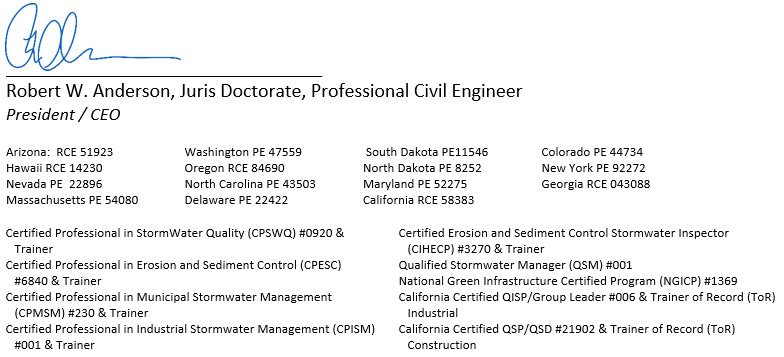
Should you have any questions or require additional information regarding this paper or the positions set forth herein, please do not hesitate to contact me at robert.anderson@envirocert.org or (805) 766-3950.
Sincerely,
| EnviroCert International, Inc. | 12 June 2026 | | | | | |