Vol. 22, No. 10

March 9, 2026

UPCOMING EVENTS


May 18-22

Branded Calling Summit 2026

Virtual Conference


September 8-10

The Connected World Live

Chicago


September 15-17

SIPNOC 2026

Herndon, Va.


November 1-3

The 2026 INCOMPAS Show

Nashville, Tenn.

MEMBER NEWS


Bluebird Fiber Completes Purchase of Everstream Assets


100% Brightspeed Fiber Ready: Multi-Gig-Speed Network Build is Complete in 13 Wiregrass Communities


Connectbase Expands Connectivity Ecosystem in Southeast Asia Through Strategic Collaboration with Converge


Greenlight Networks Expands Fiber Internet to Thousands of Households and Businesses in the City of Niagara Falls


IdeaTek Acquires Velocity, Expanding Fiber and Wireless Service Across South-Central Kansas

COMMENT DEADLINES


March 16

Comments Due on VoIP Number Authorizations


March 24

Reply Comments Due on iconectiv Petition on Toll Free Numbering Administrator Procurement


April 6

Comments Due on Gigapower Petition for Preemption


April 13

Reply Comments Due on VoIP Number Authorizations


May 6

Reply Comments Due on Gigapower Petition for Preemption

Tech and AI Companies Sign 
Ratepayer Protection Pledge

Last week, leading technology companies—including INCOMPAS members Amazon, Google, Meta and Microsoft—gathered at the White House to sign the Ratepayer Protection Pledge. The pledge is a commitment to ensure that the rapid expansion of American AI infrastructure will not result in higher energy bills for American families and businesses.


“The signing of the Ratepayer Protection Pledge marks a defining moment for the future of American innovation and economic security. By committing to ‘build, bring or buy’ their own power for new AI data centers, technology companies are demonstrating that American leadership in the global AI race and the protection of American consumers are not competing interests, but shared priorities," said INCOMPAS CEO Chip Pickering.


He added: "As the association representing the builders of the nation’s AI infrastructure, INCOMPAS knows that the race for AI dominance depends on a reliable, affordable and secure electric grid. This pledge ensures that the massive private investments being made into data centers serve as a catalyst for energy growth rather than a burden on the public. By funding their own power needs and investing in grid upgrades, these companies are accelerating the modernization of our national energy infrastructure for the benefit of all Americans."


"We applaud the administration’s focus on affordability and the collaborative spirit shown by INCOMPAS member companies, Amazon, Google, Meta and Microsoft. From rural communities to major tech hubs, this commitment to self-generation and dedicated power capacity will contribute to the revitalization of American manufacturing and the creation of thousands of high-skilled jobs without asking ratepayers to foot the bill. INCOMPAS and its members look forward to continuing our work with federal and state leaders to accelerate the deployment of AI-enabling infrastructure that is sustainable, competitive and affordable for all Americans," Pickering concluded.


Read statements from technology companies.

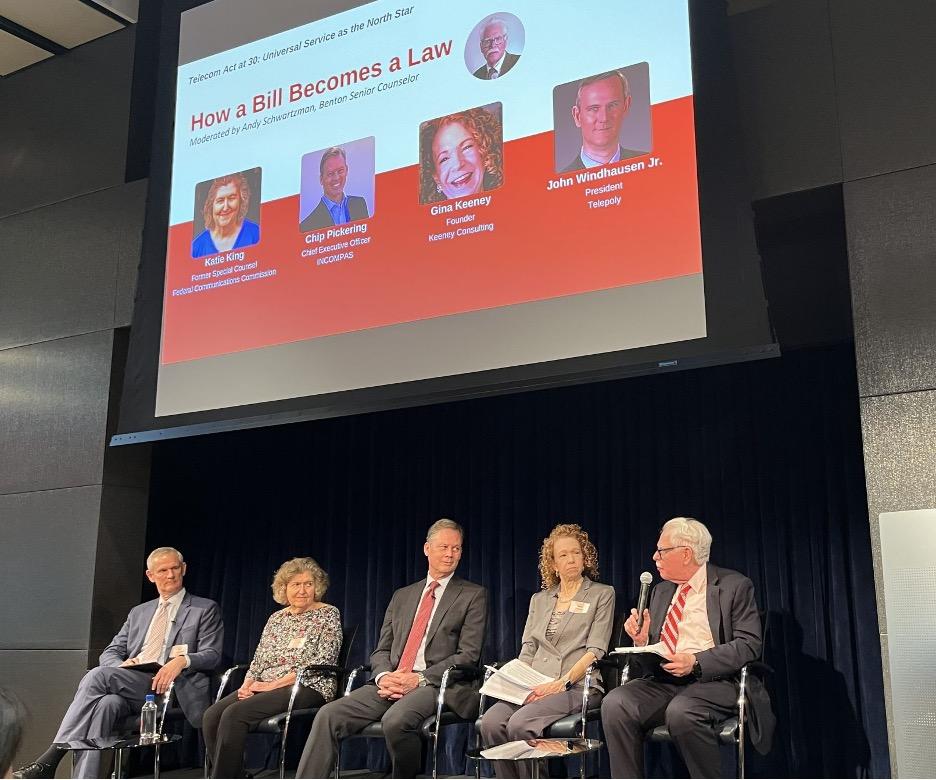
INCOMPAS CEO Speaks on Telecom Act 30th Anniversary

at Benton Institute Event

Last week INCOMPAS CEO Chip Pickering joined a panel at the Benton Institute's Telecom Act at 30: Universal Services as a North Star event, which included Katie King, former FCC special counsel; Gina Keeny, founder of Keeney Consulting; and John Windhausen Jr., president of Telepoly. 


Pickering said after the event that "30 years after the passage of the Telecommunications Act of 1996, the principles enshrined in that landmark legislation still matter deeply. Universal service isn't just a policy concept; it's a national commitment to ensuring that every American, regardless of zip code or income, can participate in our digital economy. The dialogue we had reminded us all why this work matters and why the industry behind it must stay strong."


Watch event on demand.

FCC Releases Tentative Agenda for March 26 Open Meeting

The FCC issued a tentative agenda for its March 26 open meeting, where it will consider:


  • Improving Customer Service and Consumer Protection – An NPRM that proposes a range of actions to address problems with offshore call centers, including actions to encourage and facilitate onshoring of call centers, improve customer service and security of communications, and steps to address illegal robocall scams that originate inside foreign call centers. 
  • Combatting Illegal Robocalls Through FCC Numbering Policies – An NPRM that would seek comment on and evaluate whether to adopt changes to its numbering policies with respect to how assigned numbering resources are utilized, reported and resold by service providers as part of its continuing effort to combat illegal robocalls. 
  • Modernizing Network and Communication Services – A Report and Order that adopts measures to reduce regulatory barriers and costs that hinder the transition from outdated legacy networks and services to next-generation, IP-based infrastructure. 
  • Spectrum Abundance for Weird Space Stuff – An NPRM that proposes and seeks comment on ways in which to make additional spectrum available for command and control of spacecraft supporting emergent space operations, but which do not use spectrum as part of any radio communications services provided to the public.
  • Modernizing Suspension and Debarment Rules – A Report and Order, Direct Final Rule and FNPRM that would revise the FCC’s current non-procurement suspension and debarment rules by adopting the Office of Management and Budget’s (OMB) Guidance for Governmentwide Debarment and Suspension and supplemental FCC-specific rules to expand the Commission’s tools for combatting fraud, waste and abuse, and remove bad actors from Commission programs. 
  • Amending Part 1, 73, 74 and 76 Rules Applicable to Broadcast Stations – A Report and Order to update rules for broadcast radio and television stations to reflect current application processing requirements, clarify and harmonize provisions, and remove references to outdated procedures and legacy filing systems.
  • Rescinding Obsolete Provisions – A Direct Final Rule as part of the Delete, Delete, Delete proceeding that would remove 18 rules, including 17 rule provisions impacting the Office of Economics and Analytics’ (OEA) Auction Division that are no longer in use by the Commission or govern expired events and one rule relating to the Office of International Affairs (OIA) that imposed carrier burdens under a deleted requirement.

NTIA Guidance on Non-Deployment Funds Delays

On March 6, the NTIA said guidance on the allowable uses of about $21 billion in BEAD non-deployment funds won't be coming next week, as was widely expected.


Citing recent listening sessions in which the agency got feedback on the topic, NTIA Administrator Arielle Roth said they're "taking additional time to review the comments and finalize our approach to ensure these funds are spent as efficiently and responsibly as possible. American taxpayers work hard for their money and deserve nothing less from this Administration."

House Passes Broadband Permit Reviews Legislation

The House of Representatives passed H.R. 5419, the Enhancing Administrative Reviews for Broadband Deployment Act. Introduced by Rep. Tom Kean, Jr. (R-NJ), the bill would direct the U.S. Department of the Interior and U.S. Department of Agriculture to conduct a comprehensive review of administrative barriers that delay the review of communications use authorizations. Within one year, the agencies must report to Congress with their findings and submit a plan to provide adequate staffing to ensure timely permit reviews. The bill moves to the Senate for consideration.

Bipartisan Bill to Set FCC Time Limits on License Reviews

Reps. August Pfluger (R-TX) and Josh Gottheimer (D-NJ) introduced legislation that would provide for time limits for action by the FCC on applications for the transfer of control or assignment of any license or other authorization subject to the jurisdiction of the FCC. The Keep It Moving Act would:

  • Establish strict timelines for the FCC’s review process, removing artificial delays and bringing greater transparency and oversight to how applications are handled
  • Require a full FCC vote to deny any application, ensuring consequential decisions are made by confirmed commissioners accountable to Congress and the American people

Sen. Ernst Introduces Lifeline Bill

Sen. Joni Ernst (R-IA) introduced legislation that would terminate the ability of eligible telecommunications carriers in certain states to use state eligibility determination processes in place of the National Verifier to determine eligibility of consumers for Lifeline service.

House Subcommittee Hearing on Employer-Led Training

Last week, the House Education and Workforce Subcommittee on Higher Education and Workforce Development held a hearing entitled “Building an AI-Ready America: Strengthening Employer-Led Training.”


The hearing focused on how employer-led training models—including registered apprenticeships, sector partnerships, and community college partnerships—can prepare workers for rapid changes driven by AI, broadband expansion and evolving labor market demands.


Watch the hearing on-demand.

INCOMPAS | www.incompas.org
Facebook  X  Linkedin  Youtube  Instagram