"Building capacity in disease surveillance through global communities of practice, online forums for collaboration, and public health workforce development."
|
|
|
ISDS Closing and Future Plans for Members
June 7, 2019
|
Dearest members,
As you may have seen via other communications, in the face of declining funds, the
in the recent April board meeting, ISDS Board of Directors has recommended that ISDS end its operations and create a plan to use the remaining reserve funds to help other organizations carry forward the ISDS mission. Accordingly, in the same Board meeting, the Board members voted to not host a 2020 scientific conference. We would like to thank our members for many years of collaboration and a particularly strong 2019 conference.
The mission of ISDS is to advance the science and practice of health surveillance worldwide and you have all played a critical role in that work. ISDS created a unique space where local, state, national, and global members shared their research and best practices on health surveillance. We are proud to see other agencies have adopted our approach, whether by incorporating international perspectives or enhancing technical expertise in syndromic surveillance. This is evidence that ISDS has succeeded in accomplishing its mission - something every member can be proud of as we sunset the association.
At this time, the ISDS Staff and Board of Directors are working on a proposal to transfer resources and remaining funds to other organizations to carry forward the ISDS mission. The proposal will be shared with the members within the next few weeks. Voting members will be asked to cast their official vote to approve the plan and dissolution. We recognize these decisions are difficult to make, however, the Board encourages voting members to approve the proposal upon distribution to the membership. ISDS is working with legal counsel to follow the required steps for dissolution and transfer of resources and activities. All NSSP CoP related resources and workgroups will transition to CDC. Please check your inbox for other communications containing details about this transition. We are working with the other groups to possibly find new homes so they can continue on their mission. We will offer more information in the near future. For any urgent questions regarding this announcement, please email Shandy Dearth at
sdearth@syndromic.org
.
In our final newsletter, we will offer our members a chance to share a good memory about their work with ISDS. Please email any thoughts or photos you would like to share to Catherine Tong at
ctong@syndromic.org
by June 20. We plan to publish the final newsletter at the end of June.
Best regards,
ISDS
|
|
Webinars
Topic:
Heat-related illness surveillance
June 18, 2019, 3 - 4:30 pm ET
June 19, 2019, 3 pm - 4:30 pm ET
June 21, 2019, 9 - 10:30 am ET
|
|
|
2019 ANNUAL CONFERENCE ABSTRACTS
|
|
|
|
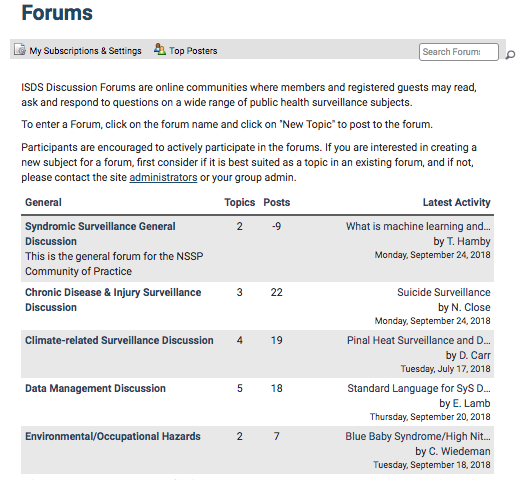
Latest Forum Activity:
Community Forums
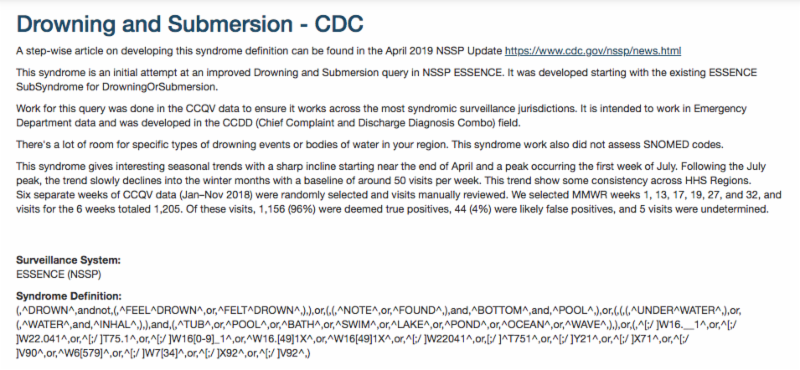
Syndrome Definition Committee Forums
|
|
Success Story Highlights:
|
|
ISDS SPONSORS INTERNATIONAL PLENARY AT NACCHO ANNUAL 2019
|
ISDS is proud to be a sponsor of a new initiative at the
National Association of City and County Health Officials (NACCHO) Annual Conference
coming up this July. To highlight the importance of sharing across the global health system, this plenary session at NACCHO Annual 2019 will convene key partners in their quest to integrate global health and domestic health here in the United States. Leveraging recent Robert Wood Johnson Foundation (RWJF) funding to support NACCHO’s keen interest in the creation of a global health initiative as well as the International Society for Disease Surveillance (ISDS) support of the global surveillance community, this work is important for local health departments (LHDs) whether large or small, whether engaged in this work already or not doing so yet.
This NA19 plenary will consist of a moderator, Dr. Umair A. Shah, who serves as chairperson of NACCHO’s newly created Global Health Taskforce and a panel of three (3) thought-leaders in the global-local public health space. One panelist will come from a global surveillance background and will explore how global disease surveillance is critical to domestic health security. The second panelist will come from a global health program innovation background who will share perspectives on how global health strategies can be applied domestically utilizing specific such examples. The third panelist will have a background in global health leadership and will discuss how systems can be strengthened by global learnings.
|
|
UPDATE ON THE HL7 2.5.1 IMPLEMENTATION GUIDE FOR SYNDROMIC SURVEILLANCE, RELEASE 1
|
After 12 months of hard work, the
Message Guide Workgroup
has completed reviewing the 221 comments submitted during the 2018 May HL7 Ballot period!
Thank you to all of the volunteers and community members who attended the weekly workgroup calls and provided feedback on the guide via email. This truly was a community effort and all involved in the project are extremely grateful for everyone’s dedication.
ISDS and CDC will continue to support the guide through the HL7 Publication process over the coming months, and we hope to have a publicly available Standard for Trial Use early this fall.
|
|
As we move through this transition, we encourage you to continue your membership in the NSSP CoP and actively engage in ongoing community activities.
Be assured, CDC supports the NSSP Community of Practice.
To help with this transition, please do the following:
- Continue to attend NSSP CoP group calls and to engage with other members via healthsurveillance.org and the group/community forums. After June 30th, NSSP will provide essential support to the NSSP CoP groups. Details about this support will be shared in the next few weeks.
- Provide ISDS with your consent to having your member information shared with CDC. To facilitate this process, ISDS has created a simple consent form. If you do not complete this consent form, your NSSP CoP member information will NOT be shared with CDC.
- To provide consent, look for a personalized email sent from ISDS on May 31, 2019 with a Subject Line: NSSP CoP Transition_ Continuation of NSSP CoP Membership (it may be in your Junk/SPAM Folder). If you didn’t receive the email, or you can’t locate it, contact Emilie Lamb (elamb@syndromic.org) or Catherine Tong (ctong@syndromic.org).
- Take a few minutes to review and update your member profile on healthsurveillance.org. You may make changes to your profile any time until 11:59 PM Eastern on June 14, 2019. Any changes to your member profile made after this date will not be shared with CDC.
|
|
This month's featured member is
Zachary Faigen
.
Zachary Faigen is an active member of the NSSP Community of Practice, currently serving on the CoP's Steering Committee and acting as ambassador for the SPHERR Committee. He has been involved with ISDS since 2010 and you can often find him on the ISDS forums, hear him speak on committee calls, and receive an enthusiastic thumbs up from him at the ISDS Annual Conferences. Zach continues to be great resource for our community members, ready to answer questions and help, and we are pleased to have him as our featured member of the month!
|
|
Past ISDS webinars can be found in the Knowledge Repository.
|
Presenters: Alexis Barbarin, Michael Doyle, Mojisola Ojo, and Grace Marx
May 21, 2019
Presenters:
Céline Caserio-Schönemann, Cécile Forgeot, Marie-Michèle Thiam, Isabelle Pontais, and Anne Fouillet
May 16, 2019
|
|
Have an article of interest you would like to share with the community? Email
syndromic@syndromic.org with your article!
or
|
Oduwa Edo-Osagie, Beatriz De La Iglesia, Iain Lake, and Obaghe Edeghere
.
February 2019
|
|
FEATURED EXTERNAL RESOURCES
|
This CDC MMWR article discusses how during 2015–2017, pool chemical injuries led to an estimated 13,508 U.S. emergency department visits, and approximately one third of those occurred in persons aged <18 years. Most injuries occurred at a residence, and two thirds occurred during the summer swimming season (Memorial Day weekend through Labor Day). Pool chemical injuries are preventable. CDC’s Model Aquatic Health Code (
https://www.cdc.gov/mahc
), based on the latest science or best practices, is an important resource to prevent pool chemical injuries.
The U.S. is experiencing its highest number of measles cases in 25 years and researchers anticipate additional outbreaks, with Chicago, Los Angeles and Miami listed among the cities at high risk. Cities and states across the U.S. have been challenged by efforts to contain the spread of this highly contagious disease. Some states have moved to prohibit all vaccine exemptions while other are considering it. Other jurisdictions have felt the need to take more urgent actions, including New York City, which declared a state of emergency and ordered mandatory vaccination.
|
|
NSSP Update
provides a monthly newsletter about the National Syndromic Surveillance Program (NSSP) and will keep you in touch with the program's latest advancements.
Learn more about
The Network for Public Health Law
and receive periodic newsletters by joining today.
|
|
Syndromic Surveillance Portal
Grant #1 NU500E000098-01-00, NSSP-CoP: Strengthening Health Surveillance Capabilities Nationwide supports NSSP CoP activities and is in the interest of public health. The mark "NSSP National Syndromic Surveillance Program BioSense Platform" is...
Read more
www.syndromicsurveillance.org
|
|
|
|
|
|
288 Grove St, Box 203, Braintree, MA 02184
|
|
|
|
|
|
|