"Building capacity in disease surveillance through global communities of practice, online forums for collaboration, and public health workforce development."
|
|
|
CATCHING UP ON THE WINTER QUARTER
March 12, 2019
|
Dear member,
As we move away from winter to spring, we want to highlight all you've accomplished already in 2019.
The
Annual Conference brought 375 of you together from 28 countries to share best practices and lessons learned. San Diego was hub of activity. The
One Health Symposium and the ISDS Conference along with the integrated workshops were a success thanks to the many volunteers who helped identify speakers, submit abstracts, review abstracts, teach workshops, identify moderators, and more. This society is truly a member driven organization and this year's conference was a great example of the dedication and commitment you all share in strengthening public health surveillance. We will share what we learned from the post conference survey in the next monthly newsletter.
|
Our
webinar schedule is already filling for 2019 as we will fulfill the topic suggestions you have voiced. We will be offering webinars on machine learning, EMS data as a opioid data source, data dashboards, the quarterly ESSENCE Q & A session, and more this spring.
The
One Health Surveillance Community of Practice
will soon have elections for a new chair as we thank Karen
Meidenbauer for her leadership these last two years. As she moves on to other projects, we are excited to see what the next chair will bring.
The ISDS
Knowledge Repository Curation Workgroup continues to add resources on a regular basis, so that the community has easy access to a myriad of surveillance related materials. Be sure to check out the
Surveillance Knowledge Repository on a regular basis to see what's new! Many of our groups and committees had a chance to meet in person at the conference and have continued to meet regularly since January. As always, you can catch up on their accomplishments and successes by checking out the group pages on healthsurveillance.org.
Thank you for continued engagement with ISDS. Please enjoy this issue of the ISDS newsletter, and we hope you'll stay active with your colleagues as we head towards spring.
Best regards,
ISDS
|
|
The
2019 Annual Conference:
Harnessing
Data Science to Improve Population Health and Public Health Surveillance
and
One Health Symposium
took place at the Marriott San Diego Mission Valley in San Diego, California from January 29 to February 1, 2019.
ISDS would like to thank all of the 375 attendees, presenters, planners, and sponsors from across 28 countries for their participation in our 2019 conference. We were excited to see such enthusiasm, engagement and conversation among the diverse group of professionals with a dedicated commitment to public health surveillance. Please stay connected with your colleagues on our
healthsurveillance.org
website.
Post-Conference Survey
Attendees were sent a post-conference survey via email over the past month. If you have not received the survey, please email
mkrumm@syndromic.org
for an opportunity to submit your feedback and also receive a $25 Amazon gift card. The results of the survey will be shared with members in the next month.
Conference Abstracts and Presentations
ISDS is currently working with the
Online Journal of Public Health Informatics (OJPHI) to publish all 2019 ISDS Conference abstracts. The abstracts will be accessible on both the OJPHI website as well as from the
Surveillance Knowledge Repository. Presentation slides approved for sharing will also be published alongside their abstracts. In the meantime, please
visit our conference page for a sneak peek of the 2019 ISDS abstracts.
|
|
MEET OUR CONFERENCE SPONSORS
Our sponsors play a key role in supporting our education mission. We thank all our sponsors for their contributions to making this year's ISDS Conference a success!
|
|
SYNDROME DEFINITION COMMITTEE: SYNDROME GUIDANCE DOCUMENT
|
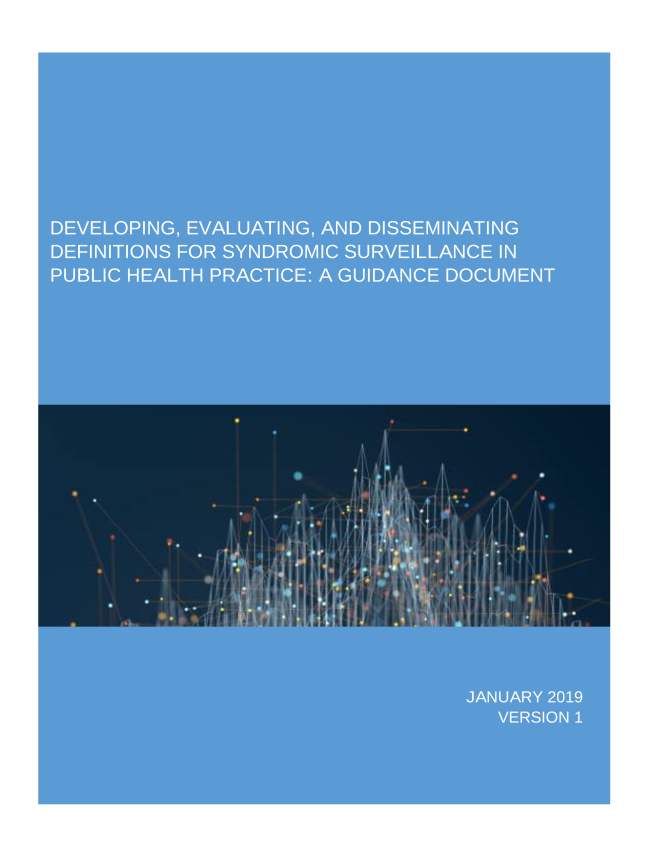
On February 18, 2019, the
ISDS Syndrome Definition Committee's
guidance document was released in the
Surveillance Knowledge Repository
. The document focuses on several key areas related to syndrome definition creation, including the basics behind a syndrome definition, steps to build a syndrome, evaluation of a new (or old) definition, and dissemination.
Starting in November of 2016, the
Syndrome Definition Committee
began a group approach to developing a syndrome definition that could be documented and used as an example in best practices. The topic selected by the committee was a suicide-related syndrome and is referenced throughout this guidance document. The methods described in this document should transfer to most syndromic surveillance platforms, but this guidance document was based on the National Syndromic Surveillance Program (NSSP) BioSense Platform, ESSENCE (Electronic Surveillance System for the Early Notification of Community-Based Epidemics).
|
|
Amanda Morse
This month's featured member is Amanda Morse from the Washington State Department of Health. She currently serves as the Deputy Chair of the NSSP CoP Steering Chair and as an ambassador to the Syndrome Definition Committee. Members will recognize her for her infectious energy on webinars and her willingness to share experiences with the community. For her enthusiasm and her commitment to keeping the syndromic community informed with new resources and events, we are pleased to have Amanda as this month's featured member.
|
|
Webinars
March 14, 2019, 3 - 4:30 pm ET
Topic:
Spring Health Hazards
March 19, 2019, 3 - 4:30 pm ET
March 21, 2019, 2 - 3:30 pm ET
|
|
|
Related Webinars
March 13, 2019, 7 - 8 pm ET
Conferences
|
|
|
|
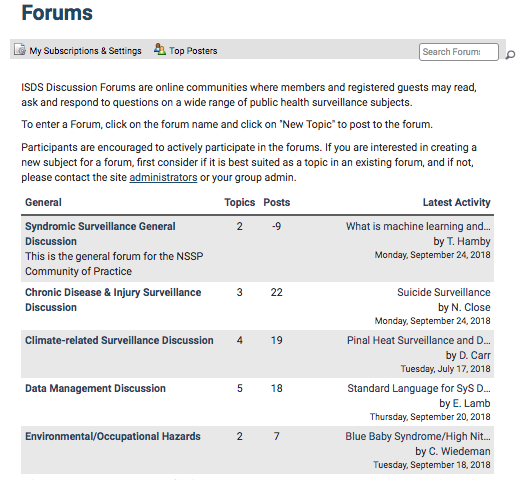
Latest Forum Activity:
Community Forums
|
|
|
Anne Hakenewerth
It is with great sadness that we share with you of the passing of Dr. Anne Hakenewerth who died on January 17, 2019 after being struck while crossing the street in Raleigh, NC. Anne was the Manager of the Surveillance Systems Unit in the Communicable Disease Branch of the North Carolina Division of Public Health. Prior to assuming that role in 2014, Anne was the senior epidemiologist and manager of the epidemiology group at the Texas Cancer Registry from 2012 to 2014. Anne received her PhD in Epidemiology from the University of North Carolina at Chapel Hill in 2011, and, while a doctoral student, spent several years working with NC DETECT. Anne was a joy to know and work with, always patient and thoughtful in her approach to every epidemiologic question, informatic decision or bureaucratic responsibility with which she was tasked. She was a mentor to many and an inspiration to fellow lifelong learners as she began her PhD studies in epidemiology in her 50s, after a longstanding career as a health informatics manager. We will greatly miss her kindness, optimism, and utter dedication to public health surveillance. Anne is survived by Paul, her husband of 41 years, two daughters, Katherine and Mary, three grandchildren and four siblings.
|
|
Past ISDS webinars can be found in the Knowledge Repository.
|
Panelists: Charlie Ishikawa, Eric Bakota, Teresa Hamby, Amanda Morse
February 26, 2019
Presenters: Hillary Hall & David Atrubin
February 19, 2019
Panelists: Joe Gibson, Krystal Collier, Howard Burkom
February 13, 2019
|
|
Have an article of interest you would like to share with the community? Email
syndromic@syndromic.org with your article!
or
|
June 2018
Kim L, Fast SM, and Markuzon N.
February 2019
|
|
FEATURED EXTERNAL RESOURCES
|
The NSSP team—with considerable guidance from the NSSP CoP Technical Committee—recently developed and posted the BioSense Platform Enhancements document. The Enhancements Document provides a historic record of enhancements being made to the Access & Management Center (AMC), data flow, and ESSENCE. Platform users will be able to view each enhancement’s review status, priority, description, and implementation stage.
The National Interoperability Collaborative (NIC) released in February 2019 a new publication that shines a spotlight on the critical role that prevention should play in addressing our nation’s opioid epidemic, including strategies – or “plays” – that communities can replicate or adapt for real-time use. The Opioid Use Disorder Prevention Playbook is derived from the growing number of efforts by practitioners, researchers and policy-makers around the country to “get upstream” of this national crisis, in addition to providing treatment and saving lives.
A new training course from PHII's Informatics Academy helps guide public health professionals along the road to becoming effective communicators.
Communications for Emerging Public Health Leaders
provides tools and techniques to refine communications skills, including common pitfalls to avoid while facilitating meetings, using data presentation design principles to convey key messages and much more. The course is free and self-paced.
On March 11, FAO, WHO, and OIE launched a guide for countries on taking a One Health approach. The guide provides principles, best practices and options to assist countries in achieving sustainable and functional collaboration at the human-animal-environment interface. It is flexible enough to be used for other health threats; for example, food safety and antimicrobial resistance (AMR).
Sustained implementation of proven population-based strategies, in coordination with Food and Drug Administration regulation of tobacco products, is important for reducing tobacco product use and initiation among U.S. youths.
The US CDC Foundation and Oxford University Press have published this manual to serve as a definitive guide to investigating acute public health events on the ground and in real-time. It serves as an essential resource for epidemiologists and other health professionals working in local, state, national, and international settings.
This primer provides key information on the 2018-2019 Ebola outbreak in the Democratic Republic of Congo, including international response efforts, U.S. preparedness and response, an outline of the major legal challenges, and emergency legal preparedness resources.
This collection of 22 “snapshots” provide an overview of the basic requirements of different federal data protection laws, including FERPA and HIPAA, and is intended to help agencies and organizations better understand legal protections associated with datasets collected by federal agencies or as part of a federally funded program like Medicaid and WIC.
|
|
Find the latest job postings in our Career Center. As a registered member, can also
submit a job posting.
No recent job postings.
Other Opportunities
Deadline: March 29, 2019
Deadline: March 29, 2019
Deadline: April 1, 2019
Deadline: April 3, 2019
Deadline: April 3, 2019
|
|
NSSP Update
provides a monthly newsletter about the National Syndromic Surveillance Program (NSSP) and will keep you in touch with the program's latest advancements.
Learn more about
The Network for Public Health Law
and receive periodic newsletters by joining today.
|
|
Syndromic Surveillance Portal
This collaboration between Centers for Disease Control and Prevention (CDC) and the International Society for Disease Surveillance (ISDS) is for carrying out the activities of grant #1 NU500E000098-01-00, NSSP-CoP: Strengthening Health...
Read more
www.syndromicsurveillance.org
|
|
|
|
|
|
Donate to ISDS by shopping on AmazonSmile and selecting International Society for Disease Surveillance Inc. as your organization to support. Also help us continue our support of low-income and student attendees to our Annual Conference by contributing to our Scholarship Fund.
|
|
|
288 Grove St, Box 203, Braintree, MA 02184
|
|
|
|
|
|
|