President's Message

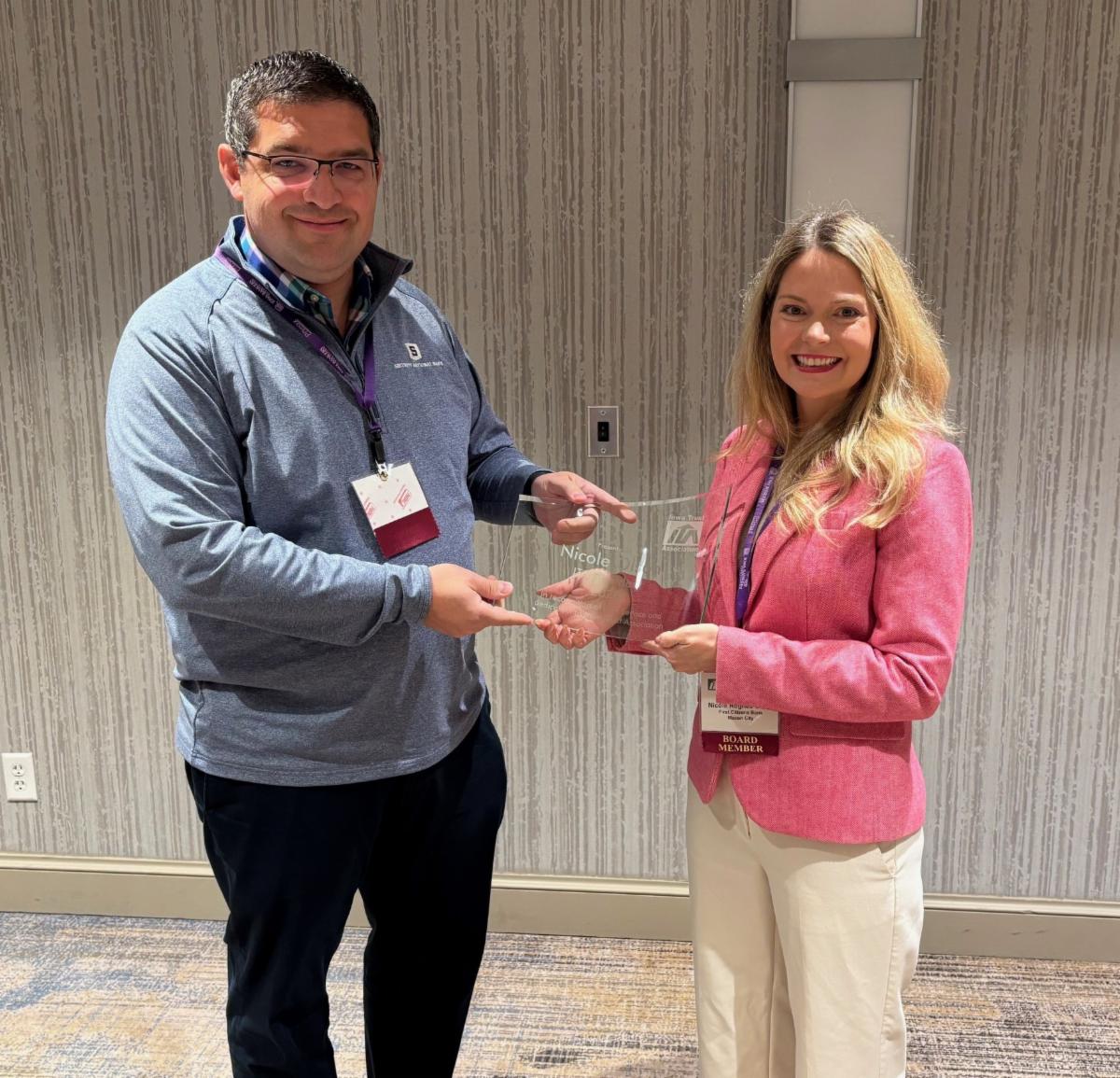
Nicole Rognes Olson, J.D., CFP®, First Citizens Bank, President of the Iowa Trust Association


Thank you to everyone who attended the 2026 ITA Fall Conference. We had a strong turnout, and I hope you found the conference valuable both for the educational content and for the opportunity to connect with colleagues from across the state. We look forward to reviewing your feedback and continuing to make the conference even better next year.

As I noted in my remarks during the Annual Meeting, it has been a privilege to serve as your President. I continue to be impressed by the camaraderie, professionalism, and engagement of our members.


The truth is, the work we do is incredibly important to the individuals and families we serve. Trust professionals are often involved during some of the most significant moments in a person’s life. We help families plan for the future, navigate difficult transitions, protect assets, carry out a loved one’s wishes, and provide continuity across generations. That is meaningful work, and it is a profession worth promoting.


As we close out 2026, I encourage each of you to think about what you can do to help promote our profession in the year ahead. It does not need to be complicated. It might be a one-on-one conversation explaining what you do, speaking to a local civic or professional group, presenting to a high school or college class, connecting with an attorney or CPA in your community, mentoring someone who is new to the industry, or simply helping a client better understand the value a trust professional can provide.


Every conversation can plant a seed

We also need to be intentional about introducing the next generation to our profession. Many of us probably did not grow up thinking we would work in trusts and estates. In fact, I don’t recall one hand raising when asked that question at our Annual meeting. Yet once you enter this profession, you quickly discover the unique combination of relationships, law, investments, problem-solving, and service that makes it such a rewarding career. We should be telling that story.


One of the greatest strengths of the Iowa trust community is that, while we may work for different organizations, we share a commitment to serving our clients well and strengthening our profession. The relationships built through ITA make all of us better at what we do.


Finally, I want to thank our board, Darcy Burnett, and the entire IBA team for their leadership, energy, and commitment to ITA. Our association is fortunate to have people who care deeply about its success, and that strong foundation will continue to move ITA forward. 

ITA Fall Conference - Thank you for attending!

With over 100 trust professionals attending, as well as 20 exhibiting companies there was a great turnout from the industry at the ITA Fall Conference. The event started Wednesday with a peer group meeting. Over 70 trust officers discussed a variety of issues and also heard an update from the Iowa Division of Banking. The conference officially kicked off on Thursday and followed with two days of informative sessions on an economic outlook, discretionary trust distributions, special needs trusts, AI use, Medicaid estate recovery, and successfully navigating change.


Iowa Trust Association would like to thank the exhibitors and sponsors who help make this event possible each year. Their attendance and support of the event helps provide the high-quality, timely speakers the conference is known for.


Thank you to everyone who was a part of the 2026 ITA Fall Conference. The association is already planning another great event for 2027. The event will be Oct. 20-22, 2027 in West Des Moines. 

On Friday, ITA held its annual meeting. President Nicole Olson reviewed the yearly financials and provided an update for the association. Olson then handed off the gavel to the incoming 2027 ITA President. Tony Lamb will chair the group in the upcoming year. Lamb addressed the group and also thanked Olson for her service.

Sponsors

Broadridge Financial Solutions

Cheetah

Federated Hermes, Inc.

Infovisa, Inc.

MainStreet AdvisorsMainStreet Advisors

SS&C Black Diamond Wealth Solutions

Steffes Group, Inc.

Touchstone Investments

Exhibitors

American Cancer Society

Broadridge Financial Solutions

BTC Capital Management

CAPIS

Cheetah

Deloitte

Farmers National Company

Federated Hermes

Fifth Third Institutional Services

Hertz Farm Management

Infovisa, Inc.

Introductions Real Estate

IPE 1031

MainStreet Advisors

Peoples Company

Proxytrust

SS&C Black Diamond Wealth Solutions

Steffes Group, Inc.

Touchstone Investments

Trust Investment Solutions

ITA upcoming events - mark your calendar!


The association is already planning more great events for 2026.


ITA Fall Conference

The event will be Oct. 21-23 in West Des Moines. Registration is now available.


ITA Webinar – Great Real Estate Reset – FREE WEBINAR

Nov. 5, 2026 • 10 am

This session focuses on national and Iowa real estate statistics, trends, and forecasts tailored to the trust industry.

Details and free registration


ITA Trust Operations Seminar

Back by popular demand, ITA will offer the Trust Operations Seminar presented by Cannon Financial. Dates for the two-day seminar offered in Johnston are Dec. 1-2. Registration is now available.

ITA online discussion groups

The ITA has online discussion group for all matters related to trust. Anyone from a member organization can be a part of the group. If you would like to be included, please email Darcy Burnett at the ITA.

AFIDA proposed rule: implications for real estate industry


from Peoples Company

On June 25, 2026, the USDA published a proposed rule overhauling the regulations implementing the Agricultural Foreign Investment Disclosure Act of 1978 (AFIDA). The proposed rule transfers administration of AFIDA from the Farm Service Agency to USDA’s Office of Homeland Security, reflecting a reorientation of the program toward national security objectives. The most consequential changes include:

  • Expanded definition of “agricultural land”: Now encompasses solar and wind energy generation, pipeline transportation, agricultural supply chain facilities, conservation land, and agricultural research, all using updated NAICS codes. The 10-acre/$1,000 de minimis exemption is eliminated. Land meeting the expanded definition is treated as agricultural land regardless of local zoning classification, even if rezoned for non-agricultural use.
  • Revised “significant interest or substantial control” test: The aggregate foreign ownership threshold triggering reporting drops from 50% to 10%, and a new “beneficial owner” concept captures any foreign person exercising decision-making authority over agricultural land regardless of equity interest.
  • Lease threshold reduction: The lease exemption drops from 10 years to 1 year for non-adversary foreign persons, and is eliminated entirely for foreign adversaries and Foreign Adversary Controlled Entities.
  • New foreign adversary framework: Definitions for “foreign adversary” (tied to countries of concern including China, North Korea, Russia, and Iran) and “Foreign Adversary Controlled Entity” create a tiered enforcement regime.
  • Mandatory electronic filing: All reports must be submitted through the USDA’s online portal.
  • Increased penalties: Late-filing penalties accrue at 1.5% of fair market value per week (2.5% for foreign adversaries), with a 25% FMV cap per violation. Downward adjustments are eliminated. The penalty appeal process is also restructured: the response window shrinks from 60 to 30 days, the options to submit a written statement or request a hearing are replaced by a single review by the OHS Director, and decisions are administratively final with unpaid penalties referred to DOJ.
  • Easements and rights of way now reportable: The prior exemption for surface and subsurface easements unrelated to agriculture is removed.

Annual trust asset reviews

A framework for identifying risk and promving long-term results

from longevity Holdings

For trustees administering a broad range of trust accounts, the annual trust asset review is one of the most consequential — and consequentially underestimated — tasks in the calendar year. It isn’t simply a compliance checkbox. It is the mechanism by which trustees demonstrate that they know what they hold, understand what it’s worth, and can defend every asset’s continued place in the portfolio. 

Trusts today hold far more than publicly traded stocks and bonds. Life insurance policies, private equity interests, real estate, LLC membership interests, and closely held businesses are commonplace — and each one requires a disciplined, asset-specific approach. Here’s what the regulatory framework requires and what sound practice looks like across the full spectrum of trust assets. 

The Regulatory Foundation: One Standard, Many Asset Types 

The annual review obligation is not limited to ILITs or any particular trust structure. Under 12 CFR 9.6(c), at least once during every calendar year, a national bank must conduct a review of all assets of each fiduciary account for which the bank has investment discretion to evaluate whether those assets are appropriate, individually and collectively, for the account. The parallel requirement for federal savings associations is found at 12 CFR 150.220. 

That phrase — individually and collectively — matters. The review isn’t just about whether each asset passes muster on its own. It’s about whether the mix of assets still serves the trust’s purposes and the beneficiaries’ interests. 

The OCC’s Unique and Hard-to-Value Assets Handbook was developed to address the full range of assets that trust accounts hold — including marketable securities, real estate, mineral interests, and closely held or private companies — recognizing that many of these asset classes require specialized expertise, controls, and valuation methods. The review obligation applies to all asset types, but the depth of each review must be calibrated to the specific characteristics and risks of what’s being held. 

Why the Asset Mix Matters for Review Design 

Marketable securities have readily observable prices and liquid markets. Most other trust assets don’t. Unique assets are not traded on a financial market and therefore do not have readily determined values — in contrast with equities and bonds, whose values are readily ascertained. The specific attributes of a unique asset can affect not only its value but its marketability. That distinction has real implications for how trustees approach each annual review. 

Contribute to the Iowa Trust Association

As a reminder, the Iowa Trust Association welcomes contributors to its quarterly newsletter. If you would like to comment on recent activities in the industry or let us know about an upcoming event that would be of interest to our readers, please feel free to contact Darcy Burnett, at 800-987-7365. Thank you for your interest in our publication and we look forward to hearing from you.


If this message was forwarded to you and you would like to receive the ITA Newsletter, please email Darcy Burnett to subscribe.


Published by Iowa Trust Association.