|
From FAA to Outlook: Recent Outages Put Federal IT Modernization to the Test
| |
TAKE NOTE (Insights and Emerging Technology)
| | |
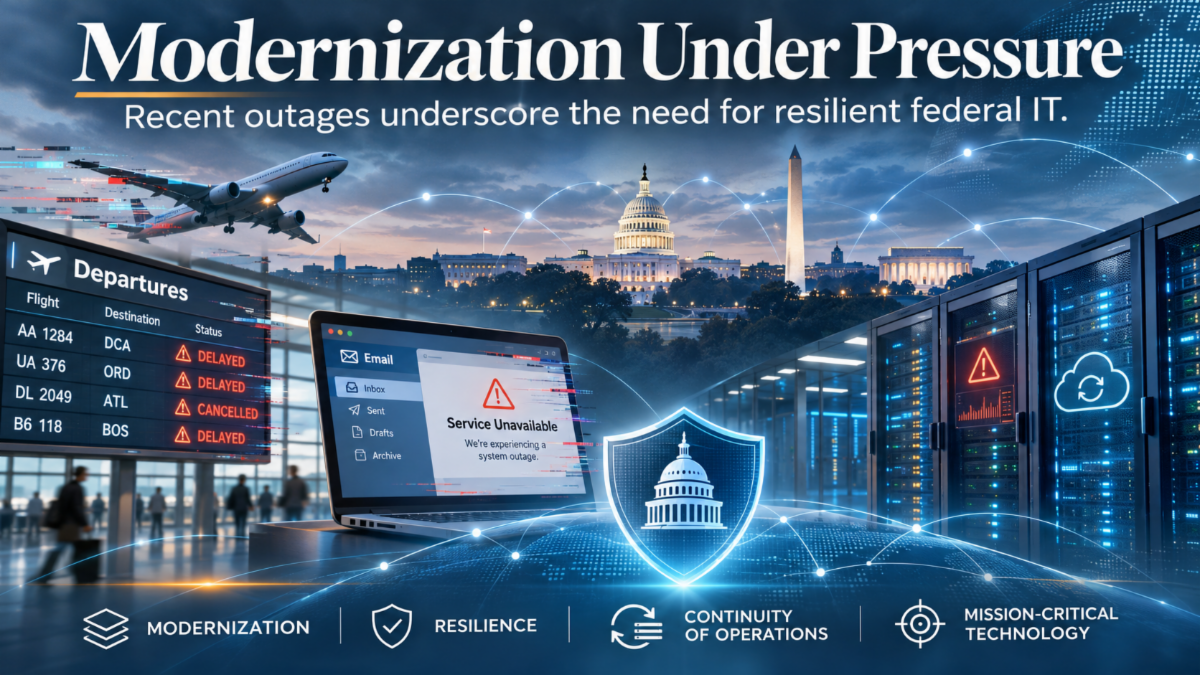
Over the past week, a series of major technology outages has raised important questions about the reliability of the systems that government agencies and businesses depend upon every day. On November 12 and 13, a global Microsoft 365 outage disrupted Outlook, Teams, Copilot, and other enterprise services for nearly 24 hours.
On November 13, a failure in the Federal Aviation Administration's telecommunications network forced a nationwide ground stop, disrupting thousands of flights. Just three days later, United Airlines experienced a separate system outage that delayed departures for more than 90 minutes. Then, on November 17, the National Security Agency acknowledged a disruption to internal systems during routine maintenance, with reports identifying its classified NSANet network as affected. While these incidents appear unrelated, their occurrence within such a short period highlights a challenge confronting both government and industry: as technology environments become increasingly interconnected, even routine maintenance or seemingly isolated failures can have significant operational consequences.
What makes these incidents particularly interesting is that none has been established as the result of a coordinated cyberattack. Instead, the early findings point toward problems involving aging infrastructure, software defects, system capacity, and maintenance activities. The FAA reported that unusual network traffic destabilized legacy telecommunications equipment, although investigators were still determining the precise root cause. Microsoft's preliminary incident report identified a previously undetected software defect that, combined with increased traffic and reduced server capacity, triggered cascading failures across its infrastructure. The NSA characterized its disruption as temporary degradation during scheduled maintenance and emphasized that mission-critical capabilities remained operational. These events demonstrate that cybersecurity alone does not guarantee operational resilience. Organizations must also consider how systems behave when components fail, traffic patterns change, software is updated, or dependencies become unavailable.
For federal agencies, this raises an important question about the next generation of modernization programs. For years, the focus has been on replacing legacy applications, migrating workloads to the cloud, consolidating infrastructure, and improving security. Those objectives remain important, but the recent outages suggest that modernization strategies must place greater emphasis on continuity of operations, system interoperability, and resilience during technology transitions. Moving an application to the cloud does not automatically eliminate operational risk, just as maintaining an on-premises system does not necessarily provide greater control. Agencies need architectures that isolate failures, provide appropriate redundancy, support recovery and rollback, and minimize dependencies that could disrupt critical business functions. Just as importantly, modernization programs need realistic testing that examines how the entire enterprise behaves under failure conditions, not simply whether individual applications meet their performance requirements.
These challenges are emerging at a time when the federal government is also accelerating the adoption of emerging technologies and rethinking its acquisition processes. GSA's expanded OneGov agreements are making advanced artificial intelligence capabilities more accessible to agencies, while the October 30 release of Version 3.0 of the FAR Companion Guide reinforces the government's interest in modular acquisition, commercial solutions, and outcome-based contracting. Yet a November 18 Government Accountability Office report found that none of the 21 agencies reviewed had fully addressed all five federal data center acquisition and operational requirements, including those involving availability, monitoring, and security. Together, these developments suggest that the next phase of federal modernization must balance speed and innovation with stronger engineering discipline. AI, automation, and cloud platforms can improve government operations, but agencies must ensure that the underlying infrastructure, integration architecture, data management, and operational controls are prepared to support them.
The broader lesson from these disruptions is not that modern technology is inherently less reliable, but that growing complexity requires a different approach to managing operational risk. As federal systems become more interconnected and increasingly dependent on shared platforms, cloud services, and automated processes, the consequences of individual failures can extend well beyond their original point of origin. Looking ahead, agencies and technology providers alike will need to give greater attention to architectural resilience, dependency management, realistic failure testing, and the ability to restore essential services quickly. Modernization and reliability should not be competing priorities. Both are essential to delivering the secure, dependable, and adaptable technology infrastructure that government missions will require in the years ahead.
| |
Interested in learning about RPA? Download our FREE White Paper on "Embracing the Future of Work"
| |
UNDER DEVELOPMENT (Insights for Developers & SME's)
| | |
After Army EBS-C: Modernize First, Converge by Design
| | |
The Army’s decision to rethink ERP consolidation may create a better path to S/4HANA modernization, enterprise-wide data integration, and a more agile business environment. When the Army decided in May 2026 not to exercise the next option year on Enterprise Business Systems Convergence (EBS-C) contract, it raised some important questions about the future of Army ERP modernization.
The original vision was ambitious. Consolidate the Army’s major financial and logistics systems into a single, modernized SAP S/4HANA environment. Replace years of fragmented business processes, eliminate redundant infrastructure, standardize data, and provide a more consistent experience for soldiers and civilian personnel. The objectives made sense. The challenge was how to get there.
Anyone who has worked with large SAP environments understands that consolidating multiple mature ERP systems is much more complicated than moving data from one system to another. Each environment has its own business processes, configuration, custom code, interfaces, security requirements, and operational dependencies. Trying to consolidate all of that while simultaneously transitioning to S/4HANA introduces enormous complexity.
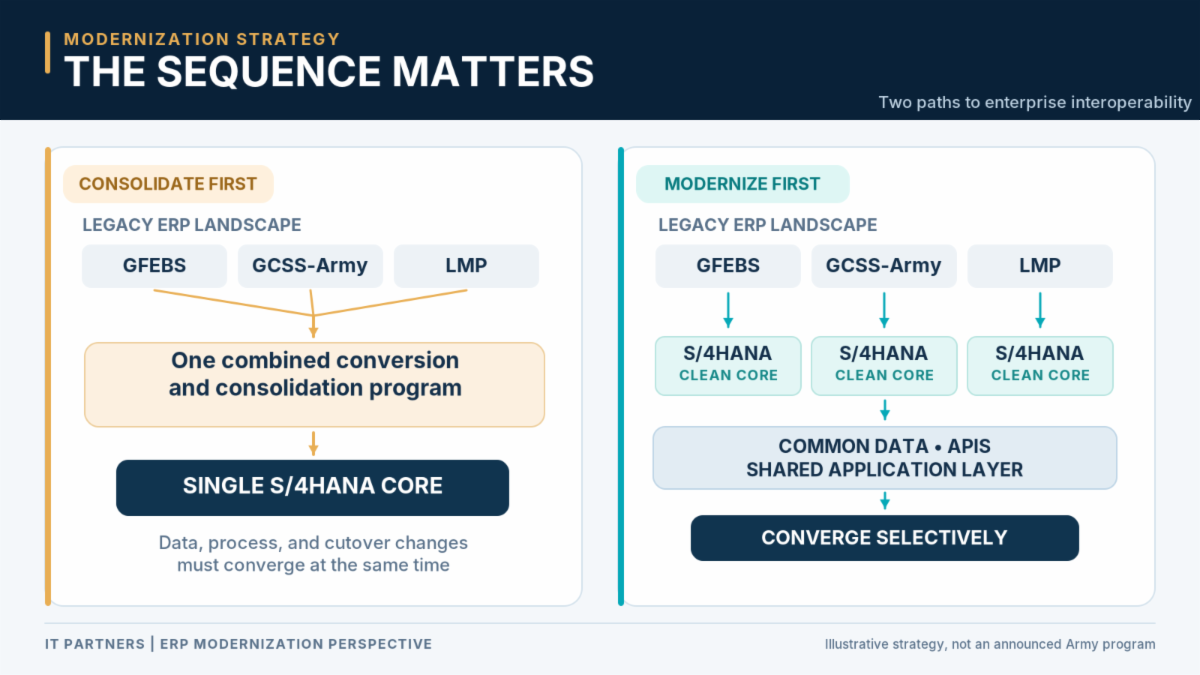
Could this decision creates an opportunity to approach the problem differently? What if rather than consolidate first and modernize second, the Army modernized each ERP independently, establish a common enterprise architecture, and then consolidate when the systems are actually ready?
I believe this approach could significantly reduce risk while delivering many of the benefits EBS-C was originally intended to achieve.
| | |
The decision not to continue the original consolidation contract does not eliminate the underlying problem. The Army’s ERP systems still need modernization.
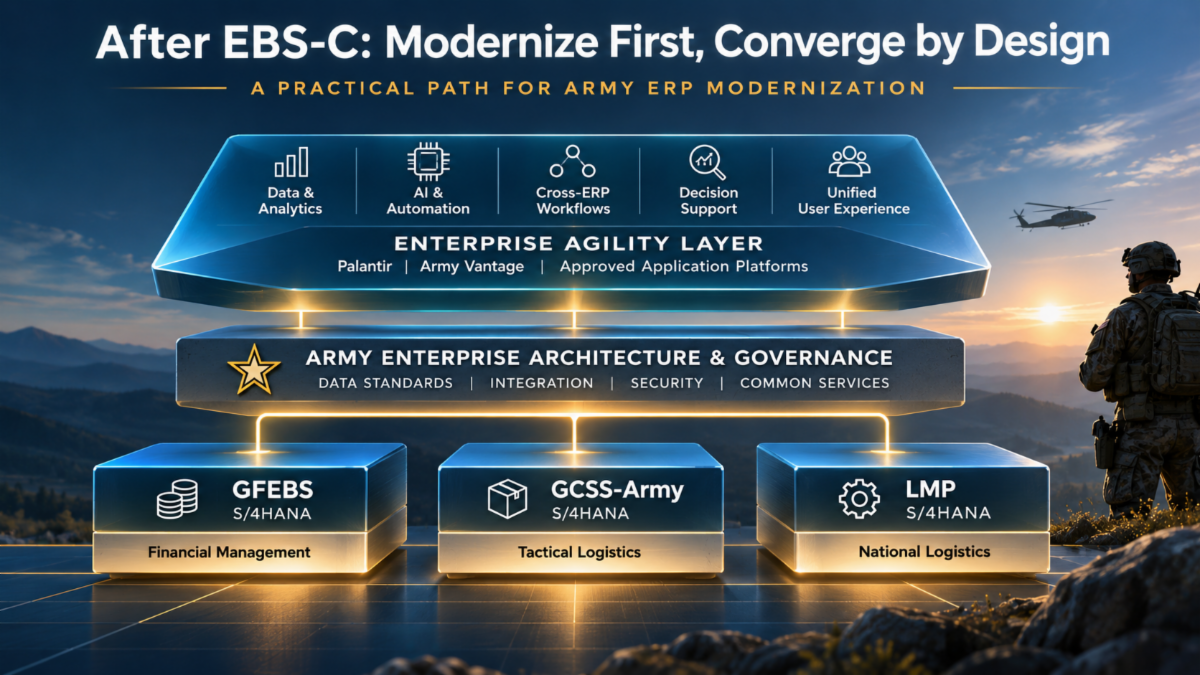
GFEBS, GCSS-Army, and LMP serve different operational missions, but they share a common SAP technology foundation. They also face many of the same challenges, including aging software, technical debt, increasingly complex integrations, cybersecurity requirements, and the need for better access to enterprise data.
There is also the SAP maintenance timeline. Mainstream maintenance for qualifying SAP ECC 6.0 releases ends December 31, 2027, with optional extended maintenance available through 2030. This does not mean every Army system must complete its migration by the end of 2027, but it does make a sustainable modernization strategy increasingly important.
The Army has already taken steps toward unified ERP management and sustainment through its Consolidated ERP organization and Shared Services Center. In fact, its 2026 industry briefing identified sustaining current ERP systems, reducing sustainment costs, maintaining audit readiness, and modernizing applications and SAP cores as major priorities.
These priorities remain relevant regardless of whether the Army ultimately operates one ERP system or several.
The question is no longer simply how to replace the existing systems. It is how to modernize them without disrupting the missions they support.
Modernize Each ERP on Its Own Timeline
| | |
It could start by allowing each Army ERP program to modernize its SAP environment according to its operational requirements, technical condition, and mission priorities.
GFEBS supports financial management. GCSS-Army supports tactical logistics. LMP supports national-level logistics and industrial operations. These systems have different users, business processes, and operational constraints. Their modernization schedules should reflect those differences. Instead of forcing all three through a single transformation schedule, each program could develop its own S/4HANA transition plan under a common Army enterprise architecture.
That distinction is important. I am not suggesting three independent modernization programs with no coordination. I am suggesting separate technical migrations governed by common enterprise standards. Each program would have an opportunity to examine its business processes, eliminate unnecessary customization, simplify its SAP configuration, remediate data, and determine which capabilities should remain in the ERP.
This would also provide an opportunity to...
| | |
- Dig Deeper -
Watch the GAO's 4 minute assessment of the risks facing federal modernization.
| |
Q&A (Post your questions and get the answers you need)
| | |
Q. Any new news on the CMMC debacle?
A. Yes, but unfortunately, we're still waiting for the most important news: a decision.
The Department of War's suspension of CMMC Phase 2 remains in place, and the promised reforms have yet to materialize. Meanwhile, a November 18 congressional hearing focused on the financial burden CMMC places on small businesses, inconsistent CUI markings, and whether existing cybersecurity certifications should receive greater recognition.
Now, we have some sympathy for the small-business argument, but perhaps a little less than others. After all, IT Partners is a small business. We made the investment, paid for the assessment, did the work, and achieved CMMC Level 2 certification. Was it inexpensive? Certainly not. Was it easy? Not particularly. But we understood the requirements and made the commitment.
Which raises an interesting question: What about the small businesses that actually complied? If the government changes the rules, reduces certification requirements, or delays implementation indefinitely, what consideration will be given to contractors who already invested significant time and money to meet the standard? We certainly wouldn't object to a more efficient and less expensive certification process. But rewarding those who waited while offering little recognition to those who complied seems like an odd way to encourage cybersecurity.
The bottom line? Reform CMMC where it needs reforming. Fix the inconsistent CUI markings, eliminate unnecessary costs, and simplify the process. But let's not forget the companies that took the government's requirements seriously and wrote the checks.
Those invoices, incidentally, didn't come with a 60-day pause.
Cheers!
| | | | |