|
July 20-24, 2026
UC Davis Conference Center
| |
August 6-7, 2026
New Delhi India
| | |
September 15-16, 2026
Ghent, Belgium
| | |
November 17, 2026
UC Davis Activities and Recreation Center
| | |
November 18-19, 2026
UC Davis Activities and Recreation Center
| |
December 1-2, 2026
Amsterdam, Netherlands
| | | |
Transit Research Symposium
April 2026
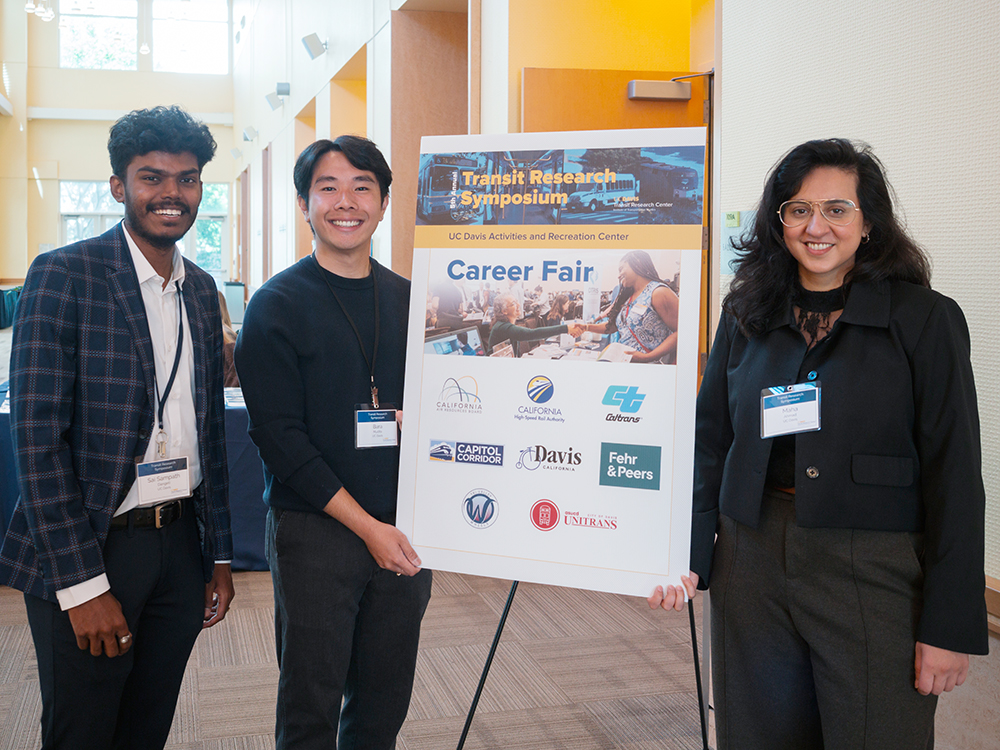
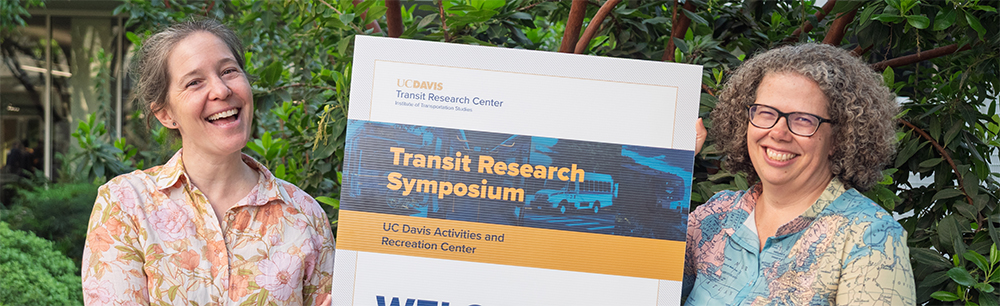
The fifth anniversary transit research symposium drew more than 140 participants. Topics discussed included land use and development, restoring ridership, and transit access for all users. Students presented research posters and participated in a career fair with representatives from transit agencies, community-based organizations, local government, and others. This year’s symposium also featured an inaugural career fair designed to connect transit professionals with ITS-Davis students and others from across campus. The Career Fair had eight participating agencies including CARB, Caltrans, Capital Corridor, Livermore Amador Valley Transit Authority, and the City of Davis. As part of the larger symposium, this job fair was an excellent networking opportunity for all event attendees, including the more than 50 students that participated!
| | | |
California-Africa Forum
April 2026
ITS-Davis collaborated with the California State Transportation Agency and the Bay Area Council to host the 2nd California-Africa Climate and Economic Forum (CACEF), convening leaders across government, industry and research from California, Kenya, Nigeria, and other African countries. More information here.
| |
GREET Model Training Workshop
May 2026
Attendees came to ITS-Davis to learn about GREET, the gold-standard model for life cycle assessment of fuel, energy, and materials in the transportation sector. (GREET=Greenhouse gases, Regulated Emissions, and Energy use in Technologies)
| | | |
Sustainable Transportation Energy Pathways (STEPS+) Spring Symposium
May 2026
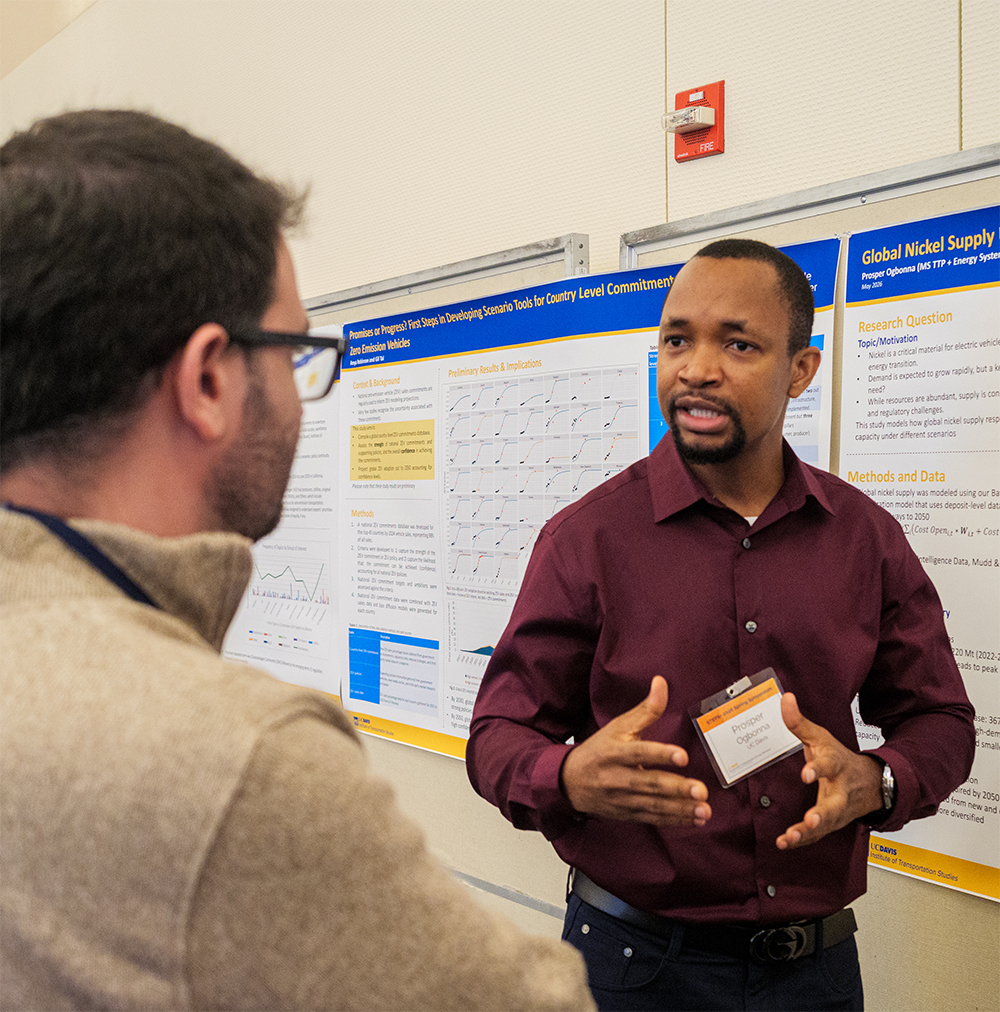
The STEPS+ Symposium had 118 attendees and featured presentations and discussions on changes in electric vehicle regulations, transition pathways for sustainable fuels, and the use of electric vehicles in ridehailing, among other topics. Christopher Grundler, Deputy Executive Officer at the California Air Resources Board delivered the keynote speech, and graduate students presented their research in a poster session.
| | | |
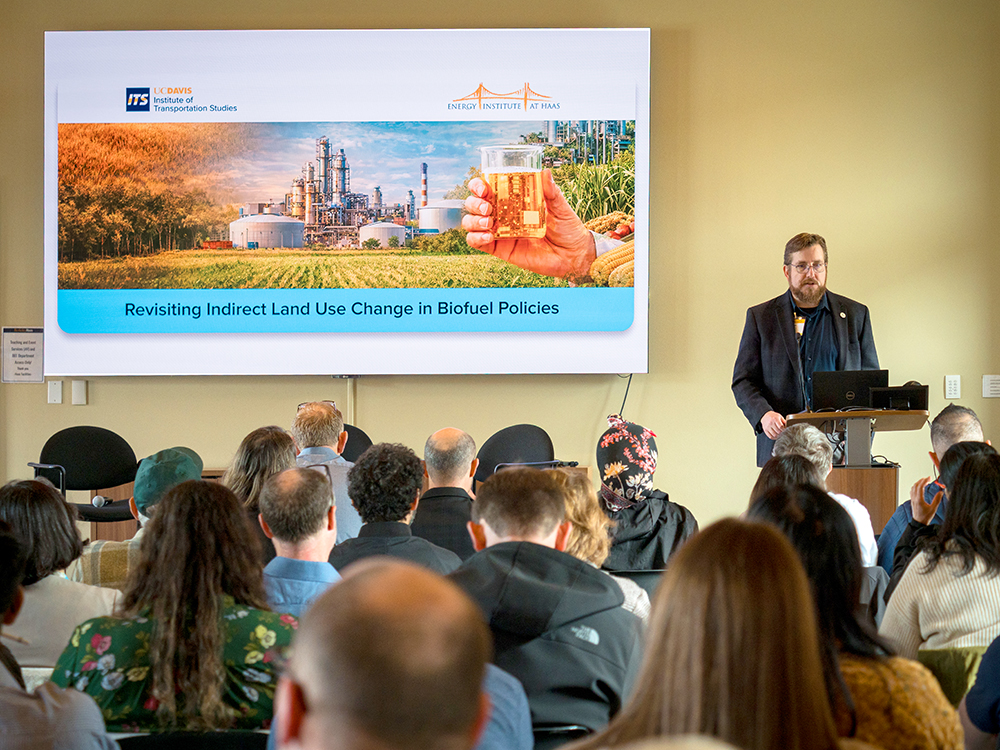
Land Use Workshop
June 2026
Over 90 registered attendees, including several from Brazil, met to discuss recent research and its application to policy aimed at limiting greenhouse gas emissions that result from deforestation and other land use changes that come from increased production of biofuels. (More information)
| | | |
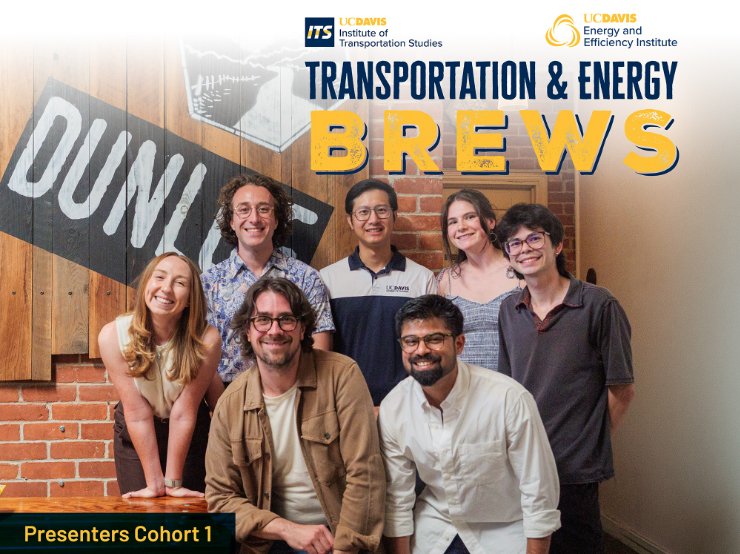
Transportation & Energy Brews
June 2026
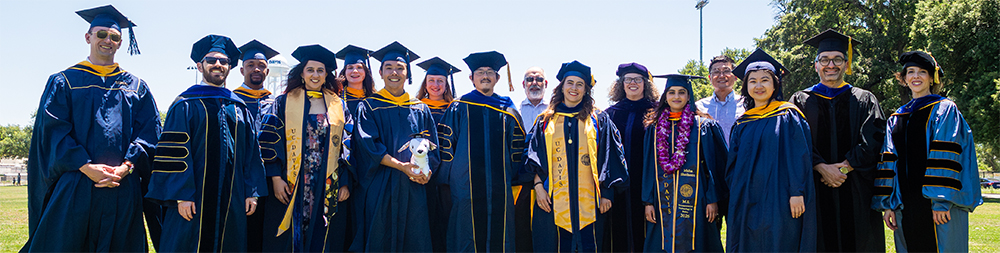
| The TTP and EGG students hosted the first Transportation & Energy Brews session at Dunloe Brewing in Davis. The first cohort featured seven engaging presentations on a variety of topics ranging from high-speed rail, to solar and agriculture integration, to energy-saving ceiling tile technology. We hope you can join us for the next session to be hosted in the Fall | | Congratulations to the 2026 graduates of the Transportation Technology & Policy Program! (video) | |
Ph.D.
Swati Agarwal
Maha Ahmad
James Giller
Carolina LaCompte
Keita Makino
Yanlin Qi
| |
Masters
Eilish Bennett
Lilly Cella
Timothy Hughes
Wendi Jiang
Chi-Lei (Ray) Lin
Joy Luo
| |
|
Bara Mudita
Prosper Ogbonna
Maha Shafaeen
Connor Spencer
Casey Walike
| | |
Air quality impacts of the trade-off between renewable diesel and sustainable aviation fuels in California
Lee, Murphy, Ro, Kleeman
Moving towards a new energy system: Background report on the energy transition in transport in the Netherlands
Bakker, van der Knokke, Cazzola, Dijkstra
Diagnostic toolkit for reducing regulatory barriers to solar, wind and pumped hydro storage in the European Union
Organisation for Economic Co-operation and Development
The effects of policy interventions on electric vehicle consideration among priority populations
Hoogland, Hardman, Barajas, Chakraborty
Battery system integration for electric mobility
Zhao, Hong, Zheng, Li, Feng, Fowler, Ouyang, Burke, Sperling
Explicit consideration of human exposure to minimize freight routing impacts
Dennis-Bauer, Pahwa, Jaller
Exploring variations in vehicle-miles traveled among latent classes of shared mobility users in California
Loa, Lee, Circella
An Assessment of microtransit impacts on its substitution and complementarity with other modes
Ahmad, Cella, Pike, Affolter, Watkins
More publications available through our searchable database.
| | | | |
Maha Ahmad, who was awarded her PhD in June, received the California Transportation Forum (CTF) Lipman Family Sustainable Transportation Graduate Fellowship ($10,000). The CTF award is given to students who demonstrate dedication to advancing sustainable transportation while presenting a clear research agenda, relevant experience, and commitment to impactful work. Ahmad's doctoral research focused on riders’ interests in improvements in passenger regional rail.
Ahmad also received the Women’s Transportation Seminar Sacramento Chapter 2025 Helen M. Overly Memorial Scholarship ($7,500). This scholarship is awarded based on specific transportation goals, academic record, and transportation-related activities. Ahmad’s application emphasized how her experiences and career goals bridge research and practice in the public transportation sector, supporting environmental, social, and economic sustainability.
| | Dan Sperling received the Clean Air Award from the Manufacturers of Emission Controls Association (MECA), a trade association. "For over 35 years, the MECA Clean Air Award has honored distinguished stakeholders who have dedicated their careers to protecting public health and advancing clean air. This award recognizes these three honorees for their visionary leadership, enduring commitment, and impactful contributions across science, policy, and advocacy that have led to cleaner air and a healthier environment for all." | | |
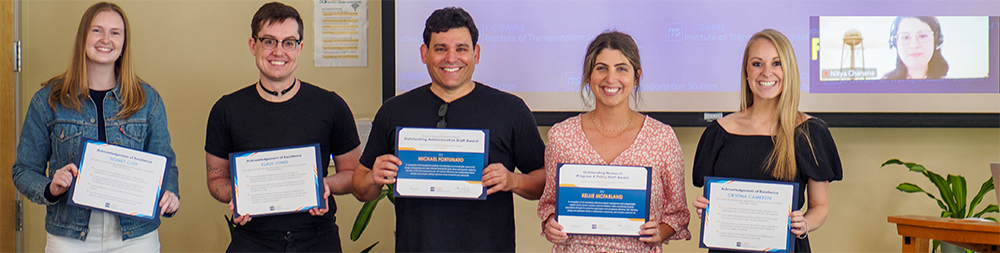
2025 Susie O’Bryant & Ernie Hoftyzer Outstanding Administrative Staff Award
For outstanding contributions by ITS-Davis administrative staff members, recognizing leadership, initiative, dedication and innovation.
Awardee: Michael Fortunato
Honorees: Klaus Jones & Cristina Cameron
2025 Outstanding Research Program & Policy Staff Award
For contributions by ITS-Davis research program management and policy analyst staff members, recognizing leadership, initiative, dedication and innovation
Awardee: Kellie McFarland
Honorees: Nitya Chanana & Sydney Cliff
|
| | | Siddhartha Gulhare, who recently completed his postdoctoral work here, was hired as a research engineer at the Urban Transportation Center at the University of Illinois, Chicago. | |
Transit Research Center - A Community of Researchers
The Transit Research Center marked its fifth anniversary in April and continues to expand its work, collaborating with multiple transit agencies and Caltrans to ensure the relevance of their research. Susie Pike, director, and Kari Watkins, co-director, say these collaborations are the most meaningful and satisfying parts of their research. “Building these relationships has been fantastic;” Pike said, “and part of that is hearing from the agencies about what's going on with them around particular topics, whether that’s ridehailing partnerships or open-loop payments.” Some of the agencies they work with are SacRT, Yolobus, Capitol Corridor, and Unitrans.
Pike formed the Transit Research Center in 2021 while researching partnerships between ridehailing companies and transit agencies. She found that many people within ITS-Davis were doing research that was relevant to transit and they were “excited about the potential to organize and coordinate that research at UC Davis and within ITS and to help bring attention to it.”
When asked about how she ended up studying transit, Pike responded, “I’ve always been interested in how to shift people towards more sustainable transportation modes. Now, as climate change becomes ever more pressing, we need to find ways to make transit a more viable option in more places.” Watkins described her interest stemming from her experience as a 16-year-old from Detroit doing a student exchange program in Germany: “Transit gave me even more freedom than what I had been looking forward to with a driver's license back in Michigan.” Years later, riding the bus with her young children in Seattle brought her family into a community of riders who looked forward to seeing each other and being able to engage in the experience of travel with her kids: “It's a totally different vibe from when you're driving in a car and your kids are in the back in a car seat, and you're not interacting with them at all.”
Watkins was happy to start working with Pike at the Transit Research Center when she arrived at UC Davis from Georgia Institute of Technology in 2022. They both pointed to the Transit Lab as another success of the Center. The lab is a weekly gathering of students and researchers who share ideas and present research. Watkins said that 20 or so people bring their enthusiasm to Friday afternoon meetings: “I feel that we've really created a community within ITS-Davis of the people who have a love for transit.”
Multiple Students working with the Transit Lab and at the Transit Research Center have won awards and garnered attention from transit agencies. Maria Carolina LeCompte and Claire McGinnis won the Bridgette Beato Leadership Legacy Scholarship for Graduates from Women Transportation Seminar (WTS) International. Matthew Liu and Hope Bodenschatz won scholarships from the Achievement Rewards for College Scientists (ARCS) Foundation. Maha Ahmad was asked to present her findings of a study on the Capitol Corridor train line from San Jose to Sacramento to commuter rail agencies around the state.
Every year in April the Center hosts a day-long symposium where attendees from academia, industry, agencies, and community-based organizations come together. “This has grown from 40 attendees in 202`1 to over 140 this year,” said Pike. As the Center continues to grow, so do the collaborations and breadth of topics studied, with the aim of supporting transit use, improving perceptions of transit, and helping it thrive in the United States and abroad. Here’s to many more years!
| |
- As an outcome of the 2nd Annual California-Africa Climate and Economic Forum in April, San Francisco International Airport and the Global South Center for Clean Transportation are co-launching a project to increase the production and use of sustainable aviation fuel (SAF) in key African aviation markets. The project will include capacity building for African government agencies and create a consortium of US, Africa, and other international stakeholders from public and private sectors to exchange lessons learned and best practices.
- In January, the team at the Global South Center, led by Aditya Ramji, engaged in multiple stakeholder discussions in New Delhi, India to strengthen and further build partnerships with government and industry stakeholders, including NITI Aayog, leading automotive manufacturers, and research partners.
- In March, the Global South Center participated in Transforming Transportation 2026, in Washington DC, where it organized and contributed to the session “Closing the Loop: Strategies for End-of-Life Battery Management in Emerging Markets.” The discussion brought together representatives from international organizations, academia, and civil society, and it helped strengthen collaboration with partners including the United Nations Environment Programme and the World Bank.
- The Global South Center co-organized two webinars with SEforAll and the Nicholas Institute for Energy, Environment and Sustainability at Duke University: the first on processing and value chains, the second on recycling, circularity, and critical minerals.
- Aakansha Jain represented the GSC at the launch of the National E-mobility policy of Kenya in Nairobi approved by Kenya’s President. The Minister of Transport Mr Chirchir in his remarks on behalf of the President of Kenya explicitly thanked key partners, including ITS-Davis.
| |
EV Center
A paper authored by graduate student Simon Duex and EGG alumni Pablo Busch titled, "The electric vehicle transition: effects on copper supply dynamics in a net-zero future" was quoted prominently in the U.S. Congress House Committee on Natural Resources, Subcommittee on Energy & Mineral Resources Hearing on “Powering the 21st Century with American Copper” in April. It was used as one of the main arguments for recycling by the representative of NRDC.
BicyclingPlus / ATRC
This spring saw the launch of the online Introduction to Active Transportation Planning and Design course and Active Transportation Special Topics training modules. ATRC has hosted multiple online sessions, with more than 300 people enrolled. The next trainings will be held in September in San Diego and October in Sacramento. See site for more details.
3RFM
Basar Ozbilen, Daniel Sperling, and Mollie Cohen D'Agostino met with Senator Christopher Cabaldon and members of his staff to discuss autonomous vehicle policy, including safety data, privacy and consumer protection considerations, and insurance regulation.
3RFM representatives met with Caltrans freight planning and active transportation teams this spring. They presented study results and recommendations on cargo bikes and discussed policy implications and future opportunities.
In March, 3RFM representatives met with Uber to discuss the company’s evolving global EV charging strategy and identify opportunities for collaboration on charging infrastructure and electrification initiatives for both human-driven and automated vehicle fleets.
NCST
A Caltrans-funded NCST cost-share project led by Dillon Fitch-Polse updated the California Active Transportation Benefit-Cost Tool, which is used by state agencies to evaluate state-funded active transportation projects across California. Based on this research, state agencies adjusted their mandatory data collection requirements for state-funded active transportation projects to improve estimates of project and program benefits.
UC Davis researchers’ work on the transportation impacts of remote and hybrid work and remote services is being used by planners at the Southern California Association of Governments in modeling efforts to study the evolution of travel demand in the Greater Los Angeles region.
NCST-funded research by Susie Pike provided evidence on the effectiveness of youth free/reduced transit fare programs for increasing youth transit ridership. The findings gave the evaluated transit operator direct insight into the impacts of its pilot program and may support other agencies considering larger-scale free or reduced fare programs for youth and other rider groups.
UC ITS Transit Initiative kick-off meeting: convened more than twenty-five state agencies, high-level transit agency representatives, legislative staff, and industry group leaders to provide input for a two-year multi-campus project: Building a Sustainable Future for California Public Transit.
| | |
Fifty-one juniors from Laguna Creek High School – Green Energy Technology Academy visited ITS-Davis in April.
The expanded 2026 Summer Undergraduate Research Fellowship Program of the National Center for Sustainable Transportation (NCST) has kicked off and includes students from UC Davis, Sacramento City College, and Woodland Community College.
Several NCST researchers at UC Davis will teach the transportation “cluster” of the California State Summer School for Mathematics and Science (COSMOS) program. The COSMOS program is an intensive four-week summer program for high school students who have demonstrated an aptitude for academic and professional careers in STEM subjects.
| | On May 21, NCST hosted the webinar “Evaluating Change in Active Transportation Volumes from Infrastructure Projects,” presented by Dillon Fitch-Polse and Caitlyn Linehan. The webinar shared research applying and evaluating the California Active Transportation Benefit-Cost Tool framework using infrastructure projects in Santa Barbara and Santa Cruz, California. The work incorporates local data, expands model training datasets, and compares methods for estimating changes in active transportation volumes, helping agencies better understand project and program cost-effectiveness, including impacts on mode shift, emissions, safety, and physical activity. | | | | |