View as Webpage

X Share This Email
LinkedIn Share This Email

nhsManagers.net

17th Septemebr 2026

What you need to know and what you need to think about - all in one place - for free!


News and comment from

Roy Lilley


Ignore...

_____________

Short on time? Get yer ears-on and listen to Roy Lilley read this morning's eLetter... free!

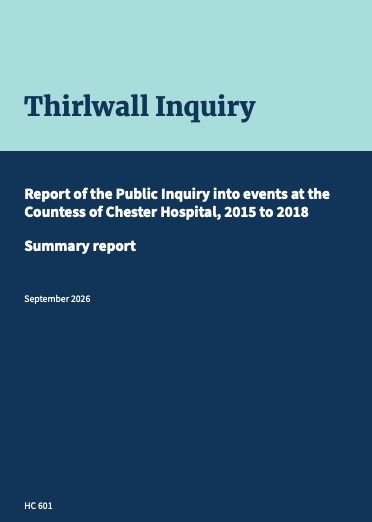
It is an 822-page doughnut... weighty around the edges, with a great hole where the central question should be.


Seventeen urgent recommendations. Three years in the making and costing more than £18m.


The Thirlwall Inquiry describes a hospital where warnings were ignored, risks minimised, consultants threatened and managers appeared more frightened of reputational damage than the possibility babies were being harmed.


It is a shocking story of leadership failure.


The Inquiry was established after Lucy Letby had been convicted of murdering seven babies and attempting to murder seven more at the Countess of Chester Hospital.


Its job was to discover how she had been allowed to do it, not… not whether she had.


That distinction has become increasingly important.


Since the convictions, a sustained campaign has questioned the medical evidence, statistics, police investigation, conduct of the trial and ultimately the safety of the verdicts.


An international panel of neonatal specialists concluded there was no medical evidence of deliberate harm, offering natural explanations and failures of clinical care for the deaths and collapses.


The criticism is contested. Her convictions stand. Nothing in Thirlwall overturns them… this was outside the Inquiry’s terms of reference.


Thirlwall was not asked to test that premise.


It was asked to retrofit the hospital’s failures around it. 


Its conclusions about how later attacks could have been prevented follow from that premise; they do not independently test them.


Thirlwall is devastating when it follows the evidence at Chester. It's frankly, hopeless when it turns the failures of one board into an indictment of NHS management.


Thirlwall says; the move towards a ‘no blame’ culture, starting in 2000, was a mistake. (Volume III, Chapter 39, “Culture of the NHS”, printed pages 89–91).  


That’s really odd. Proper safety practice doesn’t eliminate accountability...


... it distinguishes honest error from negligence, recklessness and deliberate harm, and…


... examines the system that allowed it to happen…


…it’s also at odds with the NHS’s current system-based approach, and, oddly…


… with Thirlwall’s own endorsement of HSSIB’s no-blame investigations.


It recommends regulating all NHS managers, however...


... the senior managers at the centre of events at Chester were clinically qualified and professionally regulated.


Regulation didn’t make a damn of difference.


Thirlwall implies hospital managers control all the resources. No, many are determined nationally.


These sweeping conclusions risk offering another structural answer to what was fundamentally a failure of judgement, curiosity and courage.


Thirlwall concludes that two babies would have survived and five others would have escaped harm had Letby been removed in October 2015. Earlier recognition of an insulin result, it says, 'might have protected three more.'


That answers the safeguarding question... what should managers have done when doctors suspected deliberate harm?


It does not answer the evidential questionwas deliberate harm proved correctly in every case?


A murderer can work in a badly managed hospital. Staffing shortages do not explain everything the juries heard; the unusual collapses, insulin results, Letby’s presence and the wider web of circumstantial evidence.


Nevertheless, the report exposes an uncomfortable alternative possibility.


  • The neonatal unit was cramped and outdated. 
  • Nursing numbers were 21% below recommended levels. 
  • There were shortages of doctors and consultants. 
  • Consultant-led ward rounds took place only twice a week.
  • Paediatrics and neonatology had been reorganised into obscurity, separated from maternity services and effectively disconnected from the Trust board.
  • An earlier clinical review placed four cases in a category where the collapse or death was considered explained but might have been prevented with different care.


These are not incidental details. The same hospital failings can support two opposing stories.


One… a serial murderer exploited a poorly governed organisation whose leaders failed to act on repeated warnings.


The other… failures of care contributed to deaths and collapses subsequently interpreted as murder.


Thirlwall could examine only the first.


The report does not prove Letby innocent or the convictions unsafe. Equally, its conclusions cannot be used as fresh, independent confirmation of her guilt.


The Criminal Cases Review Commission must decide whether the new expert evidence and clinical failings documented by Thirlwall materially affect the case.


If there is a real possibility the convictions would not be upheld, they should be referred back to the Court of Appeal, where the medical evidence can be tested under oath and cross-examination.


If this report were a novel, it would have a predetermined ending, an unreliable narrator and a plot-hole at its centre.


By the time Thirlwall reported, she knew her inquiry’s premise was under serious challenge.


The sensible course was to pause until the CCRC and any appeals were concluded.


Instead, she presented conclusions resting on contested convictions and a collection of misunderstandings... as settled fact.


As a result we have a report that we can largely ignore.

Podcast

Professor Shondipon Laha


Have you ever wondered what is the reality of working in intensive care? 


This is probably one of the most demanding areas of clinical practice, with staff not only having to manage organ failure with patients who are so often at the edge of life and death but also families who are anxious and distressed.  


In this their latest podcast Niall and Roy explore the modern reality of this highly pressured environment in a revealing exchange with the President of the Intensive Care Society, Professor Shondipon Laha.


Shond is a critical care consultant at Lancashire teaching Hospitals and this is an encounter full of surprises. 


While he highlights the continuing shortages of intensive care beds in the UK which was cruelly exposed when Covid hit in 2020 (and remains a challenge today) he also points to the desperate need for social care reform and for rehabilitation services.


Both of these he argues are essential if we are to achieve the right outcomes for patients who have been through intensive care.


Shond acknowledges the technical and drug advances that have been made in recent years, ironically helped by the dreadful experience of Covid. Y


Yet for him, the greatest progress in his specialty has been the development of strong multidisciplinary teams in which the key roles of nurses, physios, pharmacists, OTs, dietitians and others are recognised and team working is making care effective. 


As for doctors, he sees the development of the intensive care speciality and the move away from it being a branch of anaesthetics as vital with the development of education, training and dedicated intensive care posts.


If you want to validate or challenge your view of intensive care, or just develop a better understanding of a unique area of healthcare, please do join Niall, Roy and Shond...


... it’s a great listen.

For all the previous

In the Loop

podcasts with

----

Sir Mike Richards

Explains prostate cancer testing

Bill Kircup

Why he pulled out of the Amos Report

Jonathan Asworth

Former MP and now a stroke victim.

Dr Ian Higgson

President of the

Royal College of

Emergency Medicine.

Prof Jim Blair

Learning Disability expert

Andy Burnham

Mayor of Greater Manchester

Nichola Ranger

ChEx Gen Sec RCN

Tom Dolphin

Chair BMA

David Gregson

founder of BeeWell

Dr Charlotte Refsum

Tony Blair Institute

Rob Webster

ICB CHEx

Sarah Woolnough

CEO of the King's Fund

Sir Jim Mackey

Dame Jennifer Dixon

Lord Darzi

Professor Tas Qureshi

Dr Penny Dash,

chair NHSE

Richard Meddings,

former chair NHSE,

Sir Jeremy Hunt,

Sir Andrew Dilnot,

Paul Johnson

IFS

CLICK HERE


-oOo-


Probably, the most listened to

Podcast in the NHS!

FREE!

Want to contact Roy Lilley?

Please use this e-address

roy.lilley@nhsmanagers.net 

-----------

Know something I don't

email me

in confidence.

Leaving the NHS, changing jobs - you don't have to say goodbye to us!

You can update your Email Address from the link you'll find right at the bottom of the page,

up-date-your-profie,

and we'll keep mailing.

----------

GDPR

We don't sell or give access to your email address to any third parties.

You can unsubscribe at any time.

Click on the link right at the bottom of the page

---------

Disclaimer

... yes, 60 countries listen

to Roy Lilley's podcast, free.

You can, too.

Just click here

Dr Paul Lambden


Endometriosis


'... it is estimated that up to 50% of women with endometriosis may have some difficulty in conceiving. However, in modern gynaecological practice, there is no reason why, in most circumstances, symptoms cannot be well controlled and a range of treatments offered to achieve conception if required.'

News and Other Stuff

---

>> Health Secretary - 'This must be a turning point for the NHS'... another one?

>> Dementia drugs made in UK - but denied on NHS.

>> Global Fund Report - Shows Countries Fought to Protect Essential Health Services Despite Challenging Year.

>> Letby failings go beyond one hospital - the whole system has been found lacking

Health Improvement Through Housing - Lessons from an Innovative Homelessness Partnership


This is what I'm hearing, unless you know different. In which case, tell me, in confidence

__________


>> I'm hearing - the Trump Administration will announce $104 Million to Transform Rural Healthcare Across Mississippi Through Cutting-Edge Technology and Expanded Care Closer to Home...sounds familiar?

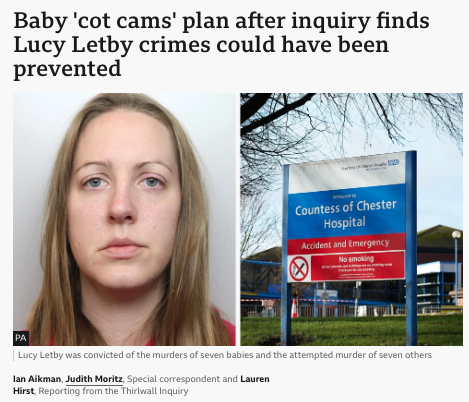
The apparently simple “cot-cam” recommendation means equipping perhaps 3,000 cot spaces across 156 units with secure, continuously supported livestreaming. Call it a £15–40 million installation and several million pounds a year thereafter.

Wi-Fi may not actually be the preferred technology. Wired, segregated connections would be more reliable and secure. Livestream-only systems avoid enormous video-storage costs, but still require controlled parental access, consent procedures, the ability to switch cameras off during treatment, cybersecurity monitoring and round-the-clock technical support. Cameras may also increase parental anxiety and staff workload. Concerns already recognised by the Health Research Authority.

More News

...

>> Most-favoured-nation pricing for prescription drugs in US Medicare - a cohort study.

>> This NHS trust no longer wants to call you a patient — here are the ‘confusing’ alternatives.

>> Staffing deficits plagued for-profit nursing homes during, after Hurricane Ian - study

Do the troubles at Medway NHS Trust have anything to do with hidden assumptions in the capitation formula?


Dr Rodney P. Jones


'...The capitation formula is a model based on existing understanding and therefore contains hidden assumptions of how human health behaves...'


Twitter  
Managers Logo