Weekly update from the National Housing Conference | | News from Washington | By Brittany Webb | | |
Housing organizations turn to ROAD implementation
Housing organizations continue to celebrate the enactment of the 21st Century ROAD to Housing Act (ROAD) while shifting their attention toward implementation of the sweeping new law. Several groups have published overviews of the package that highlight provisions related to affordable housing and community development, organizational capacity, manufactured housing, rural housing, and other priorities.
The National Housing Conference’s Housing Supply Working Group will be convening in August to begin broad consultations with stakeholders and practitioners to identify high priority implementation benchmarks and begin drafting model regulations to assist the U.S. Department of Housing and Urban Development (HUD). Nearly half of the actions in the bill are directed to be completed within one year. Although the deadlines are not binding, they underscore the priority Congress placed on implementing the law quickly.
A new roadmap from the National Association of Affordable Housing Lenders (NAAHL) offers an initial guide to the law’s implementation. The report highlights the considerable role of HUD, which will lead 88 of the law’s 124 implementation actions. The U.S. Department of Agriculture is the second-most frequently named agency, with responsibility for 17 actions. Nearly half of the actions are directed to be completed within one year. Although the deadlines are not binding, they underscore the priority Congress placed on implementing the law quickly.
The National Low Income Housing Coalition (NLIHC) released its own report emphasizing ROAD’s potential impact on households with low incomes. NLIHC identified changes to the Housing Choice Voucher program, rural housing programs, and disaster recovery as key implementation priorities. The report also highlights provisions that will directly affect current residents, including an expansion of HUD’s Family Self-Sufficiency program, changes to income calculations for veterans participating in the HUD-Veterans Affairs Supportive Housing program, and grants to install temperature sensors in assisted properties to better address resident health and comfort.
Other housing groups continue to emphasize the need for timely regulatory guidance. A coalition of multifamily housing organizations sent a letter to the U.S. Treasury Department seeking clarification of the Build-to-Rent (BTR) exception to ROAD’s restrictions on large institutional investors purchasing single-family homes.
“Members of our organizations are putting BTR investments on hold until they receive assurances regarding how Treasury will interpret the statutory language, as they are specifically concerned that an incorrect reading of the Act may make the ability to purchase BTR communities following an initial sale impermissible,” the letter reads.
ROAD’s bipartisan enactment now turns attention toward a purposeful and informed implementation process. Continued engagement among federal agencies, lawmakers, and housing stakeholders will be critical to ensuring the law expands housing supply, strengthens existing programs, and avoids unintended barriers to investment and development.
| | | |
Congressional reps show support for CDFI, CMF funds
Acting Director of the Consumer Financial Protection Bureau (CFPB) Russell Vought faced pointed questions from lawmakers during congressional oversight hearings, including about the status of the Community Development Financial Institutions (CDFI) Fund.
During the House Financial Services Committee hearing, Rep. Young Kim (R-Calif.) highlighted the role CDFIs play in financing affordable housing and community development projects. When asked about the remaining stalled funds that could finance additional affordable housing construction, Vought declined to provide a timeline, stating only that the administration had apportioned CDFI funds set to expire in fiscal year 2026 and would provide additional details later.
The issue resurfaced the following day during a Senate Banking Committee hearing, where several senators raised similar concerns. Sen. Jack Reed (D-R.I.) pressed Vought on the release of approximately $750 million in funding through both the Housing Trust Fund and Capital Magnet Fund (CMF), emphasizing that the programs are financed through Fannie Mae and Freddie Mac rather than taxpayer appropriations. Vought responded that OMB was reviewing the funding and intended to move “as quickly as possible” on the remaining apportionments. Sen. Mark Warner (D-Va.), co-chair of the Senate Community Development Finance Caucus, also questioned Vought about the administration's approach to CDFI Fund grantees. Vought responded that some recipients had supported “woke” initiatives that conflict with the administration's priorities.
Beyond housing-related funding, lawmakers questioned Vought on the CFPB's enforcement practices, regulatory priorities, consumer complaint system, workforce changes, and proposed reforms to the Bureau.
| | | |
Regulators direct lenders to consider immigration-related credit risk
The Office of the Comptroller of the Currency, Federal Deposit Insurance Corporation, and National Credit Union Administration issued joint guidance directing institutions to account for perceived risks of lending to borrowers who are not legally authorized to work in the United States. The agencies said uncertainty surrounding a borrower’s ability to maintain employment, continue earning income, or remain in the country may create elevated credit risks affecting mortgages, credit cards, auto loans, and other forms of credit. The guidance implements a May executive order from President Trump following continued pressure of the Administration to tighten immigration enforcement.
The guidance does not prohibit lending to borrowers without work authorization, as federal law does not prohibit banks from serving undocumented immigrants, but instructs lenders to incorporate immigration-related risks into operational processes. Some financial institutions expressed hesitation over enhanced status reporting, arguing that banks are not immigration officers and that excessive checks of customers are unduly burdensome.
For mortgage lending, the agencies pointed to a June Consumer Financial Protection Bureau statement explaining that creditors must make a reasonable, good-faith determination of a borrower’s ability to repay under the Truth in Lending Act. The statement also notes that the Equal Credit Opportunity Act permits lenders to consider immigration status when assessing repayment and available remedies. The new guidance could consequently narrow access to mortgage credit for undocumented borrowers and others whose employment authorization is uncertain, even when they have established income and repayment histories.
| | | |
Scott urges Fed to prioritize affordability
Senate Banking Committee Chairman Tim Scott (R-S.C.) urged Federal Reserve Chairman Kevin Warsh to keep affordability at the center of monetary policy during Warsh’s first monetary policy hearing since taking the helm at the central bank. Scott emphasized that the Fed’s decisions affect household finances through mortgage payments, credit card bills, and the availability of business and consumer loans. He also called on the central bank to protect its independence by remaining focused on its statutory responsibilities of achieving maximum employment and stable prices.
Scott highlighted the relationship between interest rates and housing affordability, noting that congressional efforts to increase housing supply cannot fully overcome elevated borrowing costs. Scott also called for appropriately tailored bank capital requirements as the Fed develops the Basel III Endgame and other regulatory changes.
“Economic activity is expanding at a solid pace, showing resilience in the face of recent developments. Household consumption growth is moderate, and manufacturing output has moved up steadily this year. The housing sector, however, strikes a different note. It gives a different picture and continues to lag,” Warsh stated, before moving on to tout a surge in capital expenditures and investment in artificial intelligence.
| |  | |
HUD’s Innovative Housing Showcase to highlight American technology
HUD announced the theme for its sixth annual Innovative Housing Showcase as "Made in America," highlighting domestic innovations designed to expand housing supply, reduce construction costs, and make homeownership more attainable.
The free, public event will take place Sept. 22–24, on the National Mall in Washington, D.C., as part of the nation's Freedom 250 celebration. The showcase will bring together builders, manufacturers, policymakers, and housing leaders to explore emerging technologies and construction methods that can help address the nation's housing challenges.
Attendees will have the opportunity to tour full-sized prototype homes and experience interactive exhibits.
HUD is currently accepting applications from exhibitors showcasing innovative housing technologies, building products, and construction methods.
| | | |
Mortgage denial rates remain highest in the South
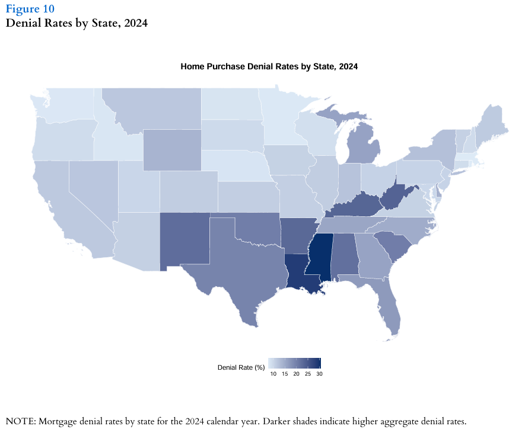
Mortgage denial rates varied sharply across states in 2024, according to the Federal Reserve Bank of St. Louis’s report The Determinants of Mortgage Denial. The map shows the highest denial rates concentrated in the South, with Mississippi and Louisiana standing out as the darkest-shaded states and indicating the most elevated levels of denial. Several other Southern states, along with parts of the Midwest and Appalachia, also appear to have relatively high denial rates compared with the national pattern. By contrast, much of the Upper Midwest, Mountain West, and some Northeastern states show lighter shading, suggesting lower denial rates and easier mortgage access. The national overview is one of persistent geographic variations in credit access, with denial outcomes clustering in regions where borrowers may face more severe affordability, debt-to-income, or underwriting constraints.
| | |
In the latest Consumer Financial Services Law Monitor, Troutman Pepper Locke breaks down the recently released regulatory agenda published by the Consumer Financial Protection Bureau. The report details the Bureau’s active rulemaking process and shift toward deregulation and procedural standards. These items range from the pre-rule stage to the final rule stage, including clarifications to the Dodd-Frank Act, Ability to Repay and Qualified Mortgage rules, and ECOA/Regulation B, among others.
According to data from the Mortgage Bankers Association, the volume of mortgage loan applications decreased by 2.7 percent for the week ending July 10. At the same time, the average 30-year fixed rate rose to 6.6%, its highest level since August 2025. Purchase activity declined on a seasonally adjusted basis and slipped below last year’s pace, while refinance applications increased 4%, driven in part by FHA and VA loan activity.
The Consumer Federation of America published a report titled Redlined: The Persistence of Racial Inequality in the Cost of Homeowners Insurance that dives into the cost of homeowners insurance and the different profiles that lead to unequal risk exposure. The report found that homeowners in majority-Black zip codes pay 16% higher premiums, while those in majority-Hispanic zip codes pay 30% higher premiums than those in majority-White zip codes. The study attributes these disparities to territorial pricing, credit score penalties, and algorithmic pricing that embeds historical inequities.
| | |
Monday, July 20
MISMO Boot Camp: July 2026 | MBA, July 20 - 21
Tuesday, July 21
Celebrating 250: Life, Liberty, and the Pursuit of Homeownership | NHC & NeighborWorks America, 2 PM ET
Wednesday, July 22
Home from Work: Design Trade-Offs in Office-to-Residential Conversions, 12:30 PM ET
NSPIRE for Vouchers Office Hour: Life-Threatening Deficiencies | HUD Exchange, 2 – 3 PM ET
Thursday, July 23
No events listed
Friday, July 24
No events listed
| | The National Housing Conference is a diverse continuum of affordable housing stakeholders that convene and collaborate through dialogue, advocacy, research, and education, to develop equitable solutions that serve our common interest. | | Defending Our American Home since 1931 | | Copyright © 2024. All Rights Reserved. | | | | |